
15 Tax Saving Mistakes Salaried Employee Makes in 2026-2027
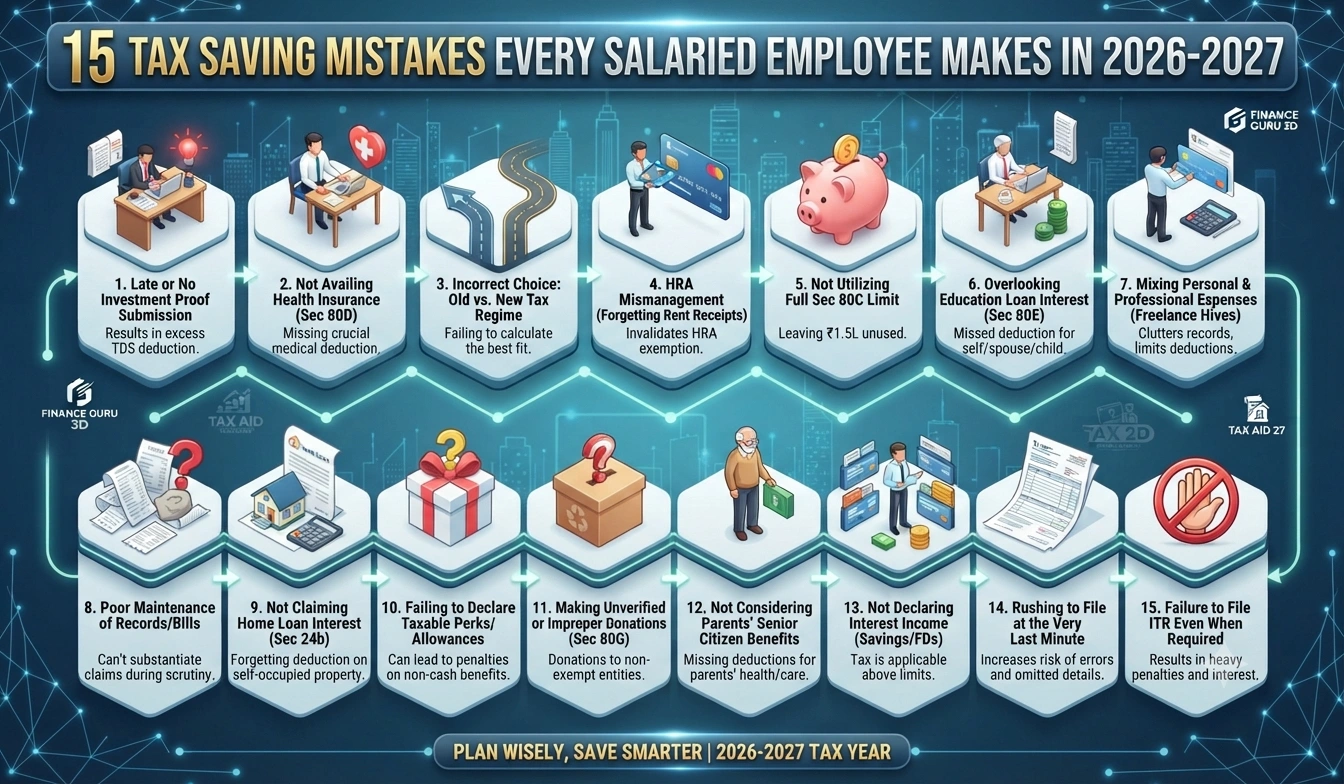
15 Tax Saving Mistakes Every Salaried Employee Makes
Expert CA guide to avoid costly tax errors in 2026-2027
Introduction: Why Salaried Employees Need Tax Planning
Let's be honest—most salaried employees think tax planning is someone else's job. They assume their HR department handles everything, file their returns on the last day, and call it done. But here's the thing: you're probably leaving thousands of rupees on the table every single year.
I've been a CA for over a decade, and I see the same mistakes repeated by smart, successful people who simply don't know better. The good news? These mistakes are completely avoidable. In 2026-2027, the tax rules haven't changed drastically, but the opportunities to save have only grown. So what does this mean for you?
This guide walks you through 15 critical errors I see every tax season. Fix even half of these, and you'll likely save between 20,000 to 1,50,000 rupees annually. That's real money that stays in your pocket.
Mistake 1: Not Maximizing Section 80C Investments
Section 80C gives you a deduction of up to 1,50,000 rupees per financial year. But most salaried employees don't even come close to using the full amount. They might invest 50,000 or 75,000 and leave the rest untouched.
What can you invest in? Life insurance premiums, ELSS mutual funds, fixed deposits, Public Provident Fund, and National Savings Certificate. Basically, you have multiple options to hit that 1,50,000 limit.
If you're in a 30% tax bracket and invest the full 1,50,000 in Section 80C instruments, you save 45,000 rupees in taxes. That's not a small number.
The mistake isn't that employees don't know about Section 80C. They do. The mistake is they don't plan their investments properly throughout the year. They wait until March and then scramble to invest whatever they can.
Mistake 2: Ignoring Section 80D Health Insurance Deductions
Here's a big one. If you buy a health insurance policy for yourself and your family, you can claim a deduction under Section 80D. For yourself and spouse, that's up to 25,000 rupees. For parents, it's another 25,000 rupees (or 50,000 if they're senior citizens).
But most employees either don't know this or they forget to claim it because the premium gets deducted from their salary automatically. They think it's already handled. It's not. You need to claim it in your tax return.
- Self and spouse: up to 25,000 rupees
- Parents (non-senior): up to 25,000 rupees
- Parents (senior citizens): up to 50,000 rupees
- Self, spouse, and dependents together: up to 25,000 rupees
- All family members combined: up to 1,00,000 rupees under new rules
In other words, if you're paying for your parents' health insurance too, you could be missing out on 50,000 to 75,000 rupees in deductions.
Mistake 3: Not Claiming Home Loan Interest Under Section 24
If you have a home loan, you can claim a deduction on the interest paid. But here's where most people mess up: they think their employer's housing benefit covers everything. It doesn't work that way.
The interest paid on your home loan is a separate deduction. You can claim up to 2,00,000 rupees under Section 24 for a self-occupied property. And if you own a second property that you rent out, the entire interest is deductible with no limit.
So what does this mean for you? If your home loan interest is 3,00,000 rupees per year, you can claim 2,00,000 as a deduction. That's a tax saving of about 60,000 rupees if you're in the 30% bracket.
You need to have the original loan agreement and interest certificate from your bank. Don't claim deductions without proper documentation.
Mistake 4: Forgetting to Claim Principal Repayment Under Section 80EE
This is separate from the interest deduction. If you bought your first home and took a loan, you can claim an additional deduction of up to 1,50,000 rupees under Section 80EE for the principal repayment. But there are conditions.
The property value shouldn't exceed 45 lakhs rupees. The loan should be sanctioned between April 2019 and March 2027. And you shouldn't own any other property. Basically, this is for first-time homebuyers only.
Most first-time buyers don't even know this exists. So they claim Section 24 interest deduction but miss out on the Section 80EE principal deduction. That's another 45,000 rupees in taxes they could have saved.
Mistake 5: Not Tracking Rent Paid for Tax Deduction
If you rent your home and don't own any property, you can claim a deduction under Section 80GG. The maximum is 5,000 rupees per month or 60,000 rupees per year. But you need to maintain proper documentation.
And here's the catch: your salary shouldn't exceed certain limits, and you shouldn't own a house anywhere in India. Most employees don't track their rent payments properly. They pay cash or don't keep receipts. Then when they file returns, they either claim nothing or claim random amounts.
Put simply, get a rent receipt from your landlord and keep it safe. If you pay 8,000 rupees monthly, that's 96,000 rupees per year. You can claim 60,000 rupees as a deduction, saving about 18,000 rupees in taxes.
Mistake 6: Missing Out on Education Loan Interest Deduction
Section 80E allows a deduction for interest paid on education loans. And here's the best part: there's no upper limit. You can claim the entire interest amount.
The loan must be taken for higher education—yours, your spouse's, or your children's. It can be from a bank or any approved financial institution. But you can only claim the interest, not the principal.
If you're repaying an education loan with 2,00,000 rupees as interest per year, you save 60,000 rupees in taxes. That's significant money. Yet most employees don't claim this because they're not aware or they think they need to wait until the loan is fully repaid.
Mistake 7: Overlooking Charitable Donations Under Section 80G
When you donate to approved charities, you get a deduction under Section 80G. Some donations get a 50% deduction, and some get a 100% deduction. So if you donate 10,000 rupees to a 100% deductible organization, you get a 10,000 rupees deduction.
But here's where employees go wrong: they donate without checking if the organization is approved. Or they donate but never keep the receipt. Or they donate but forget to claim it in their tax return.
- Check if the charity has Section 80G approval
- Keep the donation receipt or bank transfer proof
- Claim the deduction in your tax return
- Know the difference between 50% and 100% deductions
- Plan your donations strategically before March 31st
If you're a generous person and donate 50,000 rupees per year, you could be saving 15,000 rupees in taxes if you claim it properly.
Mistake 8: Not Filing Returns When Income Is Below the Taxable Limit
Here's a surprising one. Even if your income is below the taxable limit, you should file a return. Why? Because you might have paid taxes through TDS, and you're entitled to a refund.
Let's say you earned 2,50,000 rupees in a financial year. Your tax liability is zero. But your employer deducted 30,000 rupees as TDS. If you don't file a return, you don't get that 30,000 rupees back.
Also, filing a return is proof of your income. It helps when you apply for loans, visas, or credit cards. So don't skip filing just because you think you don't owe taxes.
Filing a return even when your income is below the taxable limit helps you claim refunds and builds your financial credibility.
Mistake 9: Ignoring Deductions for Professional Development
If you spend money on professional courses, certifications, or skill development, you might be able to claim it as a deduction. But there's a catch: it needs to be directly related to your job or profession.
So if you're an IT professional and you take a cloud computing course, it's deductible. If you're an accountant and you take a tax law course, it's deductible. But if you take a cooking course just for fun, it's not.
The deduction comes under different sections depending on your situation. But the key is to keep all receipts and documentation. If you spend 1,00,000 rupees on professional development in a year, you could save 30,000 rupees in taxes.
Mistake 10: Not Claiming Deductions for Medical Expenses
If you have serious medical expenses that aren't covered by insurance, you might be able to claim them under Section 80DDB. This is for ailments like cancer, diabetes, heart disease, and other specified conditions.
The deduction is up to 1,00,000 rupees per year for yourself or your dependents. But you need a medical certificate from a doctor. Most employees don't even know this exists.
Honestly, if you've had major medical expenses, ask your doctor for a certificate and explore this deduction. It could save you significant taxes.
Mistake 11: Missing the Standard Deduction
The standard deduction is a flat deduction available to all salaried employees. In 2026-2027, it's 50,000 rupees. This is separate from all other deductions. You don't need to provide any documentation.
But here's the problem: not all employees claim it. Some think it's automatic. Some don't know about it. If you're earning 5,00,000 rupees per year and you don't claim the standard deduction, you're missing out on 15,000 rupees in tax savings.
The standard deduction is available only to salaried employees and pensioners. If you have income from other sources, you might not be eligible.
Mistake 12: Not Optimizing Your Savings Across Different Sections
Here's where most employees really mess up. They have multiple deduction opportunities, but they don't plan them strategically. They invest randomly and hope for the best.
Basically, you need to map your deductions across different sections. Section 80C has a 1,50,000 limit. Section 80D has its own limit. Section 24 has a 2,00,000 limit. You need to plan which investment goes where.
| Section | Purpose | Limit |
|---|---|---|
| 80C | Insurance, ELSS, FD, PPF | 1,50,000 |
| 80D | Health insurance | 25,000-50,000 |
| 80E | Education loan interest | No limit |
| 24 | Home loan interest | 2,00,000 |
| 80G | Charitable donations | 50-100% |
The right strategy depends on your income, family situation, and financial goals. That's why working with a CA makes sense.
Mistake 13: Not Tracking Investment Documents Properly
You can claim all the deductions in the world, but without documentation, the tax department won't accept them. Yet most employees don't keep proper records.
You need certificates from your insurance company, bank statements for PPF contributions, mutual fund statements for ELSS, home loan statements, rent receipts, and medical certificates. Keep all of these for at least 7 years.
And that's really it. Good documentation is the difference between approved and rejected deductions. If you get audited and can't produce documents, you lose the deduction and pay penalties.
Mistake 14: Filing Returns Late or Not at All
The deadline for filing income tax returns for the financial year 2026-2027 is July 31, 2027. But most employees wait until the last week. And some don't file at all if they think they don't owe taxes.
Filing late comes with penalties. Filing not at all comes with even bigger penalties and legal consequences. Beyond the penalties, you lose the benefit of refunds and you don't have proof of income.
Mark your calendar. File by July 31, 2027. Don't wait until August.
Mistake 15: Not Reviewing Your Tax Computation
The last mistake is also the most important. Most employees file their returns without really understanding what they're filing. They let their CA or online tool handle it, and they don't review the final numbers.
But here's the thing: it's your return. You're responsible for what's in it. So you need to understand your total income, your deductions, your tax liability, and your refund. If something looks off, ask questions.
And that's really it. A quick review can catch errors that could cost you thousands in taxes or penalties.
Key Takeaways for 2026-2027
- Maximize Section 80C investments up to 1,50,000 rupees
- Claim health insurance deductions under Section 80D
- Don't miss home loan interest deductions under Section 24
- Track rent payments if you're renting
- Claim education loan interest under Section 80E with no limit
- Keep proper documentation for all deductions
- File your return by July 31, 2027
Frequently Asked Questions
Q1: Can I claim multiple deductions for the same investment?
No. Each investment can be claimed under only one section. For example, if you buy an ELSS mutual fund, you claim it under Section 80C, not under any other section. But you can have multiple investments across different sections.
Q2: What happens if I exceed the deduction limit for a section?
The excess amount doesn't get deducted. It's lost. So if you invest 2,00,000 rupees in Section 80C instruments, you only get a deduction of 1,50,000 rupees. The remaining 50,000 rupees doesn't reduce your taxable income. That's why planning is important.
Q3: Is the standard deduction automatic, or do I need to claim it?
You need to claim it in your tax return. It's not automatic. If you're filing through a CA or tax software, they usually claim it for you. But if you're filing manually, make sure you include it.
Q4: Can I claim deductions for my spouse's investments?
No. Each person files their own return and claims their own deductions. If your spouse earns income, they file their own return and claim their own deductions. You can't combine them.
Q5: What if I miss the July 31 deadline for filing returns?
You can still file a return after the deadline, but you'll face penalties. The penalty is 5,000 rupees if you file after the deadline but before the end of the financial year. If you file even later, the penalty increases. So file on time.
Q6: Do I need to claim deductions if my income is below the taxable limit?
You don't need to, but you should. Even if you don't owe taxes, filing a return helps you claim refunds if TDS was deducted. It also builds your income proof for loans and visas. So file even if your income is below the limit.
Conclusion: Take Action Now for 2026-2027
The 2026-2027 financial year is here. You have a chance to avoid all 15 mistakes mentioned in this guide. Don't wait until March 31, 2027, to think about taxes. Start planning now.
Review your investments. Check if you're maxing out your deductions. Track your documents. Plan your purchases. And most importantly, file your return on time.
If you're unsure about any of this, talk to a CA. A good CA can help you save way more than their fees. And if you're a salaried employee with a straightforward income, most online tax filing platforms can help too.
The bottom line? Tax planning isn't boring or complicated. It's just about knowing the rules and following them. Do that, and you'll keep more money in your pocket every year.
" } ```
© 2026 Tax Esquire | Expert CA Services in Greater Noida, Uttar Pradesh
8810380146 | info.taxesquire@gmail.com | taxesquire.in
This document is for informational purposes only. For personalised tax advice, consult our chartered accountants.