Documents Required for Company Registration in India: The 2026 Guide (Rules, Process & Tips)
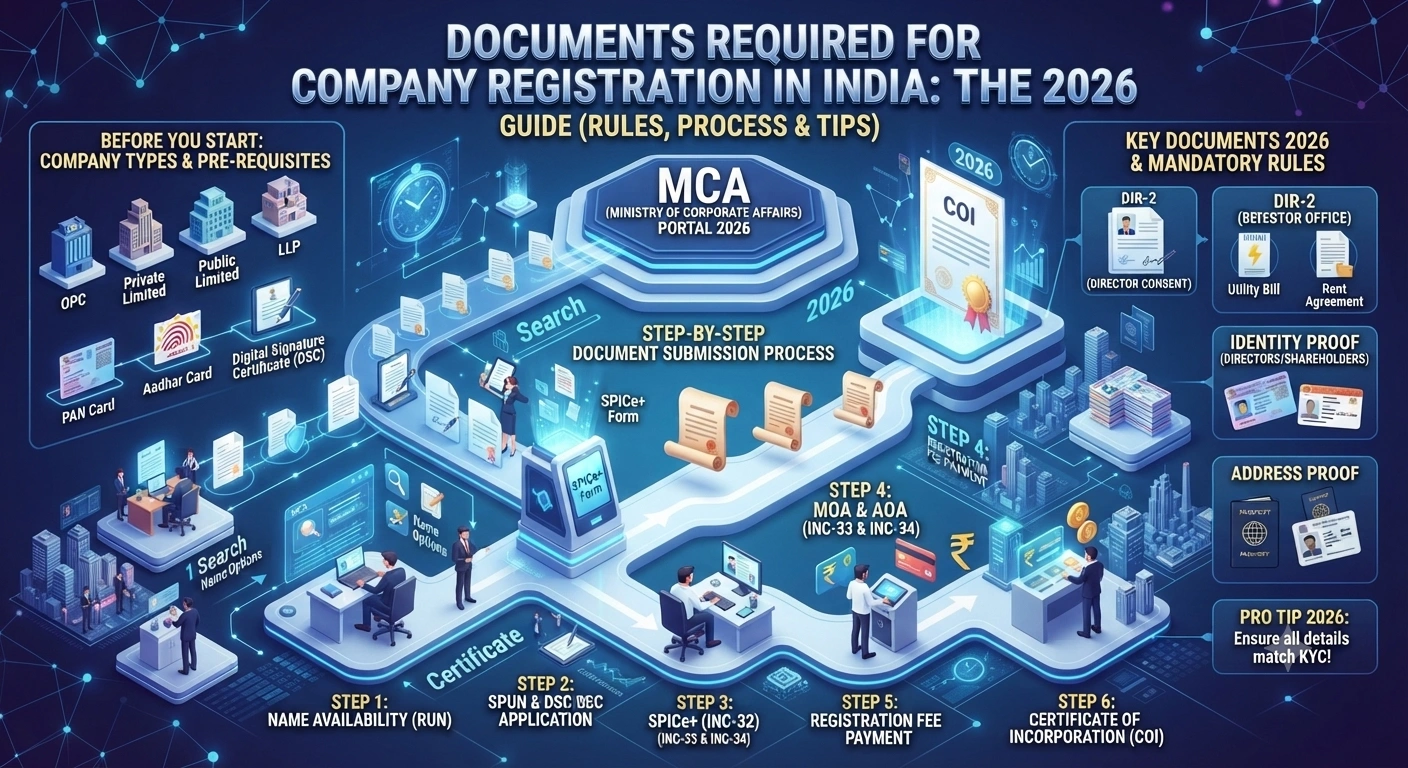
Documents Required for Company Registration in India
Your complete roadmap to gathering, filing, and submitting the right paperwork for company registration with the Ministry of Corporate Affairs
Why Getting Your Documents Right Matters
Look, I've seen countless startup founders waste months because they didn't gather the right paperwork upfront. And that's really frustrating when it could've been avoided. The thing is, company registration in India isn't rocket science—but it does need precision. Missing even one document means your application gets rejected, you lose time, and you're back to square one.
In 2026, the Ministry of Corporate Affairs (MCA) has streamlined the process through its online portal. But streamlined doesn't mean simpler if you don't know what you need. This guide walks you through every single document you'll need, why you need it, and how to get it right the first time.
Getting your documents organized before filing saves you 4-6 weeks of back-and-forth with the Registrar of Companies (ROC). That's real time you can spend building your business instead of fixing paperwork mistakes.
The Core Documents Every Company Needs
Before we dive into the specifics, let me be clear: the documents you need depend on your company structure. But there's a baseline set that applies to every private limited company, public company, and one-person company (OPC) in India.
1. Memorandum of Association (MOA)
The MOA is basically your company's constitution. It defines the company's objects, powers, and the scope of its activities. Think of it as the rulebook that tells the world what your company is allowed to do. You can't register without it.
In 2026, you'll file this as Form SPICe+ (Simplified Proforma for Incorporating Company Electronically Plus) through the MCA portal. The MOA gets embedded in this form. But here's what matters: every clause in your MOA needs to be clear and specific. Vague objects create problems later.
- Main objects (what your company will do)
- Ancillary objects (what it can do to support the main work)
- Powers of the company
- Capital structure and shares
- Liability clause
2. Articles of Association (AOA)
If the MOA is your company's constitution, the AOA is the detailed rules of governance. It covers how meetings happen, how directors are appointed, voting rights, dividend policies, and day-to-day operations. And honestly, this is where most founders get confused because it's lengthy and technical.
You don't need to write this from scratch. The Companies Act gives you a standard template called Table A (for private limited companies) and Table F (for public companies). Most startups just adopt Table A with minor tweaks. So what does this mean for you? You get a working governance structure without reinventing the wheel.
3. Affidavit by Subscribers
All subscribers (people signing the MOA) need to file an affidavit. This is a sworn statement confirming they're genuine people, they understand what they're signing, and they're not using false identities. It's a compliance check to prevent fraud.
The affidavit needs to be notarized. You'll get this from any notary public. It takes about 30 minutes and costs between ₹500–₹1,500 depending on your city.
Don't submit a self-attested affidavit. It must be notarized. The ROC will reject it otherwise, and you'll lose 2-3 weeks getting it redone.
4. Identity and Address Proof of Directors and Subscribers
You need to prove that your directors and shareholders are real people living at real addresses. This isn't optional.
- Identity proof: Passport, Aadhaar, PAN, or driving license
- Address proof: Utility bill, rent agreement, or bank statement (not older than 2 months)
- Passport-sized photographs (2-3 copies per person)
- Self-attested copies of all documents
And here's a practical tip: if you're filing through the SPICe+ form, you can upload scanned copies directly. But keep the originals handy. The ROC sometimes asks for verification, and you need to show them.
5. Registered Office Address Proof
Your company needs a registered office in India. This is where official notices and legal documents get delivered. You can't use a residential address for a private limited company—it must be a proper office space or a co-working address.
You'll need to prove ownership or authorization for that address:
- Lease agreement or rent deed (if rented)
- Property tax receipt or municipal registration (if owned)
- Letter from the landlord/owner authorizing use as registered office
- Utility bill showing the address
- NOC from co-working space (if using shared office)
Honestly, the registered office requirement trips up a lot of first-time founders. They think they can use a residential address to save money. But the Companies Act doesn't allow it for most company types. Plan your office space before filing.
Documents for Specific Company Types in 2026
The documents I mentioned above are universal. But depending on your company type, you'll need additional paperwork. Let me break it down.
For Private Limited Companies
- MOA and AOA (as discussed)
- Affidavit by all subscribers
- ID and address proofs
- Registered office address proof
- Consent and declaration of directors (Form DIR-12)
- Consent and declaration of company secretary, if applicable (Form DIR-12)
- Proof of Digital Signature Certificate (DSC) for authorized signatory
But here's the thing: if you're filing through SPICe+, most of this gets bundled into one form. You don't file 10 separate documents. The portal guides you through each section, and you upload supporting documents as attachments.
For One-Person Companies (OPC)
An OPC is a company with just one member. It's perfect for solo entrepreneurs who want limited liability without the overhead of multiple shareholders. The documents are almost the same as private limited companies, but with one key difference:
- You only need one subscriber (yourself)
- You need a nominee director (another person who acts as a backup director)
- The nominee's consent and declaration is compulsory
- All other documents remain the same
In other words, an OPC is simpler than a private limited company because you don't need multiple shareholders. But you still need a nominee director, and that person's documents are just as important as yours.
For Public Companies
If you're registering a public company, the documentary requirements are stricter. You'll need:
- MOA (with specific public company clauses)
- AOA (Table F applies, not Table A)
- Minimum 7 subscribers (not 2 like private companies)
- Affidavits from all subscribers
- Director and company secretary declarations
- Proof of capital contribution (you need at least ₹5 lakh paid-up capital)
- Bank certificate showing capital deposit
Public companies are rare for startups, so I won't go into too much detail. But if you're planning to go public eventually, start with a private limited company and convert later. It's simpler and cheaper.
The Digital Signature Certificate (DSC): Don't Skip This
Here's something a lot of first-time founders miss: you can't file company registration documents without a Digital Signature Certificate. It's not optional. The DSC is your digital identity proof for filing official documents with the government.
You need a Class 2 DSC for company registration. It costs about ₹500–₹2,000 and takes 1-2 days to get. You can buy it from authorized certifying authorities like e-Mudhra, Ncode, or TrustSign.
And here's the critical part: the DSC must be in the name of the person who'll sign the incorporation documents. Usually, that's one of the directors or the founder. So plan this early. Don't wait until you're ready to file.
A DSC is valid for 2 years and can be used for multiple future filings—GST registration, ROC returns, income tax e-filing. It's a one-time investment that keeps paying dividends.
Step-by-Step Document Checklist for 2026
Let me give you a practical checklist you can print and tick off as you gather documents.
| Document | Who Needs It | Status |
|---|---|---|
| MOA and AOA | All companies | ☐ |
| Affidavit by subscribers | All companies | ☐ |
| Director ID and address proof | All companies | ☐ |
| Registered office address proof | All companies | ☐ |
| DSC of authorized signatory | All companies | ☐ |
| Director consent (Form DIR-12) | All companies | ☐ |
| Nominee director documents | OPC only | ☐ |
| Bank certificate (capital deposit) | Public companies | ☐ |
| PAN of all directors | All companies | ☐ |
| Aadhaar of all directors | All companies | ☐ |
Common Mistakes That Delay Your Registration
I've seen founders make the same mistakes repeatedly. Let me save you the frustration.
Mistake 1: Unclear or Vague MOA Objects
If your MOA says "general business," the ROC will reject it. You need to be specific. Instead of "general business," say "manufacturing and selling of textiles" or "software development and IT consulting services." The ROC wants to know exactly what your company will do.
Mistake 2: Using Residential Address as Registered Office
I mentioned this before, but it bears repeating. Most residential addresses get rejected as registered offices for private limited companies. The ROC considers them non-compliant. Get a proper office space, even if it's just a desk in a co-working space. It costs ₹5,000–₹15,000 per month but saves you weeks of delays.
Mistake 3: Self-Attested Affidavits
Your affidavit must be notarized. Full stop. Self-attested affidavits get rejected. It's a 30-minute process to get it notarized, but it's compulsory.
Mistake 4: Outdated Address Proofs
Your utility bill or bank statement for address proof can't be older than 2 months. If it's 3 months old, get a fresh one. It's a simple thing but causes rejections.
Mistake 5: Missing DSC Before Filing
You can't file without a DSC. Period. Don't wait until the last minute. Get it done 1-2 weeks before you plan to file. It takes 1-2 days, but if there's any issue, you have time to fix it.
Timeline: How Long Does Registration Actually Take?
So what does this mean for your timeline? If you get everything right, here's what to expect in 2026:
- Gathering documents: 1-2 weeks
- Getting DSC: 1-2 days
- Filing through MCA portal: Same day
- ROC processing and approval: 7-14 days (usually 7-10 days)
- Certificate of Incorporation issued: Immediately after approval
Total timeline: 2-4 weeks if you're organized. But if you miss documents and the ROC asks for clarifications, add another 2-3 weeks for each round of corrections.
The ROC can ask for clarifications even after initial approval. Common reasons: unclear MOA objects, incomplete director details, or address proof issues. Always keep your documents organized and ready for follow-up requests.
Post-Registration Documents You'll Need
Once your company gets registered, you're not done with paperwork. There are immediate follow-up filings and registrations you need to do.
PAN Registration for the Company
Within 30 days of incorporation, you need to apply for a PAN (Permanent Account Number) for your company. You'll need your Certificate of Incorporation and the director's details.
Bank Account Opening
You'll need the Certificate of Incorporation, MOA, AOA, and director ID proofs to open a bank account. Most banks process this within 2-3 days.
GST Registration (if applicable)
If your company's turnover will exceed ₹40 lakh in a financial year, you need to register for GST. You'll need the Certificate of Incorporation, PAN, bank details, and business address proof.
MSME Registration (if applicable)
If you're a micro, small, or medium enterprise, you can register with the MSME portal. It's optional but gives you access to government schemes and loans. You'll need your PAN, Aadhaar, and business details.
And that's really it for the immediate post-registration phase. After this, your company is fully operational and compliant.
Frequently Asked Questions
Q1: Can I register a company without a physical office address?
No, you need a registered office. But you don't need to own the space. You can rent a desk in a co-working space, and they'll provide you a letter of authorization to use their address as your registered office. Most co-working spaces charge ₹5,000–₹15,000 monthly for this service.
Q2: How many directors do I need to start a company?
For a private limited company, you need at least 1 director. For a public company, you need at least 3 directors. For an OPC, you need 1 member (who can also be the director) plus 1 nominee director.
Q3: What's the difference between MOA and AOA?
The MOA defines what your company can do (its objects and scope). The AOA defines how it'll be run (governance rules, meetings, voting, etc.). Put simply, MOA is the what, AOA is the how.
Q4: Can I use a PO Box as my registered office address?
No. The registered office must be a physical location where the company can be found and where documents can be delivered. A PO Box isn't acceptable. Use a real office space or a co-working address.
Q5: How much does company registration cost in 2026?
The government filing fee is ₹500–₹1,000 depending on your company type. But if you hire a CA or company registration service, they'll charge ₹3,000–₹10,000 for the entire process. Add ₹500–₹2,000 for DSC and ₹5,000–₹15,000 monthly for registered office space. Total out-of-pocket: ₹8,500–₹28,000 for the first month.
Q6: Can a foreigner be a director of an Indian company?
Yes, but they need an Indian address and an Aadhaar number (or passport). They also need to be present in India for at least 182 days in the previous financial year to be a resident director. If they're non-resident, they can still be a director but can't be the only director—you need at least one resident Indian director.
Q7: How long is a Digital Signature Certificate valid?
A Class 2 DSC is valid for 2 years. After that, you need to renew it. But you can use the same DSC for multiple filings during those 2 years—company registration, ROC returns, GST filings, income tax e-filing, etc.
Final Tips for Smooth Registration
Let me give you some practical wisdom from years of handling registrations:
- Start gathering documents at least 3 weeks before you plan to file. Don't rush it.
- Get your DSC early. It's one of the first things you need, and delays here cascade into delays everywhere else.
- Have a CA review your MOA before filing. A small error in the objects clause creates big problems later.
- Keep digital and physical copies of everything. The ROC might ask for originals during verification.
- Don't ignore ROC queries. If they ask for clarification, respond within the deadline. Ignoring them causes your application to be rejected.
- Use the official MCA portal (www.mca.gov.in) for filing. Don't use third-party websites that claim to be faster.
And here's something I tell every founder: company registration isn't complicated. It just needs attention to detail. Get the documents right, file on time, and you're done in 2-4 weeks. Miss something, and you're back to square one.
Once your company is registered, you're a legal entity. You can open bank accounts, sign contracts, hire employees, and access government schemes. The paperwork upfront saves you from legal headaches later.
Wrapping Up
Company registration in India is straightforward if you know what documents you need. In 2026, the MCA has made the process fully digital through SPICe+, which is faster and more transparent than before. But speed doesn't mean you can skip steps or ignore requirements.
The key is preparation. Gather your documents carefully, get your DSC early, write a clear MOA, and file through the official portal. Most founders who face delays have skipped one of these steps. You don't need to be one of them.
And honestly, if this feels overwhelming, hiring a CA for ₹5,000–₹10,000 is worth it. They handle everything, respond to ROC queries, and get your company registered smoothly. For a founder's time, that's usually a good investment.
Your company registration is the foundation of your business. Get it right, and everything else becomes easier.
" } ```
© 2026 Tax Esquire | Expert CA Services in Greater Noida, Uttar Pradesh
8810380146 | info.taxesquire@gmail.com | taxesquire.in
This document is for informational purposes only. For personalised tax advice, consult our chartered accountants.