GST Compliance for Small Businesses in India: Full Details for 2026-2027
```json { "title": "GST Compliance for Small Businesses in India: Complete Guide for 2026-2027", "meta_title": "GST Compliance Guide for Small Businesses | 2026-2027 Rules", "meta_description": "Master GST compliance for your small business. Learn filing deadlines, exemptions, penalties, and practical tips from India's leading CA experts for 2026-2027.", "primary_keyword": "GST compliance for small businesses", "secondary_keywords": ["GST filing deadlines 2026", "GST registration requirements", "GST return filing process", "GST penalty and interest", "GST exemption limits", "GST compliance checklist"], "slug": "gst-compliance-small-businesses-guide-2026-2027", "excerpt": "Your complete roadmap to GST compliance. Understand registration rules, filing timelines, exemptions, penalties, and practical compliance strategies for small businesses operating in India during 2026-2027.", "category": "GST", "content": "
GST Compliance for Small Businesses in India
Everything you need to know about GST registration, filing, and staying compliant as a small business owner
Why GST Compliance Matters More Than Ever
Look, GST compliance isn't just paperwork. It's your shield against penalties, audits, and business disruption. If you're running a small business in India right now, you're likely dealing with GST in some form. And that's exactly why you need to get it right.
The GST system has matured significantly since its launch. Tax authorities now have better tracking tools, data analytics, and cross-verification systems. What I mean is, they can spot non-compliance faster than ever before. So staying on top of your GST obligations isn't optional anymore—it's critical.
In 2026-2027, the rules haven't changed dramatically, but enforcement has become stricter. Small businesses that ignore GST compliance face consequences ranging from penalties to criminal prosecution. The good news? If you understand the basics and follow the rules, you'll sleep better at night.
Who Needs to Register for GST?
This is where most small business owners get confused. Not everyone needs GST registration, but many do. And if you're supposed to register but don't, that's a violation.
Here's the thing: GST registration becomes compulsory when your annual turnover crosses certain thresholds. But the threshold depends on your type of business.
- Goods suppliers: Registration needed if annual turnover exceeds Rs. 40 lakhs (Rs. 20 lakhs for special category states)
- Service providers: Registration needed if annual turnover exceeds Rs. 20 lakhs (Rs. 10 lakhs for special category states)
- Composition scheme eligible: Can opt for registration if turnover is below Rs. 1.5 crores
- E-commerce operators: Must register regardless of turnover
- Casual taxable persons: Must register even if turnover is below threshold
- Non-resident taxable persons: Must register within 30 days of becoming liable
So what does this mean for you? Check your business type, calculate your expected annual turnover, and determine if registration applies. When in doubt, it's better to register than to face penalties later.
Operating without GST registration when it's compulsory can result in penalties up to Rs. 25,000 or 10% of tax evaded, whichever is higher. Tax authorities can also initiate criminal proceedings.
The GST Registration Process: Step by Step
Registration is straightforward if you have the right paperwork. Most businesses complete it online in about 2-3 days. But here's what you actually need to do.
First, gather your documents. You'll need your PAN, Aadhaar, business address proof, bank account details, and details of any partners or directors. Put simply, everything that proves who you are and what you do.
Then you'll go to the GST portal (gst.gov.in) and fill out Form GST REG-01. The form asks about your business, your turnover, your premises, and your bank details. Be honest here. Any false information can lead to cancellation of registration and penalties.
After submission, the tax officer will verify your application. They might ask for additional documents or conduct a physical verification. Once approved, you'll get your GST registration number (GSTIN). This is your permanent tax identity.
- Visit gst.gov.in and log in with your credentials
- Fill Form GST REG-01 with accurate business information
- Upload supporting paperwork (PAN, Aadhaar, address proof, bank details)
- Pay registration fee if applicable (usually none for new registrations)
- Wait for tax officer verification and approval
- Download your GSTIN certificate once approved
Once registered, you can claim Input Tax Credit (ITC) on goods and services you buy for your business. This can significantly reduce your actual tax burden.
Understanding GST Return Filing: What You Need to Know
Filing GST returns is where compliance becomes real. And honestly, this is where many small business owners stumble. But it's not as complicated as it sounds.
There are different return forms depending on your business size and nature. The most common one is GSTR-1 (outward supplies) and GSTR-2A (inward supplies). But let me break this down properly.
| Return Type | Who Files | Filing Deadline |
|---|---|---|
| GSTR-1 | All registered dealers (outward supplies) | 11th of next month |
| GSTR-3B | All registered dealers (monthly summary) | 20th of next month |
| GSTR-4 | Composition scheme dealers | 18th of next quarter |
| GSTR-6 | Input Service Distributors | 13th of next month |
Now, here's what actually happens when you file. You report all your sales (outward supplies) in GSTR-1. The tax system then matches this with what your customers report as purchases. If there's a mismatch, you'll get a notice. And that's really it—the system is designed to catch discrepancies automatically.
GSTR-3B is your monthly return where you declare your tax liability. You report total sales, total purchases, tax collected, and tax paid. Then you either pay the balance or claim a refund. This is where your ITC comes into play.
But here's the thing: missing even one deadline costs you. Late filing attracts penalties. And if you don't file for multiple months, your registration can be cancelled.
Late filing of GSTR-3B attracts a penalty of Rs. 100 per day (maximum Rs. 5,000). Missing the deadline by even one day triggers this penalty. Don't delay.
GST Exemptions: Who Doesn't Need to Register
Not all businesses are liable for GST. Some activities are completely exempt. And if you're doing exempt activities, you might not need to register at all. But be careful—claiming exemption when you're not entitled to it is a serious violation.
Here are the main categories of exempt supplies:
- Agricultural products (raw vegetables, fruits, grains sold by farmers)
- Education services (schools, colleges, educational institutions)
- Healthcare services (medical and hospital services)
- Financial services (insurance, banking, loans)
- Residential properties (rent of residential buildings)
- Goods supplied to charitable organizations
But here's where it gets tricky. Even if you're doing exempt activities, you might still want to register voluntarily. Why? Because if you register, you can claim ITC on your purchases. For many businesses, this ITC benefit outweighs the compliance burden.
And that's really it—exemption doesn't mean you're off the hook completely. You still need to maintain records and be ready to prove your exemption if asked.
Input Tax Credit: Your Secret Weapon
Honestly, Input Tax Credit (ITC) is one of the biggest advantages of GST. And yet, many small business owners don't claim it properly. This costs them money.
Here's how ITC works. When you buy goods or services for your business, you pay GST. This GST becomes your ITC. When you sell, you collect GST from customers. You then reduce your GST liability by the ITC you claimed. So you only pay tax on the value you add.
But you can only claim ITC if you have proper paperwork. The invoice must show GST separately. It must be from a registered dealer. And you must have actually received the goods or services.
So what does this mean for you? Keep every invoice. Maintain proper records. Match your ITC claims with your supplier's filings. If there's a mismatch, the tax officer will disallow your ITC and demand payment with interest and penalties.
Proper ITC management can reduce your effective tax rate by 5-10%. For a business with Rs. 50 lakhs turnover, this could mean Rs. 25,000-50,000 in annual savings.
Common GST Mistakes and How to Avoid Them
I've seen hundreds of small business owners make the same GST mistakes. And most of these are easily avoidable. Let me walk you through the biggest ones.
First mistake: Wrong GST rates. Different products and services attract different rates (0%, 5%, 12%, 18%, 28%). Charging the wrong rate means your return is incorrect. The tax officer will catch it and demand the difference plus penalties.
Second mistake: Mixing personal and business expenses. If you claim ITC on personal items, that's fraud. The tax officer will disallow it and ask for repayment with interest.
Third mistake: Not reconciling invoices. Your GSTR-1 (sales) must match your customers' GSTR-2A (purchases). If it doesn't, you'll get a notice asking for explanation. And that's really it—the mismatch itself is a compliance failure.
Fourth mistake: Missing deadlines. Even by one day. The penalty starts immediately.
Fifth mistake: Not maintaining proper records. If you can't prove your transactions, the tax officer will disallow them. You'll end up paying more tax than you actually owe.
- Always verify GST rates before invoicing customers
- Keep separate accounts for business and personal expenses
- Reconcile your GSTR-1 with customer GSTR-2A monthly
- Set calendar reminders for all filing deadlines
- Maintain digital and physical copies of all invoices
- Get professional help if you're unsure about anything
GST Penalties and Interest: What You Need to Know
Penalties are real. And they add up fast. Let me show you what happens when you slip up.
| Violation | Penalty |
|---|---|
| Late filing of return | Rs. 100 per day (max Rs. 5,000) |
| Operating without registration | Rs. 25,000 or 10% of tax evaded |
| Incorrect invoicing | Up to Rs. 10,000 per invoice |
| Non-maintenance of records | Up to Rs. 25,000 |
| Fraudulent claims | Criminal prosecution possible |
But that's not all. On top of penalties, you also pay interest at 18% per annum on any unpaid tax. So if you owe Rs. 10,000 in tax and it's pending for a year, you'll pay Rs. 1,800 in interest alone. Add the penalty on top, and your actual liability becomes much higher.
The worst part? If the tax officer thinks you've done this intentionally, they can pursue criminal action. You could face imprisonment up to 5 years. So this isn't just about money—it's about your freedom.
Interest on unpaid GST is charged at 18% per annum. For every Rs. 1 lakh of unpaid tax, you'll pay Rs. 18,000 in interest annually. This compounds monthly.
GST Composition Scheme: Is It Right for You?
The composition scheme is a simplified GST regime for small businesses. And it can be a game-changer if you qualify. But it's not for everyone.
Here's what it means. Instead of filing monthly returns, you file quarterly returns. Instead of calculating tax on every transaction, you pay a fixed percentage of turnover. This reduces your compliance burden significantly.
But there's a catch. If you're under the composition scheme, you can't claim ITC. You also can't supply goods and services to other composition dealers or registered dealers (with some exceptions). And you can't do inter-state supplies.
So is it worth it? For a local retail business with low input costs, yes. For a manufacturing business or a service provider with high input costs, probably not. The ITC benefit you lose might be more than the compliance savings you get.
- Composition scheme is available if turnover is below Rs. 1.5 crores
- You pay 1% (goods), 5% (services), or 6% (restaurants) of quarterly turnover
- You file quarterly returns instead of monthly
- You can't claim ITC on purchases
- You can't make inter-state supplies
- You can opt out anytime, but can't rejoin for 2 years
Practical Compliance Checklist for Small Businesses
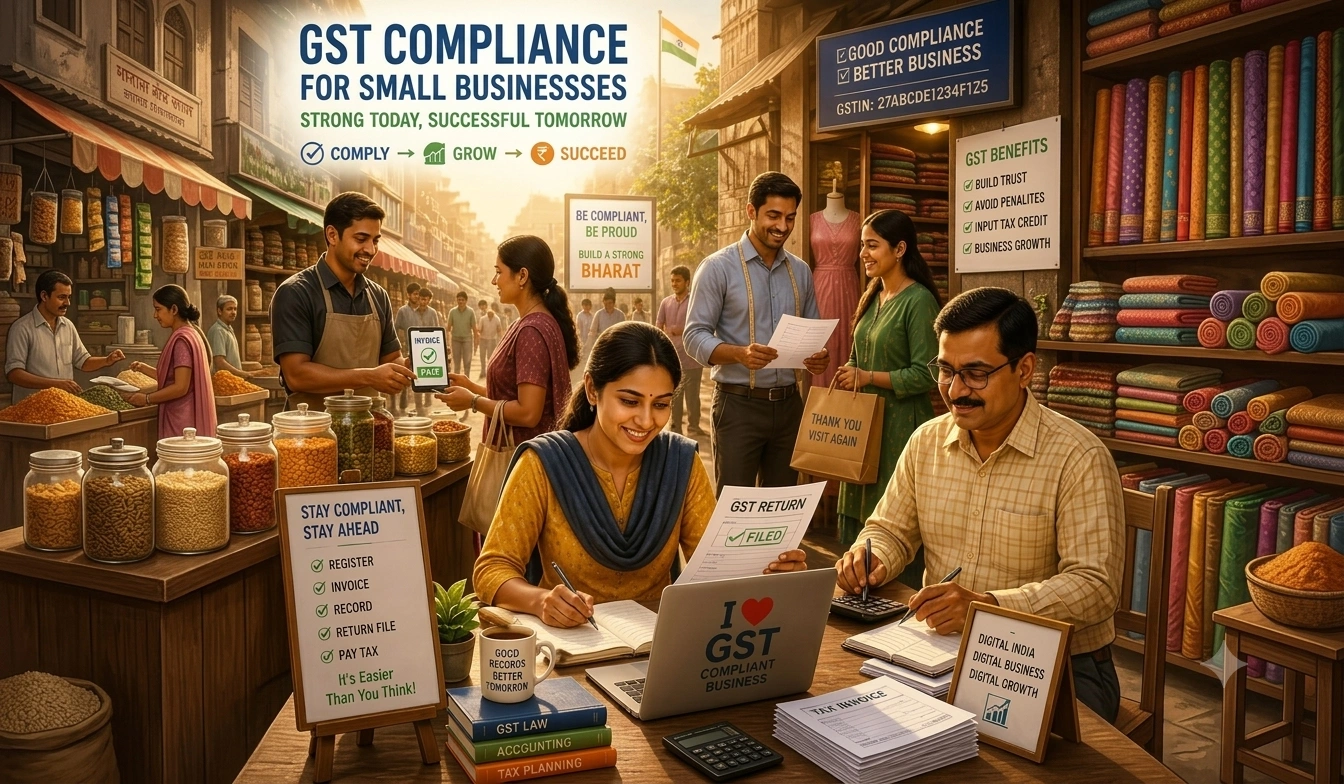
Let me give you a practical checklist that you can use right now. This covers everything you need to do to stay compliant in 2026-2027.
- Check if GST registration is compulsory for your business based on turnover and type
- If yes, complete registration within 30 days of becoming liable
- Maintain a proper accounting system that tracks sales and purchases separately
- Issue invoices with correct GST rates for every sale
- Collect GST from customers and deposit it with the government on time
- Keep all invoices (both issued and received) organized and accessible
- File GSTR-1 by the 11th of next month and GSTR-3B by the 20th
- Reconcile your GSTR-1 with customer GSTR-2A to identify and fix mismatches
- Claim only eligible ITC and maintain proper documentation
- Keep a compliance calendar with all deadlines marked
FAQs on GST Compliance
Q1: What's the difference between GSTR-1 and GSTR-3B?
GSTR-1 is where you report all your sales (outward supplies) to customers. It's detailed and transaction-level. GSTR-3B is your monthly summary return where you declare total sales, total purchases, tax collected, and tax paid. Think of GSTR-1 as the detailed report and GSTR-3B as the summary.
Q2: Can I claim ITC if my supplier hasn't filed their return?
Technically, yes. But it's risky. If your supplier doesn't file their return or files with a different amount, the tax officer will notice the mismatch. You'll get a notice asking for explanation. To be safe, always check with your supplier before claiming ITC.
Q3: What happens if I miss a filing deadline?
You'll be charged a penalty of Rs. 100 per day (maximum Rs. 5,000 for GSTR-3B). Your return will still be accepted if you file late, but the penalty is automatic. The best approach is to set reminders and file on time.
Q4: Do I need GST registration if I'm selling online?
If you're selling through e-commerce platforms like Amazon or Flipkart, you need GST registration regardless of your turnover. This is because e-commerce operators are considered taxable persons. So yes, you need to register.
Q5: What's the penalty for issuing wrong invoices?
The penalty can be up to Rs. 10,000 per invoice if the invoice doesn't show GST separately or has incorrect information. For repeated violations, it can be higher. Always double-check your invoices before sending them to customers.
Q6: Can I claim ITC on personal expenses?
No. ITC is only for business expenses. If you claim ITC on personal items like groceries, mobile phones for personal use, or car fuel for personal travel, that's considered fraud. The tax officer will disallow the entire claim and impose penalties.
Staying Ahead: 2026-2027 Compliance Tips
So here's my advice for staying compliant in 2026-2027. First, get your basics right. Know whether you need to register. If yes, register immediately. Don't delay.
Second, invest in good accounting software. Tools like Tally, QuickBooks, or even basic GST-compliant software will save you hours every month. They'll also reduce errors significantly.
Third, maintain discipline. Set aside time every week to reconcile your accounts. File returns on time. Keep records organized. These habits compound over time.
Fourth, don't hesitate to get professional help. A good CA or tax consultant will cost you a few thousand rupees per month. But they'll save you from penalties and audits that could cost lakhs. The ROI is always positive.
And finally, stay updated. GST rules change frequently. Follow official notifications from the GST portal. Read tax updates from reputable sources. Being informed is your best defense against compliance issues.
Proper GST compliance builds trust with your customers, lenders, and investors. It also protects you from legal issues and allows your business to scale without compliance baggage.
Conclusion
GST compliance isn't optional. It's a legal requirement for any business that crosses the turnover threshold. And honestly, even if you're below the threshold, the benefits of registration often outweigh the compliance burden.
The good news is that GST compliance is manageable if you understand the basics and follow the rules consistently. Register on time. File returns on deadline. Maintain proper records. Claim only eligible ITC. Avoid common mistakes. Do these things, and you'll stay compliant.
In 2026-2027, tax authorities are more vigilant than ever. But that's also good news for you. If you're compliant, you have nothing to worry about. The system is designed to catch non-compliance automatically, so staying honest is the best strategy.
If you're unsure about anything, get professional advice. A few hundred rupees spent on consultation now can save you thousands in penalties later. Your business is too important to leave GST compliance to chance.
" } ```
© 2026 Tax Esquire | Expert CA Services in Greater Noida, Uttar Pradesh
8810380146 | info.taxesquire@gmail.com | taxesquire.in
This document is for informational purposes only. For personalised tax advice, consult our chartered accountants.