GST Composition Scheme Explained Simply: A Complete Guide for Indian Businesses in 2026
GST Composition Scheme Explained Simply
A straightforward guide to understanding composition scheme eligibility, benefits, and compliance rules for 2026
What Is the GST Composition Scheme?
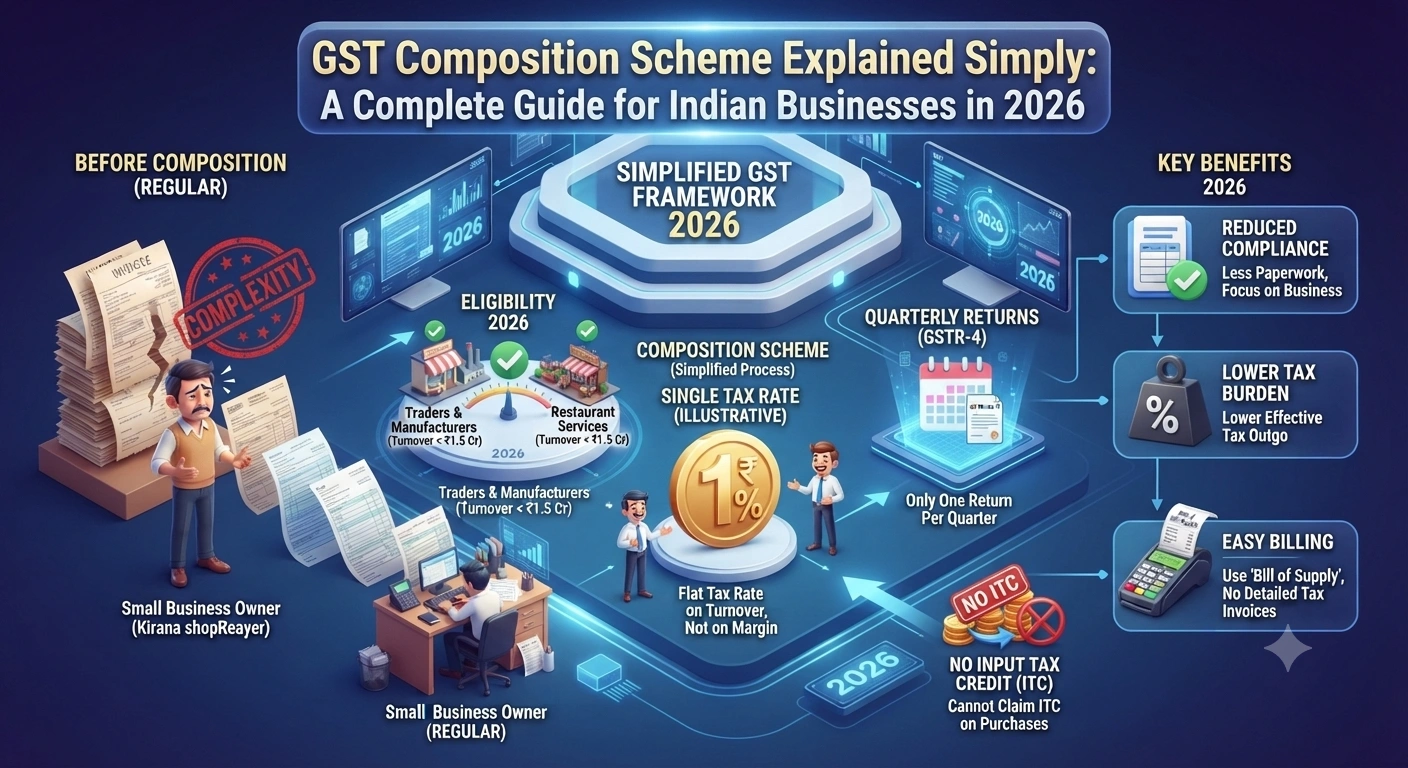
The GST Composition Scheme is a special tax option designed for small businesses. Put simply, it lets you pay a fixed percentage of your turnover as GST instead of calculating tax on every single transaction. So instead of tracking input tax credits and filing detailed returns, you just pay a flat rate and move on.
Think of it like this: a regular GST taxpayer is like a chef who tracks every ingredient cost. A composition scheme taxpayer is like a restaurant that charges a fixed menu price. Both run a business, but one approach is simpler.
The Government introduced this scheme to help small traders, manufacturers, and service providers reduce compliance burden. And honestly, for many businesses, it's a game-changer.
Composition scheme means simpler GST filing, lower compliance costs, and less paperwork. You don't need to track input credits or file monthly returns. That's real time saved for running your business.
Who Can Choose the Composition Scheme?
Not every business can opt for composition scheme. There are specific eligibility rules, and you need to meet them. Let me break down the key requirements as they stand in 2026.
- Your annual turnover must be below 1.5 crore rupees (for most businesses)
- You must be engaged in supply of goods or services (not both, in some cases)
- You can't be a business providing only services outside India
- You shouldn't be a supplier of goods where the supply is made through an e-commerce operator
- Your business shouldn't involve supply of alcohol or tobacco (in most states)
- You must have been registered under GST for at least one day before opting in
The thing is, turnover limits can vary by state and business type. So what does this mean for you? Check with your local GST office or a CA before making the choice.
Composition Scheme Tax Rates in 2026
The rate you pay depends on what your business does. And these rates are fixed, which is why the scheme is so predictable.
| Business Type | Composition Rate | Applies To |
|---|---|---|
| Traders (Goods) | 1% of turnover | Retail and wholesale dealers |
| Manufacturers | 1% of turnover | Small scale manufacturing units |
| Service Providers | 6% of turnover | Restaurants, hotels, consultants |
| Mixed (Goods + Services) | Varies | Depends on dominant activity |
So if you're a trader with 50 lakh rupees annual turnover, you'd pay just 50,000 rupees as GST. Simple math, right?
Real-World Example: How Composition Scheme Works
Let me show you how this actually works with a real example. Rajesh runs a clothing retail store in Delhi. His annual turnover in 2026 is 80 lakh rupees.
If Rajesh was on regular GST: He'd need to track every purchase (input tax) and every sale (output tax). File monthly GSTR-1 and GSTR-3B returns. Claim input credits. Handle audits. The compliance cost? About 40,000 to 60,000 rupees per year in CA fees alone.
If Rajesh opts for composition scheme: He pays 1% of 80 lakh = 80,000 rupees per year as GST. Files quarterly returns. No input credit tracking. No monthly filings. CA fees drop to about 8,000 to 12,000 rupees per year.
The difference? Rajesh saves about 30,000 to 40,000 rupees annually, plus countless hours of paperwork. That's money and time he can put back into his business.
Lower tax compliance costs, fewer filings, less documentation, and more time to focus on actual business growth. That's the real advantage of composition scheme.
Key Advantages of Composition Scheme
Why would you choose composition scheme? There are several solid reasons.
- Simpler tax calculation based on fixed percentage of turnover
- Quarterly return filing instead of monthly (less frequent compliance)
- No need to track input tax credits or maintain complex records
- Lower compliance and CA costs due to reduced complexity
- Predictable tax liability makes budgeting easier
- Reduced audit risk compared to regular scheme
And here's the thing: for most small traders and manufacturers, the tax rate itself (1% for goods) is also lower than the standard GST rates (which range from 5% to 28%).
Important Limitations You Need to Know
But composition scheme isn't perfect. There are real limitations you should understand before opting in.
- You can't claim input tax credits on anything (purchases, fuel, rent, etc.)
- You can't issue tax invoices to B2B customers, only regular invoices
- Your B2B customers can't claim credit for GST paid to you
- You can't make interstate supplies to registered businesses
- If your turnover exceeds the limit, you must exit the scheme
- You need to stay in the scheme for at least one financial year
So if you sell mostly to other businesses that need to claim GST credit, composition scheme might hurt them. And that could cost you business. Think carefully about your customer base.
If you exit composition scheme, you can't rejoin for two years. This is a serious restriction. Don't opt in unless you're sure it fits your business for at least 12 months.
Composition Scheme vs. Regular GST: Quick Comparison
| Feature | Composition Scheme | Regular GST |
|---|---|---|
| Tax Rate | 1-6% of turnover | 5-28% (product dependent) |
| Input Credit | Not allowed | Fully allowed |
| Return Filing | Quarterly | Monthly |
| B2B Supply | Limited (no tax invoice) | Full (with tax invoice) |
| Complexity | Low | High |
| Compliance Cost | Low (8k-15k/year) | High (40k-80k/year) |
How to Opt for Composition Scheme
The process is straightforward. You can apply for composition scheme when you first register for GST, or later if you become eligible.
- Log in to GST portal (www.gst.gov.in) with your credentials
- Go to Services menu and select Application for Composition Levy
- Fill Form GST CMP-02 with all required details
- Upload supporting documents (turnover proof, business details)
- Submit and get acknowledgment
- Wait for approval from GST authorities (usually 3-7 days)
Once approved, you're on the composition scheme from the date specified in the approval. And you'll get a separate GSTIN if needed.
Don't apply for composition scheme if you're not sure about your eligibility. False declarations can lead to penalties, interest, and prosecution. Always verify turnover limits and business type with your CA first.
Compliance Requirements Under Composition Scheme
Even though composition scheme is simpler, you still have compliance duties. Don't think you can ignore everything.
- File quarterly returns (GSTR-4) by the due date
- Maintain basic books of accounts and invoices
- Pay GST liability on time to avoid interest and penalties
- Issue regular invoices (not tax invoices) to customers
- Keep GST registration active and update details if they change
- Inform GST authorities immediately if you exceed turnover limit
Basically, you're still a registered taxpayer. You just have fewer filings and simpler calculations.
When Should You Exit Composition Scheme?
There are situations where staying in composition scheme becomes a bad idea. So what does this mean for you?
You should exit if your turnover crosses the limit (1.5 crore). You must exit. It's not optional. But you might also want to exit if you start selling a lot to registered businesses who need GST credit. In that case, they'll prefer suppliers on regular GST.
To exit, you file Form GST CMP-04 on the portal. But remember: you can't rejoin for two years after exiting. So think carefully before making this move.
If you grow beyond composition scheme limits, you have the option to switch to regular GST and start claiming input credits. This can actually reduce your effective tax rate as you scale up.
Composition Scheme: Common Mistakes to Avoid
I've seen businesses make these mistakes repeatedly. Don't be one of them.
- Issuing tax invoices when you're on composition scheme (you can't)
- Trying to claim input tax credit on purchases (not allowed)
- Not tracking turnover properly and accidentally exceeding the limit
- Missing quarterly return deadlines and facing late fees
- Assuming composition scheme applies to all your business activities (it doesn't)
- Not informing customers that you're on composition scheme (transparency matters)
And honestly, the biggest mistake is opting in without understanding the limitations. Take time to read the rules or talk to a CA before deciding.
FAQs on GST Composition Scheme
Q1: Can I claim input tax credit on my purchases if I'm on composition scheme?
No. That's one of the main restrictions. You pay the fixed percentage on your turnover, and you don't get credit for any GST you pay on purchases. This is why composition scheme works best for businesses with low purchase costs relative to sales.
Q2: What happens if my turnover exceeds 1.5 crore in the middle of the financial year?
You must exit the composition scheme immediately. You can't continue. File Form GST CMP-04 to exit, and you'll be moved to regular GST from that date. The good news? You can claim input credits from the date you switched.
Q3: Can I issue a tax invoice to my B2B customers on composition scheme?
No. You issue regular invoices, not tax invoices. Your B2B customers can't claim GST credit on purchases from you. This is why composition scheme isn't ideal if most of your sales are to registered businesses.
Q4: How often do I need to file returns under composition scheme?
Quarterly. You file GSTR-4 every three months by the due date. It's much simpler than monthly filings, and the form itself is straightforward. Just report your turnover and pay the tax.
Q5: Can I rejoin composition scheme after exiting?
Not for two years. Once you exit, you're locked out of composition scheme for the next two financial years. This is why you should only exit when you're absolutely sure you need to.
Q6: Is composition scheme available for all types of businesses?
No. It's not available for businesses supplying alcohol, tobacco, or certain other goods. It's also not available if you're supplying goods through e-commerce platforms in some cases. Check with your GST officer to confirm eligibility.
Is Composition Scheme Right for Your Business?
So how do you decide? Here's a practical checklist.
Composition scheme works well if: your turnover is below 1.5 crore, most of your sales are to end consumers (B2C), your customers don't need GST invoices or credit, your business has low purchase costs relative to sales, and you want simpler compliance.
Composition scheme doesn't work if: most of your sales are to registered businesses who need credit, you have high purchase costs (because you can't claim credit), you plan to grow significantly in the next year, or you import goods regularly.
And that's really it. The decision comes down to your customer base and business structure.
For retail traders, small manufacturers, and service providers selling to consumers, composition scheme can reduce your tax burden by 30-50% compared to regular GST. The savings compound year after year.
Composition Scheme in 2026: What's Changed?
As of 2026, the basic structure of composition scheme remains the same. Turnover limits, tax rates, and compliance rules haven't changed significantly. But GST rules evolve, so always check the latest notifications on the official GST portal.
The government continues to promote composition scheme for small businesses, so it's unlikely the scheme will be withdrawn. But stay updated on any amendments.
Final Thoughts
The GST Composition Scheme is a genuine benefit for small businesses. It simplifies your tax life, reduces compliance costs, and often results in lower tax liability. But it's not for everyone, and the restrictions are real.
Before you opt in, understand your business model, your customer base, and your growth plans. Talk to a CA who knows your situation. Make an informed choice, not a hasty one. And once you're in, follow the rules carefully. Compliance under composition scheme is still compliance.
The bottom line? Composition scheme can be excellent for the right business. Make sure yours is one of them.
" } ```
© 2026 Tax Esquire | Expert CA Services in Greater Noida, Uttar Pradesh
8810380146 | info.taxesquire@gmail.com | taxesquire.in
This document is for informational purposes only. For personalised tax advice, consult our chartered accountants.