GST HSN Code List for Common Products Explained: A Step-by-Step 2026 Guide
GST HSN Code List for Common Products Explained
Master product classification and stay compliant with the latest HSN codes
What's an HSN Code and Why Should You Care?
Look, if you're running a business in India and selling anything under GST, you need to know about HSN codes. HSN stands for Harmonized System of Nomenclature, and it's basically the government's way of organizing every product that exists into neat little boxes.
Here's the thing: getting your HSN code wrong doesn't just mess up your paperwork. It can lead to penalties, rejected GST returns, and audits that'll keep you up at night. And that's really it—you need to get this right from day one.
The HSN code is a six-digit number that tells the tax authorities exactly what you're selling. It determines your GST rate, affects your compliance requirements, and shows up on every invoice you create. So what does this mean for you? It means spending 10 minutes now to get it right beats spending weeks fixing it later.
Correct HSN codes help you avoid penalties, speed up GST return filing, and reduce audit risk. They also make your invoices compliant and professional.
How HSN Codes Work: The Basic Structure
An HSN code is made up of six digits, and each pair of digits tells you something different. The first two digits are the Chapter, the next two are the Heading, and the last two are the Sub-heading. Put simply, it's like a filing system that gets more specific as you go.
Let me give you an example. If you're selling cotton fabric, your HSN code might be 520512. The first two digits (52) say it's textile fibers and yarns. The next two (05) narrow it down to cotton. And the last two (12) tell you it's woven fabric of cotton. See how it gets more detailed?
Why does this matter? Because different products have different GST rates. Some items are taxed at 5%, others at 12%, and some at 28%. If you pick the wrong code, you might be charging your customers the wrong tax rate, which creates a mess when you file your returns.
- Chapter (first 2 digits): Broad product category
- Heading (next 2 digits): Specific product type
- Sub-heading (last 2 digits): Detailed product variant
- Each level adds more specificity to your product classification
- Different codes can have different GST rates applied
Common Product Categories and Their HSN Codes
And now let's get into the real stuff—the codes you'll actually use. I'm going to walk you through the most common product categories that businesses deal with every day.
| Product Category | HSN Code Range | GST Rate (2026) |
|---|---|---|
| Textiles & Fabrics | 50-63 | 5% to 12% |
| Machinery & Equipment | 84-85 | 5% to 18% |
| Electrical Goods | 85 | 5% to 18% |
| Food & Beverages | 02-21 | 0% to 18% |
| Chemicals & Plastics | 28-39 | 5% to 18% |
| Metals & Minerals | 72-81 | 5% to 18% |
Real Examples: Finding the Right Code for Your Products
Let me walk you through some actual products you might sell and show you how to find their codes. This is where it gets practical.
Example 1: Ready-Made Garments
Say you're selling cotton t-shirts. The HSN code is 6104. This falls under Chapter 61 (Articles of Apparel). The GST rate is 5%. When you invoice a customer, you'd add 5% GST on top of your selling price. Easy, right?
Example 2: Packaged Food Items
If you're selling packaged biscuits, the code is 1905. It falls under Chapter 19 (Cereals, Flour, Starch). The GST rate is 5%. But here's where people mess up: if you sell the same biscuits loose from a jar, it might fall under a different category altogether. The packaging matters.
Example 3: Electronic Equipment
You're selling mobile phones. The HSN code is 8517. It's in Chapter 85 (Electrical Machinery and Equipment). The GST rate is 12%. If you're selling phone chargers separately, they're 8504 with 18% GST. So you can't just lump everything electronic together.
Don't guess your HSN codes. Even a one-digit mistake can change your GST rate and land you in trouble during an audit. Always verify on the official GST portal or with your CA.
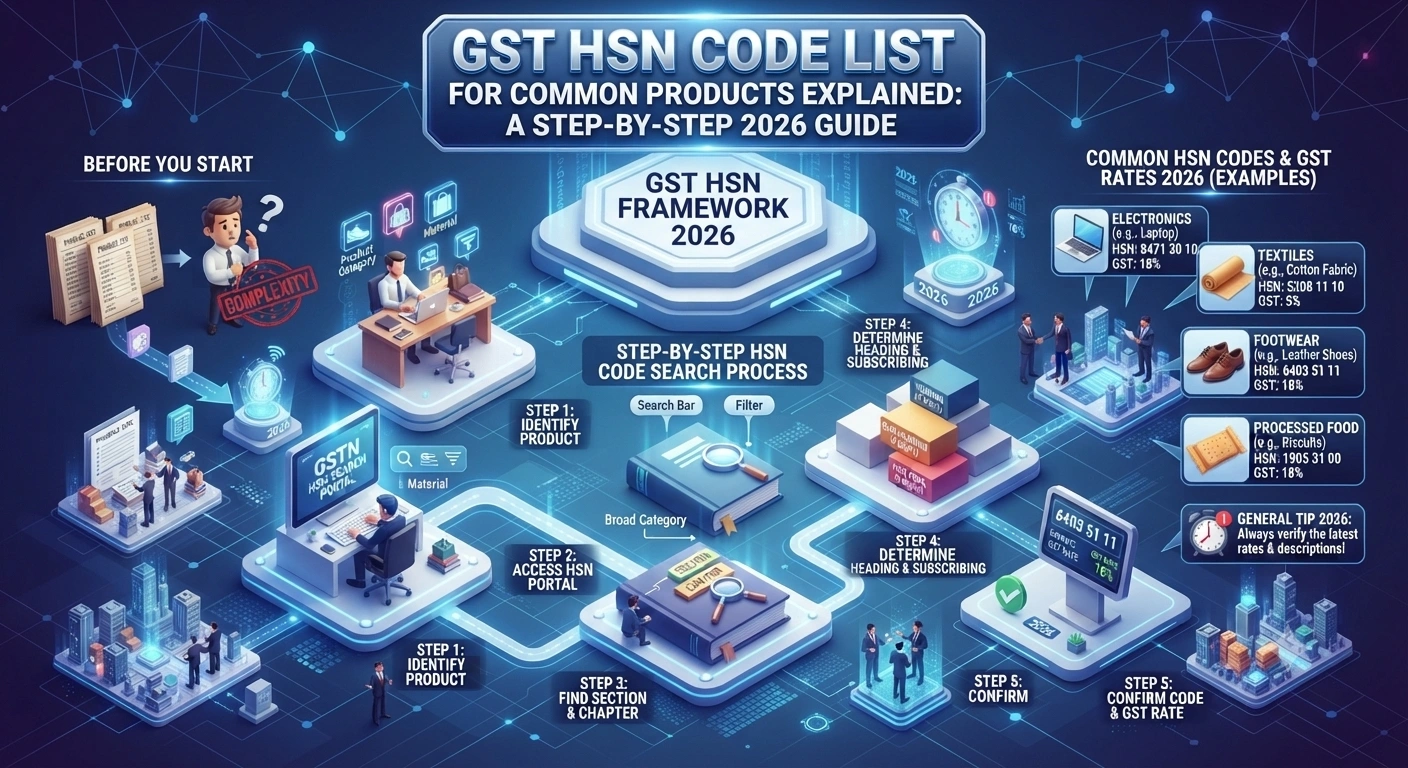
How to Find the Right HSN Code: Step-by-Step
Honestly, finding the right code isn't rocket science if you know where to look. Let me break it down into simple steps.
Step 1: Describe Your Product Clearly
Write down exactly what you're selling. Don't just say "clothes"—say "men's cotton t-shirts" or "women's silk sarees." The more specific you are, the easier it gets to find the right code.
Step 2: Check the Official GST Portal
Go to www.gst.gov.in and look for the HSN code search tool. You can search by product name or category. The portal shows you the exact code and the applicable GST rate.
Step 3: Verify the GST Rate
Once you find your code, check the GST rate attached to it. Make sure it matches what you expect. Some products have special rates or exemptions.
Step 4: Consult Your CA if You're Unsure
If you're selling something that could fit into multiple categories, don't guess. Talk to your CA. It's worth the phone call.
Step 5: Document Your Decision
Keep a record of which codes you use and why. If an auditor questions you, you can show them you did your homework.
Special Cases and Tricky Classifications
So far we've covered the straightforward stuff. But what about products that don't fit neatly into one box? These are the ones that trip people up.
Composite Products
Say you're selling a gift hamper with chocolates, cookies, and tea. What's the HSN code? The rule is: use the code of the main component by value. If the chocolates make up 60% of the value, you use the chocolate code. But you need to declare the total value correctly.
Items with Packaging
A jar of honey and the jar itself might have different codes. But if they're sold together as one product, you classify based on the main item (honey). The packaging is secondary.
Services vs. Products
Here's a big one: some things are taxed as services, not products. If you're selling custom tailoring, that's a service, not a product. You don't use HSN codes for services—you use SAC codes instead. And that's really it: services have different rules.
- Composite products use the code of the main component
- Packaging follows the main product classification
- Services use SAC codes, not HSN codes
- Bundled items are classified by dominant value
- Always document your classification logic
HSN Code Compliance Requirements in 2026
In 2026, the GST rules around HSN codes are pretty strict. You need to know what's expected of you.
First, if your annual turnover is above 5 crore rupees, you must mention HSN codes on all invoices. This isn't optional. Second, you need to mention it in your GST returns. Third, if you're filing GSTR-1, the HSN code is mandatory for each line item.
What happens if you don't? You might face penalties under Section 125 of the CGST Act. The penalty can go up to 10,000 rupees per invoice. Across 100 invoices, that's 10 lakhs. So this isn't something to take lightly.
Missing or incorrect HSN codes in your GSTR-1 can trigger automatic notices from the tax department. Your return might get rejected, and you'll have to amend and refile. Plan ahead and verify everything before filing.
Tools and Resources to Find HSN Codes
You don't have to memorize codes. There are tools that make this way easier.
Official GST Portal
Go to www.gst.gov.in and use their HSN search tool. It's free and official. You can search by product name or code.
GST Billing Software
Most GST-compliant billing software has HSN codes built in. When you add a product, you can search and select the right code. It auto-fills the rate too.
ICEGATE Portal
If you're importing or exporting, the ICEGATE portal has detailed HSN code information with descriptions.
Your CA or Tax Consultant
This is the safest option if you're confused. A good CA knows the codes inside out and can guide you.
Common Mistakes People Make with HSN Codes
Let me tell you what I see most often when working with businesses. These mistakes cost people money and headaches.
Mistake 1: Using Old Codes
HSN codes do change sometimes. If you're using a code from 2024 and it's been revised, you're already off track. Check the latest list every year.
Mistake 2: Mixing Up Similar Products
Plastic bags and plastic sheets look similar but have different codes. One might be 3923 and the other 3920. Using the wrong one changes your GST rate.
Mistake 3: Ignoring Special Exemptions
Some products are exempt from GST or have lower rates. Unbranded medicines are 0%, for example. If you charge 5% or 12%, you're overcharging and creating compliance issues.
Mistake 4: Not Updating Your Software
If your billing software isn't updated with the latest codes, you're stuck with old information. Update your software regularly.
Mistake 5: Assuming One Code Fits All Variants
A cotton shirt and a silk shirt have different codes. A 100ml perfume and a 50ml perfume might have the same code, but if one is a gift set, it might be different. Check each variant.
Quick Reference: HSN Codes by Industry
Here's a quick reference for some of the most common industries. Bookmark this section.
| Industry | Product Example | HSN Code | GST Rate |
|---|---|---|---|
| Apparel | Cotton T-Shirt | 6104 | 5% |
| Food | Packaged Biscuits | 1905 | 5% |
| Electronics | Mobile Phone | 8517 | 12% |
| Chemicals | Detergent Powder | 3402 | 18% |
| Metals | Stainless Steel Sheets | 7220 | 5% |
| Furniture | Wooden Chair | 9401 | 18% |
What Happens If You Get It Wrong?
So what's the actual impact of using the wrong HSN code? Let me be honest with you about the consequences.
First, there's the financial hit. If you charge the wrong GST rate, you'll have to refund the difference to customers or eat the loss yourself. Second, your GST returns won't match. The tax department will send you a notice asking for clarification. Third, if it looks intentional, you could face penalties and interest on unpaid taxes.
In a 2026 audit, if they find systematic errors in your HSN codes, they might assess your entire business. That means recalculating your taxes from multiple years. You could end up paying back taxes, penalties, and interest. And that's before they consider prosecution for tax evasion.
But here's the good news: if you can show you made a genuine mistake and corrected it promptly, most tax officers are reasonable. They want compliance, not blood. So if you realize you've been using the wrong code, amend your returns immediately.
Getting your HSN codes right from the start means smoother audits, faster return processing, and no surprises from the tax department. It's one of the easiest compliance wins you can get.
Frequently Asked Questions
Q1: Do I need to mention HSN codes on every invoice?
A: If your annual turnover is above 5 crore rupees, yes, you must mention HSN codes on all invoices. If you're below that threshold, it's not compulsory but highly recommended for compliance.
Q2: Can the same product have different HSN codes?
A: Not really. A specific product should have one HSN code. But variants of the same product might have different codes. For example, a cotton shirt and a silk shirt have different codes even though they're both shirts.
Q3: What's the difference between HSN and SAC codes?
A: HSN codes are for products, SAC codes are for services. If you're selling physical goods, you use HSN. If you're providing a service like consulting or repair, you use SAC.
Q4: How often do HSN codes change?
A: HSN codes are pretty stable, but they can be updated or revised. The government publishes updates, usually annually. It's a good idea to check the official list at the start of each fiscal year.
Q5: What if I can't find the exact HSN code for my product?
A: Use the most similar code and document your reasoning. If challenged, you can show that you made a good-faith effort to classify correctly. Better yet, consult your CA to get it right the first time.
Q6: Do imported products have different HSN codes?
A: No, the HSN code is the same whether the product is imported or manufactured locally. But imported goods might have additional requirements like customs documentation.
Q7: Can I change my HSN code for the same product?
A: You shouldn't unless the product itself changes significantly. If you realize you've been using the wrong code, you should amend your previous returns and correct it going forward. This shows good faith.
Your Action Plan for 2026
Alright, let's wrap this up with a practical action plan you can start today.
This Week: List all the products you sell and their current HSN codes. Check them against the official GST portal. If anything doesn't match, note it.
Next Week: Update your billing software with the correct codes. Test a few invoices to make sure they're generating correctly with the right GST rates.
Before Filing Returns: Do a final audit of your invoices. Make sure every line item has the right HSN code. If you find errors, correct them before filing.
Ongoing: Keep a master list of your HSN codes and GST rates. Review it quarterly. When you add new products, verify their codes immediately.
Once a Year: Check the official GST portal to see if any codes or rates have changed. Update your system accordingly.
Final Thoughts
HSN codes aren't complicated once you understand the basics. They're just a classification system that helps the government track what you're selling and ensures you're charging the right GST rate. Get them right, and your compliance becomes automatic. Get them wrong, and you're inviting trouble.
The good news is that this is one of the easiest things to fix. You don't need special training or expensive software. Just a bit of attention to detail and access to the official GST portal. That's it.
If you're running a business in 2026, spending an hour now to get your HSN codes right will save you weeks of stress later. Trust me on this one.
" } ```
© 2026 Tax Esquire | Expert CA Services in Greater Noida, Uttar Pradesh
8810380146 | info.taxesquire@gmail.com | taxesquire.in
This document is for informational purposes only. For personalised tax advice, consult our chartered accountants.