MSME Udyam & Mudra Yojana: How Small Businesses Can Get Loans in 2026-2027
MSME Udyam & Mudra Yojana
Your complete roadmap to accessing government-backed financing for your small business in 2026
Starting a small business is tough. Getting the money to start it? That's often the hardest part. But here's the thing—the Indian government has built two really powerful schemes to help you: MSME Udyam registration and the Mudra Yojana. I've worked with hundreds of small business owners, and most of them don't know these programs exist or how to access them. That changes today.
So what does this mean for you? It means you could be looking at loans up to 10 lakhs without collateral, with interest rates that won't crush your cash flow, and paperwork that's actually manageable. And that's really it—these schemes are designed specifically for people like you.
What Is MSME Udyam Registration?
Let me start with the basics. MSME stands for Micro, Small, and Medium Enterprises. Udyam is the government's registration system for these businesses. Think of it as your official identity card as a small business owner.
Before 2020, there was an older system called MSME registration. The government scrapped it and brought in Udyam. Why? Because the old system was slow, complicated, and didn't really help businesses access credit. Udyam changed that.
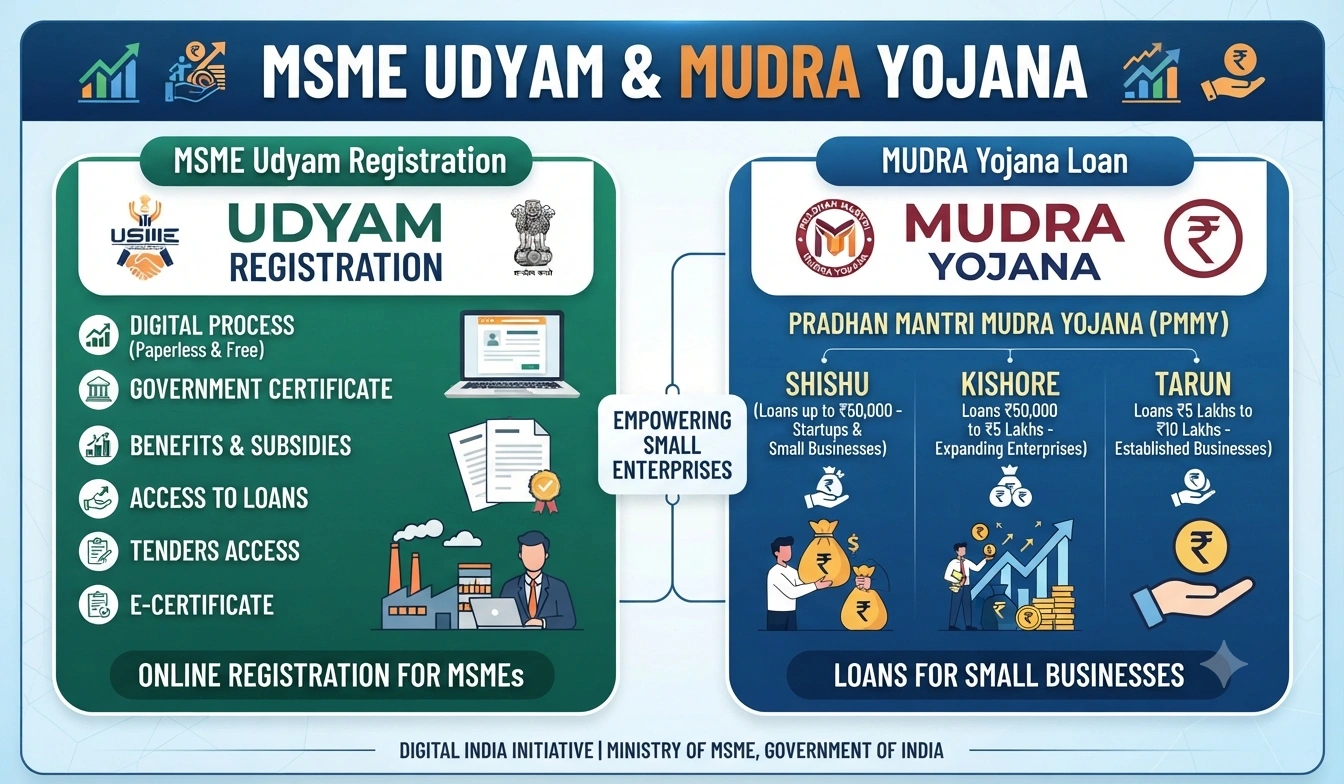
Here's what makes Udyam different: it's online, it's free, and you get instant registration. No visits to government offices. No waiting weeks for approval. You fill out a form, submit it, and boom—you're registered. Your Udyam number comes immediately.
Udyam registration is completely free and takes about 5 minutes online. You get instant registration with no hidden charges or delays.
Who Can Register for Udyam?
Not everyone can register. There are specific criteria, but honestly, most small business owners will qualify. Let me break it down for you.
- You're running any kind of business or trade activity (not a profession like doctor or lawyer)
- Your business investment in plant and machinery or equipment doesn't exceed certain limits (25 crores for small, 5 crores for micro, 10 crores for medium)
- You have a PAN (Permanent Account Number) or Aadhaar
- Your annual turnover is below 250 crores for small and medium enterprises
- You're not already registered under the old MSME system
And that's really it. You don't need to be a company. You don't need to be registered with GST (though most businesses are). You can be a sole proprietor, partnership, or anything else.
Understanding the Mudra Yojana
Now let's talk about the money. The Pradhan Mantri Mudra Yojana (PMMY) is a government scheme that helps lenders give loans to small businesses. It's not the government giving you money directly—it's the government backing the loan so banks feel safe lending to you.
Mudra means "micro units development and refinance agency." Basically, it's a safety net. If you default, the government covers part of the loss. This gives banks confidence to lend to people without a credit history or collateral.
The scheme launched in 2015 and has grown massively. By 2026, it's one of the biggest small business lending programs in the world. And the best part? You can borrow up to 10 lakhs without collateral.
Mudra loans don't need collateral or personal guarantees. The government guarantee covers the lender's risk, so you get approved based on your business plan and repayment ability.
Types of Mudra Loans
There are three types of Mudra loans, and which one you get depends on your loan amount and business stage.
| Loan Type | Loan Amount | Best For |
|---|---|---|
| Shishu | Up to 50,000 | First-time entrepreneurs, very small startups |
| Kishor | 50,000 to 5 lakhs | Growing businesses, businesses with some track record |
| Tarun | 5 lakhs to 10 lakhs | Established businesses wanting to expand |
Each type has slightly different eligibility rules, but the core idea is the same: the government backs the loan, so you don't need collateral. Put simply, you're borrowing based on your business potential, not your personal assets.
Step-by-Step: How to Get Udyam Registration
Let me walk you through this. It's honestly simpler than most people think.
Step 1: Visit the Udyam Portal
Go to udyamregistration.gov.in. You'll see a form asking for basic details. Have your Aadhaar or PAN ready.
Step 2: Fill in Your Details
Enter your name, address, business details, and investment in machinery. You'll also need to pick your business activity code. If you're not sure, look it up on the portal—there's a searchable list.
Step 3: Submit and Get Your Number
Click submit. Your Udyam registration number appears instantly on your screen. Save it. Print the certificate. You're done.
Seriously, that's it. No paperwork, no office visits, no waiting. You can register in 5 minutes from your phone.
How to Apply for a Mudra Loan
Now that you're registered, you can apply for a Mudra loan. But here's what most people don't realize: Mudra isn't a lender. The government doesn't give you the money. Banks and NBFCs do. Mudra just guarantees the loan.
So you need to apply to a bank or NBFC, not to the government. Let me show you how.
Step 1: Choose Your Lender
Almost every bank offers Mudra loans. Check with your bank first—they know you already. If not, try SBI, ICICI, HDFC, Axis, or any scheduled bank. Many NBFCs also offer Mudra loans, sometimes with faster approval.
Step 2: Prepare Your Documents
- Your Udyam certificate
- Identity proof (Aadhaar, PAN, passport)
- Address proof (utility bill, rent agreement)
- Bank statements (last 6 months)
- A simple business plan (one page is fine)
- ITR (if you've filed before) or a basic profit and loss estimate
Step 3: Fill the Application
The bank will give you a form. Fill it honestly. Tell them what you need the money for. Be specific. "I need 3 lakhs to buy equipment" is better than "I need money for my business."
Step 4: Submit and Wait
Most Mudra loans get approved within 7-14 days. Some banks are faster. The money hits your account within a week of approval. And that's really it—you're borrowing.
Don't fall for middlemen or agents who promise faster approvals for a fee. Apply directly to the bank. It's free and takes the same time.
Eligibility Criteria for Mudra Loans
Not everyone gets approved. But the criteria are pretty reasonable. Let me spell them out.
First, you need to be an Indian citizen above 18 years old. You can't have an existing loan that's in default. Your business should be in the non-farm sector (so manufacturing, retail, services, etc. are fine, but agriculture isn't covered under Mudra).
You need to show that you'll use the money for your business, not for personal reasons. And honestly, that's the main thing banks care about. They want to know your money is going into the business so you can repay the loan from business profits.
Your credit score helps, but it's not a hard requirement. Even if you don't have a credit history, you can still get approved. Banks look at your business plan and repayment capacity.
Interest Rates and Repayment Terms
Here's where most people get confused. Interest rates for Mudra loans vary. There's no fixed rate set by the government. Banks decide their own rates.
In 2026, you can expect rates between 8% to 12% annually, depending on your bank and loan type. Shishu loans (smaller amounts) might be slightly higher. Tarun loans (larger amounts) might be lower. It depends on the lender's risk assessment.
Repayment periods range from 3 to 5 years, sometimes longer. Your monthly EMI will depend on the amount, rate, and tenure. A 3 lakh loan at 10% for 5 years comes to about 6,350 per month. Calculate this before you apply—make sure your business can handle it.
| Loan Amount | Typical Tenure | Approx Monthly EMI (at 10%) |
|---|---|---|
| 50,000 (Shishu) | 3 years | 1,610 |
| 3 lakhs (Kishor) | 5 years | 6,350 |
| 10 lakhs (Tarun) | 5 years | 21,165 |
These are ballpark figures. Your actual EMI depends on the exact rate your bank charges and the tenure you choose. Most banks have EMI calculators on their website—use them before you apply.
Key Benefits of MSME Udyam & Mudra Yojana
Why should you care about these schemes? Let me list the real advantages.
- No collateral needed—you're not risking your house or car
- Fast approval—most loans are approved within 2-3 weeks
- Reasonable interest rates—cheaper than personal loans or credit cards
- Government guarantee—the bank's risk is covered, so they're more willing to lend
- Tax benefits—interest paid on business loans is deductible
- Priority sector lending—banks are encouraged to lend to MSME, so approval rates are higher
And here's something most people miss: once you successfully repay a Mudra loan, you can apply for a larger loan later. This builds your credit history and makes future borrowing easier.
Udyam registration gives you access to government schemes like subsidized insurance, energy efficiency programs, and export promotion. It's not just about loans—it's about government support for your entire business.
Common Mistakes to Avoid
I've seen a lot of people mess this up. Let me save you from those mistakes.
Mistake 1: Wrong Business Classification
When you register for Udyam, you pick a business activity code. Some people pick the wrong one to seem bigger or smaller. Don't. Pick the one that actually describes your business. Banks verify this, and misclassification can lead to rejection.
Mistake 2: Lying About Investment
You have to declare your investment in machinery and equipment. Some people understate it to stay in the "micro" category. But banks cross-check with GST records and ITR. If they find discrepancies, your loan gets rejected and you might face issues.
Mistake 3: Applying for Too Much Money
Just because you can borrow 10 lakhs doesn't mean you should. Borrow what your business actually needs. If you borrow 10 lakhs but only need 3, you're paying interest on money sitting in your account. That's wasteful.
Mistake 4: Not Having a Business Plan
Banks want to know what you'll do with the money. A one-page plan is enough. Say: "I'll buy equipment worth 2 lakhs, hire one person for 50,000, and use the rest for working capital. I expect to earn 5 lakhs in the first year." That's concrete and credible.
Mistake 5: Defaulting on Repayment
This is the big one. If you miss EMI payments, your credit score tanks. Future loans become impossible. The government guarantee doesn't protect you from that damage. Pay on time, every time. Set up auto-pay if you have to.
If you default on a Mudra loan, the bank can take legal action. Your name gets reported to credit bureaus. Future loans become expensive or impossible. Don't borrow more than you can repay.
Compliance and Tax Implications
Once you get a Mudra loan, you have compliance responsibilities. Let me break them down.
First, you need to maintain proper books of accounts. This isn't optional. If you're registered for GST, you're already doing this. If not, at least keep a simple record of income and expenses. Banks may ask for this during the loan tenure.
Second, file your income tax returns on time. Even if your income is below the taxable limit, file returns if you've taken a business loan. It shows you're serious about your business.
Third, update your Udyam registration if your business details change. If you move to a new location or change your business activity, update it within 30 days.
On the tax side, the interest you pay on a Mudra loan is deductible from your business income. So if you earn 10 lakhs and pay 1 lakh in interest, your taxable income is 9 lakhs. That saves you money on taxes.
Real-World Example
Let me give you a practical example. Meet Rajesh. He's a 28-year-old who wants to start a small manufacturing unit for plastic containers.
In January 2026, he registers on the Udyam portal. Takes him 10 minutes. He gets his registration number instantly. His investment in machinery is 2 lakhs (he's buying used equipment).
He then walks into his local bank with his Udyam certificate and applies for a Mudra loan under the Kishor category. He asks for 3 lakhs. The bank asks for basic documents: Aadhaar, address proof, and a simple one-page business plan.
Rajesh's plan says: "I'll buy machinery worth 2 lakhs, hire one worker for 50,000, and keep 50,000 for working capital. I expect to earn 5 lakhs in revenue in the first year with 2 lakh profit."
The bank approves in 10 days. The loan is sanctioned at 10% interest for 5 years. His monthly EMI is 6,350. He gets 3 lakhs in his account within a week.
He buys his machinery, starts production, and begins repaying the loan. By month 12, his business is earning 5 lakhs a month. His EMI is easy to handle. In 5 years, he's paid off the loan and has a thriving business. He can now apply for a larger loan to expand.
This isn't a fantasy. Thousands of people do this every year. You can too.
Frequently Asked Questions
Q1: Do I need to be registered with GST to get a Mudra loan?
No. GST registration isn't a requirement for Mudra loans. But if your business turnover is above 40 lakhs, you're legally required to register for GST anyway. Most banks prefer it because it shows you're compliant. If you're not GST-registered, be prepared to explain why.
Q2: Can I get a Mudra loan if I don't have a credit history?
Yes. That's actually the whole point of Mudra. It's designed for people without credit history. Your credit score helps, but it's not a deal-breaker. What matters more is your business plan and ability to repay.
Q3: How long does it take to get the loan money?
Approval usually takes 7-14 days. Once approved, the money hits your account within 3-7 days. So from application to money in hand, you're looking at 2-3 weeks. Some banks are faster.
Q4: Can I prepay a Mudra loan without penalty?
Most banks allow prepayment without penalty. Check with your bank before signing. If you can repay early, do it. You'll save on interest. Some banks might charge a small fee (usually 1-2%), but it's still worth it.
Q5: What happens if my business fails and I can't repay?
The government guarantee doesn't protect you from repayment. The bank can take legal action. Your credit score suffers. Future loans become impossible or very expensive. The guarantee protects the bank, not you. So borrow responsibly.
Q6: Can I take a Mudra loan for an existing business?
Yes. You don't have to be a startup. If you've been running a business and want to expand, you can apply for a Mudra loan. The bank might ask for your ITR or GST returns to see your track record. But existing businesses are eligible.
Q7: Is there any processing fee for Mudra loans?
Banks can charge a processing fee, usually 1-2% of the loan amount. This is deducted from your loan or added to your first EMI. It's not a government fee—it's the bank's charge. Compare fees across banks before applying.
What's New in 2026-2027?
The government keeps improving these schemes. As of 2026, here's what's changed or what you should know.
First, the Udyam portal has become even more streamlined. Registration is now possible through a mobile app as well. You don't even need a computer anymore.
Second, many banks have started offering Mudra loans through digital channels. You can apply entirely online, upload documents through your phone, and get approval without visiting a branch. It's faster and more convenient.
Third, there's a push toward linking Mudra loans with government schemes like subsidized insurance. Some banks now offer accident insurance or life insurance at discounted rates to Mudra borrowers. Check with your bank.
And finally, the credit guarantee coverage has been expanded. The government now covers up to 85% of the loan amount in case of default, making banks even more willing to lend.
Final Thoughts
Look, starting a business is hard. Getting money to start it shouldn't be. MSME Udyam registration and Mudra Yojana exist specifically to solve that problem. They're not perfect, but they're real, they work, and they're accessible to you.
The process is simple: register for Udyam (free, 5 minutes), then apply for a Mudra loan at your bank (2-3 weeks), and you're borrowing. No collateral. No personal guarantees. Just your business idea and your commitment to making it work.
But here's the real talk: borrowing is a responsibility. You're not getting free money. You're getting a loan you have to repay. So borrow what you actually need, have a real business plan, and make sure your business can generate enough profit to handle the EMI. Do that, and you're golden.
In 2026, thousands of small business owners are using these schemes to grow. You can be one of them. Start today. Register for Udyam. Walk into your bank. Apply for a Mudra loan. Your business is waiting.
" } ```
© 2026 Tax Esquire | Expert CA Services in Greater Noida, Uttar Pradesh
8810380146 | info.taxesquire@gmail.com | taxesquire.in
This document is for informational purposes only. For personalised tax advice, consult our chartered accountants.