TDS on Purchase of Property Section 194-IA: The 2026 Guide (Rules, Process & Tips)
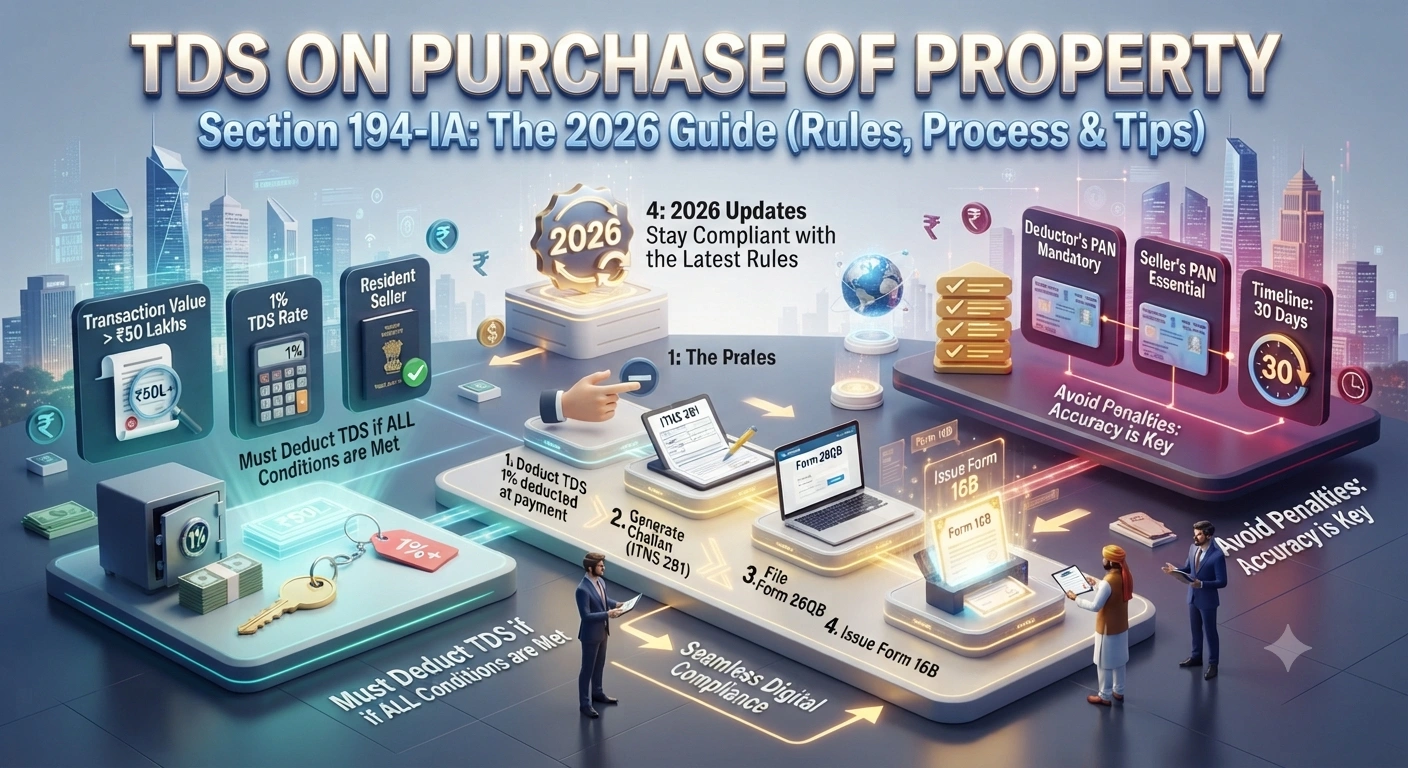
TDS on Purchase of Property Section 194-IA
Master property TDS deductions with expert compliance insights for 2026
What is Section 194-IA and Why Should You Care?
Look, if you're buying property in 2026, you need to know about Section 194-IA. This is the TDS rule that applies when you're paying money to someone selling immovable property. The buyer (that's you) has to deduct tax at source before handing over the full amount to the seller.
But here's what most people miss: this rule doesn't apply to every property deal. There's a threshold. And if you don't follow the rules, you'll face penalties. So let's break this down in plain language.
Section 194-IA came into force on June 1, 2013. It applies to the purchase of immovable property (except agricultural land) when the amount exceeds a certain limit. The tax is deducted from the sale consideration and deposited with the government on your behalf.
Who Has to Deduct TDS Under Section 194-IA?
The buyer is responsible for deducting TDS. But not every buyer. Let me explain who actually needs to do this.
- Any person buying immovable property (residential, commercial, or industrial)
- The purchase amount must exceed Rs. 50 lakhs in 2026
- The property must be located in India
- Agricultural land is excluded from this rule
- The seller must not be a company (companies are covered under different rules)
And that's really it. If all these conditions match, you're the one who needs to deduct TDS.
If you're the seller, you can get relief if TDS has been deducted. You can claim this deduction when filing your income tax return. This helps you avoid double taxation.
TDS Rate and Threshold for 2026
The threshold and rate matter. Here's what you need to know for 2026.
| Particulars | Details for 2026 |
|---|---|
| Threshold Amount | Rs. 50 lakhs and above |
| TDS Rate | 1% of the purchase price |
| Applicable to | Immovable property (not agricultural land) |
| Deduction Timing | At the time of payment or credit |
So if you're buying a property for Rs. 60 lakhs, you need to deduct 1% of Rs. 60 lakhs, which is Rs. 60,000. This amount gets deposited with the government in the name of the seller.
What happens if the property value is Rs. 49 lakhs? You don't deduct anything. The threshold is strict at Rs. 50 lakhs.
Don't try to split payments across multiple transactions to avoid TDS. The tax department will combine related transactions and apply TDS anyway. You'll face penalties for non-compliance.
Step-by-Step Compliance Process for 2026
Let me walk you through exactly what you need to do when you're buying property in 2026.
Step 1: Verify the Threshold
First, check if the purchase price exceeds Rs. 50 lakhs. Include the full consideration, even if part of it is paid in kind or through other arrangements. If it's below this amount, you're done. No TDS needed.
Step 2: Get PAN Details
You need the seller's PAN. Don't proceed without it. If the seller doesn't have a PAN, they need to apply for one before the transaction. You can't deduct TDS without a valid PAN.
Step 3: Calculate TDS Amount
Multiply the purchase price by 1%. That's your TDS amount. For example, if the property costs Rs. 75 lakhs, TDS is Rs. 75,000.
Step 4: Make the Deduction
When you pay the seller, deduct the TDS amount. So if the property is Rs. 75 lakhs, you pay Rs. 74,25,000 to the seller and Rs. 75,000 to the government (through TDS).
Step 5: File TDS Return
You must file Form 26Q (or Form 27Q if applicable) within 30 days of the financial year-end or before filing your own income tax return, whichever is earlier. This form reports the TDS you've deducted.
Step 6: Provide TDS Certificate
Give the seller a TDS certificate (Form 16A). The seller needs this to claim relief in their tax return. Without it, they can't prove the TDS was deducted.
Exceptions and Relief Provisions
Not every property purchase needs TDS deduction. And there are ways to get relief. Let me explain the main exceptions.
- Agricultural land is completely exempt from Section 194-IA
- If the seller is a company, Section 194-IA doesn't apply (different rules apply)
- If the purchase price is below Rs. 50 lakhs, no TDS is required
- If the seller has filed income tax returns for the last three years and has a clean record, you can apply for relief
- If the seller is a senior citizen with no other income, relief might be available
- Some state governments provide exemptions for affordable housing schemes
The relief provisions are important. If the seller qualifies, you don't need to deduct TDS even if the amount exceeds Rs. 50 lakhs. But you need proper documentation to prove eligibility.
Relief from TDS can help both buyer and seller. The buyer doesn't need to manage TDS deposits, and the seller gets the full amount immediately. Just make sure you have proper documentation.
Common Mistakes to Avoid in 2026
I've seen many buyers mess this up. Here's what not to do.
- Don't forget to get the seller's PAN before the transaction
- Don't split payments to avoid crossing the Rs. 50 lakh threshold
- Don't deduct TDS at a rate other than 1%
- Don't fail to file Form 26Q within the deadline
- Don't forget to give the seller Form 16A for their tax filing
- Don't assume agricultural land is subject to TDS
The most common mistake? Not filing Form 26Q on time. This leads to penalties and interest charges that add up quickly.
Practical Example: Real Property Purchase Scenario
Let me give you a real example to make this crystal clear.
Scenario: Rahul is buying a flat in Mumbai from Priya for Rs. 80 lakhs in 2026. Priya is an individual, not a company. The property is residential, not agricultural land.
- Purchase price: Rs. 80,00,000
- Threshold check: Rs. 80 lakhs exceeds Rs. 50 lakhs ✓
- TDS rate: 1% of Rs. 80,00,000 = Rs. 80,000
- Amount paid to Priya: Rs. 79,20,000
- Amount deposited as TDS: Rs. 80,000
Rahul files Form 26Q reporting this TDS and gives Priya Form 16A. Priya uses this certificate to claim relief in her income tax return. Rahul gets a receipt for the TDS deposit, which he keeps for his records.
So what does this mean for you? You're responsible for managing the TDS process, not the seller. Get it right, and everyone's happy. Get it wrong, and you face penalties.
Penalties and Consequences of Non-Compliance
Not following Section 194-IA rules carries serious penalties. Let me be honest about what happens if you mess up.
| Non-Compliance Issue | Penalty Amount |
|---|---|
| Failure to deduct TDS | 100% of TDS amount + interest |
| Late filing of Form 26Q | Rs. 100-500 per day (capped) |
| Not providing TDS certificate to seller | Rs. 10,000-50,000 |
| Deliberate non-compliance | 50% of tax amount (criminal prosecution possible) |
Interest accrues on unpaid TDS at 1% per month. Over time, this becomes expensive. And if the tax department finds you deliberately avoided TDS, they can prosecute you criminally.
The tax department cross-checks property registrations against TDS records. If you bought a property above Rs. 50 lakhs but didn't deduct TDS, they'll catch you. The penalty is automatic.
How to Get Relief if TDS Was Deducted
If you're the seller and TDS was deducted, you need to claim relief in your tax return. Here's how it works.
The TDS amount is credited to your account automatically. You just need to report it in Schedule TDS when filing your income tax return. The tax department matches the TDS certificate (Form 16A) with your return.
If your total income is zero or below the taxable limit, you can claim a refund of the TDS amount. This is really important for senior citizens or people with no other income.
- Keep the TDS certificate safe
- Report it in your income tax return
- If you're due a refund, claim it in the return
- File the return before the due date to get faster refund processing
Frequently Asked Questions About Section 194-IA
Q1: Do I need to deduct TDS if I'm buying a commercial property for Rs. 50 lakhs exactly?
No. The threshold is Rs. 50 lakhs and above. If the amount is exactly Rs. 50 lakhs, you're at the boundary. But the rule says "exceeds Rs. 50 lakhs," so Rs. 50 lakhs exactly doesn't trigger TDS. You'd need Rs. 50,00,001 or more to deduct TDS.
Q2: What if the seller doesn't have a PAN? Can I still complete the purchase?
Technically, you can't deduct TDS without a PAN. The seller must apply for a PAN before the transaction. If they don't have one, they need to get it. You can't proceed without it, and the seller can't claim relief without it either.
Q3: If I'm buying property jointly with my spouse, do we both need to deduct TDS?
No. Only one of you (usually the primary buyer) deducts and files the TDS. The property is registered in both names, but the TDS responsibility falls on one person. Make sure you're clear on this before the transaction.
Q4: Can I claim TDS as a deduction in my income tax return?
No. As the buyer, you can't claim TDS as a deduction. The TDS is on the seller's income, not yours. However, you can add the TDS amount to your cost of acquisition for capital gains purposes if you sell the property later. That's a different benefit.
Q5: What happens if I buy property through a real estate agent? Who deducts TDS?
The agent doesn't deduct TDS. You (the buyer) do. The agent is just facilitating the transaction. You're responsible for calculating TDS, deducting it from the seller's payment, and filing Form 26Q. The agent shouldn't be involved in the TDS process.
Q6: Is TDS applicable if I'm buying property in a special economic zone (SEZ)?
Yes. The location doesn't matter. Section 194-IA applies to property purchases in India, whether it's in an SEZ, a regular city, or anywhere else. The only exception is agricultural land, which is excluded regardless of location.
Key Takeaways for 2026
Let me summarize what you really need to remember about Section 194-IA in 2026.
- TDS applies when buying immovable property (non-agricultural) for Rs. 50 lakhs and above
- The TDS rate is 1% of the purchase price
- As the buyer, you're responsible for deducting and depositing TDS
- You must file Form 26Q within 30 days of the financial year-end
- Give the seller Form 16A so they can claim relief
- Agricultural land and properties bought from companies are exempt
- Penalties for non-compliance are severe and include interest charges
- Relief provisions exist for certain sellers, but proper documentation is needed
And that's really it. Follow these rules, and you'll stay compliant. Ignore them, and you'll face penalties.
Final Thoughts
Section 194-IA isn't complicated, but it's mandatory. Honestly, the biggest issue I see is people not taking it seriously until they face penalties. By then, it's too late.
If you're buying property in 2026, get professional help. A good CA can guide you through the entire process, help you calculate TDS correctly, and ensure you file Form 26Q on time. It's worth the investment to avoid penalties and stress.
The tax department is getting stricter about property transactions. They cross-check registrations against TDS records. So don't skip this step or try to work around it. Follow the rules, document everything, and you'll be fine.
" } ```
© 2026 Tax Esquire | Expert CA Services in Greater Noida, Uttar Pradesh
8810380146 | info.taxesquire@gmail.com | taxesquire.in
This document is for informational purposes only. For personalised tax advice, consult our chartered accountants.