Common Accounting Errors That Cost Businesses Money in India
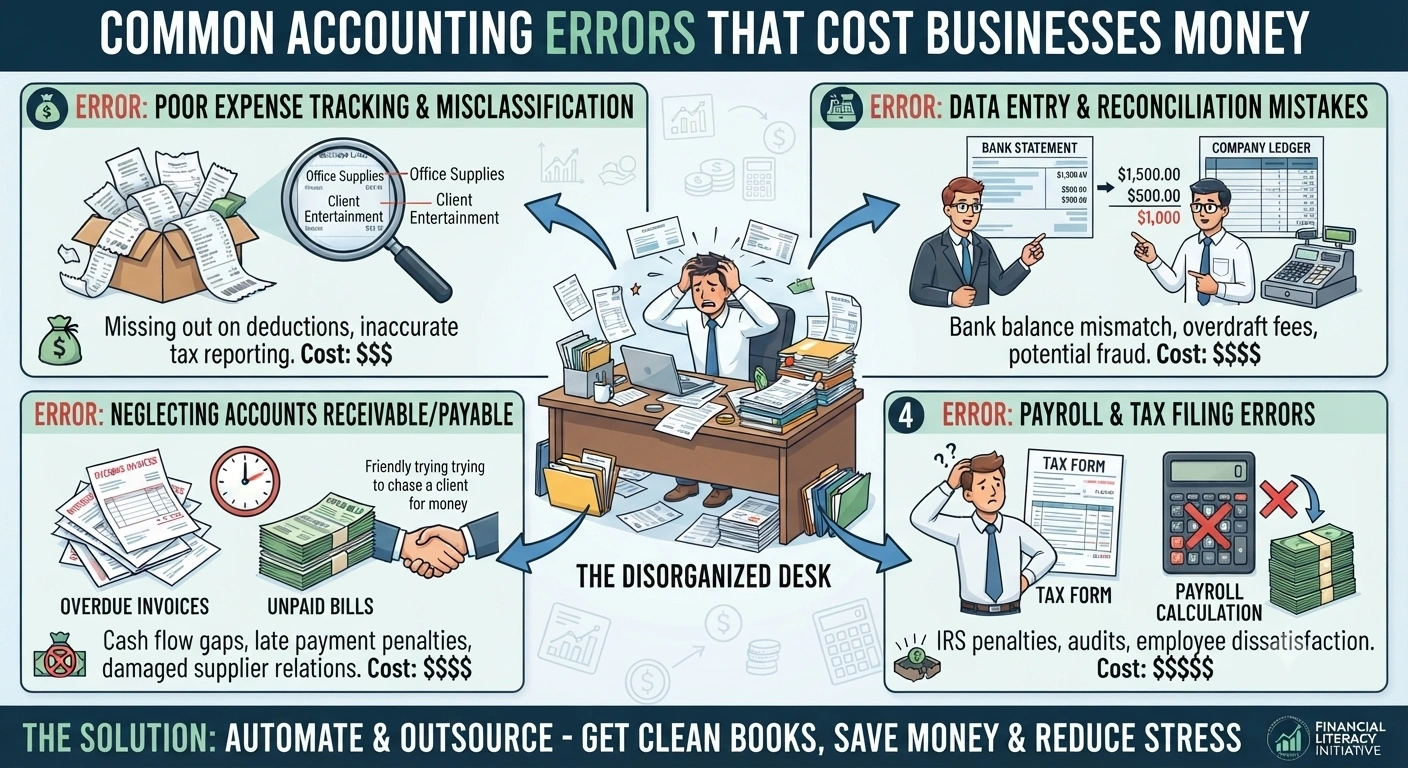
Common Accounting Errors That Cost Businesses Money
Why your numbers might be costing you more than you think
I've been working as a CA for over fifteen years, and I can tell you something with complete certainty: accounting errors aren't just about numbers being wrong. They cost real money. Lots of it. And the worst part? Most of these mistakes are completely preventable.
Every year, I see businesses lose thousands—sometimes lakhs—because of simple accounting slip-ups. A missed GST invoice here, a duplicate entry there, wrong expense categorization, mismatched bank reconciliations. These aren't small things. They add up fast and hit your profits hard.
The thing is, most business owners don't realize how much these errors cost until tax season hits or an audit happens. By then, it's too late to fix things quietly. You're either paying penalties, losing deductions, or both.
So what does this mean for you? It means you need to know what errors are happening in your business right now, before they become expensive problems.
Error #1: Not Reconciling Bank Accounts Monthly
Bank reconciliation is boring. I get it. But it's also where most accounting disasters start. And honestly, it's the easiest error to prevent.
Here's what happens: you don't match your books with your bank statement for two months, maybe three. Then you realize there's a ₹50,000 difference and you have no idea where it came from. Was it a duplicate deposit? A forgotten cheque? A bank error? Now you're stuck digging through months of transactions trying to find it.
And that's just the time cost. The real damage happens when:
- You miss fraud or unauthorized transactions
- You overstate your cash position and make bad business decisions
- You file wrong GST returns because your bank data doesn't match your books
- During audit, discrepancies look intentional rather than accidental
- You claim expenses that never actually cleared the bank
A client of mine, a small manufacturing business, didn't reconcile for six months. When they finally did, they found ₹2,35,000 in unmatched items. Turned out a vendor's cheque had bounced but they'd already recorded it as paid. Another cheque was deposited twice by mistake. The cleanup took three weeks and cost them in accounting fees.
Unreconciled accounts are red flags during tax audits. The income tax department sees them as signs of poor record-keeping or intentional manipulation. This can trigger deeper investigations.
Monthly reconciliation takes about 30-45 minutes if you do it right. It catches errors early, saves you from fraud, and makes tax time stress-free. That's a decent return on 45 minutes of your time.
Error #2: Mixing Personal and Business Expenses
This one drives me crazy. And I see it in almost every small business I work with.
You're a director. You buy office supplies but also grab groceries on the same trip. You pay for a client lunch and your family dinner at the same restaurant. You use your personal credit card for business expenses. Your personal car is sometimes used for business, sometimes personal. Where's the line?
The problem isn't that these things happen. The problem is when you try to claim all of it as business expenses. Or when you don't track which part is which.
Here's what it costs you:
- You can't claim the personal portion as a deduction—that's just lost tax savings
- If audited, the income tax department disallows your entire claim if you can't separate personal from business
- You overpay taxes because you're not claiming legitimate business expenses (because you're too confused to track them)
- Your financial statements look unreliable, which affects bank loans and investor confidence
- GST complications—if you claim GST input credit on mixed expenses, that's a serious compliance issue
A retail business owner I worked with was claiming his entire car maintenance as a business expense. Turns out he was using the car about 60% for business and 40% personal. He should've only claimed 60%. When the auditor caught this, not only did they disallow the personal portion, they also imposed a penalty because it looked intentional.
The fix? It's simple. Keep separate accounts. One personal, one business. If you must use personal money for business, track it carefully. And if you use business money for personal things, record it as a director's advance or personal withdrawal—not a business expense.
Error #3: Wrong or Missing GST Invoice Details
GST compliance is where I see the most expensive errors. And most of them are completely avoidable.
Businesses miss basic invoice details all the time. Wrong GSTIN. Missing invoice number. Incorrect tax rate. Missing HSN codes. Dates that don't match. And they don't realize it's a problem until they file their GST return and everything doesn't match up.
What happens then? Your GST return gets rejected. You file an amended return. You might face penalties. And if it's a recurring issue, the GST department gets suspicious. They might initiate an audit. That's time away from your business, accounting costs, and potential penalties.
But there's more. If you're claiming input tax credit (ITC) on invoices with wrong details, you can't claim it. That's money you've already paid that you can't get back.
I had a trading company that wasn't putting HSN codes on their invoices. They didn't think it mattered much. But when they tried to claim ITC on those purchases, the system flagged them. They lost about ₹1,80,000 in input credit because the invoices didn't match GST standards. And that's just the direct cost. Add in the time to fix it and the stress, and it was a costly mistake.
GST errors can trigger automatic notices from the system. If your invoices don't match your return, the GST department can demand explanations, penalties, and even interest on unpaid taxes. In 2026 and 2027, GST compliance checks are getting stricter.
The solution is straightforward. Make sure every invoice has the right information before you issue it. GSTIN, invoice number, date, HSN code, correct tax rate, customer details. Train your team on this. Use accounting software that has built-in GST checks. And before you file your return, match your invoices with your return data.
Error #4: Duplicate Entries and Data Entry Mistakes
You'd be shocked how often this happens. An invoice gets entered twice. A payment is recorded in two different places. A bank deposit shows up multiple times in your books.
Most of the time, nobody notices until reconciliation or audit. And by then, your entire financial picture is skewed.
Here's the real cost:
- Your profit is overstated, so you pay more income tax than you should
- Your GST return doesn't match your actual sales, triggering notices
- Your balance sheet is wrong, making it hard to get loans or investments
- During audit, it looks like careless bookkeeping (or worse, intentional manipulation)
- You waste time and money fixing the mess after the fact
A services company I worked with had their accountant enter a ₹5 lakh client payment twice. Nobody caught it for two months. By the time they found it, they'd already filed their GST return with inflated sales figures. They had to file an amended return, explain the error to the GST department, and deal with the administrative headache.
The best defense? Use accounting software that flags duplicate entries. Do regular reconciliation. Have a second person review large transactions. And train anyone entering data to be careful and double-check their work.
Error #5: Not Tracking Deductible Expenses
This one is sneaky because it's an error of omission, not commission. You're not doing something wrong—you're just not doing something at all.
Business expenses are deductible. That's the whole point of keeping records. But many business owners don't track them properly. They don't save receipts. They don't categorize expenses correctly. They forget about entire categories of spending that qualify for deduction.
And that costs them real money. If you're not claiming a deduction, you're not saving tax on it. Simple as that.
Common deductible expenses people miss:
- Professional fees (CA, lawyer, consultant)
- Training and professional development
- Software subscriptions and tools
- Travel for business purposes
- Depreciation on equipment and furniture
- Interest on business loans
A freelancer I know wasn't tracking his software subscriptions or online course expenses. He thought they were too small to matter. But when we calculated it for the year, he'd spent about ₹60,000 on these things. He'd been paying income tax on that ₹60,000 when he should've been able to deduct it. That's roughly ₹20,000 in extra taxes he didn't need to pay.
Tracking expenses properly isn't just about compliance. It's about saving money. Every deductible expense you claim reduces your taxable income. That directly reduces your tax bill. Missing deductions is like leaving money on the table.
Error #6: Incorrect Depreciation Calculations
Depreciation is confusing for a lot of people. So they either ignore it or calculate it wrong. Both are expensive mistakes.
When you buy equipment, furniture, machinery, or vehicles for your business, you can't deduct the entire cost in one year. You need to depreciate it over several years. The depreciation amount is deductible each year, which reduces your taxable income.
Get the calculation wrong and you either:
- Claim too much depreciation, which the income tax department disallows during audit
- Claim too little depreciation, which means you're paying more tax than you need to
- Don't claim depreciation at all, which is basically throwing away tax savings
- Create inconsistencies in your balance sheet that raise red flags during audit
The rates are fixed by the income tax department. Office equipment is 15%, vehicles are 15%, buildings are 5%, and so on. And the method matters too—you can use straight-line depreciation or written-down value method. Different methods give different results.
I had a manufacturing client who was depreciating their machinery at 10% when it should've been 15%. Over five years, that added up to about ₹3,50,000 in missed deductions. When the auditor caught it, they had to adjust their returns for previous years and pay interest on the underpaid taxes.
Error #7: Poor Documentation and Record Keeping
You don't need fancy systems. But you do need proper documentation. And this is where a lot of businesses fall short.
No receipts for expenses. No invoices for sales. Handwritten notes instead of proper records. Digital files scattered across different devices. Emails with transaction details instead of proper documentation.
When an auditor asks to see proof of an expense, and you can't show it, that expense gets disallowed. It doesn't matter if it's real. If you can't prove it, it doesn't count.
And that's just the direct cost. Poor documentation also means:
- You can't track cash flow accurately
- You can't identify where money is going
- You can't spot fraud or theft
- You can't prepare accurate financial statements
- You can't make good business decisions because your data is unreliable
The fix is straightforward. Get an accounting software. It doesn't have to be expensive. Even basic software keeps records organized. Save all receipts and invoices. Keep them for at least seven years. Organize them by category. And make sure your records match your bank statements.
| Error Type | Cost Impact | Prevention Method |
|---|---|---|
| Unreconciled Bank Accounts | Fraud, missed deductions, audit issues | Monthly reconciliation |
| Mixed Personal/Business Expenses | Lost deductions, penalties, disallowed claims | Separate accounts, clear tracking |
| Wrong GST Invoice Details | Lost ITC, GST notices, penalties | Invoice verification before issue |
| Duplicate Entries | Overstated profit, extra taxes | Software checks, regular reconciliation |
| Missed Deductible Expenses | Overpaid taxes, lost savings | Systematic expense tracking |
| Wrong Depreciation | Audit disallowances, interest on unpaid tax | Use correct tax rates and methods |
Error #8: Ignoring Compliance Deadlines
Deadlines are deadlines. Miss them and it costs you money. Simple as that.
GST return filing deadlines. Income tax return filing deadlines. MCA compliance deadlines. Audit deadlines. Miss any of these and you're looking at penalties. And the penalties add up fast.
Here's what happens when you miss deadlines:
- GST penalties: ₹100 to ₹5,000 per month for late filing
- Income tax penalties: Up to 50% of the tax payable if you file late
- Interest: Charged on any unpaid tax from the due date until you pay
- Prosecution risk: In serious cases, late filing can lead to legal action
- Credit impact: Banks and lenders see late filings as red flags
A small business owner I worked with missed his GST filing deadline by just one week. He thought it wasn't a big deal. But the penalty was ₹2,500. And since he missed it again the next month, it was another ₹2,500. Over a year, those small penalties added up to ₹30,000 in unnecessary costs.
In 2026 and 2027, compliance enforcement is getting stricter. The income tax department and GST authorities are using automated systems to track late filings. Penalties are being imposed automatically. You can't negotiate your way out of them anymore.
The solution is to mark all deadlines in your calendar. Better yet, set reminders two weeks before the deadline. And if you're not sure about deadlines, talk to your CA. That's what we're here for.
How to Fix These Errors: A Practical Action Plan
Knowing about these errors is one thing. Fixing them is another. Here's what you need to do:
Step 1: Audit Your Current Records
Look at your books right now. Are your bank accounts reconciled? Are there duplicate entries? Are personal and business expenses mixed? Do your invoices have all the right details? Be honest about what you find.
Step 2: Get the Right Tools
You don't need expensive software. But you need something. Tally, QuickBooks, Zoho Books, or even Excel if you're very disciplined. Something that keeps records organized and helps you reconcile regularly.
Step 3: Document Everything
Save every receipt. Every invoice. Every bank statement. Organize them. Keep them for seven years. Make this a habit, not a one-time thing.
Step 4: Train Your Team
If you have staff handling finances, train them on proper procedures. Show them how to enter data correctly. Show them what details are needed on invoices. Make sure they understand why accuracy matters.
Step 5: Set Up Regular Reviews
Don't wait until year-end to look at your books. Review them monthly. Reconcile accounts. Check for errors. Fix them right away while they're fresh.
Step 6: Get Professional Help
Talk to a CA. Even if it's just once a year, get a professional review of your books. We can spot errors you might miss. We can help you set up systems that prevent errors. And we can help you understand tax implications before they become problems.
Frequently Asked Questions
Q: How much do accounting errors typically cost a business?
A: It varies wildly. A small duplicate entry might cost you a few hundred rupees in wasted time. But systematic errors like not tracking deductions or wrong depreciation can cost you lakhs in missed tax savings and penalties. I've seen businesses lose between ₹50,000 to ₹5,00,000 per year because of preventable errors. The real cost depends on the size of your business and how long the error goes unnoticed.
Q: What's the most common accounting error you see?
A: Hands down, it's not reconciling bank accounts regularly. And closely behind that is mixing personal and business expenses. These two errors are in almost every small business I work with. The good news is they're also the easiest to fix.
Q: Can I fix old errors in my books?
A: Yes, but it's complicated. You can't just change past records without explaining why. If the error is in a previous year's return that's already been filed, you'll need to file an amended return. The income tax department might ask questions about why you're changing it. That's why prevention is so much better than cure. Fix errors now rather than dealing with them later.
Q: How often should I reconcile my accounts?
A: Monthly is the standard. If you have high transaction volume, do it weekly or even daily. The more frequently you reconcile, the easier it is to spot errors because there are fewer transactions to review. And errors are easier to fix when they're recent.
Q: What's the penalty for GST invoice errors?
A: It depends on the error and whether it's intentional. For missing details on invoices, you might lose the right to claim input credit. For wrong tax rates, you might owe additional tax plus interest. The GST department can also impose penalties up to ₹25,000 per invoice in serious cases. That's why getting invoice details right the first time is so important.
Q: Do I need an accountant if I use accounting software?
A: Software helps, but it doesn't replace professional judgment. Software can't tell you if you're claiming the right depreciation rate. It can't spot suspicious transactions. It can't help you plan for tax efficiency. What it does is keep your records organized. But you still need someone who understands tax law and compliance to make sure everything is correct. That's where a CA comes in.
Bottom Line: Prevention is Cheaper Than Cure
I've been doing this for a long time, and here's what I know for certain: the businesses that spend a little time and money on proper accounting from day one end up saving a lot of money in the long run.
The businesses that ignore accounting until something breaks? They end up paying penalties, interest, and professional fees to fix the mess. And that's if they're lucky. If they're unlucky, they face audit investigations and legal issues.
The errors I've talked about in this article aren't complicated. They're not hard to prevent. They just require discipline and the right systems. Monthly bank reconciliation. Separate accounts. Proper documentation. Regular reviews. And when you're not sure, ask a professional.
Do these things and you'll avoid the costly mistakes that hurt so many businesses. And you'll have clean, accurate books that give you confidence in your financial position.
That's worth the effort. Trust me on this.
" } ```
© 2026 Tax Esquire | Expert CA Services in Greater Noida, Uttar Pradesh
8810380146 | info.taxesquire@gmail.com | taxesquire.in
This document is for informational purposes only. For personalised tax advice, consult our chartered accountants.