GST Notice Received? What to Do Next — Complete Step-by-Step Guide
GST Notice Received? What to Do Next
A practical guide to understanding GST notices and taking the right action immediately
Getting a GST notice can feel like a punch in the gut. Your heart races. Your mind starts spinning through possibilities. Did something go wrong with my returns? Am I in trouble? But here's the thing—most GST notices aren't as scary as they feel at first. The key is knowing exactly what to do when that notice lands in your email or GSTN portal.
I've helped hundreds of business owners and accountants navigate GST notices over the past few years. And honestly, the difference between those who handle it well and those who panic comes down to one thing: they know the process. So let me walk you through it, step by step.
What Exactly Is a GST Notice?
A GST notice is basically the tax authority saying they want to talk to you about something in your GST filings, returns, or compliance. It's not an arrest warrant. It's not a penalty. It's a notice.
The GST department issues notices for many reasons. Maybe there's a mismatch between what you reported and what a supplier reported. Maybe your ITC (Input Tax Credit) claim looks unusual. Maybe they're just doing a routine audit. Whatever the reason, a notice gives you the chance to explain your side before anything serious happens.
Think of it like this—a notice is the authority knocking on your door and asking questions. It's not them breaking down the door. So breathe. You have time and options.
Types of GST Notices You Might Get
Not all GST notices are the same. Understanding which type you got is the first step to responding correctly. So let me break down the main ones you're likely to encounter.
| Notice Type | What It Means | Response Timeline |
|---|---|---|
| Section 62 Notice (Demand Notice) | Authority believes you owe GST and is asking you to pay | 30 days from receipt |
| Section 61 Notice (Show Cause) | Authority wants you to explain why they shouldn't demand GST | 30 days from receipt |
| Section 67 Notice (Audit Notice) | Authority is conducting a routine audit of your records | As per notice / within 30 days usually |
| Section 63 Notice (ITC Denial) | Authority says your input tax credit claim is wrong | 30 days from receipt |
| Section 33 Notice (Mismatch) | Mismatch between your claim and supplier's report | 15 days to reconcile or respond |
Each notice type requires a different response strategy. A demand notice needs fast action. An audit notice needs proper documentation. A show cause notice needs a detailed explanation. So the first thing you do is identify exactly which notice you got.
Your Immediate Action Plan (First 24 Hours)
When you get a GST notice, your first instinct might be to panic or ignore it. Don't do either. Instead, take these steps right now.
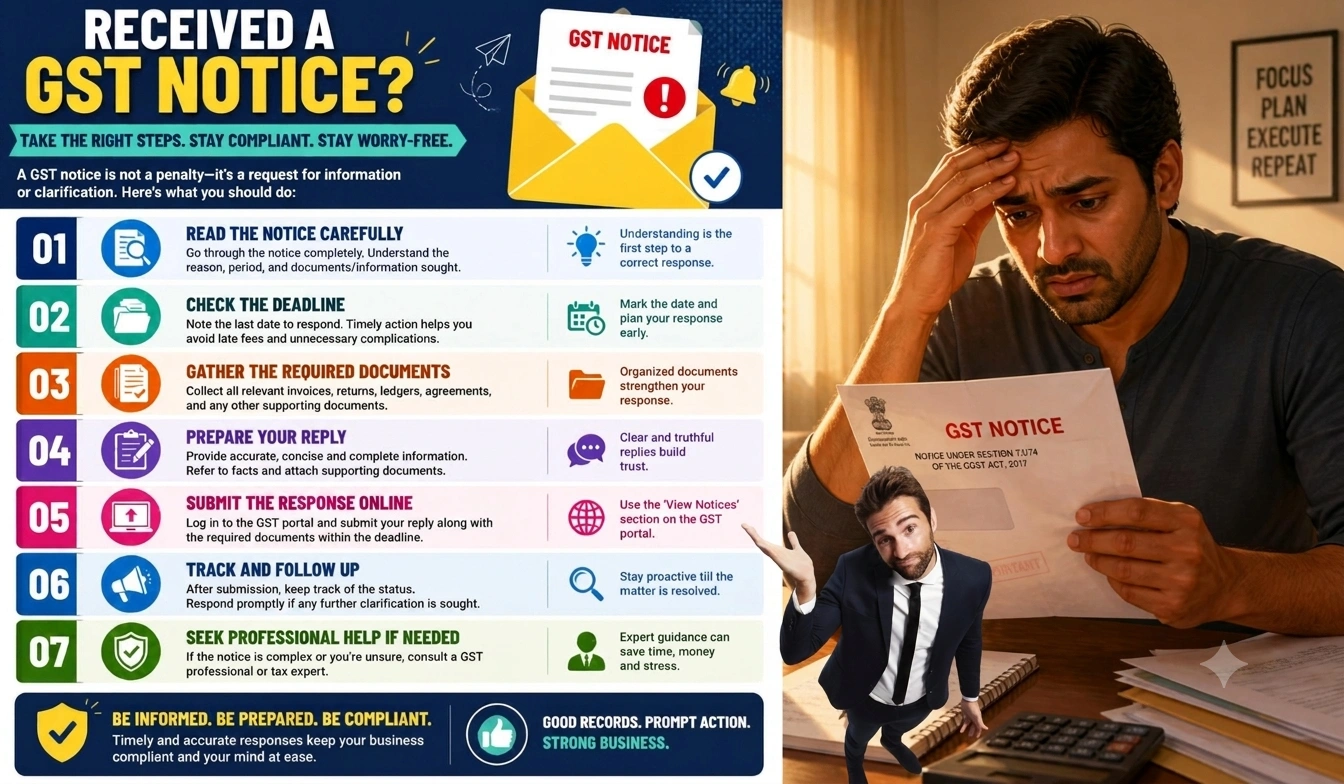
- Read the notice carefully. Don't skim it. Read every word. Understand exactly what the authority is saying and what they're asking for.
- Check the timeline. Look at the due date for your response. Mark it on your calendar. Add a reminder 5 days before the deadline.
- Identify the issue. What's the notice about? ITC mismatch? Missing invoices? Demand for unpaid GST? Understanding the core issue helps you respond correctly.
- Gather your paperwork. Find your GST returns, invoices, payment records, and any other relevant documents. Don't wait. Do this today.
- Don't respond immediately. I know you want to reply right away. But take a day to think. A rushed response often makes things worse.
- Contact a CA or GST expert. If the notice is complex, get professional help now. Don't wait until the last week.
Ignoring a GST notice is one of the worst things you can do. The authority can then issue a demand notice with interest and penalties. In some cases, they can even initiate prosecution. Don't ignore it—ever.
Understanding the Real Issue Behind the Notice
Here's what most people don't realize—the notice itself isn't always the real problem. The real problem is usually something specific that triggered the notice. And if you don't understand that trigger, your response will miss the mark.
Let me give you an example. Say you get a Section 33 notice about an ITC mismatch. Your supplier reported a sale to you for ₹1 lakh with 18% GST. But you claimed ITC on only ₹50,000. The authority is asking—why the mismatch? Now, maybe your supplier made an error. Maybe you only partially received the goods. Maybe the invoice was for a different entity. Whatever it is, you need to dig into that specific issue and explain it clearly.
So before you write your response, ask yourself: What's the actual discrepancy here? Why did the authority flag this? What documents do I have to back up my position?
Step-by-Step Response Process
Step 1: Gather All Relevant Documents
You can't respond to a notice without evidence. So start by collecting everything related to the issue mentioned in the notice. This includes invoices, delivery notes, payment receipts, bank statements, GST returns, correspondence with suppliers or customers, and any other supporting paperwork.
Organize these documents chronologically. Create a folder with clear labeling. When the authority asks for something, you want to be able to find it in seconds, not hours.
Step 2: Analyze the Notice and Identify Errors
Now read the notice again, but this time with your documents in front of you. Check if the authority has made any factual errors. Maybe they've misquoted an amount. Maybe they've cited a wrong invoice. Maybe they've misunderstood the nature of the transaction. These errors matter. If you find them, you'll highlight them in your response.
But be honest with yourself too. If the authority is right about something, acknowledge it. Trying to hide or deny a genuine error only makes you look bad.
Step 3: Prepare Your Response
Your response should be clear, concise, and factual. Write it like you're explaining to a reasonable person, not a machine. Here's the structure that works:
- Opening: Thank the authority for the notice and confirm you've received it.
- Summary of Facts: Briefly explain what happened, when it happened, and who was involved.
- Your Position: Explain why you believe your GST treatment was correct.
- Supporting Evidence: Reference the documents you're attaching. Be specific—"As per Invoice No. XYZ dated..."
- Conclusion: Request that the authority close the case or take the action you're seeking.
Step 4: Attach Supporting Documents
Don't just mention documents in your response—actually attach them. Make copies of invoices, delivery notes, payment proofs, and any other relevant paperwork. Number them clearly so the authority can reference them easily. Create an index at the beginning listing all attachments.
The more organized you are, the more credible you look.
Step 5: Submit Before the Deadline
Now here's the critical part—submit your response before the deadline. Not on the deadline. Before it. Because if you submit on the last day and there's a technical glitch, you're out of luck. Submit at least 2-3 days before the due date.
Check the notice to see how you should submit. Most notices allow email submission to the officer's email address or through the GSTN portal. Keep a copy of your submission for your records. If you're submitting by email, ask for a read receipt.
Submitting early shows the authority you're taking the matter seriously. It also gives them time to review your response and reach out if they need clarification, rather than just rejecting it on procedural grounds.
Common GST Notice Issues and How to Handle Them
ITC Mismatch Notices
These are the most common notices. Your supplier reported a sale to you. You claimed ITC on it. But something doesn't match—amount, invoice number, date, whatever. And the authority wants to know why.
The best response here is to either match the claim with the supplier's report or explain why there's a legitimate difference. For example, maybe you returned part of the goods. Maybe the invoice was for a different entity. Maybe there was a credit note. Whatever the reason, document it clearly.
Demand Notices for Unpaid GST
A demand notice means the authority believes you owe GST and is asking you to pay it. This is more serious. Your options are limited. You can either:
- Pay the amount if it's correct.
- File an appeal if you disagree with the demand.
- Request a hearing to explain your position.
If you're going to appeal, do it quickly. The appeal timeline is strict, and missing it means the demand becomes final.
Audit Notices
An audit notice is the authority's way of saying they want to examine your books and records in detail. This isn't necessarily bad. Many audits end with no action if your records are in order.
For an audit, your response is mainly about cooperation. Provide the documents they ask for. Be available for the audit meeting. Answer their questions honestly. If they find issues, address them promptly.
What Happens After You Respond?
So you've submitted your response. Now what? The authority will review it. This can take anywhere from a few weeks to a few months depending on the complexity and their workload.
There are three possible outcomes. First, the authority accepts your response and closes the case. This is the best outcome. Second, they find your response incomplete or unconvincing and ask for more information. Third, they reject your response and issue a demand or penalty.
If they ask for more information, respond promptly. If they issue a demand or penalty, that's when you consider filing an appeal. But let's be honest—getting it right the first time is always better than appealing later.
Don't assume silence means approval. If you don't hear back within a reasonable timeframe, follow up with the authority. Send a letter asking for the status of your case. Keep records of all your follow-ups.
Your Rights When You Get a GST Notice
Here's something important—you have rights. The authority can't just do whatever they want. And knowing your rights helps you respond more confidently.
- You have the right to reasonable time to respond to a notice. The law says 30 days minimum for most notices.
- You have the right to ask for an extension if you need more time. Just request it in writing before the deadline.
- You have the right to be heard before any demand or penalty is issued. The authority must give you a fair chance to explain.
- You have the right to appeal any decision you disagree with. Appeals go to the Appellate Authority for Advance Ruling or the GST Appellate Tribunal.
- You have the right to legal representation. You can hire a CA or lawyer to help you respond.
And that's really it. You're not helpless. You have options and protections.
When Should You Hire a Professional?
Not every GST notice needs a CA. Some are straightforward and you can handle them yourself. But some definitely need professional help. Here's when you should call someone:
- The notice involves a large amount of GST or a complex transaction structure.
- You don't understand what the notice is asking for.
- The issue involves multiple entities or multiple states.
- You've already received penalties or this is your second notice on the same issue.
- You're considering filing an appeal.
A good CA will help you understand the issue, gather the right documents, draft a strong response, and represent you if needed. The fee you pay is usually worth it compared to the cost of getting it wrong.
Real Example: How a Mismatch Notice Gets Resolved
Let me walk you through a real scenario so you can see how this plays out in practice.
Suppose you're a retailer who bought goods from a supplier on 15th January 2026. The invoice amount was ₹1,00,000 with 18% GST (₹18,000). You received the goods and claimed ITC of ₹18,000 in your GSTR-3B for January 2026.
But your supplier made a mistake. They reported the sale as ₹50,000 with 18% GST (₹9,000) in their GSTR-1 for January 2026. Now there's a mismatch. You claimed ₹18,000 but the supplier reported only ₹9,000. The authority sends you a Section 33 notice asking you to explain.
Here's what you do. You contact your supplier immediately and ask them to file a corrected GSTR-1 showing the correct amount of ₹1,00,000 and ₹18,000 GST. Once they do that, the mismatch is resolved on the GSTN system automatically. You then respond to the authority's notice, attach a copy of the corrected GSTR-1, and explain that the mismatch was due to the supplier's initial error which has now been corrected.
The authority reviews this, sees that the mismatch is now resolved, and closes the case. Done.
See how it works? The key was identifying the root cause (supplier's error), fixing it (corrected GSTR-1), and explaining it clearly to the authority.
How to Avoid GST Notices in the Future
Once you've dealt with one notice, you'll want to make sure you don't get another. So let me share some best practices that'll keep you off the authority's radar.
- File returns on time. Don't wait until the last day. File them early so any errors can be corrected before the due date passes.
- Match your invoices with your suppliers and customers. Make sure what you claim as ITC matches what your suppliers report as sales. This is the biggest source of notices.
- Keep detailed records. Maintain proper documentation for every transaction. Invoices, delivery notes, payment proofs, bank statements—keep them all organized.
- Reconcile your accounts regularly. Don't wait for year-end. Reconcile your GST accounts monthly. This helps you catch mismatches early.
- Communicate with your suppliers. If they're making errors in their reporting, tell them. Most suppliers are willing to file corrections if you point out the issue.
- Get professional help if needed. If you're not confident about GST compliance, hire a CA to review your returns before you file them.
Frequently Asked Questions
Q1: If I get a GST notice, does that mean I'm in legal trouble?
Not necessarily. A notice is just the authority asking questions. It doesn't mean you've done anything wrong. Many notices get closed without any penalty. The key is responding promptly and honestly.
Q2: What's the difference between a show cause notice and a demand notice?
A show cause notice (Section 61) is asking you to explain why the authority shouldn't demand GST from you. It's giving you a chance to respond before they make a final decision. A demand notice (Section 62) is the authority's final decision—they're saying you owe GST and asking you to pay. A demand notice is more serious.
Q3: Can I extend the deadline for responding to a GST notice?
Yes. If you need more time, write to the authority before the deadline and ask for an extension. Most authorities will grant you 15-30 additional days if you have a reasonable reason. But don't wait until the last day to ask. Ask early.
Q4: What happens if I don't respond to a GST notice by the deadline?
If you don't respond, the authority can proceed with their own assessment and issue a demand notice with interest and penalties. In serious cases, they can even start prosecution proceedings. So not responding is really not an option. Always respond, even if you're not sure about your position.
Q5: Can I appeal a GST notice or a demand issued based on it?
Yes. If you disagree with a demand notice or the authority's decision on your response, you can file an appeal within 30 days. The appeal goes to the Appellate Authority for Advance Ruling (AAAR) or the GST Appellate Tribunal depending on the issue. But appeals take time and money, so try to get it right in your initial response.
Q6: Do I need a lawyer to respond to a GST notice?
You don't legally need a lawyer, but a CA with GST expertise is usually more helpful than a lawyer for GST notices. A CA understands the technical GST issues better. That said, if the case is complex or involves potential criminal liability, having a lawyer on the team is smart.
Q7: How long does it take for the authority to respond after I submit my response?
It varies. Simple cases might get resolved in 4-6 weeks. Complex cases can take 3-6 months or even longer. Don't assume silence means approval. If you haven't heard back after 2-3 months, send a follow-up letter asking for the status.
Key Takeaways
Let me summarize the main points so you've got a clear action plan:
- A GST notice isn't a death sentence. It's the authority asking questions. Stay calm and respond thoughtfully.
- Identify the type of notice you got. Different notices need different responses.
- Respond before the deadline. Not on the deadline. Before it. Early submission shows seriousness.
- Gather all relevant documents and organize them clearly. Evidence is your best friend.
- Explain your position clearly and factually. Don't get defensive or argumentative.
- If the notice is complex, get help from a CA. The investment usually pays off.
- Know your rights. You have the right to respond, the right to be heard, and the right to appeal.
Final Thoughts
Getting a GST notice is stressful. I get it. But it's not the end of the world. Thousands of businesses get notices every year and resolve them successfully. The difference between those who handle it well and those who struggle is knowledge and action.
Now you have that knowledge. You know what a notice is, what types exist, how to respond, and what your rights are. So when you get a notice—and hopefully you won't—you'll know exactly what to do. You'll stay calm, you'll respond properly, and you'll likely resolve it without major issues.
And if you're reading this because you already have a notice sitting in your inbox, here's my advice: Don't wait. Start gathering your documents today. Review the notice carefully. And if you're not 100% sure about how to respond, call a CA. Better to invest a few thousand rupees now than to handle it wrong and pay much more later.
You've got this. Take action today.
© 2026 Tax Esquire | Expert CA Services in Greater Noida, Uttar Pradesh
8810380146 | info.taxesquire@gmail.com | taxesquire.in
This document is for informational purposes only. For personalised tax advice, consult our chartered accountants.