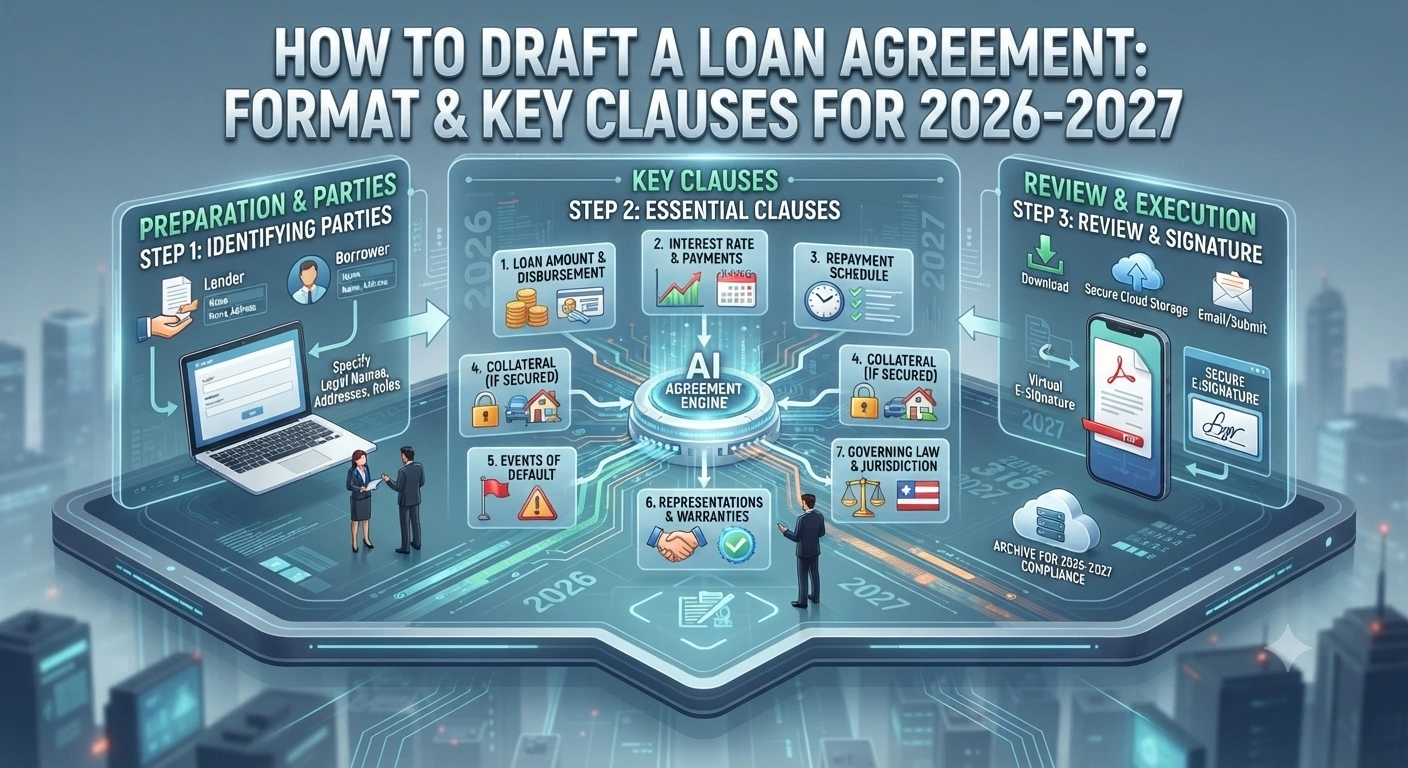
How to Draft a Loan Agreement: Format & Key Clauses for 2026-2027
How to Draft a Loan Agreement
Master the art of creating binding, legally sound loan agreements with our complete 2026-2027 guide
Why You Need a Proper Loan Agreement
Look, here's the thing: most people think a loan agreement is just a piece of paper. But it's actually your safety net. When money changes hands between two people or organizations, things can get messy fast. A written loan agreement protects both sides—the person lending the money and the person borrowing it.
Think about it this way. Without a proper agreement, you're left with nothing but a handshake and broken promises. Courts won't help you because there's no proof of what was actually agreed upon. So what does this mean for you? It means you need a solid, well-drafted loan agreement before any money moves.
And that's really it—a loan agreement is your insurance policy. It spells out everything clearly so nobody can claim they forgot what was promised.
A written loan agreement protects both lender and borrower by creating a legal record of all terms, reducing disputes and enforcing repayment obligations through courts if needed.
Essential Components of a Loan Agreement
Every loan agreement needs certain key pieces. Without them, the agreement isn't worth much. Let me walk you through each one.
1. Parties to the Agreement
First, you need to identify who's involved. Put simply, this is the lender and the borrower. Include their full legal names, addresses, and any business registration numbers if they're companies. Be specific here—don't use nicknames or shortened versions. If the borrower is a business, mention whether it's a partnership, sole proprietorship, or private limited company.
And if there are co-borrowers or guarantors, list them all. Each person should sign the agreement.
2. Loan Amount and Currency
State the exact amount being lent. Write it in both words and numbers to avoid confusion. For example: "Five Lakh Rupees (₹5,00,000) only." Always specify the currency. If it's a foreign currency loan, mention the exchange rate as on a specific date.
This section should also say whether the loan is being given in one lump sum or in installments. If it's installments, spell out the schedule clearly.
3. Interest Rate and Calculation Method
The interest rate is critical. Specify whether it's a fixed rate or a floating rate. For fixed rates, state it clearly: "The loan will carry a fixed interest rate of 10% per annum." For floating rates, mention what index it's linked to—like MCLR (Marginal Cost of Funds Based Lending Rate) or a bank's prime lending rate.
Explain how interest gets calculated. Is it simple interest or compound interest? Is it calculated monthly, quarterly, or annually? Put in an example so both parties understand exactly what they're paying.
Under the Usurious Loans Act and RBI guidelines, interest rates beyond a certain threshold may be challenged in court. Always ensure your rate is reasonable and documented properly.
4. Repayment Terms and Schedule
How will the borrower repay this loan? Monthly? Quarterly? As a lump sum at the end? Create a detailed repayment schedule. Include the due date for each payment, the amount due, and how much goes toward principal versus interest.
Be super clear about this. A sample table works best here. Show exactly what's due when. If there's a grace period before repayment starts, mention it explicitly.
5. Disbursement Terms
When does the lender actually hand over the money? Is it immediate after signing? Is it conditional on certain documents being provided? For example, if it's a home loan, the bank might release funds only after the property documents are verified.
Spell out any conditions that must be met before money is released. This protects the lender from giving money to someone who doesn't qualify.
6. Security or Collateral
If the loan is secured, what's backing it? A house? A car? Jewelry? Describe the collateral in detail—make, model, location, value, any registration numbers. If it's immovable property, include the survey number and land details.
State how the collateral is being held. Is the lender taking physical possession? Or is it staying with the borrower but registered as a charge in favor of the lender?
Critical Clauses Every Loan Agreement Needs
Beyond the basics, certain clauses protect both parties. These aren't optional—they're really important.
Default and Late Payment Clause
What happens if the borrower misses a payment? Define default clearly. Is it one missed payment? Or two? What's the grace period—say, 10 days after the due date?
Then spell out the consequences. Will there be a late fee? How much? Some agreements charge 2-5% of the due amount. Others charge a fixed amount. Make it clear so there's no argument later.
- Grace period: 10 days from due date
- Late payment fee: 2% of the overdue amount
- After 30 days default: lender can take legal action
- After 60 days default: lender can seize collateral
- Interest continues to accrue on overdue amounts
Prepayment and Early Closure Clause
Can the borrower pay off the loan early? Most agreements allow this, but some charge a penalty. Be transparent about it. If there's a prepayment penalty, state it as a percentage or fixed amount. For example: "If the loan is prepaid before 3 years, a 2% prepayment penalty will be charged on the outstanding principal."
Some lenders don't charge any penalty. That's fine too—just say so clearly.
Representations and Warranties
Both parties make promises here. The borrower promises they have the right to borrow this money and that the information they've provided is true. The lender promises the money is theirs to lend.
Put in specific promises. For example: "The borrower represents that they are the sole owner of the collateral and have the right to pledge it as security."
Covenants (Borrower's Obligations)
What must the borrower do while the loan is active? Maintain the collateral? Keep insurance on it? Not sell it without permission? List all obligations.
- Maintain insurance on the collateral
- Not sell or transfer the collateral without lender's written consent
- Keep the collateral in good condition
- Pay all property taxes and maintenance costs
- Allow the lender to inspect the collateral periodically
- Inform the lender of any legal action against the collateral
Acceleration Clause
This clause says that if the borrower defaults, the entire remaining loan amount becomes due immediately. Without this, the lender would have to wait for each payment date to pass before taking action. With acceleration, they can demand the full amount right away.
Example: "Upon default of any payment, the entire outstanding loan amount, including accrued interest, shall become immediately payable."
Dispute Resolution and Jurisdiction
If there's a disagreement, where will it be resolved? In which court? Under which state's laws? Specify this clearly. For example: "This agreement shall be governed by the laws of India and the courts of Mumbai shall have exclusive jurisdiction."
You might also include arbitration clauses if both parties prefer that over court battles.
Clear dispute resolution clauses save both parties time and money by avoiding lengthy court battles. Arbitration can be faster and more confidential than litigation.
Compliance Requirements for 2026-2027
If you're lending money in India, you need to follow certain rules. The RBI has guidelines, and so do various state laws. Let me break this down.
Income Tax Compliance
If you're giving a loan to a friend or family member, you might think there's no tax issue. But there is. Under Section 269SS of the Income Tax Act, if you lend more than ₹50,000 in cash to anyone, it's not allowed. The entire amount becomes income for the recipient.
So always lend by cheque or bank transfer. Keep records. If there's interest involved, the lender must report it as income and the borrower can claim it as a deduction.
Stamp Duty
Loan agreements need to be stamped. The stamp duty depends on the loan amount and your state. In Maharashtra, for example, the duty ranges from ₹100 for loans up to ₹5 lakhs to higher amounts for bigger loans. In some states, it's a percentage of the loan amount.
Get the agreement stamped at your state's stamp office. An unstamped agreement can't be used as evidence in court. So don't skip this.
Unstamped or inadequately stamped loan agreements are not admissible as evidence in court. You may also face penalties for non-compliance with stamp duty laws in your state.
GST Implications
If you're a registered GST dealer and you're lending money as part of your business, GST might apply. For example, if you charge processing fees or documentation fees, those could be taxable services. But simple interest on loans isn't GST-taxable.
Get advice from a CA if you're unsure. The rules can be tricky.
RBI Guidelines for Non-Banking Lenders
If you're not a bank but you're lending money regularly, you might be classified as a non-banking financial company (NBFC). The RBI has strict rules for NBFCs. You need to register, maintain certain capital ratios, and follow lending guidelines.
If you're just lending to family or friends occasionally, you're probably fine. But if it's a business, get proper registration.
Step-by-Step Guide to Drafting Your Loan Agreement
Now let's put it all together. Here's how to actually write the agreement.
Step 1: Gather Information
Before you write anything, collect all the details. Full names and addresses of both parties. Exact loan amount. Interest rate. Repayment schedule. Details of any collateral. Any special conditions. Write it all down.
Step 2: Use a Template or Hire a Lawyer
You can find loan agreement templates online. But honestly? For anything substantial, hire a lawyer. A good lawyer costs a few thousand rupees but saves you lakhs in legal trouble later.
If you're using a template, customize it. Don't just copy-paste. Make sure every clause fits your specific situation.
Step 3: Draft and Review
Write out the agreement clearly. Use simple language. Avoid legal jargon where possible. If you do use legal terms, explain them. Read it multiple times. Ask yourself: would a regular person understand this?
Have both parties review it. Discuss any concerns. Make changes if needed.
Step 4: Get It Stamped
Take the final agreement to your state's stamp office. Pay the required stamp duty. Get the official stamp applied. This makes it legally valid.
Step 5: Sign and Execute
Both parties sign the agreement in front of witnesses. Ideally, have two witnesses who are not related to either party. Each person gets a copy. Keep the original in a safe place.
If it's a big loan, consider getting it registered at the sub-registrar's office. This creates an official record.
Common Mistakes to Avoid
So what mistakes do people make? Let me tell you the big ones.
| Mistake | Why It's Bad | How to Fix It |
|---|---|---|
| Vague loan amount | Parties disagree on exact amount | Write in words and numbers, specify currency |
| No repayment schedule | Nobody knows when payment is due | Create detailed schedule with dates and amounts |
| Unclear interest calculation | Disputes over how much interest is owed | Spell out method, give examples with numbers |
| No default clause | Lender has no recourse if payment is missed | Include clear default definition and consequences |
| Unstamped agreement | Can't be used in court, penalties apply | Get stamped at stamp office before signing |
| Handwritten agreement | Harder to prove authenticity, looks unprofessional | Type it up, print it, sign printed copies |
Sample Loan Agreement Format
Here's what a basic loan agreement looks like. You can use this as a starting point.
LOAN AGREEMENT
This Loan Agreement is entered into on [DATE] between [LENDER NAME], hereinafter called "the Lender," and [BORROWER NAME], hereinafter called "the Borrower."
WHEREAS: The Lender agrees to lend and the Borrower agrees to borrow the sum of [AMOUNT IN WORDS] (₹[AMOUNT IN NUMBERS]) on the terms and conditions mentioned herein.
NOW IT IS HEREBY AGREED:
1. Loan Amount: The Lender shall disburse ₹[AMOUNT] to the Borrower on [DISBURSEMENT DATE].
2. Interest: The loan shall carry a fixed interest rate of [RATE]% per annum, calculated [MONTHLY/QUARTERLY/ANNUALLY].
3. Repayment: The Borrower shall repay the loan in [NUMBER] installments of ₹[AMOUNT] each, due on [DATES].
4. Security: The loan is secured by [DESCRIPTION OF COLLATERAL].
5. Default: If the Borrower fails to pay any installment within 10 days of the due date, a late fee of 2% shall be charged.
6. Prepayment: The Borrower may prepay the loan without penalty.
IN WITNESS WHEREOF, both parties have signed this agreement on the date first written above.
[LENDER SIGNATURE] [BORROWER SIGNATURE]
Witnesses: [WITNESS 1] [WITNESS 2]
Frequently Asked Questions
Q1: Is a verbal loan agreement enforceable in Indian courts?
Not really. Under the Indian Evidence Act, verbal agreements are tough to prove. You'd need witnesses to testify about what was said. But with a written agreement, you've got proof. Courts prefer written documents. So always get it in writing, even for small loans between family members.
Q2: What's the difference between a promissory note and a loan agreement?
A promissory note is simpler—it's basically a promise to pay. A loan agreement is more detailed. It includes interest rates, repayment schedules, collateral details, and all the clauses we talked about. For anything more than a small personal loan, use a full agreement, not just a note.
Q3: Do I need a lawyer to draft a loan agreement?
For small loans, you might get away with a template. But for anything substantial—a home loan, business loan, or loan with complex terms—hire a lawyer. It costs a bit upfront but protects you from costly mistakes later. A lawyer knows local laws and can spot issues you'd miss.
Q4: Can I charge any interest rate I want?
Not exactly. While there's no legal cap on interest rates, courts can reduce rates that seem unreasonably high. The Usurious Loans Act lets courts challenge rates that are "unconscionable." A good rule of thumb is to stay within 12-18% per annum for personal loans. Anything higher might be questioned.
Q5: What happens if the borrower dies before repaying the loan?
The loan becomes a liability of the borrower's estate. The lender can claim against the estate. That's why collateral is important—if the loan is secured by property, the lender can seize it. If there's no collateral and no money in the estate, the lender might not recover anything. Consider life insurance for big loans.
Q6: Is registration of a loan agreement compulsory?
Not always. Stamping is compulsory. Registration is optional but recommended for big loans or loans secured by immovable property. Registration creates an official record and strengthens your claim. It costs a bit but is worth it for peace of mind.
Key Takeaways for 2026-2027
- A written loan agreement protects both lender and borrower by creating a legal record
- Include all essential components: parties, loan amount, interest rate, repayment schedule, and security details
- Add critical clauses for default, prepayment, representations, and dispute resolution
- Follow compliance requirements including stamp duty, income tax rules, and RBI guidelines
- Never lend cash amounts over ₹50,000 to anyone—use cheque or bank transfer
- Always get the agreement stamped before signing
- For substantial loans, hire a lawyer to draft the agreement
- Keep detailed records of all transactions and communications
" } ```
© 2026 Tax Esquire | Expert CA Services in Greater Noida, Uttar Pradesh
8810380146 | info.taxesquire@gmail.com | taxesquire.in
This document is for informational purposes only. For personalised tax advice, consult our chartered accountants.