Tax Planning Strategies for Indian Businesses in 2026: A CA's Complete Guide
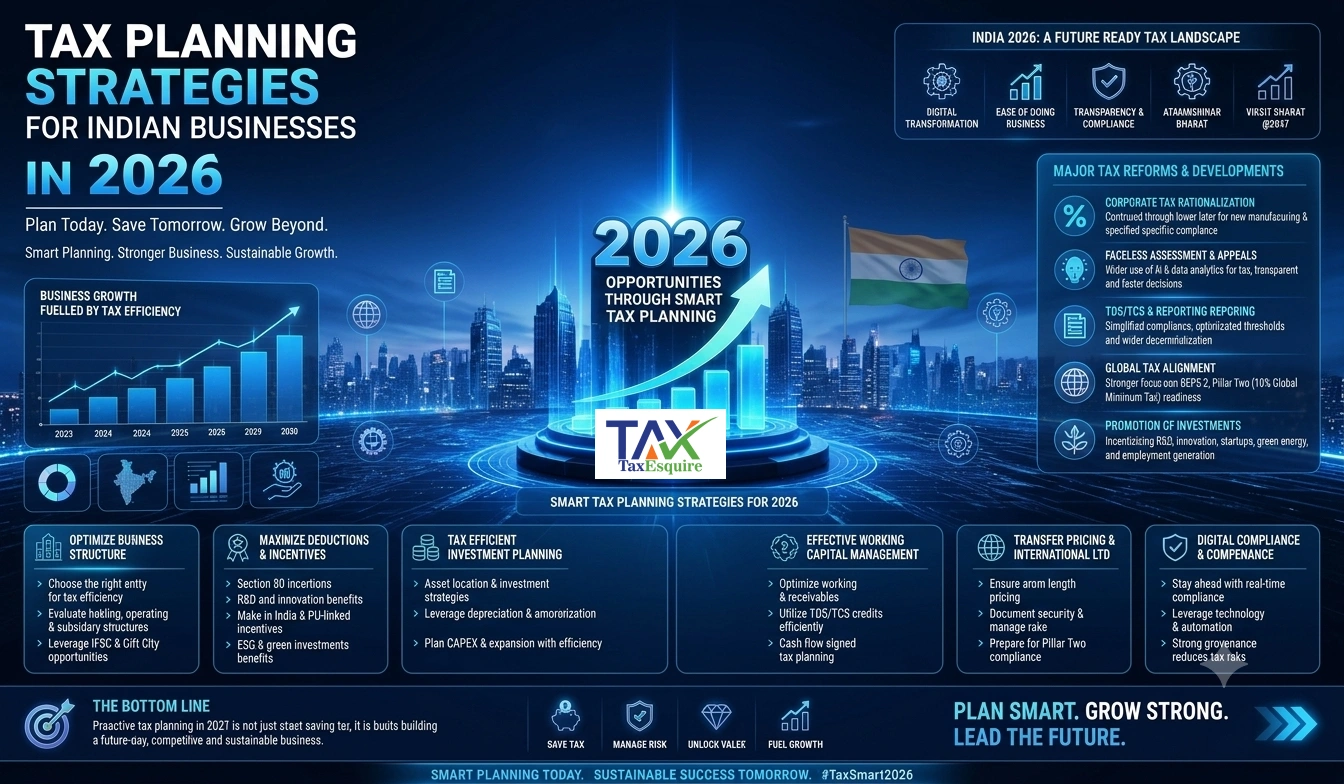
Tax Planning Strategies for Indian Businesses in 2026
Smart tax planning isn't about dodging taxes—it's about paying the right amount at the right time
Why Tax Planning Matters Right Now
Look, I've been doing this for years, and I see the same mistake over and over. Business owners wait until March-end to think about taxes. That's too late. The real magic happens when you plan from April onwards.
Tax planning in 2026 isn't optional anymore. It's survival. The tax department is getting smarter with AI-backed audits. GST compliance is tighter. And interest rates on unpaid taxes keep climbing. But here's the good news: if you plan properly, you can legally cut your tax bill by 20-40%.
So what does this mean for you? It means starting now. Not later. Not when your CA calls in March. Now.
The Core Pillars of Tax Planning for 2026
Tax planning works on four pillars. Understand these, and you've got the foundation right.
- Income Splitting: Spread income across family members in lower tax brackets
- Timing Strategy: Move income and expenses between financial years smartly
- Deduction Maximization: Claim every deduction you're legally allowed
- Entity Structuring: Choose the right business structure (sole proprietor, partnership, LLP, or company)
- Investment Planning: Put money in tax-advantaged instruments
And that's really it. These four pillars cover about 80% of what you need to know.
Section 80C Deductions: Your First Line of Defense
Section 80C is the most powerful tool in your tax planning arsenal. You can deduct up to Rs. 1,50,000 from your taxable income. That's a direct reduction in your tax bill.
But here's where most people mess up: they don't plan these investments. They buy life insurance in December because they remembered. That's not strategy—that's panic.
| Investment Type | Max Limit | Lock-in Period |
|---|---|---|
| Life Insurance Premium | No separate limit (part of 80C) | Policy term |
| ELSS Mutual Funds | No separate limit (part of 80C) | 3 years |
| Fixed Deposits (5-year) | No separate limit (part of 80C) | 5 years |
| PPF (Public Provident Fund) | Rs. 1,50,000 per year | 15 years |
| NSC (National Savings Cert.) | No separate limit (part of 80C) | 5 or 10 years |
If you're in the 30% tax bracket and invest Rs. 1,50,000 under Section 80C, you save Rs. 45,000 in taxes. That's a direct benefit with no strings attached.
Real example: Rajesh runs a trading business and earns Rs. 15 lakhs annually. He's in the 30% tax slab. If he invests Rs. 1,50,000 in PPF, his taxable income drops to Rs. 14,50,000. That saves him Rs. 45,000 in taxes. Plus, his money grows tax-free inside PPF.
Section 80D: Health Insurance Deductions
Health insurance premiums are deductible under Section 80D. You can claim up to Rs. 25,000 for yourself and your family. If you're above 60, it's Rs. 50,000.
But wait—there's more. Your parents' health insurance premiums are also deductible. That's another Rs. 25,000 (or Rs. 50,000 if they're above 60). So a family can claim up to Rs. 1,00,000 if everyone's properly insured.
- Self and spouse: Rs. 25,000
- Parents (below 60): Rs. 25,000
- Parents (above 60): Rs. 50,000
- Children: Covered under self/spouse premium
The thing is, most people don't track these properly. They pay premiums but never claim the deduction. That's free money left on the table.
Cashless claims don't automatically mean the premium is deductible. You need to keep proof that the policy was active during the financial year. Save your policy documents and premium receipts.
Home Loan Interest: A Goldmine Most People Miss
If you have a home loan, you're sitting on a tax deduction goldmine. You can deduct the entire interest amount under Section 24(b). There's no upper limit.
Let me put this in perspective. If you have a Rs. 50-lakh home loan at 7% interest, you'll pay about Rs. 3.5 lakhs in the first year. That entire amount is deductible. If you're in the 30% tax bracket, that saves you Rs. 1,05,000 in taxes.
| Loan Amount | Interest Rate | Year 1 Interest | Tax Saving (30%) |
|---|---|---|---|
| Rs. 50 Lakh | 7% | Rs. 3,50,000 | Rs. 1,05,000 |
| Rs. 75 Lakh | 7% | Rs. 5,25,000 | Rs. 1,57,500 |
| Rs. 1 Crore | 7% | Rs. 7,00,000 | Rs. 2,10,000 |
And that's just year one. As the years pass, you pay less principal and more interest. The interest component stays high for the first 10 years of a 20-year loan.
So what does this mean for you? If you're thinking about buying a home, the tax benefit is a real financial advantage. Don't ignore it in your planning.
Business Deductions: The Often-Forgotten Strategy
If you run a business, you've got a massive advantage. You can deduct almost every business expense. But here's the catch: you need proper documentation.
- Office rent and utilities
- Employee salaries and benefits
- Raw materials and inventory
- Professional fees (CA, lawyer, consultant)
- Office equipment and furniture
- Travel and conveyance
- Interest on business loans
Honestly, most small business owners leave money on the table here. They don't track expenses properly. A Rs. 5,000 expense that's not documented might as well not exist from a tax perspective.
Keeping proper expense records doesn't just help with taxes. It gives you real business insights. You'll know where your money's going and where you can cut costs.
Real example: Priya runs a consulting firm. Her annual revenue is Rs. 30 lakhs. She spends about Rs. 12 lakhs on office rent, staff, and software. But she wasn't tracking all her travel expenses. Once she started documenting every trip, she found another Rs. 2 lakhs in deductible expenses. That reduced her taxable income by Rs. 2 lakhs, saving her Rs. 60,000 in taxes.
GST Planning for 2026
GST planning is different from income tax planning, but it's equally important. The GST system in 2026 is mature, and the tax department has sophisticated tools to catch mismatches.
But there are still legitimate ways to optimize. Input tax credit is the big one. You can claim credit for GST paid on inputs and capital goods. If you're not doing this, you're paying more GST than you need to.
- Keep invoices for all business purchases
- Ensure your suppliers are GST-registered
- File GSTR-3B accurately every month
- Reconcile GSTR-1 and GSTR-2 filings
- Claim capital goods credit separately
- Monitor input tax credit reversals
In 2026, GST mismatches between GSTR-1 and GSTR-2 are flagged automatically. If your supplier shows a sale but you don't show a purchase, the system catches it. This can lead to demands and penalties. Stay compliant.
Income Splitting Strategy for Families
This is where things get interesting. If you're earning a high income, you can split it among family members in lower tax brackets. It's legal, and it saves a lot of money.
For example, if you're earning Rs. 50 lakhs and your spouse earns nothing, you're paying tax at the highest slab. But if you can structure things so your spouse earns Rs. 25 lakhs, both of you pay lower rates. The combined tax is significantly less.
How do you do this? There are several ways. You can add your spouse as a partner in your business. You can create a partnership with your spouse and allocate profits. You can gift assets to your spouse and have them generate income.
| Income Level | Tax Rate | Example Tax (Rs.) |
|---|---|---|
| Rs. 5 Lakh | 5% | Rs. 12,500 |
| Rs. 10 Lakh | 20% | Rs. 1,12,500 |
| Rs. 25 Lakh | 30% | Rs. 5,62,500 |
| Rs. 50 Lakh | 37% | Rs. 15,87,500 |
Income splitting must be genuine. Your spouse can't be a partner just on paper. They must actually participate in the business or own the assets generating income. The tax department will scrutinize this, especially in high-income cases.
Capital Gains Planning
When you sell an asset, you make a capital gain. This is taxed differently depending on how long you held the asset. Short-term gains are taxed at your regular income tax rate. Long-term gains get special treatment.
And that's really it. Hold assets for the right period, and you pay less tax.
- Equity shares held over 1 year: 15% tax (or 10% if gains exceed Rs. 1 lakh)
- Real estate held over 2 years: Indexed cost benefit available
- Bonds and debentures held over 1 year: 20% tax with indexation
- Gold held over 3 years: 20% tax with indexation
- Short-term gains: Taxed at your slab rate (up to 37%)
Real example: Arun bought property for Rs. 50 lakhs in 2016. He's selling it in 2026 for Rs. 1 crore. His gain is Rs. 50 lakhs. If he holds it for 2+ years, he gets indexation benefit, which means his cost basis gets adjusted for inflation. This could reduce his taxable gain to Rs. 30 lakhs. At 20% tax rate, he saves Rs. 4 lakhs compared to short-term treatment.
Timing Strategy: The Year-End Shuffle
Timing is everything in tax planning. You can shift income and expenses between years to reduce your overall tax burden. But you need to do this before March 31st.
If you know you'll have a big income this year, you might want to defer some income to next year. Or you might want to accelerate expenses. The key is planning ahead.
- Prepay business expenses before year-end
- Defer billing to clients if possible
- Time your investments to maximize deductions
- Accelerate loss-making investments to offset gains
- Plan bonus and salary payouts strategically
- Review your income projections quarterly
But here's the thing: this only works if you start early. If you wait until February, your options are limited.
Entity Selection: Sole Proprietor vs. LLP vs. Company
Your business structure has massive tax implications. Choosing the wrong one can cost you lakhs every year.
| Structure | Tax Rate | Compliance | Best For |
|---|---|---|---|
| Sole Proprietor | Your slab rate | Low | Startups, low income |
| Partnership | Each partner's slab | Medium | Family businesses |
| LLP | Each partner's slab | Medium | Professional services |
| Private Company | 25% (+ surcharge) | High | Growing businesses |
If you're earning Rs. 40 lakhs as a sole proprietor, you're in the 30% tax bracket. But if you convert to a company, you pay 25% tax. That saves you Rs. 2 lakhs in taxes right there. But companies have higher compliance costs, so you need to factor that in.
Section 54: Real Estate Exemption
If you sell your primary residence, you don't have to pay tax on the gain. That's Section 54. But there are conditions.
You need to invest the proceeds in another residential property within a specific timeframe. If you do, the entire gain is exempt. If you don't, you pay tax on the full amount.
- You must have owned the property for at least 2 years
- You must invest in a new residential property within 1 year before or 2 years after the sale
- The new property must be in India
- You can't have owned more than one residential property in the previous 2 years
If you're selling a property worth Rs. 1 crore that you bought for Rs. 40 lakhs, your gain is Rs. 60 lakhs. At 20% tax rate, that's Rs. 12 lakhs. But with Section 54, you pay zero if you reinvest properly. That's a huge benefit.
FAQ: Your Common Tax Planning Questions
1. When should I start tax planning for 2026?
Now. Seriously. Most deductions need to be planned from April onwards. If you wait until February 2027, you've lost most opportunities. Start your planning in April 2026, not March 2027.
2. Can I claim deductions if I don't have receipts?
No. The tax department won't accept any deduction without proper documentation. If you're claiming a business expense, you need an invoice or receipt. If you're claiming a medical expense, you need a hospital bill. No documents, no deduction. It's that simple.
3. Is tax planning the same as tax evasion?
No. Tax planning is using legal methods to reduce your tax burden. Tax evasion is hiding income or claiming false deductions. One is smart. The other is a crime. We're talking about the first one.
4. How much can I save with proper tax planning?
It depends on your situation. Most people can save 15-30% of their tax bill with proper planning. Some can save even more. But it requires effort and planning. If you're lazy about it, you'll save nothing.
5. What happens if I get audited?
If your tax planning is legitimate and well-documented, an audit isn't a problem. The tax department might ask questions, but if you have proof, you're fine. The real danger is when you've claimed deductions without proper documentation or made false claims. That's when audits become expensive.
6. Should I hire a CA for tax planning?
If your situation is simple, you might not need one. But if you're self-employed, running a business, or have multiple income sources, a good CA is worth every penny. They'll find deductions you didn't know about and keep you compliant. That's way cheaper than paying penalties later.
Common Tax Planning Mistakes to Avoid
I've seen these mistakes over and over. Avoid them, and you're already ahead of 80% of people.
- Waiting until March: By then, most planning opportunities are gone. Start in April.
- Not keeping records: Every deduction needs documentation. Invoices, receipts, bills. Keep them all.
- Mixing personal and business expenses: This is a red flag for auditors. Keep them separate.
- Ignoring GST compliance: GST mismatches are flagged automatically now. You can't hide them.
- Not reviewing your investments: Just because you invested doesn't mean it's the right investment. Review annually.
- Making false claims: The biggest mistake. Don't claim deductions you're not entitled to. It's not worth the risk.
Your 2026 Tax Planning Checklist
Here's a simple checklist. Go through it quarterly.
- [ ] Review your income projections for the year
- [ ] Identify all eligible deductions (Section 80C, 80D, etc.)
- [ ] Plan your investments (PPF, ELSS, insurance, etc.)
- [ ] Check your home loan interest deduction eligibility
- [ ] Review business expenses and ensure proper documentation
- [ ] Plan any capital gains or losses strategically
- [ ] Review your GST compliance monthly
- [ ] Evaluate your business structure for tax efficiency
- [ ] Plan any asset sales carefully (timing and structure)
- [ ] Meet with your CA in June and December for mid-year review
Final Thoughts: It's Not Too Late to Start
Tax planning isn't rocket science. It's just about being intentional with your money. Most people don't do it because they don't know how. Now you do.
The best time to start was when you earned your first rupee. The second best time is today. Don't wait until next year. Don't wait until March. Start now.
If you're in the 30% tax bracket and you implement even half of these strategies, you could save Rs. 2-5 lakhs every year. That's not small money. That's life-changing money.
And honestly, that's the whole point. Tax planning isn't about being clever. It's about keeping more of what you earn. It's about financial freedom. So start today.
" } ```
© 2026 Tax Esquire | Expert CA Services in Greater Noida, Uttar Pradesh
8810380146 | info.taxesquire@gmail.com | taxesquire.in
This document is for informational purposes only. For personalised tax advice, consult our chartered accountants.