TCS on E-Commerce in 2026-2027: Complete Guide for Indian Businesses
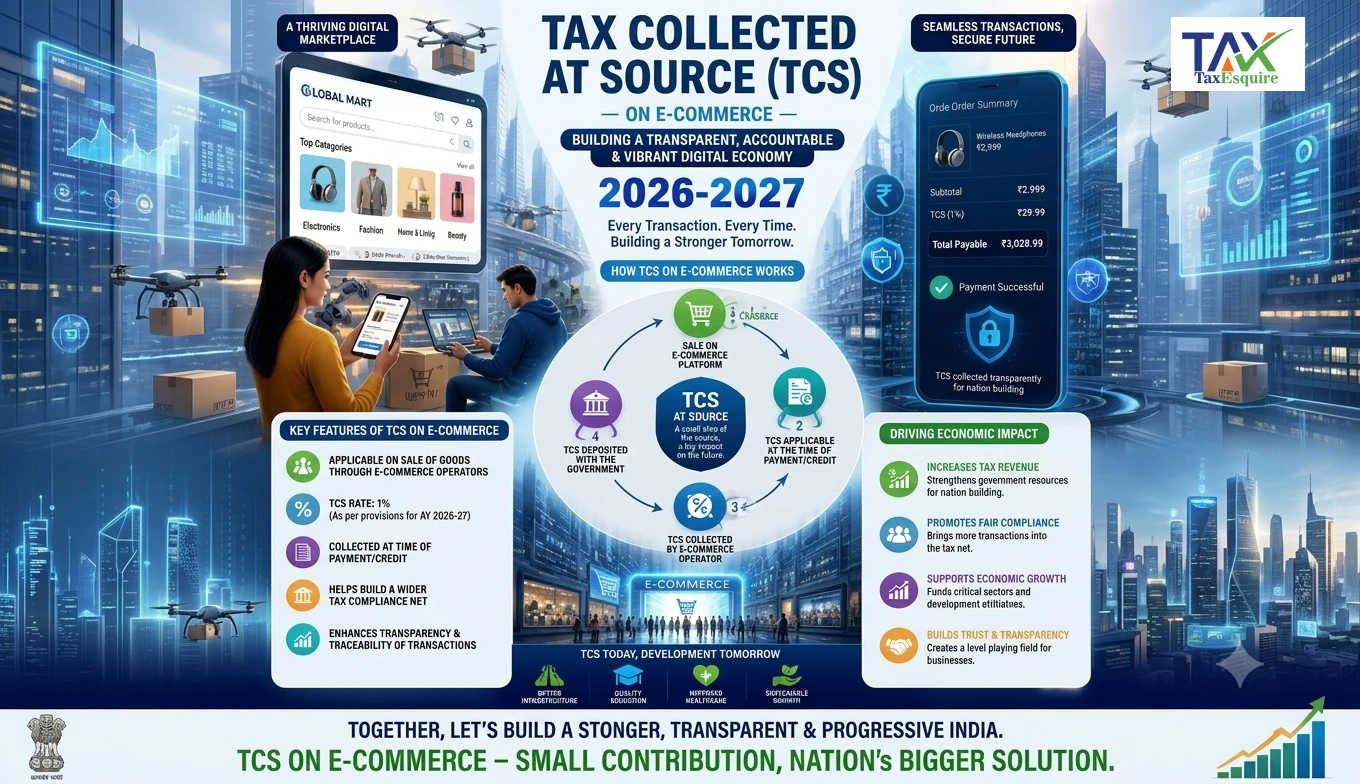
TCS on E-Commerce in 2026-2027
Everything you need to know about TCS rules, rates, and compliance requirements for online sellers
What is TCS on E-Commerce?
TCS stands for Tax Collected at Source. It's a tax that e-commerce platforms collect from sellers when they make sales through their platforms. Think of it as a way the government ensures tax compliance right at the point of sale. The platform acts as a collector, not as a taxpayer itself.
So what does this mean for you? If you're selling goods online through platforms like Amazon, Flipkart, or any other e-commerce marketplace, the platform will deduct TCS from your sale proceeds. This isn't an extra tax—it's an advance payment that gets adjusted against your final tax liability.
The rule applies to sales of goods. Services are generally not covered under this TCS provision, though there are some exceptions. The key thing to understand is that this collection happens automatically, and you need to track it properly for your GST and income tax filings.
TCS Rate and Threshold in 2026-2027
The TCS rate on e-commerce sales is 1% of the transaction value. This applies to all sellers, whether you're a small business or a large enterprise. The rate has been consistent, and there's no indication it'll change in 2026-2027.
But here's where it gets important: the threshold. TCS is collected only when your cumulative sales through e-commerce platforms cross ₹5 lakhs in a financial year. Put simply, if your total sales are below ₹5 lakhs, no TCS is collected. Once you cross that threshold, TCS applies to every transaction from that point onward.
| Parameter | Details |
|---|---|
| TCS Rate | 1% of transaction value |
| Threshold | ₹5 lakhs per financial year |
| Applicable To | Sale of goods through e-commerce platforms |
| Collected By | E-commerce platform operator |
The 1% TCS rate is quite reasonable compared to your overall tax burden. Since it's collected only above ₹5 lakhs, small sellers with lower volumes aren't affected. And here's the good part: you get credit for TCS collected when you file your income tax return.
Who Needs to Collect TCS?
E-commerce platforms are responsible for collecting TCS. But which platforms exactly? The law covers any platform that facilitates the sale of goods online. This includes major marketplaces like Amazon, Flipkart, eBay, and others.
Now, here's what matters for you: if you're a seller on these platforms, you don't collect TCS yourself. The platform does it automatically. Your job is to monitor the deductions and report them correctly in your tax filings. Basically, you're on the receiving end of this collection.
- Major e-commerce marketplaces (Amazon, Flipkart, Snapdeal, etc.)
- Online retail platforms selling goods
- Platforms that connect buyers and sellers
- Any digital marketplace facilitating goods sales
- Platforms with significant transaction volumes
- Aggregators and resellers using platforms
One thing to note: if you're selling directly from your own website without using a platform, TCS doesn't apply. The provision is specific to platform-based sales.
How TCS is Calculated: Practical Examples
Let me walk you through some real examples so you can see exactly how TCS works in practice.
Example 1: Small Seller Below Threshold
Suppose you sell clothing on Amazon. Your total sales for the financial year 2026-2027 are ₹3 lakhs. Since you haven't crossed the ₹5 lakh threshold, Amazon won't collect any TCS from you. You receive the full amount (minus platform fees and GST, of course). No TCS deduction at all.
Example 2: Seller Crossing the Threshold
Now suppose your sales reach ₹6 lakhs. You've crossed the ₹5 lakh threshold. From the moment you cross it, TCS applies. Let's say you make a sale of ₹10,000. The platform will deduct 1% TCS, which is ₹100. You'll receive ₹9,900 (assuming no other deductions). This ₹100 gets credited to your tax account.
Example 3: Multiple Transactions
You make five sales in a month after crossing the threshold: ₹5,000, ₹8,000, ₹12,000, ₹6,000, and ₹9,000. Total sales = ₹40,000. TCS collected = 1% of ₹40,000 = ₹400. So you receive ₹39,600 instead of ₹40,000. The platform tracks all this and provides you with TCS certificates.
Don't forget to track the exact date when you cross the ₹5 lakh threshold. TCS applies only from that date onward, not retroactively. If you're not sure when you've crossed it, ask your platform for a statement of cumulative sales.
TCS and GST: How They Work Together
Here's a question I get asked often: how does TCS interact with GST? The answer is important because you need to understand both to avoid confusion.
TCS is calculated on the transaction value of goods. GST is a separate consumption tax. They're independent of each other. So if you make a sale of ₹10,000, and GST is 18%, your total invoice is ₹11,800. TCS is 1% of ₹10,000 (the base value), not on the GST amount. That's ₹100.
And that's really it—they don't overlap. You pay GST on your sales (which gets remitted to the government), and TCS is collected separately as an advance tax payment. When you file your income tax return, you get credit for the TCS collected.
The platform will provide you with separate certificates for TCS and GST. Make sure your accountant files both correctly. TCS goes into your income tax return under Schedule TCS, and GST is handled in your GSTR filings.
Compliance Requirements for 2026-2027
If you're selling through e-commerce platforms and TCS is being collected from you, here's what you need to do to stay compliant.
1. Track TCS Deductions
Your e-commerce platform will send you monthly or quarterly TCS statements. Download these and keep them safe. You'll need them for your income tax return. Don't rely on memory—keep digital copies and backup files.
2. Report in Income Tax Return
When you file your income tax return for 2026-2027, you'll report the TCS collected in Schedule TCS. The amount gets credited against your total tax liability. If TCS collected is more than your tax liability, you get a refund.
3. GST Compliance
File your GSTR-1 (outward supplies) and GSTR-3B (monthly/quarterly return) showing all e-commerce sales. The platform will also file information about your sales, so your return should match their records.
4. Maintain Records
Keep invoices, delivery proofs, and payment receipts for all e-commerce sales. Keep TCS certificates from the platform. The income tax department can ask for these during an audit, and you need to be ready.
5. Annual Reconciliation
At the end of the financial year, reconcile your sales records with the TCS statement from the platform. Make sure the figures match. If there are discrepancies, get them corrected before filing your return.
- Download and save all TCS certificates from platforms
- Report TCS in Schedule TCS of income tax return
- File GST returns showing all e-commerce sales
- Maintain complete documentation for 6 years
- Reconcile platform records with your books
Common Mistakes to Avoid
In my years working with e-commerce sellers, I've seen certain mistakes repeated again and again. Let me help you avoid them.
Mistake 1: Ignoring TCS Below Threshold
Some sellers think TCS doesn't matter if they're below ₹5 lakhs. But here's the thing: you still need to track when you're approaching the threshold. Once you cross it, TCS kicks in immediately. If you're not monitoring, you might miss it and underreport your income.
Mistake 2: Not Reporting TCS in Income Tax Return
The biggest mistake I see is sellers who collect TCS but don't report it in their income tax return. This creates a mismatch. The income tax department will notice that TCS was collected on your sales but not reported. File Schedule TCS properly—it's not optional.
Mistake 3: Mixing TCS with GST
Some people think TCS reduces the amount on which GST is calculated. It doesn't. GST is on the invoice amount, TCS is separate. Calculate both independently.
Mistake 4: Not Reconciling Records
Your records should match the platform's records. If they don't, sort it out before filing your return. Discrepancies raise red flags during audits.
Don't underestimate the importance of proper TCS reporting. The income tax department cross-checks platform data with seller returns. Mismatches can lead to scrutiny, penalties, and interest charges. It's not worth the risk.
Benefits of TCS Compliance
Now, you might be thinking TCS is just another tax burden. But there are real benefits to being compliant.
TCS collected acts as an advance payment of your income tax. If your actual tax liability is less than TCS collected, you get a refund. This means TCS can work in your favor if managed properly.
Another benefit: proper TCS reporting builds a clean tax history. This matters when you apply for loans, credit, or when you want to scale your business. Banks and financial institutions look at your tax compliance records.
And honestly, compliance gives you peace of mind. You're not worried about audits or notices. You can focus on growing your business instead of managing tax stress.
TCS Certificates and Documentation
E-commerce platforms are required to issue TCS certificates to sellers. These are important documents you'll need for your tax filings.
A TCS certificate shows the period, total transaction value, TCS rate, and total TCS collected. It's usually issued monthly or quarterly, depending on the platform. Some platforms provide it in their seller dashboard, others email it to you.
Make sure you download and save these certificates. You'll need them when filing your income tax return. If you can't find a certificate, contact the platform's support team immediately. Don't wait until the last minute.
The certificate will have a unique reference number. Keep track of all certificate numbers. When you file your return, you might need to reference them. And if there's ever a discrepancy, you have proof of what was collected.
Frequently Asked Questions
Q1: If I sell through multiple platforms, how is the ₹5 lakh threshold calculated?
The threshold is cumulative across all platforms. So if you sell ₹3 lakhs on Amazon and ₹2.5 lakhs on Flipkart, your total is ₹5.5 lakhs. Once you cross ₹5 lakhs in total, both platforms will start collecting TCS on your subsequent sales. Each platform tracks its own sales, but the threshold applies to your aggregate sales.
Q2: Can I claim TCS as an input credit in GST?
No. TCS is an income tax mechanism, not a GST mechanism. You can't claim it as input tax credit in your GST return. However, you get credit for TCS when you file your income tax return. These are two separate systems.
Q3: What if the platform doesn't collect TCS even though I've crossed the threshold?
This is rare but can happen if the platform's system isn't updated. Contact their support immediately. You're responsible for reporting TCS in your return, even if the platform didn't collect it. If you have evidence that TCS should have been collected, you might need to self-assess and pay it.
Q4: Do I need to file a separate return for TCS?
No. TCS is reported in your regular income tax return in Schedule TCS. You don't file a separate return. Just make sure you include it when you file your annual income tax return.
Q5: What happens if I get a refund due to excess TCS?
If TCS collected is more than your final tax liability, the excess becomes a refund. This is processed when you file your income tax return. The refund gets credited to your bank account (usually within a few months). It's straightforward—just file your return correctly.
Q6: Are services sold through e-commerce platforms subject to TCS?
The TCS rule applies to sale of goods, not services. If you're providing services through a platform, TCS doesn't apply. However, if you're selling physical goods (even digital goods in some cases), TCS applies. Check with your platform or accountant if you're unsure whether your offering qualifies as goods or services.
Key Takeaways for 2026-2027
Let me summarize what you really need to know about TCS on e-commerce in 2026-2027.
- TCS is 1% of transaction value on e-commerce sales above ₹5 lakh threshold
- E-commerce platforms collect TCS automatically—you don't collect it yourself
- Track TCS deductions and report them in Schedule TCS of your income tax return
- TCS and GST are separate—calculate both independently
- Save all TCS certificates from platforms for your records
- Reconcile your sales records with platform statements before filing your return
Conclusion
TCS on e-commerce is a straightforward mechanism once you understand how it works. The 1% rate isn't burdensome, and the ₹5 lakh threshold ensures small sellers aren't affected unnecessarily. The key is to stay organized, track your deductions, and report them correctly in your tax filings.
If you're selling through e-commerce platforms in 2026-2027, don't ignore TCS. Download your certificates, reconcile your records, and report everything in your return. This isn't complicated, but it does need attention. And if you're unsure about anything, talk to your accountant. It's worth the investment to get it right.
The bottom line: TCS is manageable. Stay compliant, and you'll have nothing to worry about.
" } ```
© 2026 Tax Esquire | Expert CA Services in Greater Noida, Uttar Pradesh
8810380146 | info.taxesquire@gmail.com | taxesquire.in
This document is for informational purposes only. For personalised tax advice, consult our chartered accountants.