Top 10 Avoid to Income Tax Filing Mistakes in 2026-2027
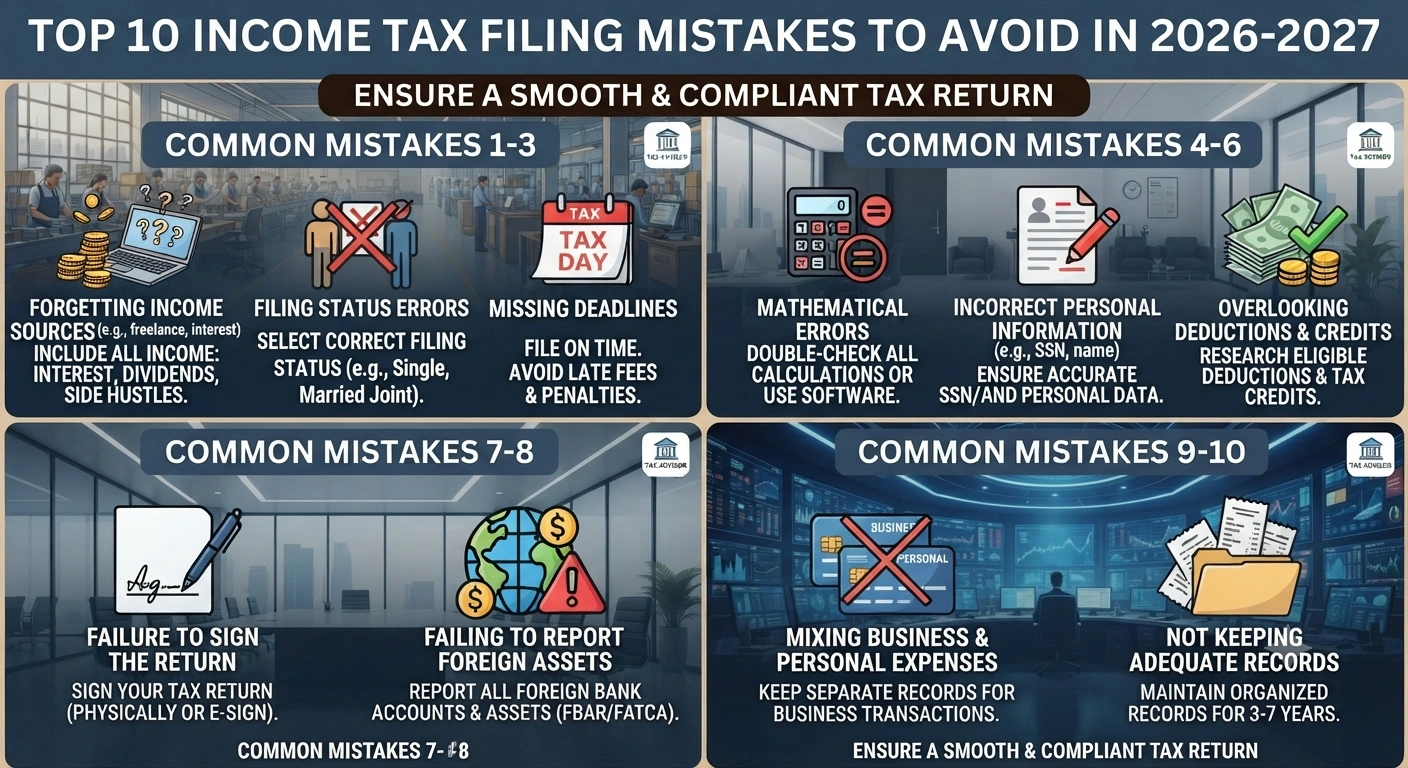
Top 10 Income Tax Filing Mistakes to Avoid
Don't let avoidable errors cost you money. Here's what every taxpayer needs to know for the 2026-2027 filing season.
Tax season can feel overwhelming. Between tracking income, managing deductions, and keeping up with changing rules, it's easy to slip up. But here's the thing: most mistakes are completely preventable. I've worked with hundreds of taxpayers over my years as a CA, and I've seen the same errors pop up again and again. The good news? You don't have to be one of them.
Filing your income tax return isn't just about meeting a deadline. It's about protecting yourself from penalties, avoiding audits, and making sure you're not paying more tax than you need to. So what does this mean for you? It means taking a few hours now to understand these common mistakes could save you thousands of rupees later.
Mistake 1: Missing the Filing Deadline
Let's start with the most obvious one. For the 2026-2027 financial year, the ITR filing deadline is July 31, 2027. And I mean July 31, not August 1.
Missing this date isn't just inconvenient—it's expensive. You'll face a late filing penalty under Section 234F of the Income Tax Act. If your income is below the taxable limit, you'll pay Rs. 1,000. If it's above, you'll pay Rs. 5,000. But wait, there's more. Filing late can also trigger scrutiny from the tax department, and you might miss out on refunds.
If you filed late in previous years, the tax department has records. Don't assume they'll forget. File early this time and get ahead of potential issues.
The smart move? File by June 30, 2027. That gives you a full month buffer and shows the tax department you're serious about compliance.
Mistake 2: Reporting Wrong Income Figures
This is where carelessness costs real money. You report your salary, but you forget about that freelance income. Or you include a bonus that wasn't actually paid. Or you misremember how much interest your savings account earned.
The tax department has copies of your Form 16, bank statements, and investment statements. They cross-check everything. So when your ITR doesn't match what they have on file, red flags go up. And that's when the notices start arriving.
- Salary income from Form 16
- Interest from savings accounts and fixed deposits
- Dividend income from shares or mutual funds
- Rental income from property
- Freelance or consulting fees
- Capital gains from selling assets
Put simply, gather all your income documents before you start filling your return. Match them line by line with what you're reporting. It takes an extra 30 minutes but saves you months of headaches.
When you report accurate income figures, you build a clean tax history. This makes future loans easier to get and shows the tax department you're trustworthy.
Mistake 3: Forgetting to Claim Deductions
This one makes me sad because people leave money on the table without realizing it. You've earned the deductions. You've paid the money. But you don't claim them on your return. That's like finding cash in your pocket and throwing it away.
Section 80C alone lets you deduct up to Rs. 1.5 lakhs from your taxable income. And that's just one section. There's also 80D for health insurance, 80E for education loans, 80G for charitable donations, and many more.
| Deduction Section | What You Can Claim | Limit (2026-2027) |
|---|---|---|
| 80C | Life insurance, PPF, ELSS, home loan principal | Rs. 1.5 lakhs |
| 80D | Health insurance premiums | Rs. 25,000 (Rs. 50,000 if senior) |
| 80E | Education loan interest | No limit |
| 80G | Donations to approved charities | 50% or 100% of donation |
| 80TTA | Savings account interest | Rs. 10,000 |
And that's really it—you need to track these throughout the year. Keep your receipts. Keep your bank statements. When filing time comes, you'll be ready to claim every rupee you're allowed to.
Mistake 4: Not Matching Your ITR with Form 16
Your employer gives you a Form 16 showing how much tax they deducted from your salary. Your ITR should match this. If it doesn't, you've got a problem.
I've seen people report different salary figures on their ITR than what's on their Form 16. Maybe they made a typo. Maybe they forgot about a bonus. Whatever the reason, the tax department notices immediately. They'll send you a notice asking for an explanation.
Here's what you should do: Get your Form 16 from your employer. Open your ITR form. Compare the salary figure line by line. If there's a difference, contact your employer and ask them to issue a corrected Form 16. Then file your ITR with the correct figure.
When your ITR matches your Form 16, the tax department processes your return faster. You might get your refund within 60 days instead of waiting months.
Mistake 5: Choosing the Wrong ITR Form
There are different ITR forms for different types of people. But many taxpayers just pick the first one they see. That's a mistake.
Basically, you need to match your form to your income sources. If you're a salaried employee with no business income, you file ITR-1. If you're self-employed, you file ITR-3. If you have rental income, you might file ITR-2. Filing the wrong form can lead to your return being rejected or flagged for scrutiny.
- ITR-1: Salaried individuals with income from salary, interest, and other sources (not business)
- ITR-2: Individuals with income from capital gains, foreign income, or multiple sources
- ITR-3: Self-employed persons with business or professional income
- ITR-4: Self-employed persons with income up to Rs. 50 lakhs (can use presumptive scheme)
- ITR-5: Partnership firms, LLPs, and other entities
So what does this mean for you? Before you start filling your return, ask yourself: What are my income sources? Then pick the right form. When in doubt, talk to a CA. It's worth the investment.
Mistake 6: Ignoring TDS Certificates
TDS stands for Tax Deducted at Source. When someone pays you money, they might deduct a portion as tax and send it to the government on your behalf. You get a TDS certificate showing this.
Many people ignore these certificates. They don't report the TDS in their ITR. Then when the tax department cross-checks, there's a mismatch. The government thinks you paid more tax than you actually did, which can trigger notices.
For the 2026-2027 financial year, you need to report all TDS received. This includes TDS on:
- Interest from banks and post offices
- Rent paid to landlords
- Professional fees or commissions
- Dividend income
- Freelance work or contract payments
Collect all your TDS certificates before filing. The certificate shows the TDS amount, the entity that deducted it, and the financial year. Report it accurately in your ITR.
Mistake 7: Not Reporting Cash Deposits or Large Transactions
The tax department has access to your bank statements. They see every deposit. If you deposit a large amount but don't explain where it came from in your ITR, they'll ask questions.
This is especially true if you deposit cash. Deposits of Rs. 10 lakhs or more in a single financial year trigger a report to the tax department. But even smaller deposits can raise eyebrows if they don't match your reported income.
Let me give you an example. You're a salaried person earning Rs. 8 lakhs per year. But your bank statements show deposits totaling Rs. 20 lakhs. Where did that money come from? If you don't explain it in your ITR, the tax department will assume it's unreported income and demand tax on it.
Large unexplained deposits can trigger income tax notices, money laundering investigations, and penalties. Always keep records of where your money comes from.
The solution is simple: Track your deposits. If it's a gift, keep the gift deed. If it's a loan, keep the loan agreement. If it's from selling something, keep the sale documents. Then report everything properly in your ITR.
Mistake 8: Making Calculation Errors
Math errors happen to everyone. But on your income tax return, they can be costly.
I'm talking about simple mistakes like adding up your income wrong, calculating deductions incorrectly, or making errors in your total taxable income. These errors might seem small, but they change how much tax you owe.
The good news? The income tax portal does a lot of the math for you now. It auto-calculates your tax liability. But you still need to check it. Don't just accept what the form shows. Review every number. Make sure it matches your documents.
And honestly, this is where hiring a CA makes sense. We've filed hundreds of returns. We know where errors hide. We catch them before you file.
Mistake 9: Not Keeping Supporting Documents
Your ITR is just a summary. It shows your income and deductions. But the tax department wants proof. They want to see the documents that back up every number.
So what documents do you need? Everything. Your Form 16, bank statements, investment receipts, deduction proofs, TDS certificates, donation receipts, home loan documents—you name it. Keep them for at least 6 years.
- Form 16 and Form 16A from your employer
- Bank statements showing all deposits and withdrawals
- Investment receipts for 80C investments (PPF, insurance, ELSS)
- Health insurance policy documents
- Home loan documents and interest statements
- Donation receipts for 80G deductions
- Property documents if you have rental income
If the tax department sends you a notice asking for documents and you don't have them, you're in trouble. You might lose your deductions or face penalties. So start building your document file now.
When you have all your documents organized and ready, you can respond to any tax notice quickly. This shows the department you're organized and compliant, which often leads to faster resolution.
Mistake 10: Filing After Getting a Tax Notice
Some people don't file their ITR until they get a notice from the tax department. That's backwards. Filing after a notice is way more complicated than filing proactively.
When you file after a notice, you're explaining yourself. You're defending your position. You're dealing with penalties and interest. The tax department has already flagged you as non-compliant.
But when you file early and correctly, you're showing compliance. You're being a good citizen. The tax department moves your return through their system smoothly, and you get your refund quickly.
So here's my advice: File your ITR by June 30, 2027. Don't wait for a notice. Don't wait until July. Get it done early, get it done right, and then forget about it until next year.
Summary Table: Common Mistakes and Solutions
| Mistake | Impact | How to Avoid |
|---|---|---|
| Missing deadline | Rs. 1,000-5,000 penalty | File by June 30, 2027 |
| Wrong income figures | Tax notice and demand | Match all documents before filing |
| Missed deductions | Pay more tax than needed | List all eligible deductions |
| ITR-Form 16 mismatch | Tax notice | Cross-check before filing |
| Wrong ITR form | Return rejected or flagged | Match form to income sources |
| Ignored TDS | Mismatch with govt records | Report all TDS received |
| Unexplained deposits | Tax demand on assumed income | Keep records of all sources |
| Calculation errors | Wrong tax liability | Review all numbers carefully |
| Missing documents | Can't defend your ITR | Keep 6 years of records |
| Filing after notice | Penalties and interest | File proactively by June 30 |
Frequently Asked Questions
Q1: Can I file my ITR after the July 31 deadline?
Yes, you can. But you'll pay a penalty. If your income is below the taxable limit, it's Rs. 1,000. If it's above, it's Rs. 5,000. You also won't get a refund if the tax department owes you money—that's gone. So basically, don't file late unless you absolutely have to.
Q2: What happens if I don't file my ITR at all?
The tax department will send you notices. If you ignore those, they can assess your income and demand payment. You might also face prosecution under Section 276D of the Income Tax Act, which can mean jail time and a fine. It's not worth the risk. File your return every year, even if you don't owe any tax.
Q3: Do I need to file an ITR if my income is below the taxable limit?
Technically, no. But you should anyway. Filing an ITR creates a record of your income, which helps if you want a loan or visa later. It also protects you if the tax department has questions about your income. Plus, if you've had tax deducted from your income, filing gets you a refund. So even if you don't owe tax, file your return.
Q4: Can I amend my ITR after filing?
Yes, you can. You can file an amended return (revised ITR) before the tax department issues a notice. But you can't amend after they send you a notice. So if you realize you made a mistake, fix it immediately. Don't wait for a notice.
Q5: What's the best way to avoid these mistakes?
Honestly? Get professional help. Hire a CA to prepare your return. Yes, it costs money. But it saves you from penalties, notices, and stress. Plus, a CA knows about deductions you might miss. They know about changes in tax law. They know what documents you need. It's an investment that pays for itself.
Key Takeaways for 2026-2027 Filing Season
- File by June 30, 2027—don't wait until the last day
- Gather all documents before you start: Form 16, bank statements, investment receipts, TDS certificates
- Report all income sources accurately—the tax department has records
- Claim every deduction you're allowed to—don't leave money on the table
- Choose the right ITR form based on your income sources
- Match your ITR with your Form 16 before submitting
- Explain any large deposits or unusual transactions
- Keep supporting documents for 6 years
- Review your return carefully before filing—catch errors before the tax department does
- Consider hiring a CA if you have complex income sources
Final Thoughts
Filing your income tax return doesn't have to be stressful. Most of these mistakes are completely preventable. You just need to be organized, careful, and thorough.
Start early. Gather your documents. Review everything. Ask questions if you don't understand something. And if you're not confident, get help from a professional.
The tax department isn't trying to trap you. They just want accurate information filed on time. Give them that, and you'll have no problems. Ignore these mistakes, and you'll spend months dealing with notices and penalties.
So this year, be the person who files early, files correctly, and files completely. Your future self will thank you.
" } ```
© 2026 Tax Esquire | Expert CA Services in Greater Noida, Uttar Pradesh
8810380146 | info.taxesquire@gmail.com | taxesquire.in
This document is for informational purposes only. For personalised tax advice, consult our chartered accountants.