GST Compliance for Small Businesses in India: A Complete 2026-2027 Guide
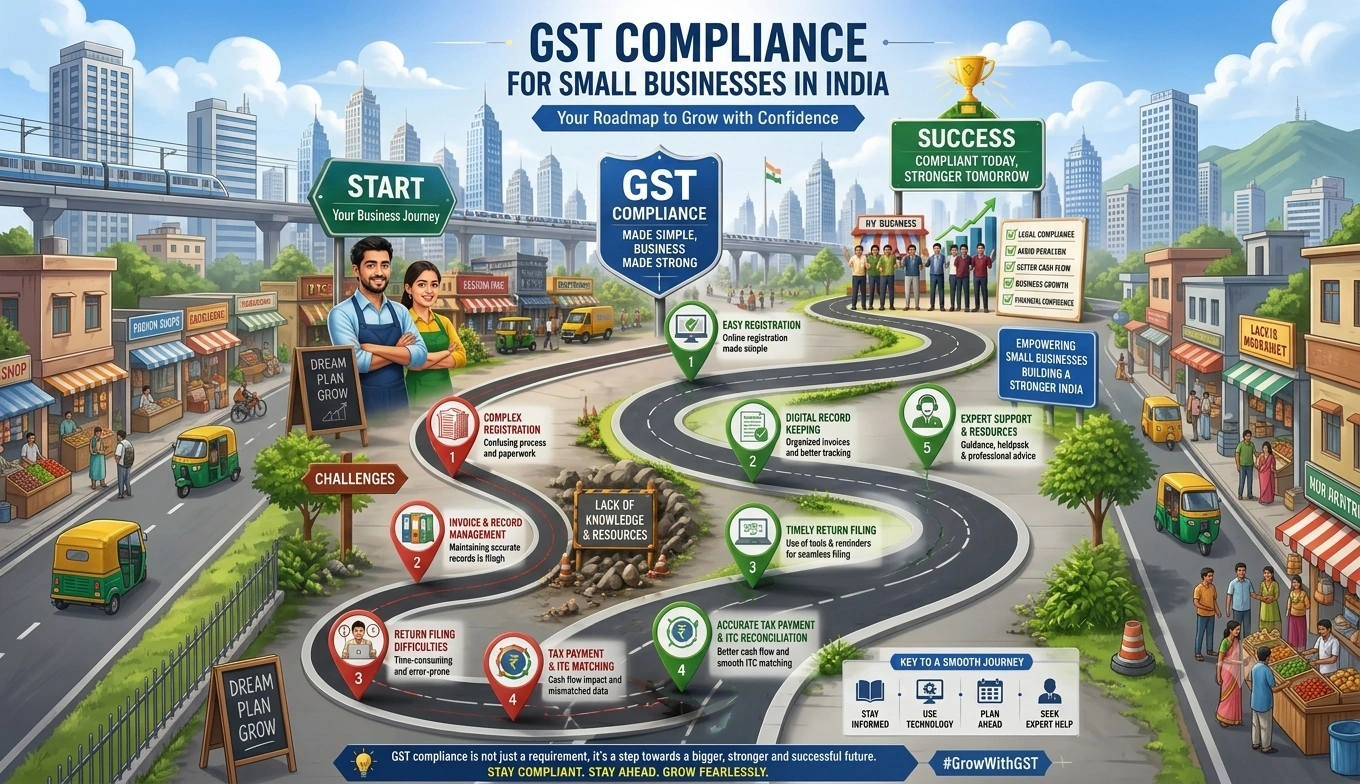
GST Compliance for Small Businesses in India
Everything you need to know about staying compliant and avoiding penalties
Let's be honest: GST compliance feels like a maze when you're running a small business. You're juggling operations, managing cash flow, and the last thing you want is a tax notice landing on your desk. But here's the thing—GST isn't as complicated as it seems once you understand the basics.
I've helped hundreds of small business owners navigate GST over the past few years, and I've seen what works and what doesn't. In this guide, I'm sharing everything you need to know about GST compliance in 2026-2027. Think of this as your roadmap to staying on the right side of the tax authorities.
What Is GST and Why Does It Matter for Your Business?
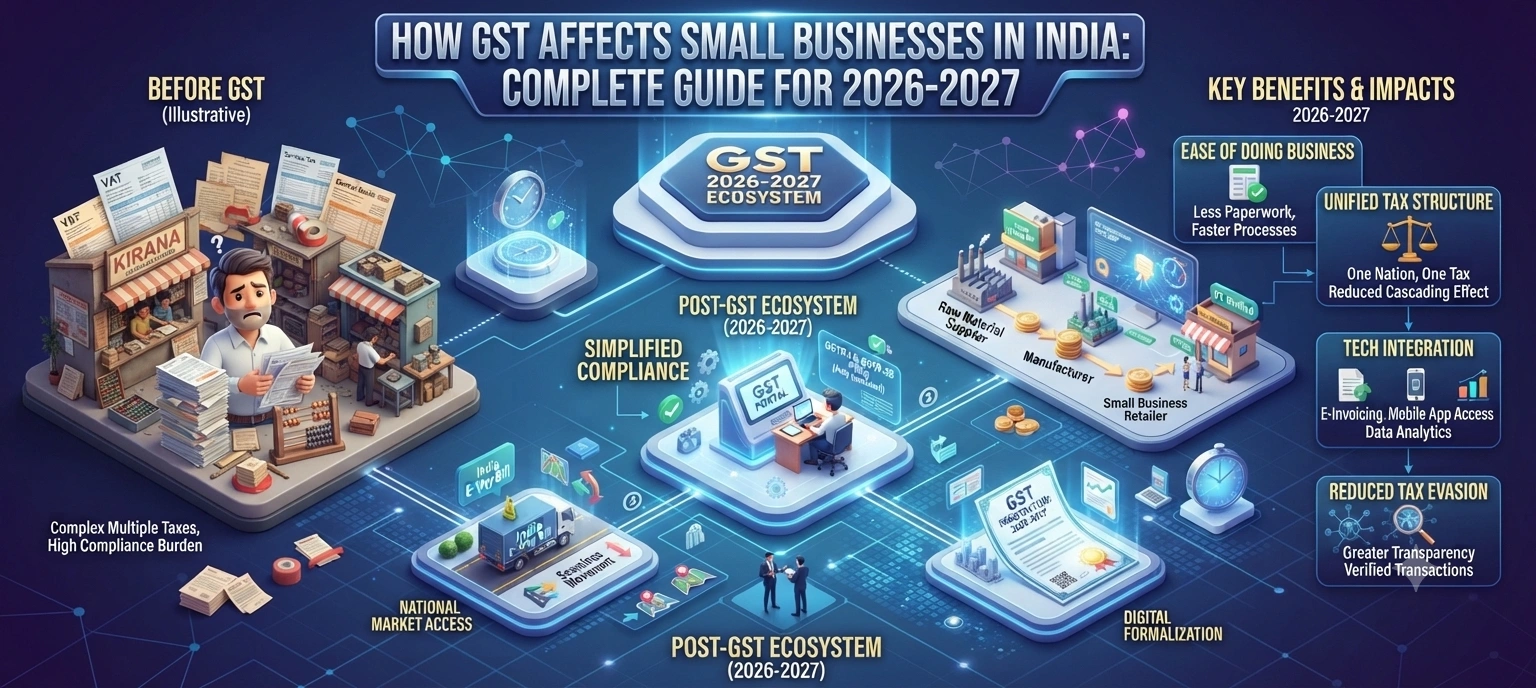
GST—Goods and Services Tax—is a single indirect tax that replaced multiple taxes like VAT, excise, and service tax. Instead of paying different taxes to different authorities, you now pay GST to one system. So what does this mean for you? Simpler tax filing, better input credit, and if you mess up, bigger penalties.
The GST system works like this: you collect tax from your customers, you claim credit on taxes you pay to suppliers, and you remit the difference to the government. It's straightforward in theory, but the paperwork and deadlines can trip up business owners who aren't careful.
GST brings transparency to your supply chain. You can track every transaction, claim input credits properly, and reduce your overall tax burden when you're compliant.
Do You Actually Need GST Registration?
Not every business needs GST registration. The rules are pretty clear on this. If your annual turnover is below the threshold, you can skip registration—but there's a catch.
And that catch is important: even if you're below the threshold, you might still want to register. Why? Because once you register, you can claim input tax credit on everything you buy. That can save you serious money.
- Annual turnover above Rs. 40 lakh (Rs. 20 lakh for services)—you must register
- Intra-state supplies above Rs. 40 lakh in a financial year—mandatory registration
- Inter-state supplies above Rs. 20 lakh—you need to register
- You're supplying goods to other registered dealers—consider registering
- You're importing goods or services—registration is compulsory
- You want input credit on purchases—voluntary registration helps
Here's what I tell my clients: if you're growing your business, register early. It's easier to manage GST from day one than to scramble later.
The GST Registration Process: Step by Step
Registration is online and takes about 3-5 days if everything's correct. Let me walk you through it.
First, you'll go to the GST portal (www.gst.gov.in) and fill out Form GST REG-01. You'll need your PAN, business address, bank details, and details of any partners or directors. Then you submit it. The system generates an ARN (Application Reference Number), and the authorities review your application.
What happens next depends on whether the tax officer has questions. Most of the time, they don't—you get your GSTIN (Goods and Services Tax Identification Number) within a week. But if they ask for documents, you've got 7 days to submit them.
- PAN card of the business owner or partners
- Address proof (electricity bill, rental agreement, or property tax receipt)
- Bank account details and cancelled cheque
- Business registration documents (if applicable)
- Authorization letter if someone else is applying on your behalf
Don't submit incorrect documents. If your address proof doesn't match your application, the authorities will reject it. You'll lose time and have to reapply.
Understanding GST Return Filing: What You Need to File
Once you're registered, you're filing returns. And there are different returns for different situations. Let me break this down because it's where most people get confused.
The main return you'll file is GSTR-1, where you report all your outward supplies (sales). Then there's GSTR-2A, which shows what your suppliers have reported selling to you. You match these, and if there are differences, you need to explain them. Then you file GSTR-3B, which is your summary return where you calculate your tax liability.
So what's the filing frequency? Put simply, if your turnover is below Rs. 5 crore, you file quarterly. If you're above that, you file monthly. And honestly, if you're doing more than Rs. 5 crore in turnover, you probably already have a CA handling this.
| Return Type | When to File | What It Contains |
|---|---|---|
| GSTR-1 | By 11th of next month | All sales and supplies made |
| GSTR-2A | Auto-generated by system | Supplier invoices matched by GST |
| GSTR-3B | By 20th of next month | Tax liability and payments due |
| GSTR-9 | By 31st December (annual) | Annual reconciliation of all returns |
Common GST Compliance Mistakes (And How to Avoid Them)
I see the same mistakes over and over. And most of them are preventable.
The biggest one? Missing the filing deadline. You've got until the 20th of the next month to file GSTR-3B. Miss it by even one day, and you're looking at late fees. The penalty is 5% of your tax liability or Rs. 100, whichever is higher. It doesn't sound like much, but it adds up fast.
Then there's the input credit mistake. You claim credit for invoices that don't have a proper GST number or that don't match what your supplier reported. The authorities flag this, and you lose the credit plus pay interest.
- Filing returns late or not at all
- Claiming input credit without proper documentation
- Not maintaining proper invoices with GSTIN details
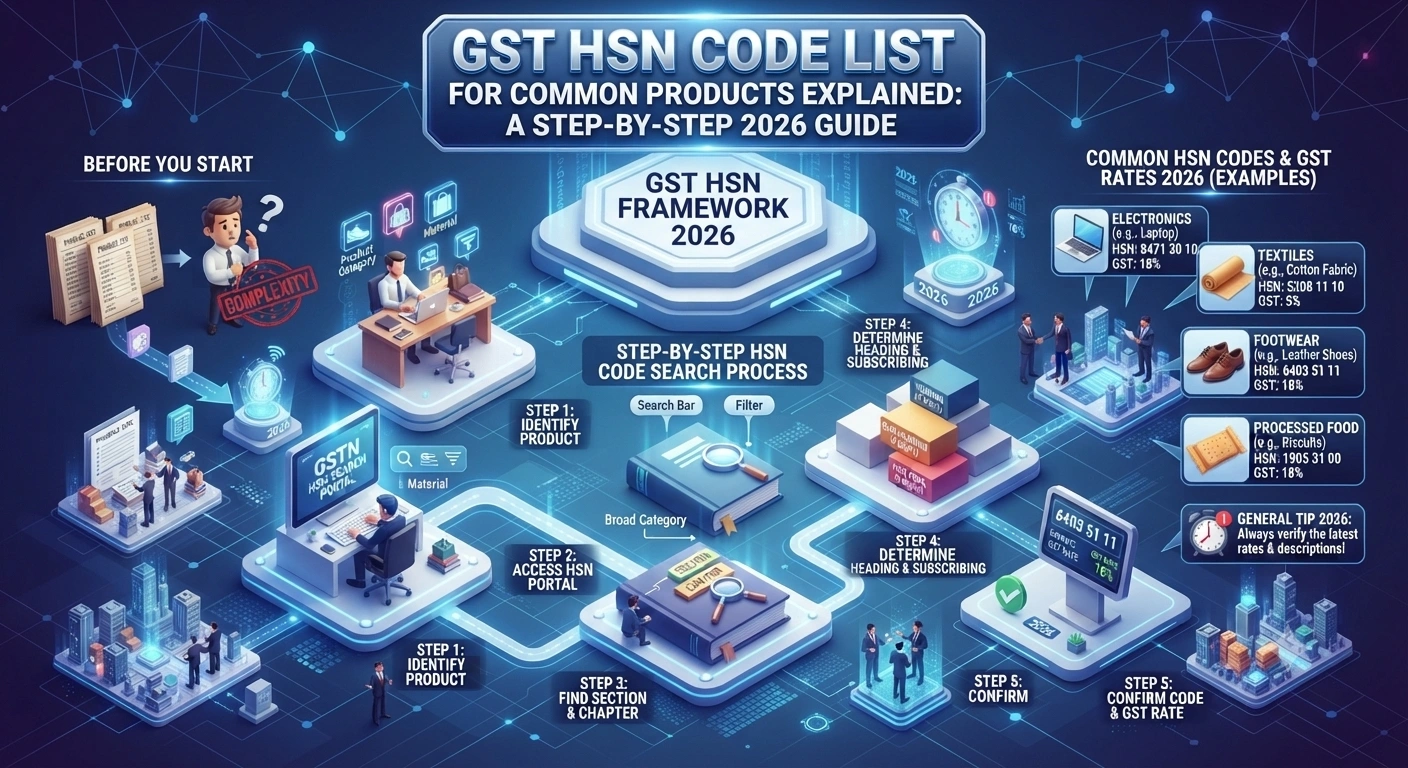
- Misclassifying goods or services under wrong HSN codes
- Not reconciling GSTR-2A with your purchase records
- Paying GST late or partially
Keep digital copies of all invoices. Use accounting software that tracks GST automatically. This saves you hours during filing season and protects you from audit notices.
GST Penalties: What Can Go Wrong and What It Costs
Let me be straight with you: GST penalties are harsh. The government doesn't mess around here.
If you don't file your return, you're looking at a penalty of Rs. 100 per day, up to a maximum of Rs. 25,000. That's just for not filing. If you file late, it's 5% of your tax liability. If you claim input credit you're not allowed to claim, it's 10% plus interest at 18% per annum.
And here's what scares most business owners: if the authorities think you've done it deliberately, they can impose penalties up to 10 times the tax amount. Plus they can prosecute you criminally.
| Violation | Penalty Amount |
|---|---|
| Late filing of return | 5% of tax liability or Rs. 100 (whichever is higher) |
| Not filing return at all | Rs. 100 per day (max Rs. 25,000) |
| Wrong HSN code classification | 5% to 10% of tax amount |
| Unjustified input credit claim | 10% plus 18% interest |
| Willful default or fraud | Up to 10 times the tax amount |
GST authorities conduct random audits. If you're selected, they'll ask for invoices, purchase bills, and bank statements. If your records don't match your returns, you'll pay penalties plus interest. Keep everything organized.
Input Tax Credit: How to Maximize It Without Getting Caught
Input tax credit is where you save real money. It's the GST you pay on your purchases, and you can subtract it from the GST you collect from customers. So what does this mean for you? Lower tax bills.
But—and this is a big but—you can only claim credit on invoices that meet specific conditions. The supplier must be registered, the invoice must have their GSTIN, and the goods or services must be used for your business.
You can't claim credit on personal expenses. You can't claim credit on food and beverages (unless you're in hospitality). You can't claim credit on motor vehicles (unless you're a transport operator). And you definitely can't claim credit on expenses that the law says you can't.
- All business purchases from registered suppliers
- Capital goods purchased for business use
- Raw materials and components
- Services like audit, legal, and accounting (if related to business)
- Rent and utilities (if for business premises)
Here's my advice: match your GSTR-2A with your purchase invoices every month. If something doesn't match, fix it immediately. Don't wait until the year-end audit.
Special GST Schemes for Small Businesses in 2026-2027
The government has created special schemes for small businesses. And honestly, if you qualify, you should be using them.
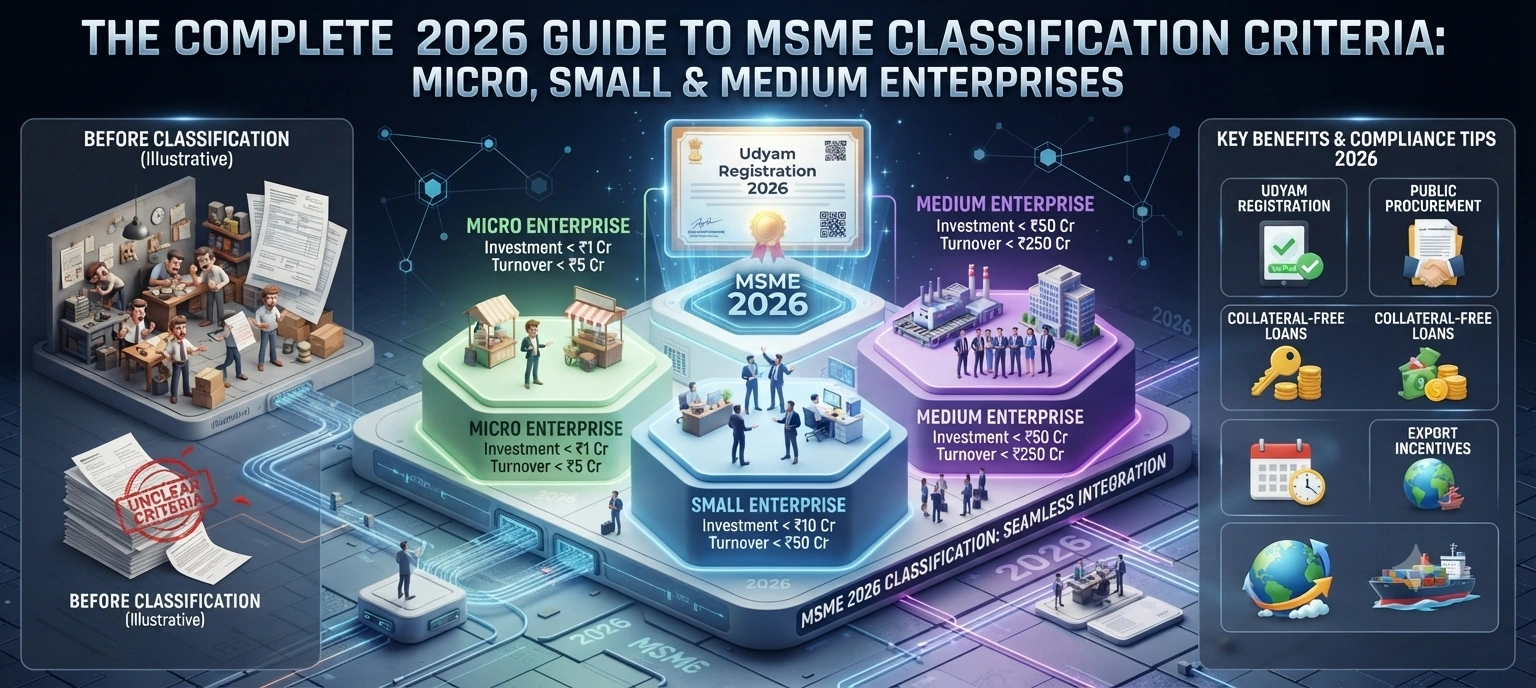
The Composition Scheme is one of them. If your annual turnover is below Rs. 50 lakh (or Rs. 75 lakh for certain services), you can opt for this scheme. Instead of filing quarterly returns and calculating tax, you pay a fixed percentage of your turnover as tax. It's simpler, and you don't need to maintain detailed records.
But there's a trade-off: you can't claim input credit. So if you're buying a lot of goods and want to claim credit, the Composition Scheme might not be right for you. You need to do the math.
Composition Scheme means no quarterly filings, no GSTR-1, no GSTR-3B. You file just one annual return. It's a massive time-saver if you're doing simple business with low input costs.
Practical Tools to Stay Compliant
You don't need to be a tax expert to stay compliant. You just need the right tools and systems.
First, get accounting software. There are plenty of options—Tally, Busy, Zoho Books, or even QuickBooks. Most of them have GST modules that automatically calculate taxes and generate returns. It takes the guesswork out of filing.
Second, maintain a checklist. Create a monthly checklist of what needs to be done: reconcile invoices, check GSTR-2A, prepare GSTR-1, file GSTR-3B. Stick to it. Missing one deadline can snowball into problems.
Third, keep backups. Digital copies of all invoices, bills, and bank statements. Cloud storage is cheap—use it.
- Cloud-based accounting software (Tally Prime, Zoho Books, or similar)
- GST portal account with active login credentials
- Digital signature for filing returns online
- Organized folder structure for invoices and bills
- Monthly reconciliation checklist
- Calendar reminders for filing deadlines
What to Do If You Get an Audit Notice
Getting an audit notice is stressful, but it's not the end of the world. Most audits happen because the system flagged something unusual—maybe your input credit is too high, or your turnover jumped suddenly.
When you get a notice, don't panic. You've got 30 days to respond. Gather your documents—invoices, bank statements, purchase bills, everything that supports your return. If you can't explain something, be honest about it. The authorities respect honesty more than you'd think.
And honestly? Get professional help. A CA can represent you, respond to notices, and negotiate with the authorities. It's worth the cost.
Frequently Asked Questions About GST Compliance
Q: Can I claim GST input credit on food and beverages purchased for my office?
No. GST law specifically excludes input credit on food and beverages, even if they're for your office. There's an exception if you're in hospitality or catering, but for regular businesses, it's not allowed. The government doesn't want businesses to claim credit on what it considers personal consumption.
Q: What happens if I don't register for GST when I should have?
You're liable for penalties and interest. The authorities can demand unpaid GST from the date you should've registered, plus 18% interest per annum. And if they think you did it deliberately, there are criminal penalties too. If you realize you missed the deadline, register immediately and file an application for waiver of penalties. Being proactive helps.
Q: Can I deregister from GST if my turnover drops below the threshold?
Yes, you can. If your turnover stays below the threshold for two consecutive financial years, you can apply for deregistration. But be careful—if you deregister, you lose input credit on your inventory. Do the math before applying.
Q: How long should I keep GST records?
Keep them for six years. That's the rule. The authorities can audit you up to six years back, so you need to have everything. After six years, you can destroy them, but I'd recommend keeping digital copies longer just to be safe.
Q: What's the difference between GSTR-1 and GSTR-3B?
GSTR-1 is where you report all your sales. GSTR-3B is where you report your tax liability after adjusting for input credit. Think of GSTR-1 as the detail and GSTR-3B as the summary. You file GSTR-1 by the 11th of the next month and GSTR-3B by the 20th.
Final Thoughts: Staying Ahead of GST Compliance
GST compliance doesn't have to be complicated. The key is staying organized, filing on time, and keeping proper records. Most problems happen because people leave things to the last minute or don't maintain proper documentation.
And honestly, if you're confused about anything, ask a professional. A CA or tax consultant can help you set up systems that work for your business. It's an investment that pays for itself in saved penalties and recovered input credit.
The good news? GST compliance is getting easier. The government keeps improving the system, and more tools are available every year. In 2026-2027, with the right setup, you can manage GST compliance in a few hours each month instead of days.
So take action today. Register properly, set up your accounting system, and file your returns on time. Your future self will thank you.
" } ```
© 2026 Tax Esquire | Expert CA Services in Greater Noida, Uttar Pradesh
8810380146 | info.taxesquire@gmail.com | taxesquire.in
This document is for informational purposes only. For personalised tax advice, consult our chartered accountants.