
CA Career Path in 2026: Skills, Salary, and Success Strategy for Indian Chartered Accountants
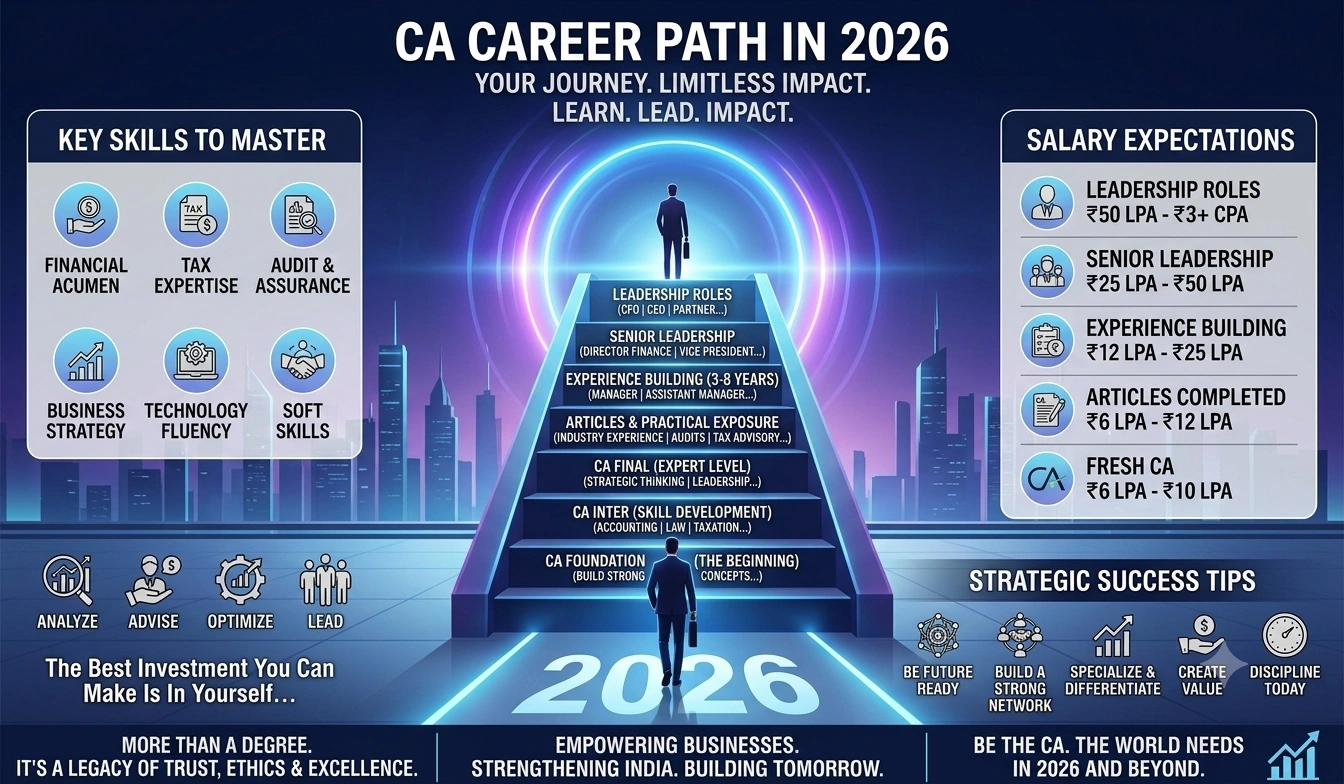
CA Career Path in 2026
Build a rewarding accounting career with practical insights on salary trends, essential skills, and growth opportunities
Why CA Career Matters More Than Ever in 2026
Look, the accounting profession has changed dramatically. Back in 2015, being a CA meant knowing tax laws and audit procedures. That's still important, but now? You also need to understand data analytics, GST compliance systems, and digital transformation. The job market rewards CAs who adapt fast.
India's economy is growing. More startups are launching every month. Regulations keep getting stricter. What does this mean for you? There's genuine demand for skilled chartered accountants who can help businesses navigate complexity. And that's really it—demand creates opportunity.
But here's the thing: not all CA careers look the same. Some people earn ₹5 lakhs annually. Others make ₹50+ lakhs. The difference? Skills, specialization, and strategic choices. This guide walks you through exactly what you need to do in 2026 to build real income and impact.
CA Salary Reality Check for 2026
Let's talk money. I won't sugarcoat it. Your first year after qualification? You're looking at ₹3.5 to ₹6 lakhs annually if you join a firm. That's entry-level. It's honest work, but not life-changing income.
| Experience Level | Typical Annual Salary (2026) | Career Path |
|---|---|---|
| Fresh CA (0-1 year) | ₹3.5L - ₹6L | Audit/Tax firms |
| Junior CA (1-3 years) | ₹6L - ₹12L | Senior roles/specialization |
| Senior CA (3-5 years) | ₹12L - ₹25L | Manager/consultant level |
| Lead CA (5-8 years) | ₹25L - ₹45L | Partner/practice owner |
| Established Practice (8+ years) | ₹45L - ₹100L+ | Firm owner/partner |
These numbers assume you're working in metro cities like Delhi, Mumbai, or Bangalore. Smaller cities pay 20-30% less. But here's what matters: salary grows fast if you pick the right specialization and build genuine expertise.
And honestly, the biggest earners aren't always the ones who stay in firms. Some CAs start their own practice by year 3-4. Others move into corporate roles with better stability. The path you choose shapes your earning potential dramatically.
CAs who specialize in GST, transfer pricing, or forensic accounting earn 30-50% more than generalists. Specialization is your fastest path to higher income in 2026.
Essential Skills Every CA Needs Right Now
Technical knowledge alone won't cut it anymore. Yes, you need to know tax law, audit standards, and accounting principles. But that's just the baseline. What separates high-earning CAs from average ones?
- Data Analytics & Excel Mastery: Most CAs are weak here. If you can build dashboards, write pivot tables, and understand basic SQL, you're already ahead. Clients pay premium fees for CAs who can turn data into decisions.
- GST & Indirect Tax Expertise: GST compliance is complex. Businesses struggle with it. CAs who truly understand GST filing, ITC claims, and compliance become indispensable. This is a genuine money skill in 2026.
- Financial Planning & Advisory: Audit work is getting automated. But advice? That's still human. Learning to advise startups on financial structure, tax planning, and growth strategies builds long-term client relationships.
- Digital Tools Proficiency: Tally, SAP, QuickBooks, and cloud-based accounting software. The more platforms you know, the more valuable you become. Many firms pay extra for CAs with software expertise.
- Communication & Client Management: Your technical skills mean nothing if clients don't trust you. Learning to explain complex tax concepts in simple terms, following up consistently, and building relationships—these soft skills directly impact your earning potential.
- Business Acumen: Understanding how businesses actually work—cash flow, working capital, profitability—helps you give better advice. Read annual reports, follow market trends, and learn how different industries operate.
So what's the priority? Start with GST mastery and Excel skills. These two alone will boost your market value significantly in 2026.
Many CAs rely only on traditional audit and tax work. But automation is eating into these services. If you don't develop advisory and specialized skills, your income growth will plateau after 5-7 years. Invest in learning now.
Top CA Specializations for 2026
Basically, choosing a specialization early is like choosing a high-demand skill. You become the expert. Clients seek you out. Fees go up. Let me break down the most profitable specializations right now.
1. GST & Indirect Tax Specialization
GST is still evolving. Compliance is messy. Businesses need help. A CA who masters GST filing, input tax credit optimization, and compliance can charge ₹15,000 to ₹50,000 per client monthly. That's real income. Consider getting specialized GST certifications and building a practice around this.
2. Transfer Pricing & International Tax
India's cross-border business is booming. Companies doing international trade need transfer pricing documentation. This is high-value work. A single transfer pricing engagement can be ₹2-5 lakhs. But you need specialized knowledge and experience.
3. Forensic Accounting & Fraud Investigation
Banks, corporates, and government agencies hire forensic accountants. The work is interesting. The pay is solid—₹20,000 to ₹75,000 per assignment. But you need investigative skills and experience in fraud detection.
4. Startup & MSME Advisory
Startups are everywhere. They need help with financial structure, funding rounds, compliance, and tax planning. And honestly, they're willing to pay well for good advice. Building a startup-focused practice can be very profitable, especially if you understand equity, valuations, and investor requirements.
5. Insolvency & Bankruptcy
The Insolvency and Bankruptcy Code created new opportunities. Insolvency professionals earn well. If you get certified and build expertise in this area, there's consistent work and good income potential.
The thing is, you don't need to pick just one forever. But starting with one specialization builds your reputation faster. Once you're known as an expert in GST or transfer pricing, clients come to you. That's when income really grows.
Career Paths: Which Route Should You Take?
After qualification, you have roughly four main paths. Each has different income potential, work-life balance, and growth trajectory. Let me walk through each honestly.
Path 1: Join a Big Audit Firm
The Big 4 (Deloitte, EY, KPMG, PwC) and other large firms offer structured growth, exposure to big clients, and good learning. You'll work on complex audits, tax matters, and advisory projects. The downside? Long hours, especially during audit season. The upside? Strong foundation, good network, and decent salary progression.
By year 3-4, you can move to corporate roles or start your own practice with solid experience. But be honest: can you handle 50-60 hour weeks for 3-4 years? If yes, this builds real expertise.
Path 2: Join a Mid-Size Practice
Smaller practices (5-30 people) give you more responsibility faster. You might handle client relationships, tax planning, and compliance work directly. The salary is similar to big firms, but you learn business management earlier. This path is good if you want to start your own practice eventually.
Path 3: Corporate Finance Role
Some CAs join corporates directly—finance teams, tax departments, or financial planning roles. The hours are better. The work is more focused. But learning is slower compared to practice. Salary starts at ₹5-8 lakhs and grows steadily. This path suits people who value stability and work-life balance over maximum income.
Path 4: Start Your Own Practice
Some CAs start practicing immediately after qualification. This requires business skills, client relationships, and financial runway. Year 1-2 is tough—you might earn ₹2-3 lakhs while building your practice. But by year 3-4, if you build good clients, income can be ₹15-30 lakhs. By year 8-10, it's ₹50+ lakhs for successful practitioners.
The risk? No guaranteed income. The reward? Unlimited upside. This suits people who are disciplined, good at sales, and can handle uncertainty.
Most successful CAs combine paths. They work in firms for 3-4 years, build expertise and relationships, then start their own practice. This gives you the best of both worlds: strong foundation plus entrepreneurial upside.
Building Your Personal Brand as a CA
Here's something most CAs ignore: personal branding. And that's a mistake. Your reputation directly impacts your income. Let me explain what I mean.
When clients hire a CA, they're not just buying technical knowledge. They're buying trust, reliability, and reputation. A CA with a strong brand can charge 2-3x more than an unknown CA doing the same work. So how do you build this?
- Content Creation: Write articles about tax changes, GST updates, or compliance issues. Share them on LinkedIn. When people search for GST advice and find your article, they start seeing you as an expert. This builds credibility.
- LinkedIn Presence: Most CAs don't use LinkedIn effectively. Post regularly. Share client wins (anonymously). Comment on industry posts. Build your network. By 2026, your LinkedIn profile should show you as an active professional in your field.
- Speaking Engagements: Speak at industry events, webinars, or business chambers. Every speaking engagement positions you as an expert. It also brings client inquiries.
- Certifications & Courses: Get certified in specialized areas. Take advanced courses. Update your skills publicly. Clients trust certified experts more than generalists.
- Client Testimonials: Ask satisfied clients for testimonials. Display them on your website or LinkedIn. Social proof is powerful. Potential clients see that real people trust you.
- Networking: Attend industry events, join professional groups, build relationships with other professionals. Most high-earning CAs get clients through referrals, not advertisements. Your network is your net worth.
Building personal brand takes time, but it's the fastest way to increase your fees and attract better clients. Start now. By 2027, you'll see the difference.
Compliance & Regulatory Knowledge That Matters
Look, being a CA means staying updated on regulations. It's not optional. In 2026, the compliance landscape keeps changing. What's important right now?
- GST Compliance: GST rules change frequently. You need to know the latest amendments, notification changes, and compliance requirements. This is fundamental.
- Income Tax Updates: Tax rates, deductions, and filing requirements change annually. Stay current. Many CAs lose credibility by giving outdated advice.
- Companies Act & MCA Rules: If you advise companies, you need to know company law, MCA compliance, and corporate governance. This knowledge is valuable.
- IBC (Insolvency & Bankruptcy Code): This is a growing area. Understanding insolvency processes helps you advise troubled businesses and opens new income streams.
- Digital Audit & Technology: Auditing is becoming digital. Learn about blockchain, digital signatures, and technology-enabled audit procedures. This is the future.
But here's the thing: don't try to know everything. Pick 2-3 areas and become really deep in those. Depth beats breadth in building expertise and income.
Practical Action Steps for 2026
Enough theory. Let me give you concrete steps you can start right now.
- Month 1-2: Choose Your Specialization Decide which area interests you most—GST, transfer pricing, startup advisory, or forensic accounting. Research the market demand. Talk to CAs working in that field. Commit to becoming an expert.
- Month 2-3: Get Certified Enroll in specialized courses or certifications. ICAI offers many. Online platforms have others. Invest in formal training. By month 3, you should be enrolled in a course that builds your chosen specialization.
- Month 3-4: Start Building Your Online Presence Create a LinkedIn profile. Write your first article. Share it. Start engaging with content in your field. By month 4, you should have posted at least 4-5 times.
- Month 4-6: Gain Practical Experience Work on real projects in your specialization. If you're in a firm, volunteer for specialized work. If you're starting your own practice, take on clients in your chosen area. Real experience builds confidence and expertise.
- Month 6-12: Build Your Network Attend 2-3 industry events. Join a professional chamber. Connect with 50+ people in your field on LinkedIn. Have coffee conversations. Build relationships. By year-end, you should have a solid network in your specialization.
These aren't revolutionary steps. But most CAs don't do them. If you do, you'll be ahead of 80% of your peers by end of 2026.
Challenges You'll Face (And How to Handle Them)
Let me be honest about the tough parts. The CA journey isn't easy. Knowing what's coming helps you prepare mentally.
Challenge 1: Long Hours in Early Years Audit season is brutal. You might work 50-60 hours weekly. This affects your health and personal life. Solution? Accept it as temporary. These years build your expertise. But set a deadline—by year 4-5, transition to a better work-life balance.
Challenge 2: Constant Regulatory Changes Tax laws change. Compliance requirements evolve. Staying updated requires continuous learning. Solution? Allocate 2-3 hours weekly to reading regulatory updates. Subscribe to ICAI newsletters. Join professional groups. Make learning a habit.
Challenge 3: Client Management & Difficult Clients Some clients are unreasonable. They want free advice. They delay payments. They don't value your work. Solution? Develop clear policies. Set boundaries. Fire bad clients. Your time is valuable. Protect it.
Challenge 4: Competition & Income Pressure There are many CAs. Fees are getting compressed. Starting your own practice means uncertain income. Solution? Differentiate yourself through specialization and personal branding. Build a unique value proposition. Don't compete on price.
Don't get stuck in a generalist trap. If you do basic audit and tax work for everyone, you'll always be competing on price. Specialization protects your fees and makes you irreplaceable.
Frequently Asked Questions
Q1: What's the realistic salary for a fresh CA in 2026?
A: In metro cities, expect ₹3.5-6 lakhs annually if you join a firm. Smaller cities pay 20-30% less. If you start your own practice, the first year is tough—you might earn ₹1-3 lakhs while building clients. But by year 3, income jumps significantly if you've built good client relationships.
Q2: How long does it take to earn ₹20+ lakhs as a CA?
A: If you're in a firm, it takes about 5-7 years to reach senior positions with ₹20+ lakhs salary. If you start your own practice and specialize in high-value services (like transfer pricing or forensic accounting), you can reach ₹20+ lakhs by year 4-5. The key is specialization and client relationships, not just time.
Q3: Is it better to work in a firm or start my own practice immediately?
A: Honestly, working in a firm for 2-3 years first is smarter. You build expertise, get client exposure, and develop a network. Then, starting your own practice becomes easier because you have experience and relationships. The exception? If you have existing client relationships or significant financial runway, starting immediately can work.
Q4: Which specialization gives the highest income potential?
A: Transfer pricing and forensic accounting offer the highest fees per engagement. But GST specialization has more consistent work. Startup advisory is growing fast. Pick based on market demand in your region and your genuine interest. Income follows expertise, not the other way around.
Q5: How important is personal branding for a CA's success?
A: Very important. CAs with strong personal brands charge 2-3x more than unknown CAs. Your reputation is your biggest asset. Start building it now—write articles, be active on LinkedIn, speak at events, get certified. By 2027, your personal brand will directly impact your income and client quality.
Final Thoughts: Your CA Career in 2026
So here's the reality: being a CA in 2026 is both challenging and rewarding. The market is competitive, but there's genuine demand for skilled, specialized accountants. Your income potential is real—from ₹50 lakhs to ₹100+ lakhs annually if you make smart choices.
The difference between average CAs and high-earning ones isn't talent. It's specialization, continuous learning, and personal branding. Pick a specialization. Build expertise. Develop your personal brand. Serve your clients exceptionally well. Do these things, and income follows naturally.
And honestly, the best time to start is now. Don't wait for the perfect moment. Choose your specialization this month. Enroll in a course next month. Start building your online presence. By year-end 2026, you'll be positioned for serious income growth in 2027.
Your CA career is what you make it. Make it count.
" } ```
© 2026 Tax Esquire | Expert CA Services in Greater Noida, Uttar Pradesh
8810380146 | info.taxesquire@gmail.com | taxesquire.in
This document is for informational purposes only. For personalised tax advice, consult our chartered accountants.