
Professional Deductions Under Income Tax Act 2026: Complete Guide for Indian CAs and Professionals
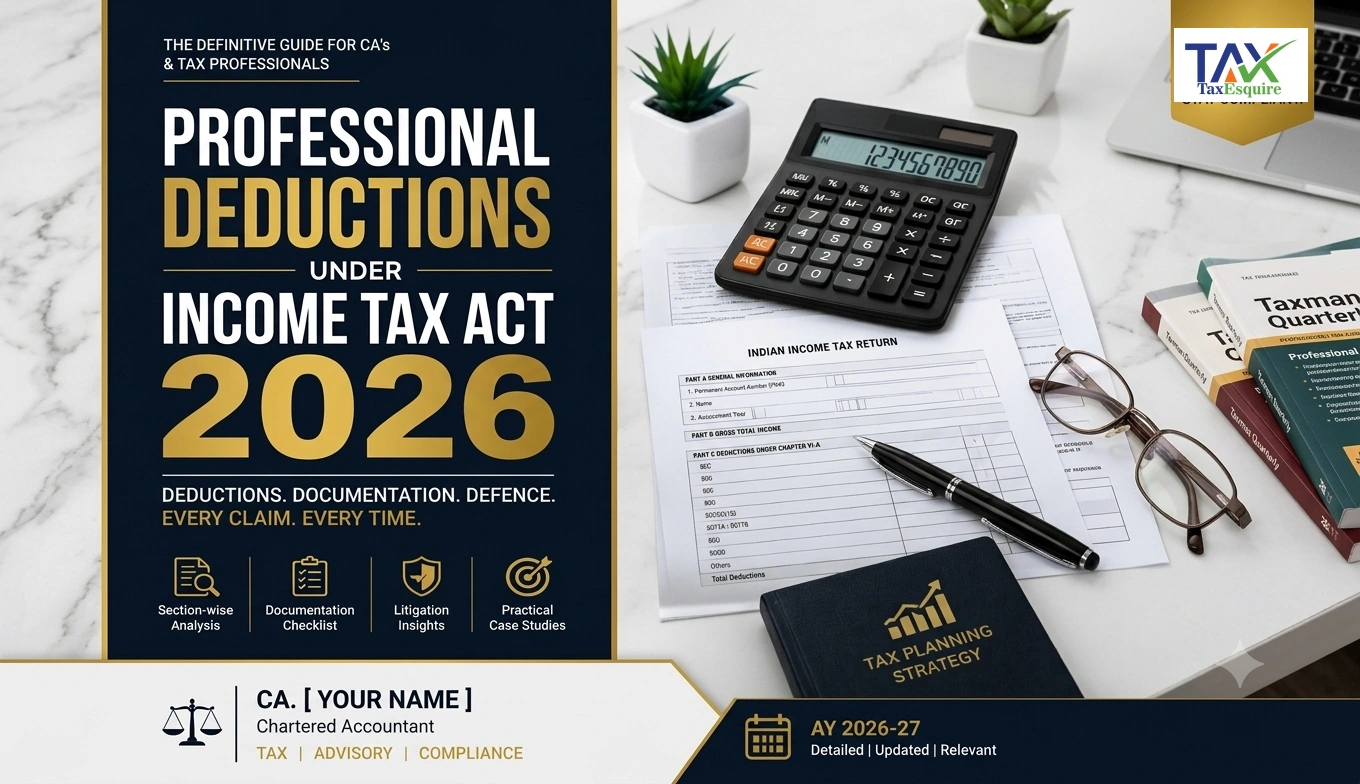
Professional Deductions Under Income Tax Act 2026
Everything you need to know about claiming legitimate business deductions as a professional in 2026-2027
What Are Professional Deductions?
Look, professional deductions are basically expenses you pay while running your practice that directly help you earn income. If you're a CA, doctor, lawyer, consultant, or any other professional, you can claim these against your gross income to reduce your taxable amount.
The thing is, the Income Tax Act allows this under Section 37. But here's what catches most professionals off guard—not every expense counts. The expense needs to be directly connected to your profession and reasonable in amount. So what does this mean for you? You need to be smart about what you claim and keep solid paperwork to back it up.
And that's really it at the core level. You earn money, you spend money to earn that money, and you deduct the legitimate spending from your income before paying tax. Simple concept, but the details matter.
Claiming professional deductions can reduce your taxable income by 20-35% depending on your practice structure, directly lowering your tax liability for 2026-2027.
Categories of Professional Deductions You Can Claim
Professional deductions fall into several buckets. Let me walk you through each one so you don't miss anything legitimate.
1. Office Rent and Premises Costs
If you rent an office space, the entire rent is deductible. But here's the catch—if you run your practice from home, you can't claim rent. However, you can claim a portion of your home maintenance, property tax, and utilities if you have a dedicated office room. The rule is straightforward: the expense must be wholly and exclusively for your profession.
Honestly, most professionals get this wrong. They either claim too much or claim nothing at all. The right approach? Calculate the percentage of your home used for office work and claim that proportion of maintenance costs.
2. Staff Salaries and Employee Benefits
Every rupee you pay to your employees, assistants, or support staff is deductible. This includes salaries, bonuses, gratuity contributions, and leave encashment. You also get to deduct employer's contribution to PF, ESI, and other statutory benefits.
But—and this is important—you need to file Form 12BA with the income tax office if you have employees. Also, you must deduct TDS from their salaries and deposit it on time. Missing this will create problems during audit in 2026 or 2027.
3. Professional Fees and Subscriptions
As a CA, you pay annual membership fees to ICAI. Doctors pay to medical councils. Lawyers pay to bar associations. All of these are fully deductible. You also get to claim fees for professional courses, certifications, and training programs that help you stay current in your field.
- ICAI membership fees and annual subscriptions
- Professional development courses and certifications
- Continuing education programs in your field
- Journal and publication subscriptions related to your profession
- Professional software licenses and tools
4. Office Equipment and Supplies
Stationery, computer supplies, printer ink, paper—these are all deductible. But here's where depreciation rules kick in. If you buy furniture, computers, or office equipment costing more than 5,000 rupees, you can't deduct it fully in one year. You need to claim depreciation over several years as per Schedule II of the Income Tax Act.
Put simply, small items go straight to deductions. Big items get depreciated. For 2026-2027, depreciation rates remain the same: 15% for computers and office equipment, 10% for furniture, 40% for vehicles.
5. Utilities and Communications
Telephone bills, internet charges, mobile recharge for business use—you can claim these. If you have a landline for your office, the entire bill is deductible. For mobile phones, claim only the business portion. Many professionals claim 100% of their mobile bill, which raises audit flags. Be conservative and honest here.
Electricity and water bills for your office space are also deductible. If it's a shared space, claim proportionately.
6. Conveyance and Travel
Local travel for meeting clients or attending to professional work is deductible. Auto-rickshaw fares, cab rides, fuel for your car—all count. But here's the rule: the travel must be for business purposes, not personal commuting.
For vehicle maintenance, fuel, and repairs, you can claim actual expenses. Alternatively, some professionals use a fixed rate method. In 2026-2027, most CAs use actual method since it's clearer and audit-friendly. Keep receipts for everything.
7. Professional Indemnity and Other Insurance
If you pay professional indemnity insurance (PII), it's fully deductible. CAs, lawyers, and doctors typically buy this to protect against liability claims. The premium you pay is a business expense and reduces your taxable income.
Health insurance for yourself and your staff also qualifies, but there's a cap. For 2026-2027, you can deduct up to 25,000 rupees per person for health insurance premiums under Section 80D. Beyond that, it goes under Section 80D limits, not professional deductions.
8. Audit and Compliance Costs
The fees you pay to get your books audited are deductible. Statutory audit fees, internal audit costs, tax compliance fees—all of these are legitimate business expenses. In 2026-2027, many professionals spend 15,000 to 50,000 rupees annually on audit and compliance, and every rupee is deductible.
What You Cannot Deduct as Professional Expenses
Just as important as knowing what you can deduct is knowing what you can't. The tax department is strict about this, and claiming non-deductible items invites scrutiny.
- Personal expenses like groceries, clothing, or personal grooming products
- Rent paid to yourself if you own the building your practice operates from
- Capital expenditure like buying land, buildings, or major equipment (these get depreciated, not deducted)
- Income tax paid by you (this isn't deductible; it's a personal liability)
- Penalties, fines, or legal costs related to your own violations
- Donations to political parties (not deductible as business expense)
- Personal loans or interest on personal borrowing
Many professionals claim personal expenses as business deductions and get caught during audit. In 2026-2027, the tax department is using data analytics to flag unusual deduction patterns. Be honest about what you claim or face penalties of 50-100% of the tax evaded plus interest.
Practical Example: CA's Annual Deductions
Let me show you how a typical CA in Delhi might claim professional deductions for 2026-2027.
| Expense Category | Annual Amount (₹) |
|---|---|
| Office rent (1000 sq ft @ ₹50/sq ft) | 6,00,000 |
| Staff salary (2 assistants) | 4,00,000 |
| ICAI membership and CPD | 35,000 |
| Professional software licenses | 1,50,000 |
| Office utilities and internet | 60,000 |
| Vehicle fuel and maintenance | 1,20,000 |
| Professional indemnity insurance | 25,000 |
| Audit and tax compliance fees | 40,000 |
| Office supplies and stationery | 30,000 |
| Total Professional Deductions | 13,60,000 |
So if this CA earned a gross income of 25,00,000 rupees in 2026-2027, their taxable income would be 11,40,000 rupees (25,00,000 minus 13,60,000 deductions). That's a significant reduction in tax liability. But—and this is crucial—every single one of these deductions needs supporting documentation.
Documentation and Record-Keeping for 2026-2027
Here's what separates professionals who get audited from those who don't: documentation. The tax department doesn't just look at your profit and loss statement. They want to see the actual bills, receipts, and invoices.
For 2026-2027, maintain these records:
- Rent agreement and monthly rent receipts or bank transfer statements
- Salary slips and PF/ESI contribution proofs for all employees
- Membership certificates and subscription payment receipts
- Software license agreements and annual renewal invoices
- Utility bills (electricity, water, internet) showing your office address
- Vehicle maintenance bills and fuel receipts or credit card statements
- Insurance policy documents and premium payment receipts
- Audit reports and compliance certificates
- Travel tickets and hotel bills for professional travel
And that's really it for documentation. Keep everything for at least 6 years from the end of the assessment year. The Income Tax Act requires this, and you don't want to be caught without proof during an audit notice.
Proper documentation not only helps you claim deductions confidently but also speeds up the audit process. If the tax officer sees organized records, they're likely to close the audit faster and without questions.
Common Mistakes Professionals Make When Claiming Deductions
I've reviewed hundreds of tax returns, and certain patterns keep repeating. Let me point out the mistakes you should avoid in 2026-2027.
Mistake 1: Claiming 100% of Mixed-Use Expenses
Your mobile phone bill includes personal calls. Your vehicle is used for both business and personal travel. Your home has an office room but also living spaces. You can't claim 100% of these mixed expenses. The tax department expects you to allocate them fairly. If you claim everything, you'll get a notice.
Mistake 2: Confusing Deductions with Depreciation
A new computer costs 80,000 rupees. You can't deduct the full amount in year one. You claim depreciation at 15% per year. Many professionals get this wrong and face disallowances during audit. The rule is simple: assets costing more than 5,000 rupees get depreciated. Consumables and supplies get deducted.
Mistake 3: Not Maintaining Proper Invoices
You pay someone cash for office repairs. No invoice, no receipt. You can't claim it because you can't prove it. The tax officer will disallow it. For every expense over 2,000 rupees, get a proper invoice. For cash expenses under 2,000 rupees, keep a memo or receipt.
Mistake 4: Claiming Personal Expenses as Business Expenses
Your spouse's health insurance, your children's education fees, your home loan interest—these aren't professional deductions. They're personal expenses with their own tax benefits under different sections. Mixing them up invites trouble.
Mistake 5: Ignoring GST on Professional Invoices
If you're registered for GST, the GST amount on your business expenses is input tax credit, not a deduction. You claim it in your GST return, not your income tax return. But the net amount (before GST) is what you deduct from income. This confusion costs many professionals thousands of rupees annually.
Special Deductions for Specific Professionals
Different professionals get different deductions. Let me break this down by profession.
For Chartered Accountants
Beyond regular deductions, CAs get to claim audit fees they pay to other CAs, book-keeping software costs, and fees for attending ICAI seminars. If you conduct audit assignments, the cost of audit sampling and testing is deductible.
For Doctors and Surgeons
Medical equipment maintenance, sterilization costs, medical journals, and continuing medical education are all deductible. If you operate a clinic, the cost of medicines and consumables used on patients is also deductible.
For Lawyers
Law books, legal database subscriptions, bar association fees, and court fees are deductible. If you hire junior advocates or paralegals, their salaries are deductible.
For Consultants and Coaches
Training materials, online course subscriptions, webinar fees, and conference registrations are deductible. If you maintain a library of reference materials, those costs are deductible too.
How Professional Deductions Interact with Other Tax Benefits
Professional deductions don't exist in isolation. They work alongside other tax benefits, and you need to understand how they fit together.
For example, if you pay health insurance premiums, part of it might be a professional deduction (for employee insurance) and part might be a personal deduction under Section 80D. You can't claim the same amount twice. The system prevents double-counting.
Similarly, if you work from home and claim home office deduction, you can't also claim the full rent as a business expense elsewhere. The rule is simple: each rupee gets claimed only once, in the right category.
For 2026-2027, if you have a home office, you can claim either actual rent (if you rent) or a notional deduction of 30% of rent or 24% of property tax (whichever is higher) if you own the property. Choose wisely based on your situation.
Audit Red Flags Related to Professional Deductions
The tax department uses algorithms to identify suspicious patterns. If your return shows any of these, expect an audit notice in 2026 or 2027.
- Deductions exceeding 50% of your gross income (unless justified by your profession)
- Claiming rent to a related party (spouse, parent, child) without proper documentation
- Round figures in deductions (exactly 1,00,000 or 5,00,000 looks suspicious; actual expenses are rarely round)
- Deductions that increase suddenly year-over-year without explanation
- Claiming high travel or conveyance costs without supporting bills
- Employee salaries that don't match TDS deposits or PF contributions
- Professional fees paid to individuals without GST invoices (if they're registered)
If you're audited and the tax officer disallows your deductions, you face not just tax liability but also interest at 6-12% per annum and penalties up to 50% of the disallowed amount. In 2026-2027, the tax department is aggressive about this. Don't risk it.
FAQs on Professional Deductions
Q1: Can I claim my home loan interest as a professional deduction?
No, you can't. Home loan interest is a personal deduction under Section 24. But if you've taken a loan to buy equipment or machinery for your practice, that interest is a professional deduction. The key difference is what you bought with the loan.
Q2: If I work from home, what percentage of my utilities can I claim?
You can claim the percentage of your home used for office. If your home is 1,000 sq ft and your office is 200 sq ft, you claim 20% of utilities. Some professionals use 15-25% as a safe range. Keep it reasonable or the tax officer will question it.
Q3: Are training and certification costs always deductible?
Yes, if they're related to your profession. A CA taking a GST course—deductible. A CA taking a photography course—not deductible. The rule is that the training must help you in your current profession, not prepare you for a different career.
Q4: Can I claim depreciation and deduction for the same asset?
No, absolutely not. You choose one method. For assets costing more than 5,000 rupees, you claim depreciation. For consumables and supplies, you claim deduction. You don't do both for the same item.
Q5: What happens if I can't find receipts for small expenses?
For expenses under 2,000 rupees, you can maintain a memo or diary entry without formal receipts. But it's better to have invoices for everything. If audited and you can't produce proof, the officer can disallow the entire expense. Don't take chances with this.
Q6: Can I claim deductions for a business I shut down mid-year?
Yes, but only for the period you were active. If you shut down in June 2026, you claim deductions for January to June 2026. You don't get a full-year deduction. Also, you need to file your return showing the business closure and declare any closing stock or assets.
Q7: Are gifts to clients deductible?
Gifts to clients are not deductible as business expenses under Section 37. But gifts to employees on festivals or occasions are deductible if they're reasonable in amount (generally up to 500 rupees per person per occasion). Be careful here because the rules are strict.
Recent Changes and Updates for 2026-2027
Tax laws change every year, and 2026-2027 brings some updates you should know about.
The depreciation rates remain unchanged from previous years, but the tax department is now more focused on verifying GST compliance alongside income tax deductions. If you claim a business expense, make sure the corresponding GST invoice (if applicable) is filed in your GST return. Mismatches between income tax and GST returns trigger automatic audits.
Also, the definition of "wholly and exclusively" for professional purposes has been interpreted more strictly by recent tax tribunals. Courts have ruled that expenses must have a direct connection to earning income, not just a loose connection. So if you're on the fence about whether an expense qualifies, err on the side of caution.
For 2026-2027, the tax department is also cracking down on professionals who claim high deductions but show low income growth. If your deductions are 60% of income but your income hasn't grown in 3 years, expect scrutiny. Keep your business growth aligned with your deductions.
Action Plan: How to Optimize Your Professional Deductions
Let me give you a practical roadmap to maximize your deductions legitimately in 2026-2027.
First, audit your current practice. Sit down and list every expense you've incurred in the last 3 months. Go through it with a checklist of deductible items. You'll likely find 10-15% of expenses you're currently not claiming.
Second, organize your documentation. Create folders for each category—rent, salaries, supplies, travel, etc. As soon as you get a bill, scan it and file it. Don't wait until tax season. This saves time and ensures you don't lose any receipts.
Third, maintain a deduction register. A simple spreadsheet tracking date, description, amount, and category for each expense. This makes preparing your profit and loss statement easier and shows the tax officer you're organized.
Fourth, consult a CA before making big purchases. If you're thinking of buying equipment costing 2,00,000 rupees, talk to your CA first. There might be better ways to structure it for tax purposes (lease vs. buy, for example).
Fifth, track your home office allocation. If you work from home, measure the area, calculate the percentage, and document it. Use this consistently every year. Changes year-over-year look suspicious.
And finally, reconcile your tax return with your actual expenses. If you claim 10,00,000 rupees in deductions, make sure your bank statements and GST returns support this. Inconsistencies between documents are the biggest audit triggers.
Conclusion
Professional deductions are one of the most effective ways to reduce your tax liability legally. As a CA, doctor, lawyer, or any other professional, you're entitled to claim every legitimate expense you incur to earn your income. The key is to be smart, organized, and honest about what you claim.
In 2026-2027, the tax department is more vigilant than ever. They're using data analytics and cross-matching information from multiple sources. But if your deductions are genuine and well-documented, you've got nothing to worry about. The worst thing you can do is claim questionable expenses to save a few thousand rupees and then face a major audit with penalties and interest.
Take the time now to organize your records, understand what qualifies as a deduction, and work with a qualified CA to prepare your tax return. The investment in proper tax planning pays for itself many times over.
Remember: the goal isn't to pay the least tax possible. It's to pay the right amount of tax on the right income. Professional deductions help you achieve that balance.
" } ```
© 2026 Tax Esquire | Expert CA Services in Greater Noida, Uttar Pradesh
8810380146 | info.taxesquire@gmail.com | taxesquire.in
This document is for informational purposes only. For personalised tax advice, consult our chartered accountants.