
CMA vs CA vs MBA Finance: Career Comparison for Commerce Students
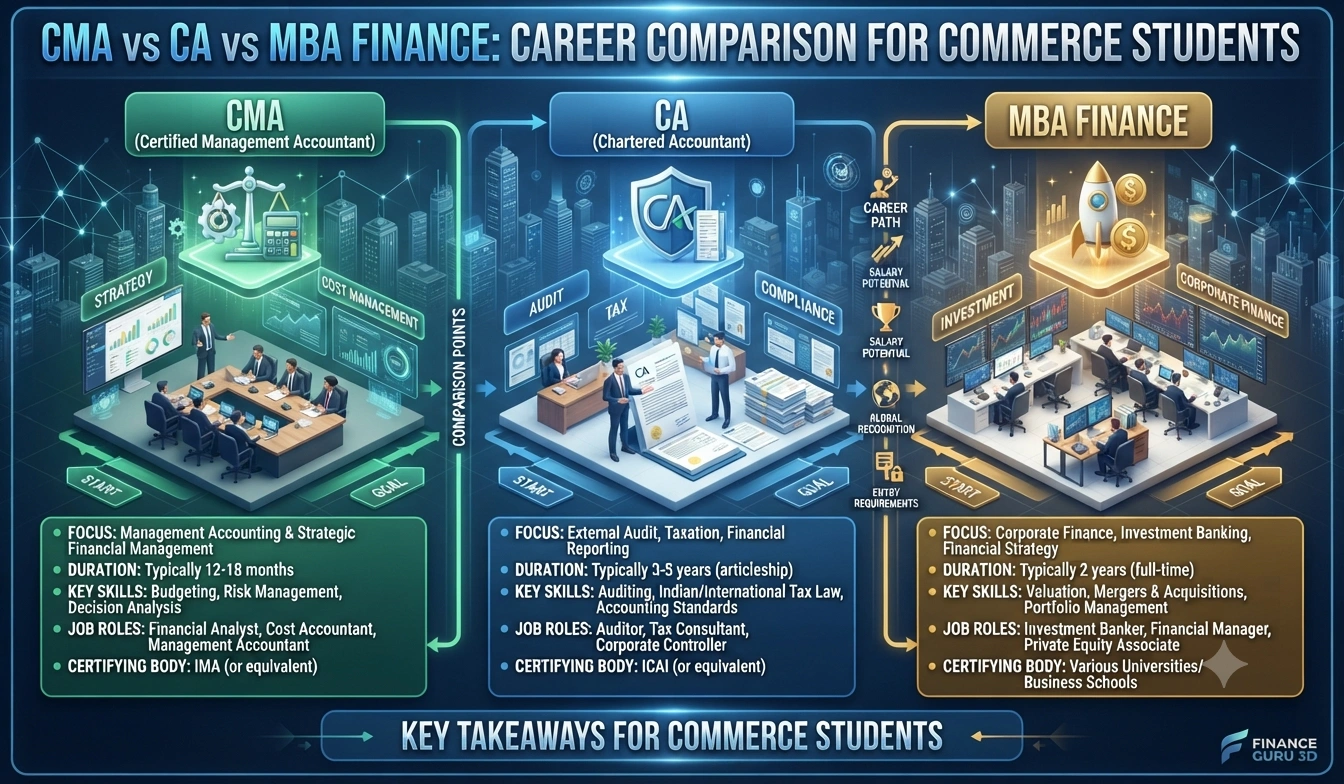
CMA vs CA vs MBA Finance
Which qualification opens the right doors for your financial career?
Why This Matters Right Now
If you're a commerce student standing at a crossroads, you're not alone. Every year, thousands of students like you wonder: should I chase the CA route, go for CMA, or pick an MBA in Finance? The stakes feel high because they are. Your choice today shapes your career for the next 10-15 years.
The thing is, there's no single right answer. But there are right answers for you specifically. So let's break down what each path actually looks like, what you'll earn, how long it takes, and most importantly, what kind of professional life you'll lead.
Quick Comparison Table
| Aspect | CA | CMA | MBA Finance |
|---|---|---|---|
| Total Duration | 4.5-5.5 years | 4-5 years | 2-3 years |
| Entry Salary (2026) | ₹4-6 LPA | ₹3.5-5 LPA | ₹6-10 LPA |
| Peak Salary | ₹25-50+ LPA | ₹20-40+ LPA | ₹18-35+ LPA |
| Difficulty Level | Very High | High | Moderate |
| Job Scope | Audit, tax, compliance | Cost control, budgeting | Finance roles, leadership |
| Global Recognition | Very High | Growing | Very High |
Understanding the CA Path
Chartered Accountant—this is the heavyweight champion of Indian finance qualifications. And for good reason. A CA is basically the gold standard in audit, taxation, and financial compliance work.
Here's how it works: You start with a 4.5-month articleship after passing your final exams. Then comes 4.5 years of on-the-job training while studying simultaneously. It's intense. Really intense. But when you emerge on the other side, you're qualified to sign audit reports, prepare tax filings, and handle complex financial matters that no one else can touch legally.
What Makes CA Special
- Legal authority to sign audit reports and financial statements
- Can practice independently or join firms right away
- Recognized globally—you can work in any country
- Compliance and tax expertise is always in demand
- Strong earning potential from day one as a practitioner
- Can specialize in forensic accounting, insolvency, or valuations
CA qualification gives you legal standing in financial matters. Clients and employers trust you because the law backs your expertise. That's huge for your credibility and earning power.
The Real Challenge
But here's what nobody tells you: the CA exam is brutal. Pass rates hover around 10-15% per attempt. Many students take 2-3 years longer than planned. The workload during articleship is heavy—you're working full-time while studying for final exams. And honestly, if you're not genuinely interested in accounting and tax rules, this path will feel like torture.
Also, the first few years as a CA aren't glamorous. You'll be doing routine audit work, checking invoices, and preparing compliance paperwork. The real money and interesting work come after 5-7 years of experience.
Don't pursue CA just for the prestige or salary. The exam success rate is low, and you need genuine interest in accounting. Many students quit midway because they underestimated the difficulty.
The CMA Route Explained
CMA stands for Cost Management Accountant. It's the specialist qualification for managing costs, budgets, and internal financial operations of companies. Think of it as the internal finance expert—while CAs handle external audit and tax, CMAs handle what happens inside the company.
The path takes about 4-5 years total. You do 8 months of practical training, then study for three levels of exams. The good news? It's less demanding than CA. Pass rates are higher—around 40-50% per attempt. And you can start earning while studying because practical training starts early.
Where CMAs Shine
- Manufacturing companies need CMAs for cost control and budgeting
- Finance teams rely on CMAs for internal reporting and analysis
- You become the expert in cost reduction and profit optimization
- Less stressful exam pattern than CA
- Good salary growth in manufacturing and large corporations
- Can move into CFO roles eventually
But here's the thing: CMA is more specialized. If you want to switch careers later, it's harder than with a CA or MBA. Also, the job market is smaller. Not every company needs a CMA, but every company needs a CA or someone with an MBA.
CMA qualification is your ticket to cost management and operational finance roles. Companies actively hire CMAs for efficiency improvement projects, and you get direct responsibility for profit margins.
MBA Finance: The Generalist Approach
An MBA in Finance is different. It's broader. You're not learning compliance and audit like a CA, and you're not specializing in cost management like a CMA. Instead, you're learning corporate finance, investment analysis, financial planning, and business strategy.
The duration is shorter—2-3 years depending on whether you pick a full-time or part-time program. And here's the big advantage: you start earning much faster. MBA graduates get placed immediately at higher salaries than CA or CMA freshers.
MBA Finance Career Paths
- Investment banking and equity research roles
- Corporate finance roles in large companies
- Finance management in startups and tech companies
- Risk management and financial planning positions
- Faster path to management and leadership roles
- Better suited for people who want business exposure, not just finance
So what's the catch? An MBA doesn't give you legal standing like a CA does. You can't sign audit reports. You can't set up as a financial consultant independently. And if you want to practice as a professional accountant, you'll need additional qualifications.
MBA graduates earn more initially, but without CA or CMA qualification, your long-term earning potential plateaus. You're limited to employment roles. You can't practice independently or offer professional services.
Salary Breakdown: What You'll Actually Earn
Let's talk money because it matters. Here's what the market looks like in 2026-2027:
CA Salary Progression
- Freshly qualified CA (in audit firm): ₹4-6 LPA
- After 3 years experience: ₹8-12 LPA
- After 5-7 years (senior roles): ₹15-25 LPA
- After 10+ years (partner or CFO level): ₹30-50+ LPA
CMA Salary Progression
- Freshly qualified CMA: ₹3.5-5 LPA
- After 3 years: ₹7-10 LPA
- After 5-7 years (senior cost accountant): ₹12-18 LPA
- After 10+ years (head of finance): ₹20-35+ LPA
MBA Finance Salary Progression
- Freshly placed MBA: ₹6-10 LPA (much higher starting)
- After 3 years: ₹12-18 LPA
- After 5-7 years (manager level): ₹18-28 LPA
- After 10+ years (director/VP): ₹25-40+ LPA
The pattern is clear: MBA graduates earn more upfront. But CA and CMA holders catch up and often surpass MBA salaries after 7-10 years, especially if they move into independent practice or senior leadership roles.
Time Commitment: What Your Life Will Look Like
And that's really it when it comes to choosing—time and lifestyle matter as much as money.
CA Route
You're looking at 4.5-5.5 years of intense commitment. During articleship, you'll work 9-10 hours daily in an audit firm, then study for exams in the evening and weekends. Your social life takes a hit. Relationships suffer. Mental health can take a toll. But once you qualify, the hard part is mostly over. You've paid your dues.
CMA Route
Similar timeline to CA, but slightly less demanding. Practical training is often in corporate offices rather than audit firms, so the environment is more relaxed. Exam pass rates are better, so you're less likely to get stuck. Still, you're committing 4-5 years to the process.
MBA Route
Shortest timeline—2-3 years. But it's compressed intensity. You're studying full-time, attending classes, doing projects, and preparing for placements. Once you're done, you're done. No lengthy practical training period like CA or CMA.
Job Security and Demand
Let's be honest: job security matters more than people admit.
CAs will always be in demand. Every company needs audit, every person needs tax planning. The demand is structural and won't change. In 2026-2027, the shortage of quality CAs is actually increasing because not enough people are clearing the exam.
CMAs are in good demand in manufacturing and large corporations. But the market is smaller and more specialized. If you're in a sector where CMAs aren't valued, you might struggle.
MBA graduates face more competition. Every college produces thousands of MBA finance graduates annually. You're competing with many others for the same jobs. But top MBA graduates from recognized colleges get placed easily.
CA qualification provides the strongest job security. You're solving a problem that every organization must solve. That's why CAs rarely face unemployment, even during economic downturns.
Which Path Should You Choose?
Here's the honest breakdown. Choose CA if you're genuinely interested in accounting, tax, and audit. If you like rules, compliance, and detailed work, you'll enjoy it. Also choose CA if you want maximum earning potential and job security long-term. The pain now pays off forever.
Choose CMA if you're more interested in business operations and cost management. If you like working inside a company rather than auditing from outside, CMA is better. It's less brutal than CA and still respectable.
Choose MBA Finance if you want to earn quickly, get into management roles faster, or if you're not sure about accounting specifically. MBA gives you flexibility to move into different finance roles. Also choose MBA if you're tired after your undergrad and don't want another 4-5 years of intense studying.
But here's what I tell most students: if you're genuinely smart and hardworking, do CA first. You can always do an MBA later. But if you do MBA first, getting a CA becomes much harder because you'll be working and won't have time. So the sequence matters.
Combination Strategies
And that's where combination strategies come in. Some smart students do CA first, then MBA later. You get the best of both worlds—legal standing plus business education. By 2026-2027, this combo is increasingly valued.
Some do CMA plus MBA. It's faster than CA plus MBA, and you get cost accounting expertise plus business education.
The downside? It takes longer and costs more. But if you're serious about reaching CFO or senior finance leadership, the combination approach is worth it.
Practical Considerations for 2026-2027
Cost Factor
- CA: Low direct cost (about ₹2-3 LPA for coaching), but you earn during articleship
- CMA: Similar to CA, moderate cost
- MBA: High cost (₹5-20 LPA depending on college tier)
Flexibility
- CA: Rigid, structured path. Limited flexibility once you start
- CMA: Moderate flexibility in practical training placement
- MBA: Most flexible. You can switch colleges or programs
International Scope
- CA: Recognized globally. Easy to practice abroad
- CMA: Recognized in Commonwealth countries, growing elsewhere
- MBA: Recognized globally, but depends on college reputation
Frequently Asked Questions
Can I do CA and MBA together?
Technically yes, but it's not recommended. You'll be stretching yourself too thin. Most students who try this end up doing both poorly. Better to finish CA first, gain experience, then do MBA as a part-time program after 3-4 years of work.
Which qualification pays the most?
In the first 3-5 years, MBA pays more. But after 10 years, CA and CMA practitioners who've built their own practices earn significantly more than salaried MBA professionals. If you want maximum earning potential, CA is the answer.
What if I fail CA exams?
You can retake them, but there's a limit to attempts and time. If you've been attempting for 3+ years without success, it's time to pivot. Switch to CMA or MBA. There's no shame in it. Some people just aren't suited for CA's difficulty level, and that's okay.
Is CMA recognized outside India?
CMA is recognized in Commonwealth countries and growing in recognition globally. But it's not as strong as CA internationally. If you plan to work abroad, CA is safer. That said, CMA plus MBA gives you better global mobility.
Can I switch from CA to MBA or vice versa?
Yes, but it's difficult. If you're halfway through CA and want to switch to MBA, you lose the time invested. If you're an MBA graduate wanting to become a CA, you'll need to start the articleship from scratch. Switching is possible but costly in terms of time and effort. Choose wisely from the start.
Final Thoughts
Look, there's no wrong choice here. All three paths lead to successful careers. But they lead to different kinds of success.
CA is for people who want to be the expert that everyone trusts. It's for people who don't mind hard work and are willing to sacrifice 5 years for a lifetime of security and respect. The earning potential is highest, and the job security is unmatched.
CMA is for people who like the business side more than the compliance side. You'll be the person helping companies make smarter financial decisions. It's less brutal than CA and still highly valued.
MBA is for people who want to move fast. You earn more initially, get into management quicker, and have more flexibility in your career path. But you're competing with thousands of others, and your earning ceiling is lower without additional qualifications.
In 2026-2027, the market values all three. But the market values CAs the most because they're scarce. So if you're capable of doing CA, do it. The sacrifice is worth it.
" } ```
© 2026 Tax Esquire | Expert CA Services in Greater Noida, Uttar Pradesh
8810380146 | info.taxesquire@gmail.com | taxesquire.in
This document is for informational purposes only. For personalised tax advice, consult our chartered accountants.