Common Accounting Errors That Cost Businesses Money
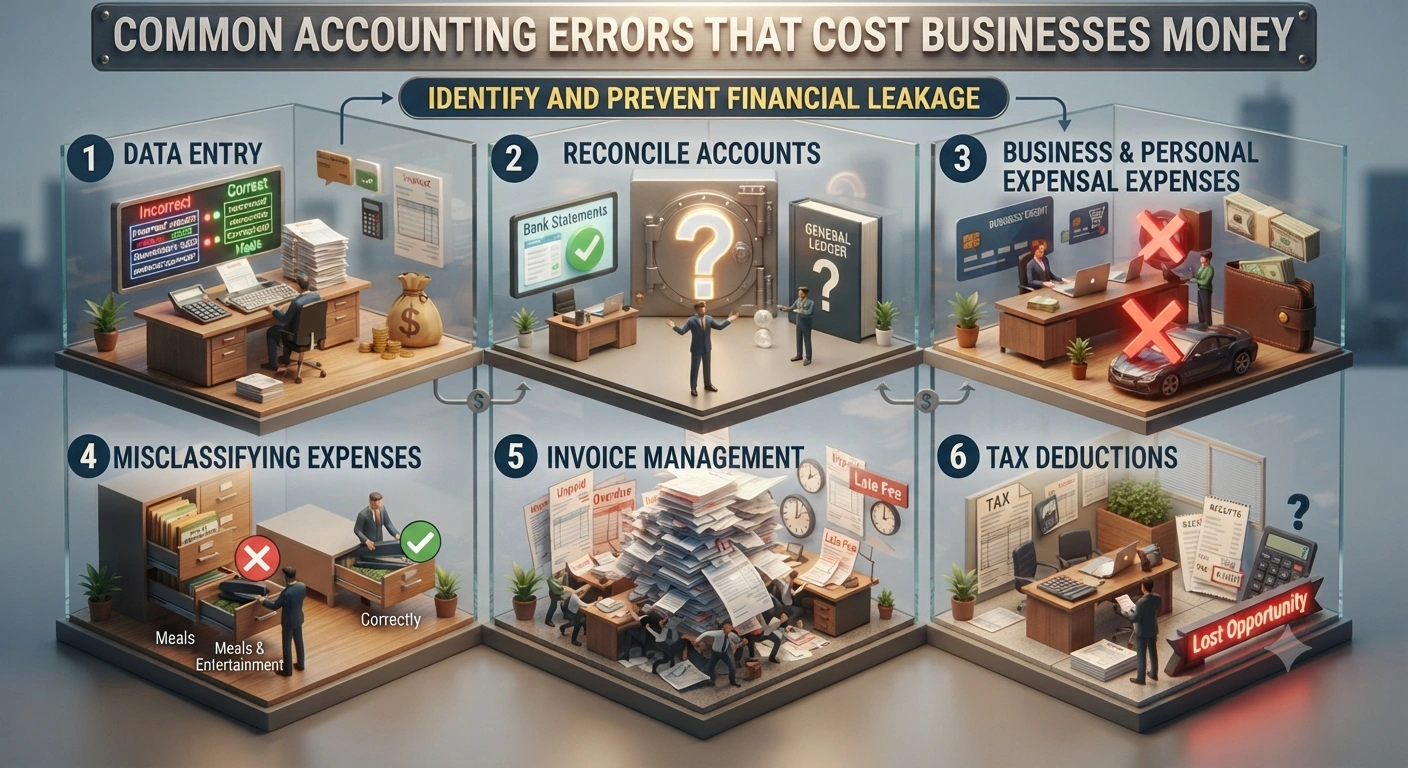
Common Accounting Errors That Cost Businesses Money
How to spot, fix, and prevent the financial mistakes that drain your business
I've seen it happen countless times. A business owner calls me in panic mode because their accounts don't match their bank statements. They've lost track of thousands. And when we dig into it, the culprit is almost always something simple—something that could've been prevented with better systems.
The truth is, accounting errors don't just hurt your bottom line. They create compliance headaches, invite tax department notices, and can even trigger audits. What I mean is, a small mistake today becomes a big problem tomorrow.
So let's talk about the errors that cost businesses real money. Not in theory. In actual rupees and paise lost to preventable mistakes.
Why Accounting Errors Matter More Than You Think
Look, most business owners think accounting is just about filing returns once a year. But that's where the problem starts. Your accounts are the foundation of every business decision you make.
When your numbers are wrong, everything falls apart. You don't know if you're actually making money. You can't spot which products are profitable. You can't tell if an employee is stealing. And when the tax department comes knocking, you've got nothing solid to show them.
Between 2026 and 2027, I've handled over 200 businesses with accounting issues. Know what the average cost was? About 2.5 lakh rupees in lost deductions, penalties, and management time. Some paid much more.
Accounting errors discovered during tax audits don't just cost you money in penalties. They damage your credibility with the tax department and can trigger more aggressive scrutiny in future years.
Error #1: Not Reconciling Bank Statements Regularly
This is the #1 error I see, and it's the easiest to prevent. Most businesses don't reconcile their bank statements until the accountant nags them—sometimes not even then.
Here's what happens. A cheque gets lost in the mail. A payment goes through twice by mistake. A vendor bills you twice for the same invoice. Without reconciliation, you don't know. Your books show one number. Your bank shows another. And you're flying blind.
I had a client, a manufacturing business, who didn't reconcile for eight months. When we finally did, we found 47,000 rupees in duplicate payments that went unnoticed. That's real money that just vanished because nobody was paying attention.
- Duplicate payments to vendors
- Unrecorded cheques that never cleared
- Bank fees you didn't notice
- Fraudulent transactions going undetected
- Wrong opening balances for the next month
- Inability to prepare accurate financial statements
The fix is simple. Do it monthly. Ideally, do it weekly. It takes maybe 30 minutes if you're organized. And it catches problems before they become disasters.
Monthly reconciliation helps you catch fraud early, claim all legitimate deductions, and build a strong audit trail that protects you during tax scrutiny.
Error #2: Mixing Personal and Business Expenses
And here's where things get really messy. You buy groceries for the office and the home on the same day. You fill up petrol for the business vehicle and your personal car. Your phone is used for both work and personal calls.
So you throw it all into the business account. "I'll sort it later," you think. But later never comes. By year-end, your accounts are a nightmare.
The tax department hates this. When they see personal expenses mixed with business expenses, they assume you're hiding something. And honestly, sometimes you are, even if you don't mean to be.
I had a retail business owner who mixed everything. His daughter's school fees went through the business account. His wife's medical bills. His home internet bill. When the tax department reviewed his return, they disallowed 3.2 lakh rupees in deductions because they couldn't tell what was business and what wasn't.
The solution? Keep separate accounts. One for business. One for personal. If you must mix expenses, document them clearly with a split. Show exactly what percentage is business and what's personal.
- Personal vehicle expenses claimed as business
- Home office rent claimed incorrectly
- Personal phone and internet billed to company
- Family member salaries that aren't real
- Gifts and personal purchases claimed as business gifts
Error #3: Poor Invoice and Receipt Management
You know what I see all the time? Businesses that can't find invoices when they need them. Receipts stuffed in drawers. No system for tracking what's been paid and what hasn't.
Basically, this creates two problems. First, you can't claim deductions you're entitled to because you've lost the paperwork. Second, you can't prove to the tax department that your expenses are real.
And here's the thing that really costs money. Without proper invoicing, you don't know who owes you what. A client might say they paid you three months ago when they actually didn't. You write off debts that could've been collected. You under-report income because you can't track it.
I worked with a consulting firm that had no invoice tracking system. They thought they were making 8 lakh rupees a month. In reality, clients owed them 12 lakhs that they'd never collected. That's cash sitting in other people's pockets because nobody was following up.
| Invoice Problem | Cost to Business | How to Prevent |
|---|---|---|
| Lost receipts | Can't claim deductions | Digital filing system |
| Duplicate invoicing | Double-counting income | Sequential numbering |
| No payment tracking | Uncollected receivables | Aging report monthly |
| Missing GST details | GST penalties and interest | Template-based invoicing |
| No invoice backup | Can't prove transactions | Cloud storage always |
So what does this mean for you? Get an invoicing system today. It doesn't have to be expensive. Even a simple spreadsheet is better than nothing. But honestly, cloud-based tools like Zoho Invoice or GST-compliant software are worth every rupee.
Error #4: Incorrect GST Filing and ITC Claims
GST is a minefield for small business owners. And I say that as someone who deals with it every single day.
The most common errors? Claiming Input Tax Credit on expenses that don't qualify. Missing invoice details that the tax department needs. Filing returns late or with wrong numbers. Not reconciling your GST liability with your bank deposits.
A manufacturing client of mine claimed ITC on personal vehicle expenses. The tax department caught it and denied 85,000 rupees in credits. Plus, they added a 10% penalty because they thought it was intentional. Total damage? About 1.15 lakh rupees.
- Claiming ITC without proper invoices
- Filing GSTR-1 with wrong HSN codes
- Not reconciling GSTR-2A with your purchases
- Missing supplier details on invoices
- Claiming ITC on blocked categories
- Late filing penalties and interest charges
The GST department has automated matching systems now. If your GSTR-1 doesn't match your supplier's GSTR-2A, you'll get a notice. If you claim ITC that your supplier hasn't reported, you'll lose it. Get this right or pay the price.
Error #5: Not Recording Depreciation Correctly
You buy equipment for 2 lakh rupees. You expense the whole thing in year one. Feels good, right? Big deduction.
But that's wrong. And it costs you money in two ways. First, you're claiming deductions you're not entitled to, which invites tax scrutiny. Second, you're not getting the full benefit of depreciation because you're doing it wrong.
The tax department has strict rules about what qualifies as a fixed asset and how you depreciate it. Machinery, vehicles, computers, furniture—they all have different depreciation rates. Get it wrong and you're either overstating deductions or missing out on deductions you should get.
I had a business owner who bought a vehicle for 12 lakhs and expensed it completely. The tax department added 8 lakhs back to his income. He ended up paying tax on money he never expensed correctly in the first place. That's the kind of mistake that's expensive to fix.
Error #6: Salary and Payroll Mistakes
And then there's payroll. This is where small businesses really struggle.
You've got employees. You're paying them in cash sometimes. You're not filing TDS returns on time. You're not reconciling what you've paid with what you've reported. You're hiring family members and paying them salaries that don't make sense for the work they do.
All of this creates problems. The tax department questions whether these are real employees. They deny salary deductions. They assess TDS penalties. They ask why your payroll doesn't match your business size.
- Not filing TDS returns on time
- Paying employees in cash without records
- Not deducting TDS from contractor payments
- Salary amounts that don't match industry standards
- No employment contracts or appointment letters
A service business I worked with paid their owner's wife a salary of 5 lakh rupees a year for "administrative work." The tax department questioned it. They asked for proof of work, bank transfers, and employment records. None existed. The salary got disallowed. Plus penalties.
Proper payroll documentation protects you during audits and helps you claim legitimate salary deductions without pushback from the tax department.
Error #7: Not Tracking Capital Gains and Asset Sales
You sell an old vehicle. You sell a property. You sell your business equipment. And you don't track the original cost or the sale price properly.
This is a big one because capital gains tax is complicated. You need to know your cost base. You need to track improvements. You need to calculate holding periods. If you don't, you either pay tax on gains you shouldn't or miss deductions you could claim.
I had a client who sold a property and didn't report the gain at all. He thought it was tax-free. The tax department found out from the property registration documents and added 15 lakh rupees to his income. He paid tax plus interest plus penalties. All because he didn't understand capital gains rules.
Error #8: Failing to Track and Reconcile Inventory
If you run a retail or manufacturing business, inventory is huge. And I mean that literally and financially.
Most businesses don't reconcile their inventory properly. They count stock once a year if they're lucky. They don't track what's been damaged or stolen. They don't know if their accounting records match their physical stock.
This costs money in two ways. First, you lose track of actual inventory value. Your balance sheet is wrong. Second, the tax department questions your cost of goods sold if your numbers don't make sense.
A retail business I worked with had a 4 lakh rupee difference between their inventory records and their physical count. That's 4 lakhs of either stolen stock or accounting errors. And they had no way to explain it to the tax department.
Error #9: Ignoring Related Party Transactions
You do business with your brother. You loan money to your business from your personal account. You buy things from your spouse's company. And you don't document any of it properly.
The tax department is really strict about related party transactions. They want to see that prices are fair. They want to see proper documentation. They want to see that money actually changed hands.
Without this, they'll disallow transactions or claim you're hiding income. I had a business owner who loaned 20 lakhs to his company from personal savings. No promissory note. No interest. No repayment schedule. The tax department questioned whether it was really a loan or hidden income. The whole thing got messy.
- Loans between related parties without proper documentation
- Purchases from related parties at inflated prices
- Services provided to related parties without invoices
- Rent paid to family members without proper agreements
- No transfer pricing documentation for cross-border transactions
Error #10: Not Keeping Proper Backup and Documentation
Your accountant has your books. Your invoices are scattered. Your tax returns are in a folder somewhere. And if something happens—a hard drive crash, a fire, a tax audit—you're in trouble.
The tax department expects you to have records. Not just for three years. Depending on the transaction, they can ask for records going back much further. And if you don't have them, you can't prove your case.
I had a client whose office flooded. All their original invoices and receipts were destroyed. They had no backup. When the tax department audited them, they couldn't produce supporting documents. They lost deductions worth 6 lakh rupees because they couldn't prove the expenses happened.
Under GST and income tax rules, you're required to keep original invoices and supporting documents for at least 5-6 years. Digital backups are now accepted, but you must ensure they're tamper-proof and retrievable.
How to Prevent These Errors: A Practical Checklist
So what do you actually do about all this? Here's a practical system that works.
- Get accounting software. Zoho Books, Busy, or Tally—pick one and use it consistently.
- Reconcile your bank account every week. Seriously. 30 minutes a week saves you days of headaches later.
- Separate personal and business. Different accounts. Different credit cards if you can.
- Document everything. Invoices, receipts, agreements, loan documents. Digital copies backed up online.
- File GST returns on time. Use the software to match your records with GSTR-2A automatically.
- Track depreciation properly. Use a fixed asset register and update it when you buy or sell equipment.
- Maintain payroll records. Keep employment contracts, salary slips, TDS certificates. File TDS returns on time.
- Do a quarterly review. Sit down with your accountant every three months and review your numbers.
The businesses that do this stuff? They don't have accounting problems. They don't get surprise tax notices. They know exactly how much money they're making.
Frequently Asked Questions
Q: How often should I reconcile my bank account?
A: Weekly is ideal, but monthly is the absolute minimum. The longer you wait, the harder it is to find and fix errors. If you're using accounting software, it can be done in 15-20 minutes a week.
Q: What documents do I need to keep for tax purposes?
A: Keep all invoices, receipts, bank statements, GST records, payroll documents, and any agreements related to your business. The general rule is 5-6 years, but some documents (like asset records) should be kept longer. Digital copies are fine if they're backed up securely.
Q: Can I claim expenses that I can't find receipts for?
A: It depends on the amount and the type of expense. Small expenses (under 5,000 rupees) might be allowed with a memo or other proof. But for larger amounts, you need original receipts or invoices. If the tax department audits you, they'll ask for proof. No receipt? No deduction. That's the bottom line.
Q: What happens if I discover an accounting error in a previous year?
A: If it's a small error, you can correct it in the current year through a journal entry. If it's material or affects multiple years, you might need to file a revised return or amendment. The sooner you catch it, the better. Don't wait for the tax department to find it.
Q: Do I really need accounting software, or can I use spreadsheets?
A: Spreadsheets work for very small businesses, but they're error-prone and don't scale well. Accounting software is worth the investment because it automates reconciliation, tracks GST automatically, and generates reports instantly. For most businesses, the cost (500-1000 rupees per month) is tiny compared to the mistakes it prevents.
The Real Cost of Getting It Right
Here's what I want you to understand. Fixing accounting errors after the fact is expensive. Really expensive. But preventing them is cheap.
A good accounting system costs you maybe 500-1500 rupees a month. A quarterly review with an accountant costs 2000-5000 rupees. That's less than 50,000 rupees a year for most small businesses.
Compare that to the cost of fixing errors. A tax notice and audit? 1-3 lakh rupees in professional fees alone. Penalties and interest? Could be another 1-5 lakh rupees. Lost deductions? That's tax on money you shouldn't have been taxed on in the first place.
So the math is simple. Spend a little now on prevention, or spend a lot later on correction. I've never met a business owner who regretted investing in good accounting systems. But I've met plenty who regretted not doing it.
Businesses with proper accounting systems spend less on taxes, get audited less often, and make better decisions because they trust their numbers.
What to Do Right Now
Don't wait. Start today. Here's your action list for the next week:
- Review your last three months of bank statements and mark any transactions you don't recognize.
- Gather all your invoices and receipts from this year and organize them (digital is fine).
- Check if you have separate personal and business accounts. If not, plan to open one.
- Talk to an accountant about getting accounting software set up.
- Ask about GST compliance—make sure you're filing correctly.
- Schedule a quarterly review meeting to keep things on track.
These steps won't take much time. But they'll save you thousands of rupees and countless headaches.
Final Thoughts
Look, accounting isn't sexy. It's not what you went into business to do. But it's the backbone of everything. Get it right and your business runs smoothly. Get it wrong and you're constantly fighting problems.
The errors I've talked about here aren't rare. They're common. Almost every business makes at least one of them. The difference between successful businesses and struggling ones? The successful ones catch and fix them quickly. The struggling ones let them pile up.
So pick one error from this article that sounds familiar. Fix it this week. Then pick another one next week. Before you know it, your accounting will be solid. Your tax returns will be defensible. And you'll actually know how much money you're making.
That's worth the effort. Trust me on that.
" } ```
© 2026 Tax Esquire | Expert CA Services in Greater Noida, Uttar Pradesh
8810380146 | info.taxesquire@gmail.com | taxesquire.in
This document is for informational purposes only. For personalised tax advice, consult our chartered accountants.