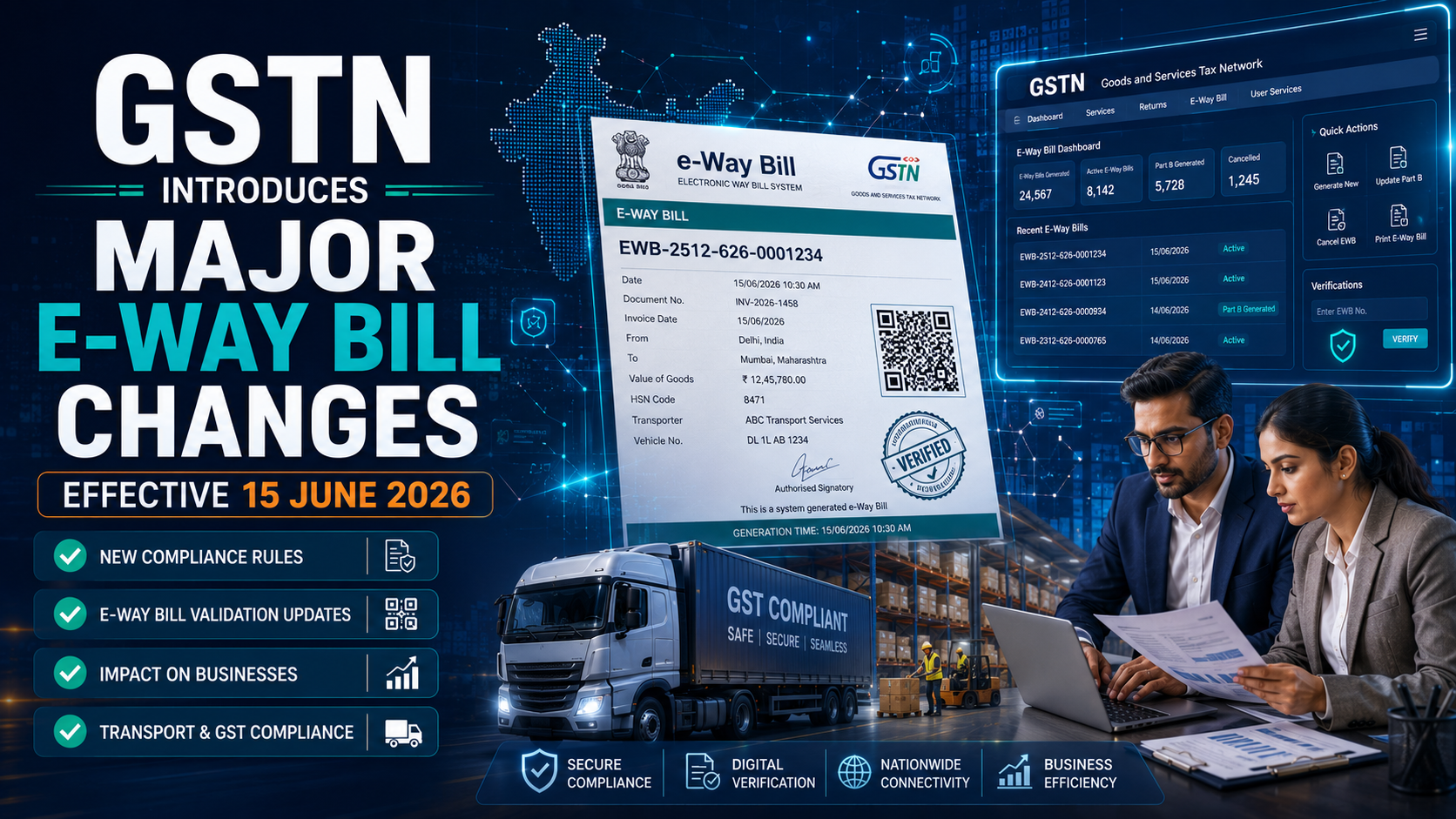
E-WAY BILL CHANGES EFFECTIVE FROM 15 JUNE 2026
|
GSTN has rolled out two major enhancements to the e-Way Bill (EWB) system, taking effect from 15 June 2026. These updates are designed to strengthen the digital audit trail between invoices, e-Invoices, e-Way Bills, and actual delivery of goods — making compliance monitoring sharper and more transparent. |
The Goods and Services Tax Network (GSTN) has rolled out a fresh set of modifications to the e-way bill (EWB) framework, scheduled to take effect from 15 June 2026. These reforms are designed to plug compliance gaps, strengthen the traceability of consignments, and bring more transparency to inter-state and intra-state movement of goods. Businesses, transporters, and tax professionals must align their internal systems and workflows well in advance to avoid disruption.
Why Has the GSTN Introduced These Changes?
Over the past few years, the e-way bill mechanism has emerged as a key tool for monitoring the movement of taxable goods across the country. However, gaps in reporting—particularly relating to "Bill-To-Ship-To" transactions and inactive or expired EWBs—continued to create reconciliation challenges. The latest updates aim to:
- Make consignment tracking more accurate by capturing the actual destination GSTIN.
- Reduce mismatches between e-way bills and GSTR-1 filings.
- Allow taxpayers to close pending or unutilised EWBs systematically.
- Curb fraudulent practices and circular trading patterns.
The revised framework focuses on ensuring better tracking and verification of goods movement by establishing stronger connectivity between tax invoices, e-Invoices, e-Way Bills, transportation records, and final delivery details.
The two major changes introduced by GSTN are:
1. Mandatory Reporting of Ship-To GSTIN in Bill-To / Ship-To Transactions
Taxpayers will now be required to provide the GSTIN of the actual recipient (Ship-To party) in applicable Bill-To / Ship-To transactions. This measure aims to improve accuracy in reporting and strengthen transaction traceability.
2. Introduction of the E-Way Bill Closure Facility
A new closure mechanism will allow taxpayers to confirm the completion of goods delivery, enabling more effective tracking of the movement cycle and creating an additional layer of compliance verification.
1. MANDATORY SHIP-TO GSTIN IN BILL-TO / SHIP-TO TRANSACTIONS
Under the earlier framework, businesses frequently generated e-Way Bills by mentioning only the billing party's GSTIN, leaving the actual consignee's details incomplete or unverified. GSTN has now addressed this gap.
Understanding Bill-To-Ship-To Transactions
A Bill-To-Ship-To transaction typically involves three parties:
- Supplier (A) – the entity issuing the invoice.
- Buyer (B) – the entity to whom the invoice is billed.
- Consignee (C) – the actual recipient of the goods.
The new rule mandates that when goods physically move from A to C, the GSTIN of C must be reported in the e-way bill, even though the invoice is issued to B.
What Has Changed?
With effect from 15 June 2026, reporting the Ship-To GSTIN is mandatory wherever goods are delivered to a location different from the billing entity. In cases where the consignee is unregistered, the taxpayer must enter 'URP' (Unregistered Person) — leaving the field blank will no longer be permitted.
|
Practical Illustration A manufacturer raises an invoice on a dealer, but goods are shipped directly to the dealer's customer: ▶ Bill-To GSTIN: Dealer's GSTIN (the entity being billed) ▶ Ship-To GSTIN: Customer's GSTIN (the entity actually receiving goods) — now mandatory |
Practical Scenario
Suppose ABC Traders (Maharashtra) sells goods to XYZ Distributors (Karnataka) but delivers them directly to PQR Retailers (Tamil Nadu) on XYZ's instructions. Under the new rule, ABC Traders must mention PQR Retailers' GSTIN as the Ship-To party in the e-way bill, in addition to XYZ Distributors' GSTIN as the Bill-To party. Failure to do so may trigger validation errors on the EWB portal.
Why This Change Matters
• Enables accurate identification of the actual recipient of goods
• Enhances end-to-end traceability across the supply chain
• Strengthens reconciliation between e-Invoices and e-Way Bills
• Reduces data gaps in Bill-To / Ship-To transactions
• Improves quality of information available for GST audit and assessment
2. THE NEW E-WAY BILL CLOSURE FACILITY
Until now, the e-Way Bill system offered two states: active and cancelled. There was no way to formally confirm that goods had actually been delivered. GSTN has now introduced a Closure Facility to address this critical gap.
How the Closure Facility Works
Suppliers, recipients, transporters, and other authorised persons can now formally mark an e-Way Bill as 'Closed' once goods have been successfully delivered. This creates an official confirmation of delivery — a significant improvement for audit documentation and logistics tracking.
Why This Matters
- Helps in cleaner reconciliation of EWBs with tax invoices.
- Prevents misuse of expired but unclosed e-way bills.
- Provides better audit trails during departmental inspections.
Cancellation vs. Closure — Key Differences
|
Particulars |
Cancellation |
Closure (New) |
|
Purpose |
Generated incorrectly or goods not transported |
After successful completion of delivery |
|
Stage |
Before or during movement of goods |
After delivery of goods |
|
Effect on EWB |
EWB becomes invalid |
EWB is marked as completed |
|
Impact on Movement |
Goods cannot move on cancelled EWB |
Movement already completed |
|
Time Limit |
Within 24 hours (subject to conditions) |
After delivery, within GSTN timeframe |
|
Objective |
Correct an erroneous transaction |
Confirm a genuine completed transaction |
|
Compliance Benefit |
Prevents misuse of incorrect EWBs |
Creates clear delivery trail & audit documentation |
Comparative Snapshot: Before vs After 15 June 2026
|
Particulars |
Current Rule (Before 15 June 2026) |
New Rule (From 15 June 2026) |
|
Ship-To GSTIN |
Optional / not strictly enforced |
Mandatory for registered consignees |
|
EWB Closure |
Not available; only cancellation within 24 hours |
Dedicated closure facility introduced |
|
Reconciliation with GSTR-1 |
Frequent mismatches |
Improved due to accurate destination data |
|
Audit Trail |
Partial |
Comprehensive end-to-end tracking |
|
Risk of Fraud |
Higher due to data gaps |
Significantly reduced |
IMPACT ON DIFFERENT BUSINESS MODELS
Branch Transfers
Businesses operating multiple branches or warehouses under different GST registrations must ensure accurate GSTIN mapping for each consignee. Mismatches between dispatch and delivery locations will attract scrutiny.
Job Work Transactions
Manufacturers sending materials to job workers need to capture Ship-To GSTIN for each leg of movement — outward dispatch as well as return of processed goods — to maintain a clean job-work trail.
Drop Shipment / Direct Delivery
Drop-ship arrangements, where goods travel from manufacturer directly to end-customer, now require both Bill-To and Ship-To GSTINs to be precisely reported. This is perhaps the most significant operational impact for companies running e-commerce or dealer networks.
Warehouse & Depot Dispatches
Centralised billing systems coupled with multiple dispatch points need ERP re-configuration to ensure that the Ship-To GSTIN auto-populates correctly for each outgoing consignment.
Third-Party Logistics (3PL) Providers
Transporters and logistics partners will play a pivotal role in the closure process. Proof of delivery documentation becomes not just operationally important but a compliance necessity under the new framework.
COMPLIANCE RISKS IF YOU ARE NOT PREPARED
|
Businesses that do not update their systems and processes before 15 June 2026 risk the following: |
• E-Way Bill generation failures due to missing Ship-To GSTIN
• Validation errors from outdated or incorrect GSTIN master records
• Operational delays at dispatch points leading to delivery bottlenecks
• Heightened scrutiny during GST audits, assessments, and departmental visits
• Reconciliation mismatches between invoices, e-Invoices, and e-Way Bills
• Potential demands, penalties, and interest arising from non-compliant EWBs
YOUR ACTION CHECKLIST BEFORE 15 JUNE 2026
✓ Review all Bill-To / Ship-To transaction workflows across your business
✓ Update customer, warehouse, and consignee GSTIN master data in your ERP
✓ Configure ERP to make Ship-To GSTIN a mandatory field wherever applicable
✓ Ensure 'URP' is correctly populated for all unregistered consignees
✓ Brief and train dispatch, logistics, accounts, and billing teams on the changes
✓ Test updated e-Way Bill APIs and software integrations end-to-end
✓ Draft and implement an SOP for timely e-Way Bill closure after each delivery
✓ Conduct an internal compliance review of pending open e-Way Bills
CONCLUSION & OUR PERSPECTIVE
The GSTN upgrades effective 15 June 2026 represent a decisive move towards end-to-end digital tracking of goods movement. The introduction of mandatory Ship-To GSTIN reporting and the new Closure Facility collectively create a much tighter linkage between every step of a commercial transaction — from invoice to delivery.
While these changes demand upfront investment in system updates and process redesign, they also create an opportunity to build a more robust compliance infrastructure. Businesses that prepare now will avoid operational disruptions, reduce audit exposure, and position themselves favourably in an increasingly technology-driven GST ecosystem.
|
Need help navigating these changes? Tax Esquire's
expert team of Chartered Accountants, Advocates, and Company Secretaries with
15+ years of experience in Indirect Taxation and GST Compliance is here to
assist you. CA Poonam Gupta / Adv
Lokesh Gupta ☎ +91-8810380146 |
✉ info.taxesquire@gmail.com | 🌐 www.taxesquire.in |
|
DISCLAIMER This document is for informational purposes only. For personalised tax advice, consult our chartered accountants. |
© 2026 Tax Esquire | Expert CA Services in Greater Noida, Uttar Pradesh
8810380146 | info.taxesquire@gmail.com | taxesquire.in
This document is for informational purposes only. For personalised tax advice, consult our chartered accountants.