GST Compliance for Startups in 2026: A Complete CA Guide to Registration, Filing, and Penalties
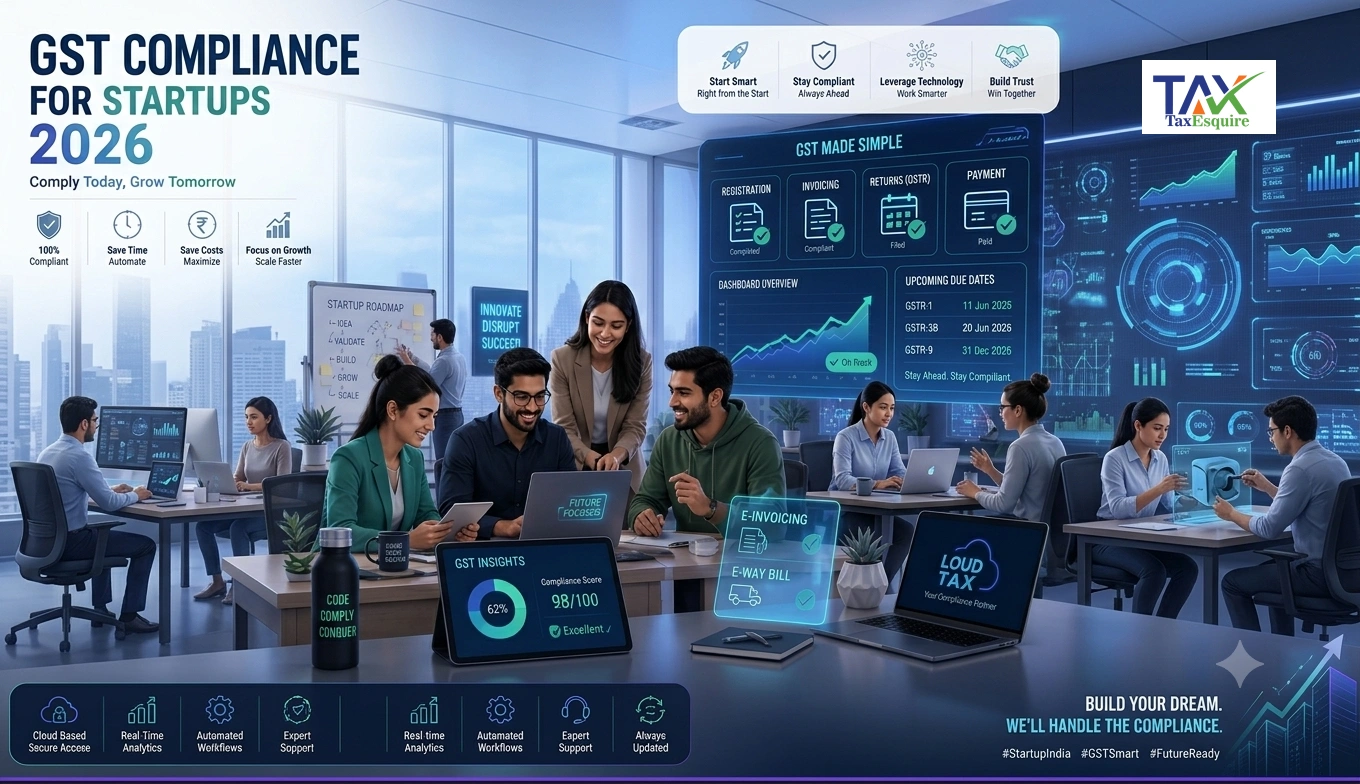
GST Compliance for Startups in 2026
Everything you need to know about staying compliant with GST laws as a startup founder
Why GST Compliance Matters for Your Startup Right Now
Look, I've seen startups grow from a garage to a multi-crore operation. And I've also seen them collapse because they ignored GST compliance. The thing is, GST isn't just about paying tax—it's about protecting your business from penalties, interest, and legal trouble that can derail everything you've built.
In 2026, the GST framework is tighter than ever. The tax authorities have better data analytics, cross-verification systems, and automated checks. So what does this mean for you? It means you can't slip under the radar anymore. You need a solid compliance strategy from day one.
Basically, getting GST right saves you money, protects your reputation, and lets you focus on growing your business instead of fighting tax notices.
Early GST compliance helps you claim input tax credits faster, improves your credit rating with suppliers, and makes fundraising easier because investors trust compliant businesses.
Do You Actually Need to Register for GST?
Here's the first question every startup founder asks me: Do I really need GST registration? The answer depends on your turnover and the nature of your business.
The basic threshold is simple. If your annual turnover crosses ₹40 lakhs, you're compulsory. But there's more to it than just that number.
| Business Type | Threshold (2026) | Action Required |
|---|---|---|
| Goods Business | ₹40 lakhs | Register if you cross this |
| Services Business | ₹20 lakhs | Register if you cross this |
| Composition Scheme | ₹1.5 crores | Eligible if below this |
| Casual Taxable Person | No threshold | Must register |
And here's something many startups miss: even if you're below the threshold, you might want to register voluntarily. Why? Because you can claim input tax credits on your purchases, which actually saves you money. Put simply, if you're buying stuff for your business, voluntary registration often makes financial sense.
If you cross the threshold and don't register within 30 days, you're liable for a penalty of ₹10,000 or 10% of tax due, whichever is higher. Plus, you'll owe interest on unpaid tax from the date you should've registered.
The GST Registration Process: Step by Step
Registering for GST is actually straightforward if you know what you're doing. But I've seen founders mess it up because they skip steps or submit incomplete paperwork. Let me walk you through it.
The entire process happens online on the GST portal. You'll need your PAN, Aadhar, bank details, and some basic business information. The whole thing takes about 10 to 15 minutes to fill out, but the approval can take 3 to 7 working days.
- Log into the GST portal with your PAN and create an account
- Fill in your business details accurately—this is where most errors happen
- Upload scanned copies of your PAN certificate, Aadhar, and business address proof
- Submit Form GST REG-01 online
- Get an acknowledgment number and wait for verification
- Once approved, you'll get your GSTIN (13-digit unique number)
But here's the thing: the tax officer might ask for additional documents. It's not always automatic approval. They might want to verify your business location, check your bank statements, or confirm your business relationship with suppliers. So don't be shocked if you get a notice asking for more paperwork.
Once you have your GSTIN, you can immediately start claiming input tax credits on your business expenses. This means the GST you pay on office rent, equipment, software, and supplies can be offset against your tax liability.
Understanding GST Filing Deadlines and Return Types
Now that you're registered, you need to file returns. And this is where most startups get confused because there are different return forms for different situations.
In 2026, the standard return for regular taxpayers is GSTR-1 (outward supplies) and GSTR-3B (summary return). If you're on the composition scheme, you file GSTR-4 quarterly. And if you're a casual taxable person or non-resident, you have different forms.
So what's the deadline? GSTR-1 is due by the 11th of the next month. GSTR-3B is also due by the 20th of the next month. Missing these dates means penalties and interest charges that add up fast.
| Return Type | Frequency | Deadline |
|---|---|---|
| GSTR-1 | Monthly | 11th of next month |
| GSTR-3B | Monthly | 20th of next month |
| GSTR-4 | Quarterly | 13th of next month after quarter |
| GSTR-9 | Annual | 31st December of next year |
And honestly, the biggest mistake I see startups make is waiting until the last day to file. The portal crashes, your internet goes down, or you realize you're missing invoices. File early. Give yourself a buffer of at least 5 days before the deadline.
Late filing of GSTR-1 and GSTR-3B attracts a penalty of ₹100 per day (maximum ₹5,000) for each return. If you miss the deadline by more than 30 days, you also lose the right to claim input tax credits on that month's purchases.
GST Penalties: What Can Go Wrong and How Much It'll Cost
Penalties are the part of GST that keeps founders up at night. And rightly so, because they can be brutal if you're not careful.
The thing is, GST penalties aren't just about money. They're also about compliance records. Multiple penalties damage your business reputation with tax authorities and can trigger audits.
- Late registration: ₹10,000 or 10% of tax due, whichever is higher
- Late return filing: ₹100 per day (capped at ₹5,000)
- Non-filing of return: ₹500 per day (no upper limit)
- Furnishing incorrect information: ₹25,000 per offense
- Failure to issue invoice: ₹10,000 or 10% of invoice value, whichever is higher
- Supplying goods without GST: ₹10,000 and confiscation of goods
But here's what most startups don't know: there's also interest on top of penalties. If you owe tax and don't pay it on time, you're charged 18% annual interest. So a ₹1 lakh tax liability that you miss by 3 months costs you an extra ₹4,500 in interest alone.
| Violation | Penalty Amount | Interest Applicable |
|---|---|---|
| Late registration | ₹10,000 or 10% tax | Yes, 18% p.a. |
| Late return filing | ₹100 per day | Yes, if tax unpaid |
| Non-payment of tax | Varies by case | Yes, 18% p.a. |
| Incorrect invoicing | ₹10,000 minimum | Depends on amount |
If you self-report an error in your GST return before the tax authorities notice it, you can pay the tax with just 12% interest—no penalties. This is called voluntary disclosure and can save you thousands of rupees.
Input Tax Credit: How to Claim It and What You Can't Claim
Input tax credit is the biggest advantage of GST for startups. Basically, it means the GST you pay on your business purchases can be subtracted from the GST you owe on your sales.
But—and this is important—you can't claim credit on everything. There are rules about what qualifies and what doesn't.
You can claim credit on GST paid for office rent, equipment, software subscriptions, raw materials, and professional services. You can't claim credit on GST paid for personal expenses, entertainment, or goods used for personal consumption.
- You must have valid GST invoices from registered suppliers
- The goods or services must be used for your business
- The invoice must show the supplier's GSTIN
- You must report the credit in your GSTR-2B within the deadline
- You can't claim credit on items with nil or exempt GST rate
And here's something critical: if you don't file your return by the deadline, you lose the right to claim input credit for that month. So even if you have valid invoices, if you missed the filing date, you can't use them. This is why timely filing matters so much.
If you claim input credit on invoices from unregistered suppliers or fake invoices, you're liable for penalties up to ₹25,000 per invoice, plus interest on the tax amount. The authorities actively cross-check invoices, so don't take this risk.
Common GST Mistakes Startups Make and How to Avoid Them
I've been doing this for years, and I see the same mistakes over and over. Let me save you the headache.
First mistake: not maintaining proper records. GST is all about documentation. If the tax authorities ask for proof, you need to show invoices, payment receipts, bank statements, and delivery documents. If you can't, you lose credibility and face penalties.
Second mistake: mixing personal and business expenses. Your personal laptop purchase shouldn't be claimed as business equipment. Your personal car shouldn't be claimed as a business vehicle. The tax authorities can easily spot this, and it triggers audits.
Third mistake: not reconciling your GST liability with your bank statements. If you're claiming ₹10 lakhs in sales but your bank shows ₹5 lakhs, something's wrong. This discrepancy raises red flags with tax authorities.
- Filing returns late because you don't have invoices organized
- Claiming input credit on invoices from suppliers who aren't registered
- Not issuing proper GST invoices to your customers
- Mixing GST-liable and GST-exempt sales without proper segregation
- Not updating your business details when your address or nature of business changes
Using accounting software that integrates with the GST portal automatically flags compliance issues, reduces manual errors, and makes filing returns a one-click process. This saves hours every month and keeps your records audit-ready.
GST Audit and Scrutiny: What to Expect
So you're filing returns on time, paying your taxes, and maintaining records. But then you get a notice for GST audit. What now?
First, don't panic. An audit notice doesn't mean you've done something wrong. It's just the tax authorities checking that your returns are accurate and your claims are legitimate. In 2026, audits are more common because the authorities have better data and automated systems.
When you get an audit notice, you'll have about 7 to 10 days to respond. You need to provide all your invoices, payment proofs, bank statements, and any other documents the notice asks for. The audit can be conducted at the tax office or at your business location.
The key is to be prepared. Have your documents organized, your records reconciled, and your explanations ready. If the auditor finds discrepancies, you get a chance to explain them. If you can't, they'll assess the tax and levy penalties.
- Keep all invoices and receipts for at least 6 years
- Maintain a GST register showing all inward and outward supplies
- Reconcile your GST liability with your profit and loss statement
- Document any exemptions or special schemes you're using
- Respond to audit notices within the given timeline
If you don't respond to an audit notice, the tax authorities can assess your tax liability based on their own calculations and levy penalties up to 100% of the tax amount. You'll also face interest charges. Always respond to official notices.
GST Compliance Best Practices for Startups in 2026
Let me give you a practical roadmap to stay compliant without losing your mind.
First, automate everything. Use accounting software that syncs with the GST portal. This reduces manual entry errors and saves you hours every month. Tools like Tally, Zoho Books, or even simple spreadsheet templates with formulas can help.
Second, maintain a monthly GST checklist. By the 10th of each month, reconcile your invoices. By the 15th, prepare your returns. By the 20th, file them. This routine keeps you from scrambling at the last minute.
Third, keep your supplier list updated. Know which suppliers are GST-registered and which aren't. This helps you plan your input credit strategy and avoid claiming credit on ineligible invoices.
- Hire a CA or GST consultant who understands startup dynamics
- Use e-invoicing if your turnover is above ₹50 crores
- Maintain digital copies of all invoices and receipts
- Monitor GST law changes through official GST portal notifications
- File your annual return (GSTR-9) even if it shows zero liability
Startups that maintain clean GST records get faster approval for loans, better terms from suppliers, and higher credibility with investors. Banks and VCs check GST compliance as part of their due diligence.
Frequently Asked Questions About GST Compliance
Q1: Can I register for GST before my turnover reaches the threshold?
Yes, you can register voluntarily. In fact, it's often a smart move because you can start claiming input credit on your expenses from day one. This reduces your effective cost and improves your cash flow.
Q2: What happens if I miss the GST return filing deadline?
You'll be charged ₹100 per day penalty (capped at ₹5,000 for GSTR-1 and GSTR-3B). More importantly, you lose the right to claim input credit for that month. Plus, the tax authorities might notice the late filing and initiate an audit.
Q3: Do I need to issue GST invoices for every sale?
Yes. Every sale must be documented with a proper GST invoice showing your GSTIN, the buyer's GSTIN (if registered), the tax rate, and the tax amount. For sales to unregistered customers, you still need to issue an invoice, but you don't need their GSTIN.
Q4: Can I claim input credit on expenses paid before I registered for GST?
No. Input credit can only be claimed from the month you're registered. Expenses before registration can't be claimed, even if you have invoices. This is why early registration makes sense for startups.
Q5: What's the difference between composition scheme and regular GST?
Under composition scheme, you pay a fixed percentage of turnover (1% to 5% depending on your business) instead of calculating GST on each transaction. You can't claim input credit, but you don't need to file monthly returns. It's simpler but only works if your turnover is below ₹1.5 crores. Regular GST lets you claim input credit but requires monthly filing.
Wrapping Up: Your GST Compliance Action Plan
GST compliance doesn't have to be complicated. The key is to start early, stay organized, and file on time. In 2026, the tax system is more automated and more transparent than ever. This means there's nowhere to hide, but it also means that if you're compliant, you're completely safe.
Here's your action plan: First, check if you need to register. Second, register early if you do. Third, set up a system to track invoices and maintain records. Fourth, file your returns on time every month. Fifth, claim your input credits correctly. And finally, respond to any notices from the tax authorities promptly.
Do this, and you'll never have to worry about GST penalties or audits. Your business will have a clean compliance record, which opens doors to funding, partnerships, and growth.
And that's really it. GST compliance is just about being organized and consistent. You've got this.
" } ```
© 2026 Tax Esquire | Expert CA Services in Greater Noida, Uttar Pradesh
8810380146 | info.taxesquire@gmail.com | taxesquire.in
This document is for informational purposes only. For personalised tax advice, consult our chartered accountants.