How to Become an Accountant in India: Complete Career Roadmap for 2026-2027
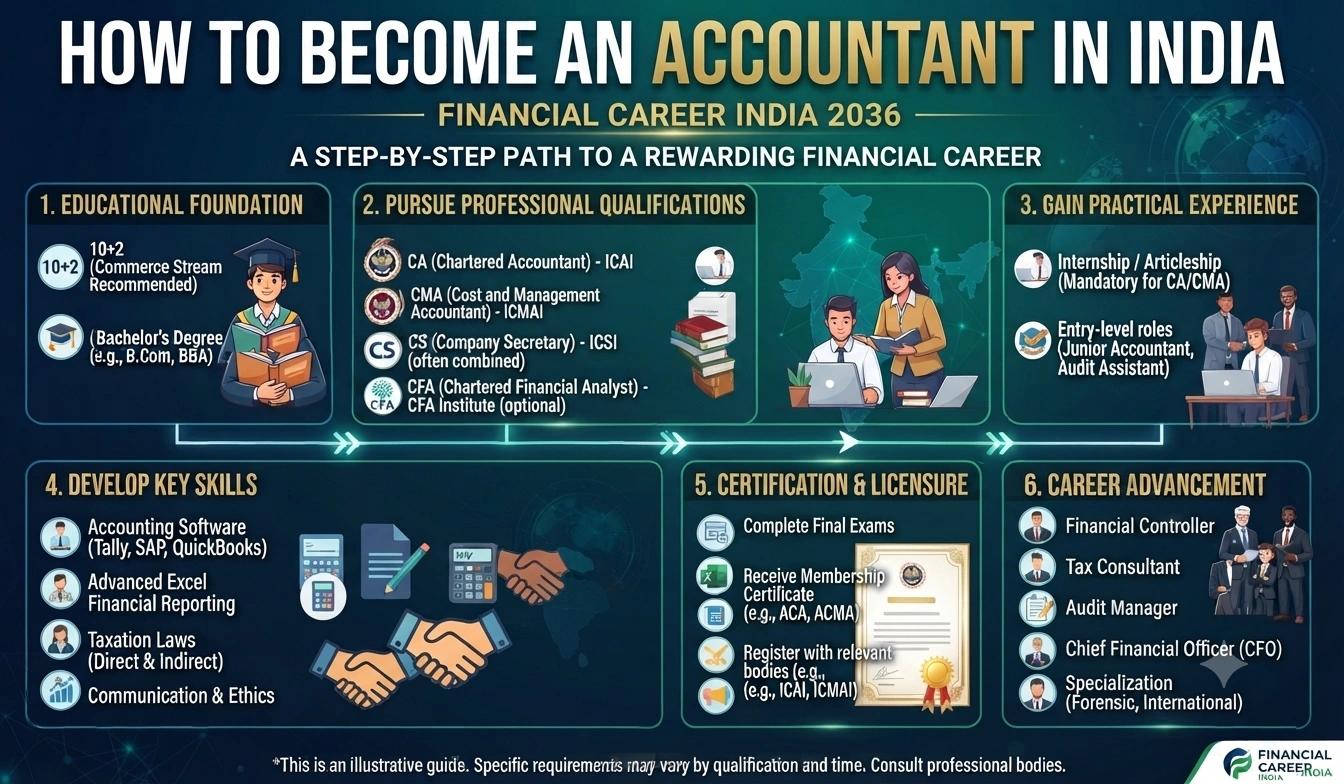
How to Become an Accountant in India
Your complete roadmap to a thriving accounting career in 2026-2027
So you're thinking about becoming an accountant in India. Smart move. The accounting profession is one of the most stable and rewarding careers you can pick, and honestly, the demand for skilled accountants keeps growing every single year. But here's the thing—there isn't just one path. You've got multiple routes to choose from, and each one has its own timeline, costs, and career outcomes.
I've worked with hundreds of students over the years, and the biggest mistake they make is jumping into a qualification without understanding what they're really signing up for. This guide will walk you through every option, from the most prestigious Chartered Accountant (CA) route to the faster CMA path, plus the traditional B.Com degree. By the end, you'll know exactly which path fits your situation.
Why Become an Accountant in India?
Let me be straight with you—accounting is a career that actually pays well and stays relevant. The Indian business ecosystem is booming, GST compliance is mandatory, audits are non-negotiable, and every company needs someone who knows how numbers work.
Accountants in India earn between ₹4-8 lakhs annually as freshers, scaling to ₹15+ lakhs with 5-7 years of experience. Self-employed CAs can earn significantly more depending on their client base and specialization.
And that's really it—accounting isn't just a job, it's a gateway to financial independence. You can work in corporations, start your own practice, move into forensic accounting, or specialize in taxation. The flexibility is incredible.
The Three Main Paths to Becoming an Accountant
There are three primary ways to build an accounting career in India. Each has different entry points, duration, and career prospects. Let me break them down so you can pick what works for you.
Path 1: Chartered Accountant (CA) – The Gold Standard
The CA qualification is the most respected accounting designation in India. If you want the highest prestige and earning potential, this is your route. But I won't lie—it's also the longest and toughest.
The Institute of Chartered Accountants of India (ICAI) manages the CA program. It's a four-and-a-half-year journey after your 12th, and you need to clear two major exams along the way. So what does this mean for you? It means commitment, but also unmatched credentials.
Eligibility for CA Foundation
- You must have passed your 12th from any recognized board
- There's no age limit and no specific subject requirement
- You can register for CA Foundation immediately after 12th
- The Foundation course is compulsory and lasts 4 months
- You must complete this before moving to the Intermediate level
CA Qualification Timeline
| Stage | Duration | Key Details |
|---|---|---|
| CA Foundation | 4 months | Study period before exam; exam conducted twice yearly |
| CA Intermediate | 8 months | Two groups of subjects; can attempt both or one at a time |
| Articleship | 3 years | Practical training under a practicing CA; you get paid |
| CA Final | 6 months | Can start 6 months before completing articleship; exam twice yearly |
Total time? About 4.5 years minimum. And that's if you clear exams on your first attempt. Most students take longer because the exams are genuinely tough. In 2026-2027, expect the CA Foundation exam to be even more competitive as more students enroll.
CA Exam Pattern and Subjects
The CA Foundation exam has 4 subjects covering basics of accounting, business law, economics, and quantitative aptitude. The Intermediate level gets tougher—you'll study financial accounting, auditing, taxation, law, and costing. The Final exam covers advanced topics like financial reporting, strategic management, and advanced auditing.
The CA pass rates are low—usually between 5-15% depending on the exam level. Don't underestimate the difficulty. Many students fail multiple times before passing. You'll need serious dedication and a good study plan.
Path 2: Cost Management Accountant (CMA) – The Faster Route
The CMA qualification is managed by the Institute of Cost Accountants of India (ICAI). This path is faster than CA—about 4.5 years total, but you can start working earlier. CMAs focus on cost accounting, financial management, and internal audit rather than external auditing.
But here's what you need to know: CMAs are slightly less prestigious than CAs in the market, but they're incredibly valuable for manufacturing companies, financial planning roles, and management accounting positions. Put simply, if you want to work in corporate finance and cost optimization, CMA might actually be better suited to your career goals.
CMA Eligibility Requirements
- 12th pass from any recognized board (any stream)
- No age limit restrictions
- Registration for CMA Foundation can happen immediately after 12th
- Foundation course is 4 months long
- You can start practical training after Foundation exam clearance
CMA Program Structure
The CMA program has three levels: Foundation (4 months study), Intermediate (8 months study), and Final (6 months study). After Foundation, you start your practical training, which lasts 3 years. The good part? You're earning money while you train, unlike CA articleship which is unpaid in many cases.
CMA trainees typically earn ₹15,000-25,000 monthly during their practical training period. This helps cover your education costs and gives you real-world experience simultaneously.
Path 3: Bachelor of Commerce (B.Com) + Specialization
The traditional B.Com degree is a 3-year undergraduate program offered by most universities across India. You can specialize in accounting, taxation, auditing, or financial management. This is the most flexible path because you can combine it with other qualifications later.
Honestly, a B.Com alone won't make you a fully qualified accountant, but it's a solid foundation. Many students do B.Com and then pursue CA or CMA afterward. Some companies hire B.Com graduates directly as junior accountants or accounts executives.
B.Com Eligibility
- 12th pass from any recognized board
- Commerce stream is preferred but not compulsory in many universities
- Some universities allow Science and Arts students too
- Admission based on merit or entrance exam (varies by university)
B.Com Specializations in Accounting
- Financial Accounting and Reporting
- Management Accounting and Cost Control
- Taxation and Audit
- Corporate Accounting
- International Accounting Standards
- Digital Accounting and ERP Systems
Comparison of All Three Paths
| Factor | CA | CMA | B.Com |
|---|---|---|---|
| Duration | 4.5 years | 4.5 years | 3 years |
| Difficulty Level | Very High | High | Moderate |
| Earning Potential | Highest | High | Moderate |
| Job Flexibility | Excellent | Good | Good |
| Self-Employment Option | Yes (High earning) | Limited | No |
| Market Prestige | Highest | High | Moderate |
Step-by-Step Guide to Becoming a CA in 2026-2027
Let's say you've decided the CA route is for you. Here's exactly what you need to do, step by step.
Step 1: Register for CA Foundation
Right after your 12th results, visit the ICAI website and register for CA Foundation. You'll pay about ₹10,000-12,000 as registration fees. The registration process is online and takes about 15 minutes. You'll get your registration number immediately.
Step 2: Complete the 4-Month Study Period
After registration, you get 4 months to study before the exam. During this time, you'll cover 4 subjects: Fundamentals of Accounting, Fundamentals of Business Laws and Other Allied Laws, Fundamentals of Economics, and Fundamentals of Quantitative Aptitude. The syllabus is dense but manageable if you study consistently.
And that's where most students struggle—they don't take the Foundation seriously. But I'll tell you, it sets the tone for your entire CA journey. If you can't master Foundation, Intermediate will destroy you.
Step 3: Appear for CA Foundation Exam
The Foundation exam is held twice a year—in June and December. Each subject is 1 hour long, and you need to score at least 40% in each subject and 50% overall to pass. The exam is conducted on the same day with all 4 papers.
Step 4: Register for CA Intermediate
Once you pass Foundation, you can register for Intermediate. This is where things get serious. Intermediate has 8 subjects split into two groups. You can attempt both groups together or one at a time. Most students take one group first, then the other.
Don't rush through Intermediate. The failure rate here is around 50-60%. Many students who breezed through Foundation struggle with Intermediate because the subjects are more complex and application-based. Take your time and understand concepts deeply.
Step 5: Start Your Articleship
After passing both groups of Intermediate, you can start your 3-year articleship. This is where you work under a practicing CA and get hands-on experience. You'll learn practical auditing, taxation, financial reporting, and GST compliance. During articleship, you'll also study for the Final exam.
Articleship is tough. You're working full-time while studying for the Final exam. But honestly, this is where you actually become a real accountant. The theory makes sense when you apply it in practice.
Step 6: Appear for CA Final Exam
You can start appearing for the Final exam 6 months before completing your articleship. The Final exam has 8 subjects and is considered the toughest. You need 40% in each subject and 50% overall to pass. Most students take 1-2 attempts to clear this.
Step 7: Complete Articleship and Get Your Certificate
Once you pass the Final exam and complete your 3-year articleship, you apply for your CA certificate. ICAI will verify your articleship completion and issue your certificate. Congratulations—you're now a qualified Chartered Accountant.
Practical Tips for Success
I've seen thousands of students take this journey, and the ones who succeed have a few things in common. Let me share what actually works.
- Get coaching from a reputable institute—self-study alone rarely works for CA
- Join study groups and discuss concepts with peers regularly
- Practice past exam papers at least 3 times before your actual exam
- Don't skip any topic thinking it won't come in the exam
- Take care of your health—accounting studies are mentally draining
- Find a mentor who's already qualified and get their guidance
Career Prospects After Qualification
So what happens after you're qualified? The job market for accountants in 2026-2027 is incredibly strong. Companies are hiring like crazy, and the salary packages are getting better.
As a CA, you can work as an auditor, tax consultant, financial advisor, or start your own practice. Many CAs earn ₹8-15 lakhs annually in corporate roles. Self-employed CAs can earn much more—some make ₹25+ lakhs annually once they build a decent client base.
The thing is, your earning potential isn't capped. Unlike many other professions, accounting has no salary ceiling. The more clients you serve, the more you earn.
In-demand specializations for 2026-2027 include GST compliance, transfer pricing, forensic accounting, and international taxation. If you specialize in any of these areas, you can command premium fees.
Frequently Asked Questions
Q1: Can I become an accountant without a CA qualification?
Yes, absolutely. You can work as an accountant with just a B.Com degree or a CMA qualification. Many companies hire B.Com graduates as junior accountants, accounts executives, or finance officers. But if you want to do audits, provide tax consultation, or practice independently, you'll need a CA qualification.
Q2: How much does it cost to become a CA in India?
The direct costs from ICAI are about ₹50,000-60,000 for all registrations and exams. But if you add coaching fees, study materials, and other expenses, the total can be ₹3-5 lakhs. Many students manage it by working part-time during their articleship, which offsets the costs.
Q3: What's the average time to become a CA?
The minimum time is 4.5 years if you clear all exams on your first attempt. But realistically, most students take 5-7 years because they need 1-2 extra attempts on some exams. Some take even longer. It's not a race—it's about getting qualified properly.
Q4: Is CA harder than engineering or medicine?
It's different, not necessarily harder. CA requires consistent effort over 4.5 years, while engineering and medicine are intense but shorter. The CA pass rates are low, but that's because the bar is high. If you're disciplined and focused, you can definitely crack it.
Q5: Can I work while studying for CA?
During Foundation and Intermediate, it's tough but possible to work part-time. During articleship, you're already working under a CA, so that covers your experience requirement. Many students intern at accounting firms part-time before starting their formal articleship. It's definitely doable if you manage your time well.
Q6: What's the job market like for accountants in 2026-2027?
The job market is booming. GST compliance, audit requirements, and financial regulations keep growing. Companies are desperate for qualified accountants. In 2026-2027, you'll have multiple job offers even before you finish your qualification. The demand far exceeds the supply of qualified professionals.
Final Thoughts
Becoming an accountant in India is absolutely achievable if you're willing to put in the work. Whether you choose the CA route, CMA path, or B.Com plus specialization, you're setting yourself up for a stable, well-paying career with excellent growth prospects.
The key is to start now, pick your path based on your situation, and commit to it. Don't jump between qualifications or get distracted by shortcuts. The accounting profession respects discipline and expertise, and if you develop both, your career will flourish.
And honestly, if you love numbers, problem-solving, and building businesses, accounting is genuinely one of the best careers you can pick. The financial independence you'll achieve is worth every hour of study.
" } ```
© 2026 Tax Esquire | Expert CA Services in Greater Noida, Uttar Pradesh
8810380146 | info.taxesquire@gmail.com | taxesquire.in
This document is for informational purposes only. For personalised tax advice, consult our chartered accountants.