ITC Blocked Under Section 17(5)
Introduction
Input Tax Credit (ITC) is the backbone of the GST system, designed to eliminate the cascading effect of taxes. It allows businesses to claim credit for GST paid on purchases and set it off against output tax liability.
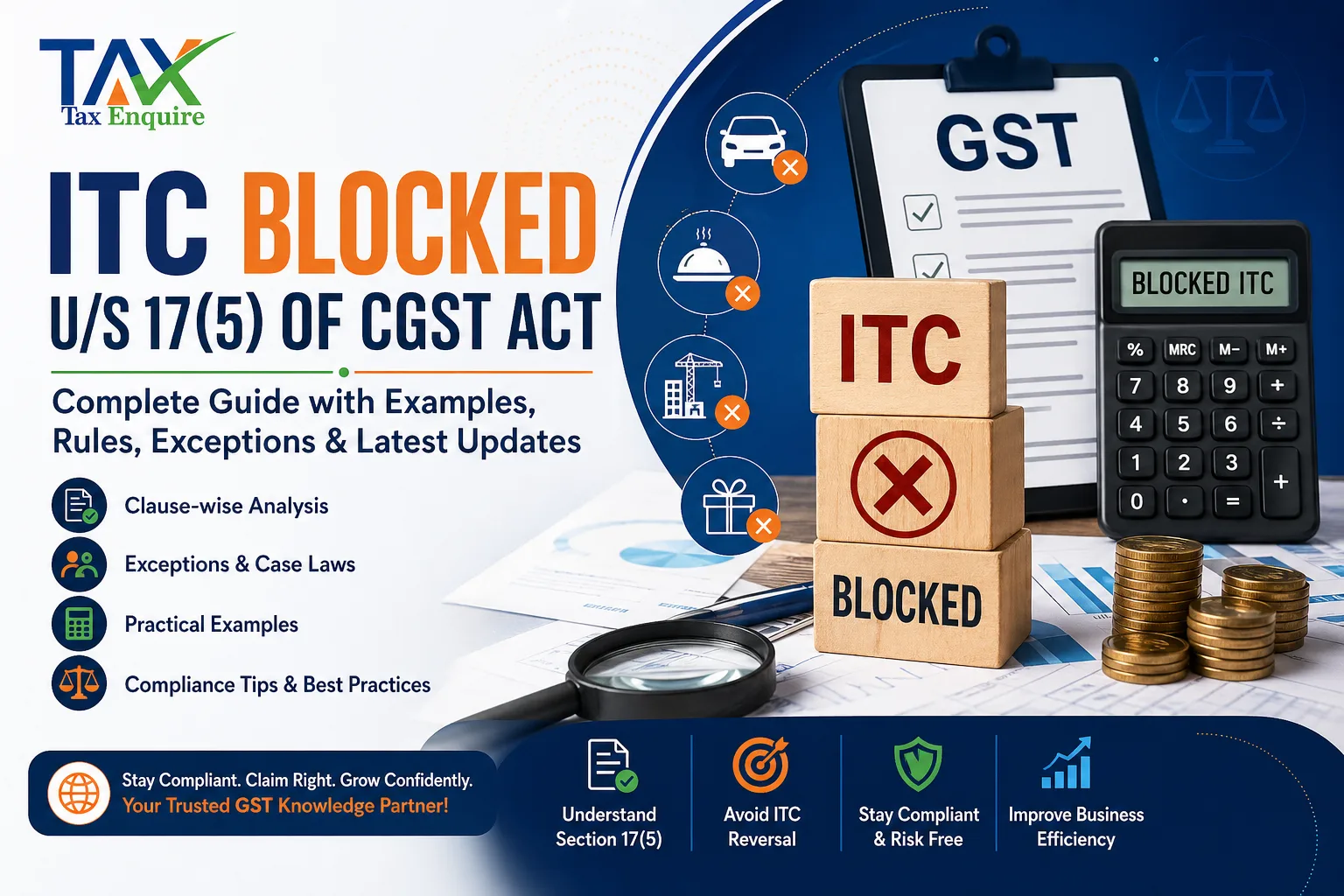
However, ITC is not universally allowed. The law specifically blocks certain credits under Section 17(5) of the CGST Act, commonly known as “Blocked ITC”.
Understanding these restrictions is critical because wrong ITC claims can lead to reversal, interest, and penalties.
Latest Amendments in Section 17(5)
Key Recent Updates (2024 GST Council Recommendations) Amendment in Clause (d) Restriction rationalization Removal of references These amendments aim to simplify compliance and reduce litigation. Clause-wise Table of Blocked ITC (Section 17(5)) Below is a comprehensive tabular summary explaining what is allowed vs disallowed: Detailed Explanation of Key Clauses 1. Motor Vehicles & Conveyances ITC is restricted on vehicles used for personal or office use (≤13 seating capacity). However, it is allowed when used for commercial activities like passenger transport or resale. 2. Food, Beverages & Employee Benefits Expenses such as canteen, catering, health services, club memberships are blocked unless: Used for outward supply of the same service, or Provided as a statutory obligation under labour laws. 3. Construction & Works Contract ITC is not allowed on: Construction of immovable property Works contract services Exception: Allowed for plant and machinery or when used for further supply of works contract. 4. Personal Consumption Any goods/services used for personal purposes are strictly disallowed, regardless of business connection. 5. Lost or Free Goods ITC must be reversed if goods are: Lost Stolen Destroyed Distributed as gifts or free samples Compliance & Reporting in GSTR-3B Blocked ITC must be reported separately in Table 4(B) Only eligible ITC is credited to electronic credit ledger Proper segregation is essential for audit compliance Conclusion Section 17(5) plays a critical role in GST compliance by clearly defining ineligible ITC categories. While GST promotes seamless credit flow, this section ensures checks against misuse. With recent amendments, especially regarding plant and machinery and rationalization of penalties, the law is evolving toward clarity and reduced disputes. Businesses must maintain proper documentation, classification, and periodic ITC review to ensure compliance and avoid litigation.
“Plant or Machinery” replaced with “Plant and Machinery” retrospectively from 01 July 2017 to remove ambiguity.
ITC blockage related to Section 74 (fraud cases) proposed to be limited up to FY 2023-24.
Proposed removal of Sections 129 & 130 (detention/confiscation) from blocked ITC category (awaiting notification).
© 2026 Tax Esquire | Expert CA Services in Greater Noida, Uttar Pradesh
8810380146 | info.taxesquire@gmail.com | taxesquire.in
This document is for informational purposes only. For personalised tax advice, consult our chartered accountants.