ITR Filing for Freelancers and Self-Employed in 2026: Complete Compliance Guide
ITR Filing for Freelancers and Self-Employed in 2026
Everything you need to know about filing your income tax return as a freelancer or self-employed professional
Why Freelancers and Self-Employed People Need to File ITR
Look, I see this all the time. Freelancers think that because they don't have a fixed employer, they can skip filing an Income Tax Return. That's wrong. Really wrong.
The thing is, the Income Tax Department doesn't care if you're a freelancer, consultant, or running a small business from home. If you're earning income in India, you need to file an ITR. And I mean everyone—even if your income is below the taxable limit.
So what does this mean for you? Filing an ITR isn't just about paying taxes. It's about building a clean financial record. When you apply for a loan, a credit card, or want to expand your business, banks ask for your ITR. A good ITR filing history makes everything easier.
Filing ITR regularly helps you get loans, credit cards, and business partnerships approved faster. It also protects you from income tax notices and penalties.
Who Needs to File ITR? Freelancer Edition
Not everyone needs to file an ITR. But if you're a freelancer or self-employed, the rules are different from salaried employees.
- Your gross income exceeds ₹2.5 lakhs in a financial year
- You have income from multiple sources (freelancing + investments)
- You want to carry forward losses from your business
- You're claiming GST refunds or input tax credits
- You have foreign income or assets abroad
- You want to build a clean credit history for loans
Honestly, even if your income is below ₹2.5 lakhs, filing an ITR is smart. Why? Because you're creating proof of income. That matters when you need it most.
If you don't file ITR when you're supposed to, the Income Tax Department can issue a notice under Section 143(2). You'll face penalties, and it gets messy. File on time.
Which ITR Form Should You File?
Here's where most freelancers get confused. There are different ITR forms, and picking the wrong one is a pain. Let me break it down for you.
| ITR Form | Who Should File | Best For |
|---|---|---|
| ITR-1 | Individuals with income from salary, pension, one house property, or other sources (not business) | Salaried employees and investors |
| ITR-2 | Individuals with income from multiple sources but not business | People with salary, rental income, and investments |
| ITR-3 | Individuals and HUFs with income from business or profession | Freelancers, consultants, and self-employed professionals |
| ITR-4 | Self-employed with presumptive income scheme eligibility | Small business owners and freelancers with gross receipts under ₹2 crores |
If you're a freelancer earning from writing, designing, coding, or consulting, you'll file ITR-3 in most cases. But if your gross receipts are under ₹2 crores and you meet the presumptive income scheme conditions, ITR-4 might be simpler.
And here's the thing—pick the wrong form, and the Income Tax Department will reject your return. You'll have to file again. Save yourself the trouble and get this right the first time.
Key Deadlines for ITR Filing in 2026
The deadline for filing ITR for the financial year 2025-26 is July 31, 2026. Mark it on your calendar. But don't wait until the last day—that's when the portal crashes.
- Financial Year 2025-26 ITR deadline: July 31, 2026
- If you've received an income tax notice, file within 30 days of receiving it
- For revised returns, you have one year from the end of the financial year
- If you miss the deadline, you can still file, but you'll face penalties
Late filing penalties? Up to ₹5,000 if your income is above ₹5 lakhs, and ₹1,000 if it's below. It's not huge, but why pay if you don't have to?
What Deductions Can Freelancers Claim?
This is where you can save real money. Most freelancers don't know what they can deduct, so they end up paying more tax than they should.
Put simply, anything that's directly related to your business can be deducted. Let me give you examples.
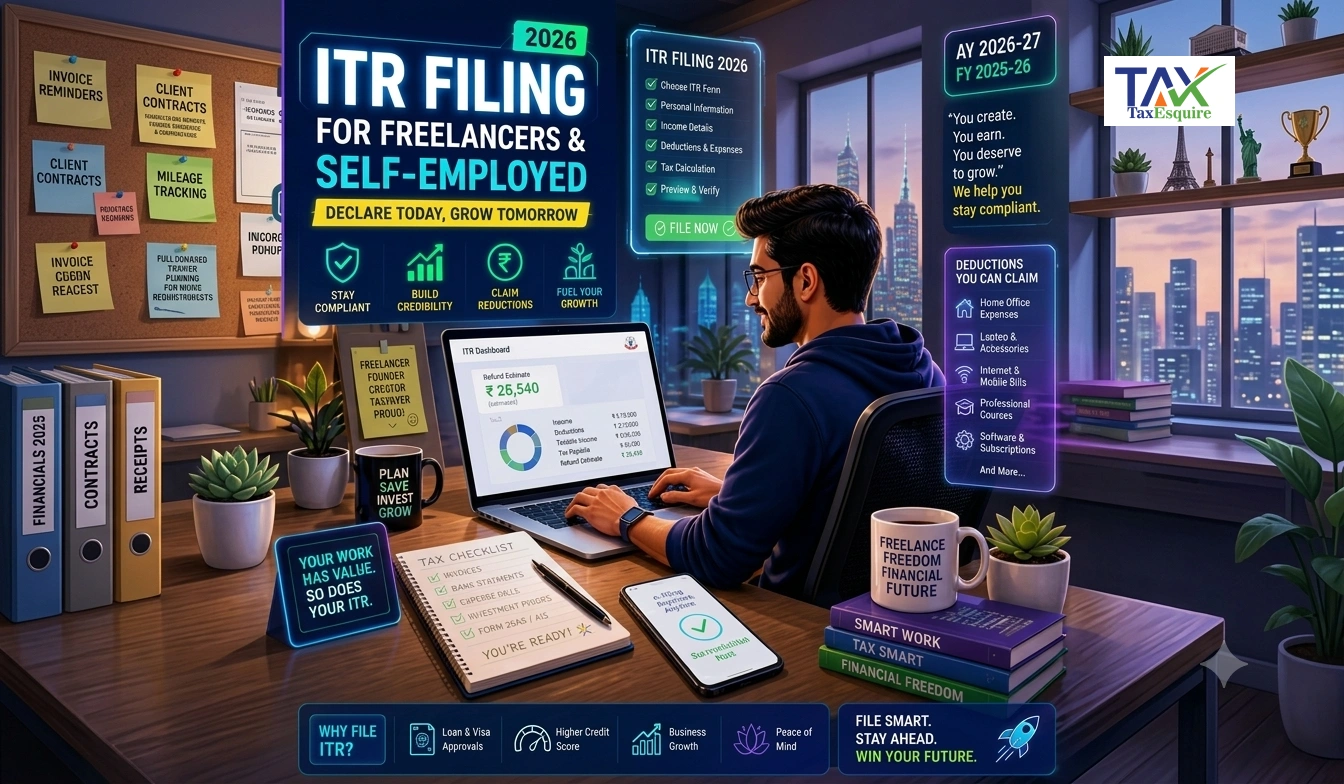
- Home office rent (proportionate to the space you use for work)
- Internet and phone bills (business portion only)
- Laptop, camera, software subscriptions, and tools
- Professional courses and certifications
- Travel and accommodation for client meetings
- Office furniture and equipment
But here's what you can't deduct: personal expenses like groceries, car payments for personal use, or gym memberships. The Income Tax Department is strict about this.
| Expense Type | Can You Deduct? | Notes |
|---|---|---|
| Internet bill | Yes | Only the business portion |
| Software licenses | Yes | Full amount if used for business |
| Car fuel | Partial | Only for business-related travel |
| Home electricity | Partial | Proportionate to office space |
| Lunch expenses | No | Personal expense |
Smart deduction planning can reduce your taxable income by 20-40%. Keep all receipts and bills organized. That's how you save money legally.
Understanding Income Tax Slabs for 2026
Tax slabs change every year. For the financial year 2025-26, here's what you're looking at.
| Income Range | Tax Rate | Plus Cess |
|---|---|---|
| Up to ₹3 lakhs | Nil | Nil |
| ₹3 lakhs to ₹7 lakhs | 5% | 4% |
| ₹7 lakhs to ₹10 lakhs | 20% | 4% |
| ₹10 lakhs to ₹12.5 lakhs | 30% | 4% |
| Above ₹12.5 lakhs | 30% | 4% |
So what does this mean for you? If you're a freelancer earning ₹5 lakhs, your tax liability is about ₹10,000 (5% of ₹2 lakhs above the ₹3 lakh threshold, plus 4% cess). That's why deductions matter—they reduce your taxable income.
How to File ITR Online: Step-by-Step
Filing ITR online is easier than you think. I'll walk you through it.
- Go to the official Income Tax e-filing portal (incometax.gov.in)
- Log in with your PAN and password (or Aadhaar OTP)
- Click "File Income Tax Return"
- Select the right assessment year (2026-27 for FY 2025-26)
- Choose the right ITR form (ITR-3 for most freelancers)
- Fill in your personal details, income, and deductions
And that's really it. The portal guides you through each step. But here's my advice: don't fill it all in one sitting. Save your progress and come back to it. That way, you don't make mistakes.
Double-check your income figures before submitting. If you report wrong income and the IT Department finds out later, you'll face penalties and interest. Get it right the first time.
Digital Signature and e-Verification
After you file your ITR, you need to verify it. That's where digital signatures come in. But don't worry—most freelancers don't need a full digital signature certificate.
You have two options. First, you can use e-verification through OTP sent to your registered mobile number or email. That's the easiest. Second, if your income is above ₹50 lakhs, you need a digital signature certificate (DSC). But most freelancers don't hit that threshold.
So basically, use OTP verification. It takes 2 minutes, and you're done.
Common Mistakes Freelancers Make When Filing ITR
I've seen these mistakes hundreds of times. Let me save you from making them.
- Reporting round numbers instead of actual income (the IT Department flags this)
- Not matching bank deposits with reported income
- Claiming deductions without keeping receipts
- Forgetting to report income from multiple clients or platforms
- Filing the wrong ITR form for their business type
The thing is, the Income Tax Department now uses data analytics. They can see your bank deposits, GST filings, and credit card transactions. If your ITR doesn't match, they'll send you a notice. So be honest and accurate.
What Happens After You File ITR?
After you file, the Income Tax Department processes your return. In most cases, they accept it without any questions. But sometimes, they send you a notice.
A notice under Section 143(1) means they want you to verify your return. It's routine. You just confirm the details and respond. A notice under Section 143(2) is more serious—it means they're questioning your income or deductions. You'll need to provide proof.
And here's what I tell all my freelancer clients: keep your receipts and bank statements for at least 6 years. If the IT Department asks for proof, you need to show it.
Once your ITR is accepted, you get a refund if you've overpaid taxes. The refund is usually processed within 2-3 months. That's free money the government is giving back.
ITR Filing for Freelancers on GST Registration
If you're registered for GST, your ITR filing gets a bit more complex. But not much.
You need to report your GST-registered income in your ITR. The good news? You can claim input tax credits for GST you've paid on business expenses. That reduces your tax liability.
And here's the thing—your ITR and GST returns should match. If you report ₹10 lakhs in your ITR but ₹8 lakhs in your GST return, the IT Department will notice. Keep them aligned.
Frequently Asked Questions
Q1: Can I file ITR if I'm earning below ₹2.5 lakhs?
Yes, you can and should. Even if you're below the taxable limit, filing ITR helps you build a financial record. Banks and lenders love it. Plus, you can carry forward losses if your business is new.
Q2: What's the difference between ITR-3 and ITR-4?
ITR-3 is for all self-employed people. ITR-4 is simpler and only for people with gross receipts under ₹2 crores who opt for the presumptive income scheme. ITR-4 assumes 50% of your gross receipts as income, so you don't need detailed bookkeeping. But ITR-3 gives you more control over deductions.
Q3: What happens if I miss the ITR deadline?
You can still file, but you'll face a penalty. If your income is above ₹5 lakhs, it's ₹5,000. Below that, it's ₹1,000. Plus, you can't claim a refund if you've overpaid. So file on time. The deadline for FY 2025-26 is July 31, 2026.
Q4: Do I need to show GST invoices in my ITR?
You don't need to attach them, but you should keep them. The IT Department might ask for proof of income and expenses. GST invoices are the best proof. Keep them organized for at least 6 years.
Q5: Can I claim home office rent as a deduction?
Yes, but only the proportionate amount. If your home is 200 square meters and your office space is 20 square meters, you can deduct 10% of your rent. Keep a clear record of how you calculated it. The IT Department appreciates transparency.
Final Thoughts on ITR Filing for Freelancers
Filing ITR as a freelancer isn't as scary as it sounds. Yes, there's paperwork. Yes, there are rules. But if you stay organized and honest, you'll be fine.
The key is to start early. Don't wait until July 2026 to think about your ITR. Keep track of your income and expenses throughout the year. Use accounting software if you can. And if you're not sure about something, ask a CA. That's what we're here for.
Remember, filing ITR isn't just about paying taxes. It's about building trust with the financial system. Banks, lenders, and business partners all trust people with clean ITR records. So file on time, file accurately, and file honestly.
" } ```
© 2026 Tax Esquire | Expert CA Services in Greater Noida, Uttar Pradesh
8810380146 | info.taxesquire@gmail.com | taxesquire.in
This document is for informational purposes only. For personalised tax advice, consult our chartered accountants.