Types of Accounting Careers: A Complete Guide for 2026 and Beyond
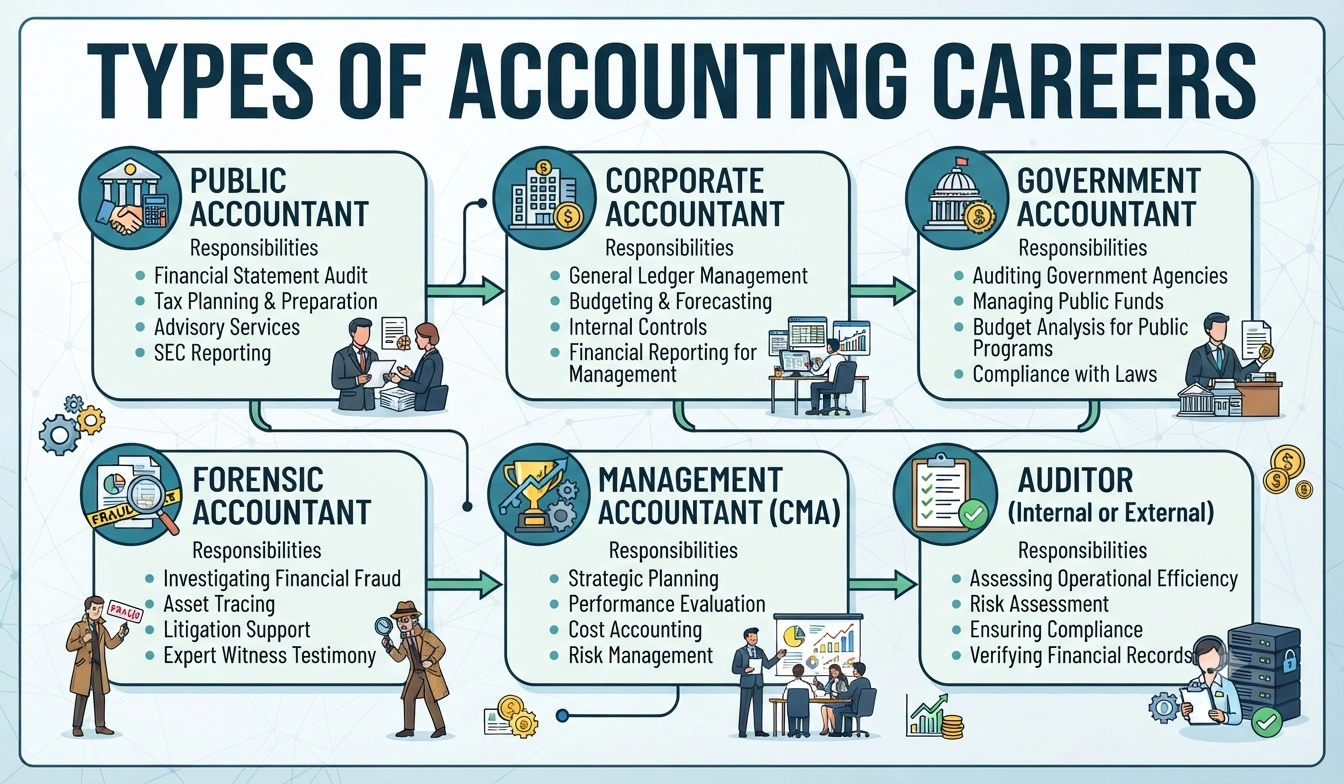
Types of Accounting Careers
A comprehensive guide to accounting career paths, roles, and opportunities in 2026
So you're thinking about an accounting career. Good choice. The accounting field is massive, and honestly, most people don't realize how many different paths you can take. You could work in a big firm, go solo, chase fraud, work for a startup, or even become a CFO. The thing is, each path is completely different—different pay, different stress levels, different skills you'll need.
As a CA with years of experience, I've seen people thrive in every single accounting role. And I've also seen people pick the wrong one and regret it. So let's talk about what's actually out there, what you'll be doing, and what might fit you best.
Public Accounting: The Classic Path
Public accounting is where most accounting graduates start. And there's a reason for that. When you work in public accounting, you're basically a hired gun for multiple clients. Your firm takes on the work, and you deliver the results.
What does this actually mean for you? You'll be doing audit work, tax planning, compliance checks, and advisory services. You'll move between clients. You'll meet different business owners and CFOs. You'll see how different industries actually work—not from a textbook, but from the inside.
- Audit services—checking financial statements and internal controls
- Tax compliance and planning for individuals and businesses
- Assurance services—making sure financial data is reliable
- Advisory and consulting on business restructuring
- Payroll and HR compliance services
- Forensic accounting and fraud investigation
The money is decent, especially as you move up to Senior Accountant or Manager level. But here's the catch—the hours can be brutal during peak seasons. Tax season? You might be working 60-70 hour weeks. That's just how it is.
Public accounting gives you exposure to multiple industries and clients. You learn fast because you're solving different problems every day. Plus, the credentials you pick up—CA, CPA, or other certifications—are portable and respected everywhere.
Corporate Accounting: The Stable Route
Now, corporate accounting is the other side of the coin. Instead of serving multiple clients, you work for one company. You become part of their finance team. And honestly, this is where a lot of accountants end up because the lifestyle is usually better.
But what does a corporate accountant actually do? Put simply, you're responsible for keeping your company's books clean. You process transactions, manage accounts payable and receivable, prepare financial statements, and help with budgeting and forecasting.
- General ledger accounting and journal entries
- Accounts payable and accounts receivable management
- Month-end and year-end close processes
- Financial reporting and analysis
- Budget preparation and variance analysis
- Internal controls and compliance with company policies
The best part? You usually work 40-45 hours a week. You get to know your company deeply. You see the same people every day. And you understand the business from the inside—not just the numbers, but the strategy and the people behind it.
The downside is that you're limited to one company's industry and processes. If that company goes through a rough patch, you feel it. But for people who want stability and work-life balance, corporate accounting is genuinely the better choice.
Corporate accounting roles can become repetitive if you don't seek growth opportunities. Make sure your company has a clear path to senior roles like Controller or CFO, or you might feel stuck after a few years.
Government and Non-Profit Accounting
And then there's the public sector. Government agencies, NGOs, and non-profit organizations all need accountants. This path isn't as flashy as public or corporate accounting, but it's genuinely rewarding for a lot of people.
Why? Because you're managing public funds. You're making sure taxpayer money is spent right. You're helping organizations that actually change communities. The work matters differently when you're not just chasing profit.
- Fund accounting and grant management
- Compliance with government regulations and audit requirements
- Budget management for public programs
- Reporting to government bodies and donors
- Internal controls specific to public sector rules
- Audit preparation and coordination
The salary is usually lower than corporate or public accounting, but the job security is excellent. Government jobs especially don't disappear in recessions. And the benefits—pension, health insurance, leave—are typically really good.
Forensic Accounting and Fraud Investigation
Now here's where it gets interesting. Forensic accountants are basically the detectives of the accounting world. You're looking for fraud, embezzlement, money laundering, and other financial crimes. Some days you're in a courtroom. Other days you're digging through spreadsheets looking for suspicious patterns.
The work is genuinely different from regular accounting. You need to think like an investigator. You need to understand how people hide money. You need to be comfortable testifying in court as an expert witness.
- Fraud detection and investigation
- Litigation support and expert witness testimony
- Asset tracing and recovery
- Embezzlement investigation
- Money laundering detection
- Digital forensics and e-discovery
The pay is excellent. Really excellent. Especially if you work on high-profile cases or testify in court. But you need to be ready for the stress. You're dealing with criminals sometimes. You're handling sensitive information. And the hours can be unpredictable.
Forensic accounting is intellectually stimulating. You're solving real crimes. You're getting paid well. And you're genuinely making a difference in the justice system. If you like the detective work side of accounting, this is your lane.
Tax Accounting: Specialization with Purpose
Tax accounting is its own world. And honestly, it's a world that needs people badly. Tax laws change every year. Businesses need to stay compliant. Individuals need someone who actually understands the rules.
So what does a tax accountant do? You prepare tax returns. You plan tax strategies to minimize liability. You handle audits and disputes with tax authorities. You advise on complex situations like mergers, acquisitions, or international transactions.
- Individual and corporate tax return preparation
- Tax planning and strategy
- GST and indirect tax compliance
- International tax planning
- Tax audit representation
- Payroll tax compliance
The thing is, tax accounting has seasonal peaks. January to March is chaos if you're dealing with individual returns. But outside those periods, it's actually manageable. And the expertise you build is incredibly valuable. Good tax accountants are always in demand.
Internal Audit: The Quality Control Role
Internal auditors work inside companies to make sure everything is running properly. You're checking processes, testing controls, and making sure people aren't cutting corners or breaking rules. Basically, you're the company's internal police force.
And honestly? This role is becoming really important. Companies are getting more complex. Regulations are getting stricter. They need people who can dig into operations and find problems before external auditors or regulators do.
- Internal control testing and evaluation
- Risk assessment and management
- Compliance audits
- Operational audits
- Fraud prevention programs
- Management recommendations and follow-up
Internal auditors usually have good work-life balance. You're inside one company, so you're not jumping between clients. You're not dealing with the public. You're reporting to senior management or the audit committee directly, which gives you real influence.
Management Accounting and Cost Accounting
Management accountants work with company management to help with decision-making. You're not just reporting what happened—you're analyzing what should happen next. You're helping leaders understand costs, profitability, and performance.
What I mean is, you're the bridge between accounting and business strategy. You're preparing budgets, analyzing variances, doing cost-benefit analyses, and providing insights that actually drive business decisions.
- Cost analysis and management
- Budget preparation and monitoring
- Performance measurement and KPI tracking
- Profitability analysis by product or department
- Pricing strategy recommendations
- Capital budgeting and investment appraisal
This role is perfect if you like using accounting as a tool for business improvement. You're not just crunching numbers—you're solving business problems. And management accounting skills are incredibly valuable as you move toward leadership roles.
Accounting for Startups and Small Businesses
And then there's the startup world. If you work for a startup or as a consultant to small businesses, everything is different. You're doing everything—bookkeeping, tax planning, financial forecasting, maybe even HR and operations.
But here's the reality: startup accounting is chaotic. You don't have established processes. You don't have a big team. You're learning the business as you go. And the owner is probably asking you questions about cash flow at 9 PM on a Friday.
- Bookkeeping and transaction recording
- Cash flow management and forecasting
- Tax compliance and planning
- Financial reporting for investors
- Fundraising support and documentation
- Business advisory and strategic planning
But you know what? If you like variety and direct impact, this is amazing. You're helping a business grow from nothing. You're learning how business actually works. And if the startup succeeds, you're part of that success story.
Startup accounting can be unstable financially. If the startup fails, you're out of a job. And the pay might be lower than corporate roles, at least initially. Make sure you can handle that risk before jumping in.
Accounting Education and Training
Some accountants move into teaching. You could work at a college or university teaching accounting, auditing, taxation, or other subjects. Or you could work for professional bodies training people for CA, CPA, or other certifications.
This path is perfect if you like mentoring and knowledge sharing. You're shaping the next generation of accountants. You're staying current with regulations and standards. And you get academic freedom and job security.
- Classroom teaching and curriculum development
- Professional certification training
- Online course development
- Research and publication
- Professional body consulting
- Training program management
Accounting Career Comparison Table
| Career Type | Work Environment | Salary Range | Work-Life Balance |
|---|---|---|---|
| Public Accounting | Client-facing, multiple industries | Medium to High | Moderate (busy seasons) |
| Corporate Accounting | Single company, stable | Medium | Good |
| Government/Non-Profit | Public sector, mission-driven | Medium (lower) | Excellent |
| Forensic Accounting | Investigation, litigation | High | Moderate to Poor |
| Tax Accounting | Compliance-focused, seasonal | Medium to High | Poor (tax season) |
| Internal Audit | Single company, strategic | Medium to High | Good |
| Management Accounting | Internal, strategic focus | Medium to High | Good |
| Startup Accounting | Fast-paced, varied work | Variable | Poor (initial phase) |
Key Skills You'll Need Across All Roles
Regardless of which accounting career you pick, certain skills are non-negotiable. So let's talk about what actually matters in 2026 and beyond.
- Technical accounting knowledge—GAAP, IFRS, tax codes, GST rules
- Software proficiency—Tally, SAP, QuickBooks, Excel (seriously, Excel mastery is huge)
- Analytical thinking—you need to spot patterns and anomalies
- Attention to detail—one decimal point error can cause chaos
- Communication skills—you need to explain complex stuff to non-accountants
- Integrity and ethics—this profession is built on trust
Certifications That Matter in 2026
If you want to move up in accounting, certifications are basically mandatory. They show you know your stuff. They open doors. And they increase your earning potential significantly.
- CA (Chartered Accountant)—the gold standard in India and many countries
- CPA (Certified Public Accountant)—essential if you want to work in the US
- CMA (Certified Management Accountant)—great for management accounting roles
- CIA (Certified Internal Auditor)—if you're going into internal audit
- CFE (Certified Fraud Examiner)—for forensic accounting
- ACCA (Association of Chartered Certified Accountants)—recognized globally
How to Choose the Right Accounting Career for You
So you've read about all these different paths. Now the real question: which one is right for you?
Honestly, it depends on what matters to you. Are you chasing money? Forensic accounting and public accounting pay well. Want stability? Corporate accounting or government roles are your best bet. Like solving problems? Management accounting or internal audit. Want to hunt criminals? Forensic accounting is calling you.
Here's what I tell people: try different roles early in your career. Work at a firm for a few years. Then move to corporate. Or do a rotation through internal audit. You'll figure out what fits your personality and your life. And that matters way more than salary.
The accounting field is flexible. You can change directions. A corporate accountant can become a forensic accountant. A tax accountant can move into management accounting. Your early choices don't lock you in forever.
Frequently Asked Questions
1. What's the highest-paying accounting career?
Forensic accounting and senior roles in public accounting (like Partner) pay the most. But it depends on your location and experience. In 2026, experienced forensic accountants can earn significantly more than other accounting roles, especially if they do expert witness work in high-profile cases. But remember, the money comes with stress and unpredictable hours.
2. Can I switch between accounting careers?
Absolutely. You can move from public accounting to corporate, or from tax accounting to internal audit. The skills transfer pretty well. But some moves are easier than others. Moving from public accounting to corporate is simple. Moving from bookkeeping to forensic accounting takes more work because you need different skills. The earlier you make the switch, the easier it is.
3. Is accounting automation going to kill these careers?
Not really. Yes, AI and automation are handling routine bookkeeping. But that's not what accountants do anymore anyway. You're analyzing data, solving problems, advising on strategy, and managing risk. Those things still need humans. If anything, automation is making accounting careers more strategic and valuable. You're not spending time on data entry—you're spending time on analysis and advice.
4. Do I need a degree to become an accountant?
In most countries, yes. You need at least a bachelor's degree in accounting or a related field to sit for professional certifications like CA or CPA. Some countries have alternative pathways, but a degree is pretty much standard. And honestly, you'll want it. It gives you the foundational knowledge you need.
5. What's the job market like for accountants in 2026?
Strong. Businesses always need accountants. Tax laws keep getting more complex. Regulations keep tightening. Compliance requirements keep growing. So demand for accounting talent is solid. The jobs that might be harder to get are entry-level bookkeeping roles because automation is handling some of that. But mid-level and senior accounting positions are in good demand. Specialized roles like forensic accounting and management accounting are particularly hot right now.
Wrapping Up: Your Accounting Career Path Starts Here
So there you have it. Eight different types of accounting careers, each with its own vibe, challenges, and rewards. Public accounting if you want exposure and growth. Corporate accounting if you want stability. Forensic accounting if you want excitement. Tax accounting if you want specialization. Government accounting if you want purpose. Internal audit if you want influence. Management accounting if you want strategy. Startup accounting if you want variety.
The thing is, there's no single "right" choice. There's only the right choice for you. And that depends on your personality, your goals, your tolerance for stress, and what kind of life you want to live.
My advice? Start somewhere. Get your feet wet. Learn the basics. Build your network. Get certified. Then reassess. You don't have to make the perfect choice right now. You just have to make a good choice and be willing to adjust as you learn more about yourself and the profession.
And honestly, no matter which path you pick, if you're good at what you do and you keep learning, you'll build a solid career. The accounting field rewards competence and integrity. Those two things matter more than anything else.
" } ```
© 2026 Tax Esquire | Expert CA Services in Greater Noida, Uttar Pradesh
8810380146 | info.taxesquire@gmail.com | taxesquire.in
This document is for informational purposes only. For personalised tax advice, consult our chartered accountants.