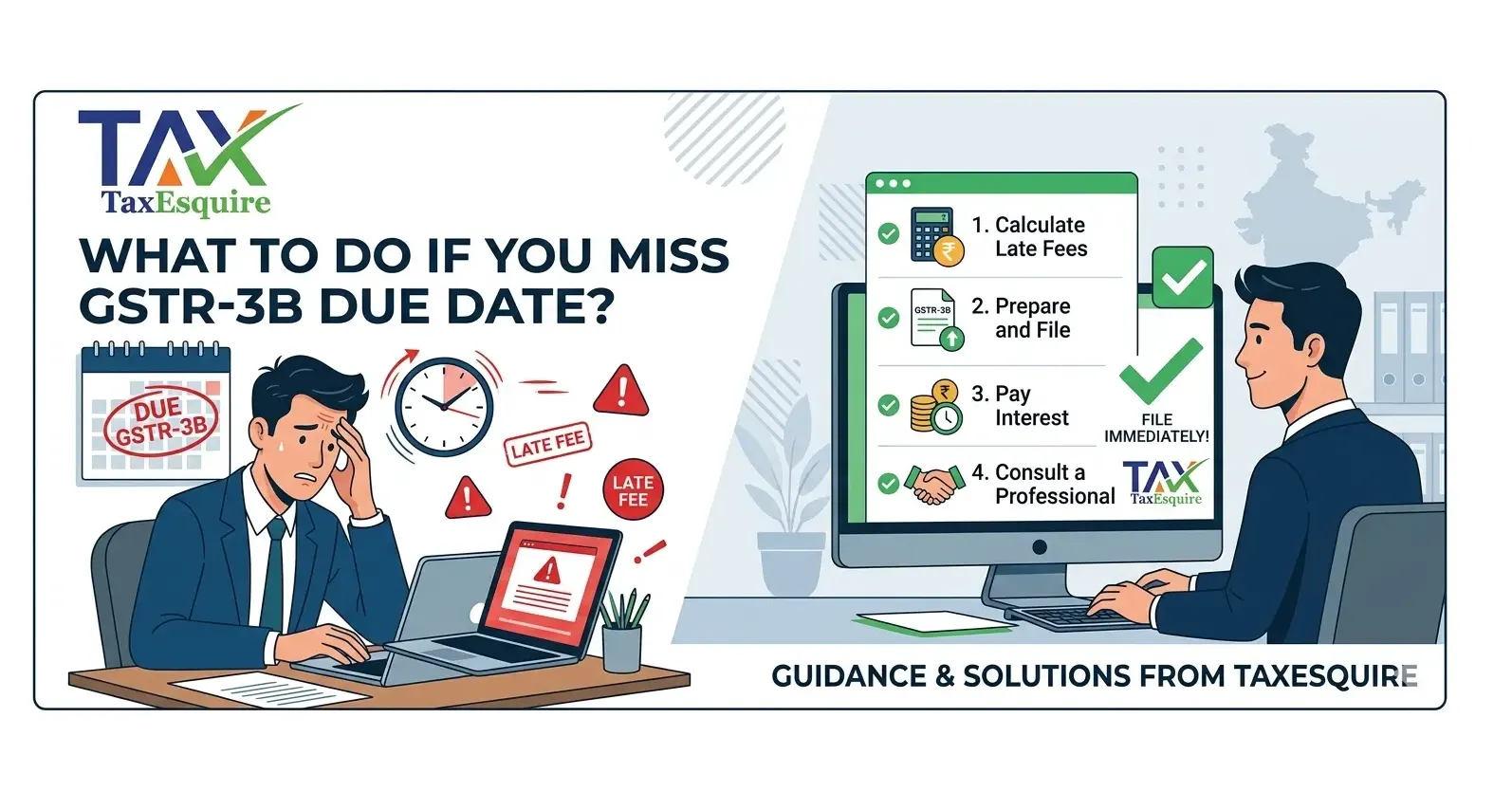
What to Do If You Miss GSTR-3B Due Date?
Introduction
Staying compliant with Goods and Services Tax (GST) in India is a critical responsibility for every registered taxpayer, and filing GSTR-3B on time plays a key role in this process. However, in the fast-paced world of business, deadlines can sometimes be missed due to oversight, workload, or technical issues. If you’ve missed the GSTR-3B due date, it’s natural to feel concerned about penalties, interest, and compliance risks.
The good news is that a missed deadline doesn’t have to turn into a major problem if handled correctly and promptly. Knowing what actions to take immediately, how to calculate late fees, and how to avoid further consequences can make a significant difference. In this blog, we’ll guide you through everything you need to do after missing the GSTR-3B due date, helping you stay compliant, reduce financial impact, and keep your business on track.
What is GSTR-3B? GSTR-3B is a monthly self declaration summary return that every registered taxpayer under GST must file. It includes consolidated details’ of: Outward supplies (sales) Inward supplies liable to reverse charge Input Tax Credit (ITC) claimed Total tax liability and payment Although introduced as a temporary measure when GST was implemented in 2017, GSTR-3B has now become a permanent and essential compliance requirement. Due Dates for GSTR-3B Filing: Timely filing of GSTR-3B is crucial to avoid penalties and ensure smooth compliance. Standard Due Dates: Monthly Filer’s: 20th of the next month QRMP Scheme Taxpayers: 22nd of next month (Category 1 states) or 24th of next month (Category 2 states) Key Considerations: Deadline’s may be extended by the government in special cases Delay results in late fees + interest Filing GSTR-3B is required before filing GSTR-1 in many cases Late Filing of GSTR-3B – Interest & Penalties Late filing leads to financial consequences that increase over time. Late Fees: ₹50 per day (₹25 CGST + ₹25 SGST) ₹20 per day for NIL return Maximum cap may apply based on turnover Interest: 18% per annum on unpaid tax Calculated from due date till payment Who Needs to File GSTR-3B? GSTR-3B filing is compulsory for most GST-registered taxpayers. Applicable To: Regular taxpayers registered under GST Businesses under the QRMP (Quarterly Return Monthly Payment) scheme Companies with active GSTIN, even with no transactions Not Applicable To: Composition scheme taxpayers (they file CMP-08) Input Service Distributors (ISD) Non-resident taxable person’s TDS/TCS deductor’s Important Note: Even if there is no sale or purchase, or business operations are temporarily inactive. Filing a NIL return is still mandatory. What Happens If You Miss GSTR-3B Filing? Missing GSTR-3B filing can disrupt business operations. 1. Late Fees under Section 47 of the CGST Act, 2017 If you don’t file your GSTR 3B on time, the first thing you’ll encounter is a late fee, which keeps growing each day until it reaches the maximum limit. This fee will automatically appear in the following month’s GSTR 3B, and, unfortunately, you won’t be able to adjust or file your return until the late fee is paid. 2. Interest under Section 50 If you’re supposed to pay your taxes within a specific time but end up missing the deadline, an interest of 18% will apply for the delay, but only if you use the cash ledger balance to cover it. The good news is that if you’ve got enough input tax credit and don’t use net banking, challans, or funds from your cash ledger to make the payment, no interest will be charged. 3. Restricting E-Waybill Generation Under Rule 138E If someone hasn’t filed their GST returns for two back-to-back tax periods, their ability to generate E-Way Bills will be temporarily blocked for all types of outward supplies. But don’t worry once the GST returns are filed, this restriction will be lifted. While the restriction is in place, it will impact any outward supply worth more than ₹50,000 leaving the state and any supply within the state that meets the specific value limit set by the State Government. 4. Penalty Under Section 122- levy after 3 months of due date Apart from late fees and interest, continuous non-filing or non-payment of GST may also attract scrutiny and penalty proceedings by the GST department. Under Section 61 of the CGST Act, the department may scrutinize GSTR-1, GSTR-3B, ITC claims, and tax payments. If discrepancies are not resolved, proceedings may be initiated under Section 73 for non-fraud cases or Section 74 for fraud or suppression cases. Further, as per Section 122(1)(iii) of the CGST Act, if a taxpayer collects GST from customers but fails to deposit the same with the Government within 3 months from the due date, penalty provisions may become applicable. The penalty shall be equal to the tax amount not deposited or ₹10,000, whichever is higher. Penalty=max (Tax Amount," ₹" 10,000) For example, if a taxpayer collected GST of ₹28,000 for December 2025 but failed to deposit the same even after 20 April 2026, then along with late fee under Section 47 and interest under Section 50, a penalty of ₹28,000 may also be levied under Section 122(1)(iii). In certain cases, authorities may additionally invoke general penalty provisions under Section 125, where the total penalty exposure may extend up to ₹50,000 including CGST and SGST. 5. Suspension and Cancellation of GST Registration (Section 29(2)) If a regular taxpayer does not file GSTR-3B for 6 continuous months, the GST officer may start the process of cancelling the GST registration. Before cancellation, the officer will send a notice, and the taxpayer must reply within 7 working days explaining the reason for non-filing. Although cancellation is not automatic after 6 months, once the process starts, the GSTIN may be suspended. During suspension, the taxpayer cannot make taxable supplies, which can directly affect business operations. 6. Recovery Proceedings (Section 79) This is the strictest action taken for non-filing of GSTR-3B. Before recovery starts, several reminders and steps are followed: First Reminder: Sent 3 days before the due date Second Reminder: Sent immediately after the due date Notice (GSTR-3A): Issued 5 days after the due date, asking to file return within 15 days Assessment Order: If still not filed, the officer may assess tax based on available data (sales, purchases, e-way bills, etc.) and issue order in ASMT-13 along with DRC-07 Recovery Action: If dues are not paid within 30 days, recovery proceedings may begin under Section 79 Under recovery, the department can collect dues from: Bank accounts Debtors Refunds Goods or property Important: The officer is not bound to act exactly after 15 days. Action can be taken anytime after that. 7. Restriction on Input Tax Credit (ITC) One key condition for claiming ITC is that the supplier must pay tax to the government. If a supplier does not file GSTR-3B, it is generally assumed that tax has not been paid. This may lead to denial or restriction of ITC to the buyer. Although taxes can also be paid through other forms like annual return or DRC-03, most businesses use GSTR-3B. This issue is often ignored and debated because buyers have no direct way to verify whether the supplier has actually paid the tax. Conclusion GSTR-3B is a critical GST return that requires timely and accurate filing. Delays or mistakes can lead to penalties, loss of ITC, and compliance issues. By understanding the process and leveraging professional support, businesses can: Avoid costly errors Maintain compliance Improve financial efficiency Get your GSTR-3B filed accurately and on time with expert assistance today.
© 2026 Tax Esquire | Expert CA Services in Greater Noida, Uttar Pradesh
8810380146 | info.taxesquire@gmail.com | taxesquire.in
This document is for informational purposes only. For personalised tax advice, consult our chartered accountants.