GST Compliance for Startups in 2026: Complete Guide to Registration and Filing
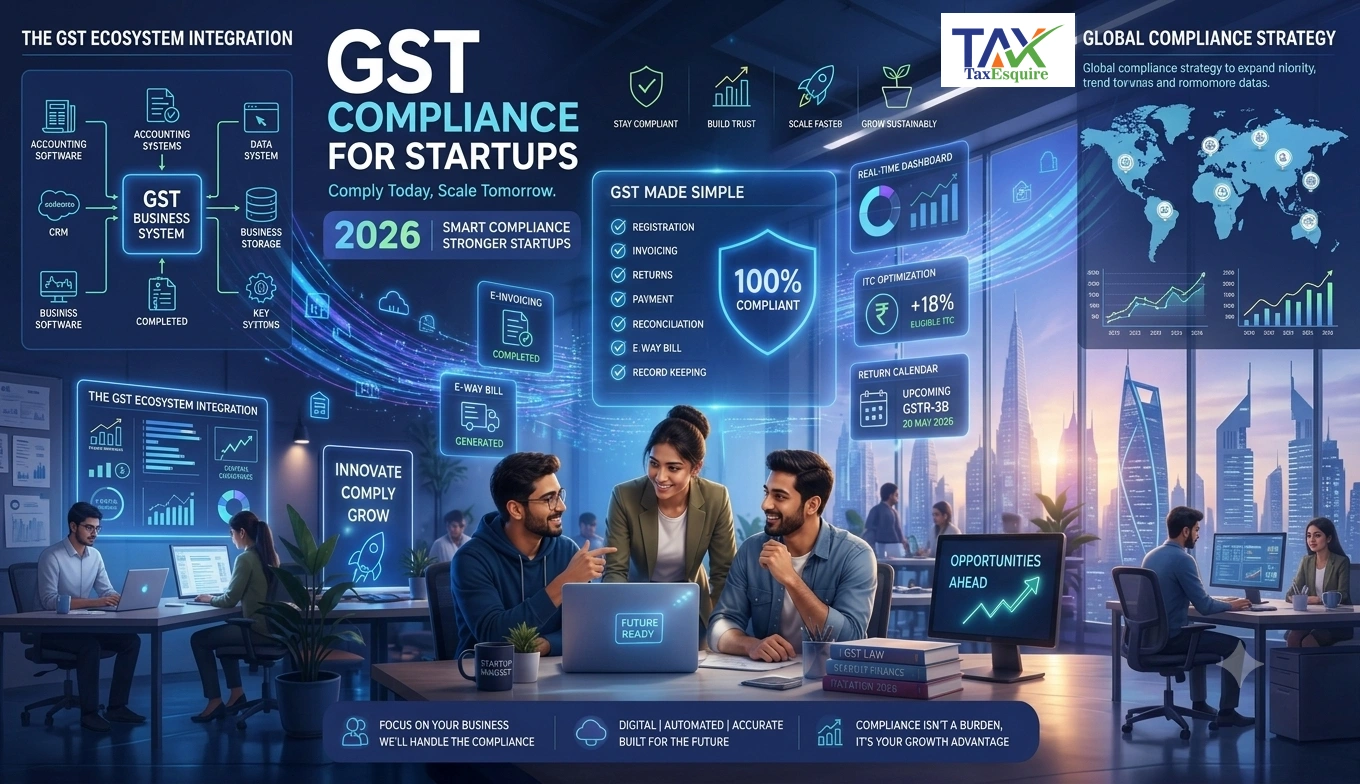
GST Compliance for Startups in 2026
Everything you need to know about GST registration, filing requirements, and staying compliant as a startup founder
Why GST Compliance Matters for Your Startup Right Now
Look, I've worked with hundreds of startup founders, and here's what I see most often: they get so focused on building their product or service that GST compliance becomes an afterthought. Then, when the tax department shows up with a notice, things get messy fast.
The thing is, GST isn't optional in India. It's a real responsibility, and getting it wrong can cost you penalties, blocked bank accounts, and a ton of stress. But here's the good news—if you understand the basics and stay organized, compliance becomes straightforward.
In 2026, the GST rules haven't fundamentally changed, but what's important is that more startups are under scrutiny now. The tax department has better tools, better data, and better ways to catch non-compliance. So you need to be sharp.
Getting GST compliance right from day one saves you money on penalties, builds trust with your suppliers and customers, and makes scaling your business way easier down the road.
Do You Actually Need GST Registration?
This is the first question every startup founder asks me. And honestly, the answer depends on your business turnover.
As of 2026, you need to register for GST if your annual turnover crosses the threshold. For most businesses, that threshold is 40 lakh rupees. But there are exceptions—and that's where things get interesting.
| Business Type | GST Registration Threshold 2026 | Compulsory Registration |
|---|---|---|
| Supply of goods | 40 lakh per year | No, unless turnover exceeds threshold |
| Supply of services | 20 lakh per year | No, unless turnover exceeds threshold |
| Composition scheme eligible | 1.5 crore per year | Can opt for regular or composition |
| Supply of liquor | No threshold | Yes, always compulsory |
| Interstate supplies | No threshold | Yes, even below threshold |
So what does this mean for you? If you're running a service-based startup and your turnover is 15 lakh in your first year, you don't need to register for GST. But if you cross 20 lakh, you do.
And here's a key point: if you're making interstate supplies—meaning you're selling to customers in different states—you need GST registration even if your turnover is below the threshold. That's non-negotiable.
Don't assume you don't need GST just because you're small. The department can still notice you and demand registration retroactively, which creates a mess with back taxes, interest, and penalties.
The GST Registration Process: Step by Step
Let me walk you through this. The process is actually simpler than most people think, and it's entirely online now.
First, you go to the GST portal—that's www.gst.gov.in. You'll create an account and start the registration process using your PAN and Aadhaar. Then you fill in your business details, address, nature of business, and expected turnover.
- Create a login on the GST portal with your email and mobile number
- Fill in your business details—PAN, Aadhaar, business address, and bank account information
- Upload supporting paperwork: incorporation certificate, partnership deed, or sole proprietor ID
- Provide your bank details for any refunds or notices from the department
- Submit the application and wait for acknowledgment
- The department reviews your application, which usually takes 3 to 7 days
But here's what I tell startups: don't just fill in random numbers for expected turnover. Be honest. If you put down 5 crore when you're actually a 20-lakh startup, the department will notice the mismatch when you file your first return, and that raises red flags.
Once you're approved, you get a GST registration certificate with your GSTIN. That's your unique GST number, and you'll use it on every invoice you send out.
Understanding GST Filing Requirements
And now we get to the part that actually matters day-to-day: filing your GST returns. This is where compliance lives.
In 2026, there are three main returns you need to file, depending on your business structure. Let me break them down for you.
GSTR-1: Your Sales Invoice Return
This return is where you report all the invoices you've issued to your customers. Every sale you make, every invoice you send out, gets reported here.
The deadline is the 11th of the next month. So if you make sales in January, you file GSTR-1 by February 11th. And honestly, this is the one that catches most startups off guard because they're not tracking invoices properly from day one.
What I mean is, if you're not organized with your invoicing from the start, filing GSTR-1 becomes a nightmare. You'll be scrambling to find invoices, cross-checking amounts, and wasting time. So set up a simple system right away—whether that's accounting software or even a spreadsheet.
GSTR-2A and GSTR-2: Your Purchase Records
GSTR-2A is auto-populated by the GST system based on invoices your suppliers have filed. It shows what you've bought from them. You review this and accept or reject the entries.
GSTR-2 is where you report your actual purchases. The deadline is the 15th of the next month. But here's the thing: if your supplier hasn't filed their invoice in GSTR-1, you won't see it in GSTR-2A, which creates a mismatch.
This happens a lot with startups buying from small vendors who aren't GST-registered or who file late. It's frustrating, but you need to follow up with your suppliers to make sure they're filing on time.
GSTR-3B: Your Monthly Summary Return
This is the big one. GSTR-3B is where you calculate your net GST liability. You report your sales, subtract your input tax credits from purchases, and pay the difference to the government.
The deadline is the 20th of the next month. So if you're in January, you file GSTR-3B by February 20th and pay any tax due.
Here's where a lot of startups stumble: they forget that GST is a tax you collect on behalf of the government. If you sell something for 1,000 plus 180 rupees GST, that 180 isn't your money—it's the government's. You need to pay it by the deadline. If you don't, penalties kick in fast.
Filing GST returns on time keeps you off the department's radar, prevents penalties, and makes it easier to claim input tax credits that reduce your actual tax burden.
Common GST Mistakes Startups Make
I've been doing this for years, and I see the same mistakes over and over. Let me save you the headache.
- Not maintaining proper invoices: Your invoices need to have your GSTIN, the customer's GSTIN (if they're registered), HSN codes, and the exact GST amount. Missing any of these creates compliance issues.
- Claiming input tax credit on ineligible items: You can't claim GST on personal expenses, entertainment, or fuel. But startups often try, and the department catches it during audits.
- Filing returns late: Even one day late triggers a penalty. It's 50 rupees per day, capped at 500 rupees for the first offense, but it adds up fast if you're consistently late.
- Misclassifying goods or services: If you're not sure which GST rate applies to what you sell, you'll get it wrong. This leads to underpayment and demands from the department.
- Not reconciling GSTR-1 and GSTR-2A: If your sales invoices don't match what your customers are reporting, the system flags discrepancies and you'll get notices.
The good news? Most of these are preventable if you stay organized and use decent accounting software. Put simply, automate what you can.
GST Penalties and What They Actually Cost
Let me be straight with you: GST penalties hurt. They're not small warnings—they're real money that comes out of your business.
| Violation | Penalty Amount | Additional Details |
|---|---|---|
| Late filing of return | 50 rupees per day, max 500 rupees | First offense only |
| Non-filing of return | 10,000 rupees or 5% of tax due | Whichever is higher |
| Incorrect invoice details | 10% of tax on incorrect amount | Minimum 10,000 rupees |
| Unsubstantiated input tax credit | Same as tax amount plus interest | Plus 18% annual interest |
| Non-payment of tax | Same as tax amount plus interest | Interest accrues monthly |
So if you owe 50,000 rupees in GST and don't pay it, you're not just paying 50,000. You're paying 50,000 plus 18% annual interest plus potential penalties. That's 59,000 rupees or more, depending on how long you delay.
And that's just the financial hit. There's also reputational damage. If you're consistently non-compliant, the department can block your bank account, suspend your GST registration, or worse, refer you for prosecution.
A single missed GST payment can snowball into a nightmare. Interest compounds monthly, and if you're not paying attention, you could owe double or triple the original amount within a year.
Best Practices for GST Compliance in 2026
Honestly, compliance doesn't have to be complicated. Here's what I recommend to every startup I work with.
- Use accounting software: Tools like Tally, Zoho Books, or even Wave automate GST calculations and make filing much easier. The investment is worth it.
- Keep invoices organized: Every invoice you issue needs to be tracked. Create a system from day one, whether digital or paper. Don't wait until filing time.
- Reconcile monthly: Don't wait until the end of the quarter to check your numbers. Review your sales and purchases every month so discrepancies are caught early.
- Set calendar reminders: File returns two or three days before the deadline, not on the deadline itself. This gives you a buffer if something goes wrong.
- Keep supporting documents: Hold onto invoices, bills, bank statements, and delivery receipts for at least five years. The department can ask for these at any time.
- Educate your team: If you have people handling invoicing or purchases, make sure they understand GST rules. A mistake by an employee becomes your compliance issue.
And that's really it. These aren't complicated steps. They're just being organized and staying on top of things.
The Composition Scheme: Is It Right for Your Startup?
If your startup's annual turnover is below 1.5 crore, you might be eligible for the composition scheme. This is a simplified GST option, and it's worth understanding.
Under the composition scheme, you pay a fixed percentage of your turnover as GST instead of calculating it on every invoice. For most businesses, that's 1% or 2% of turnover. You don't file GSTR-1 or GSTR-2—just a quarterly return. It's simpler.
But here's the catch: if you opt for composition, you can't claim input tax credits. So if you're buying a lot of materials or services that have GST, you might actually pay more under composition than under regular GST. Do the math before you decide.
Also, not all businesses can use composition. If you're doing interstate supplies or you're in certain sectors like restaurants or hotels, you're not eligible. Check the rules carefully.
What Happens During a GST Audit
So let's say the department decides to audit you. What does that actually look like?
They'll send you a notice asking for specific documents: invoices, purchase bills, bank statements, delivery receipts, and your GST returns. They'll cross-check your sales against your customers' purchases and your purchases against your suppliers' sales.
If there are discrepancies—like you claimed input tax credit for something you shouldn't have, or you didn't report some sales—they'll raise a demand. You'll have to pay the tax, plus interest, plus penalties.
The good news? If you've been honest and organized, audits are usually not a big deal. You show your documents, they verify everything, and you move on. It's only when there are inconsistencies or missing records that things get messy.
Maintaining proper records and filing correctly means you'll pass any audit without stress. Audits are actually a chance to prove you're compliant and trustworthy.
Frequently Asked Questions About GST Compliance
Q1: If I'm below the GST threshold, do I still need to file returns?
No, you don't. If your turnover is below 20 lakh (for services) or 40 lakh (for goods) and you're not making interstate supplies, you don't need to register or file returns. But keep records anyway, because if you cross the threshold later, you'll need to show your turnover history.
Q2: What's the difference between GSTIN and GSTTIN?
GSTIN is your GST registration number. It's 15 digits and unique to you. GSTTIN doesn't exist—people sometimes confuse it with GSTIN. Just remember: GSTIN is what you get when you register.
Q3: Can I claim input tax credit if I buy something for personal use?
No. Input tax credit is only for goods and services you buy for your business. If you buy a laptop for your personal use, you can't claim the GST. But if you buy it for the office, you can. The line can be blurry sometimes, so document everything.
Q4: What happens if I file my GST return late?
You'll be charged a penalty of 50 rupees per day, capped at 500 rupees for the first late filing. If you're consistently late, the penalties add up. Plus, your input tax credit might be denied if you file too late, which costs you money.
Q5: Can I deregister from GST if my business shuts down?
Yes. You can file an application for cancellation of registration if you stop business. But you need to settle all outstanding tax dues and file your final return first. Don't just disappear—that creates problems.
Q6: What's the difference between HSN and SAC codes?
HSN codes are for goods, SAC codes are for services. You need to mention the right code on your invoices. If you get it wrong, the GST rate might be wrong, and that's a compliance issue. Check the official GST website for the correct codes.
Final Thoughts: Making GST Work for Your Startup
Look, GST compliance isn't rocket science. It's about being organized, staying on top of deadlines, and keeping accurate records. That's it.
The startups that struggle with GST are the ones who ignore it until something goes wrong. The ones that thrive are the ones who set up systems early and stick to them.
In 2026, the rules haven't changed dramatically, but the scrutiny has increased. The department has better tools and better data. So the time to get compliant is now, not later.
If you're still confused about something, don't guess. Reach out to a CA or a tax professional. Getting advice early costs you a few thousand rupees. Getting it wrong costs you a lot more.
A compliant startup is a scalable startup. When you're ready to raise funding or sell your business, clean GST records make due diligence smooth and fast.
" } ```
© 2026 Tax Esquire | Expert CA Services in Greater Noida, Uttar Pradesh
8810380146 | info.taxesquire@gmail.com | taxesquire.in
This document is for informational purposes only. For personalised tax advice, consult our chartered accountants.