LLP Registration & Compliance Guide 2024: Formation, Costs & Annual Filing Requirements
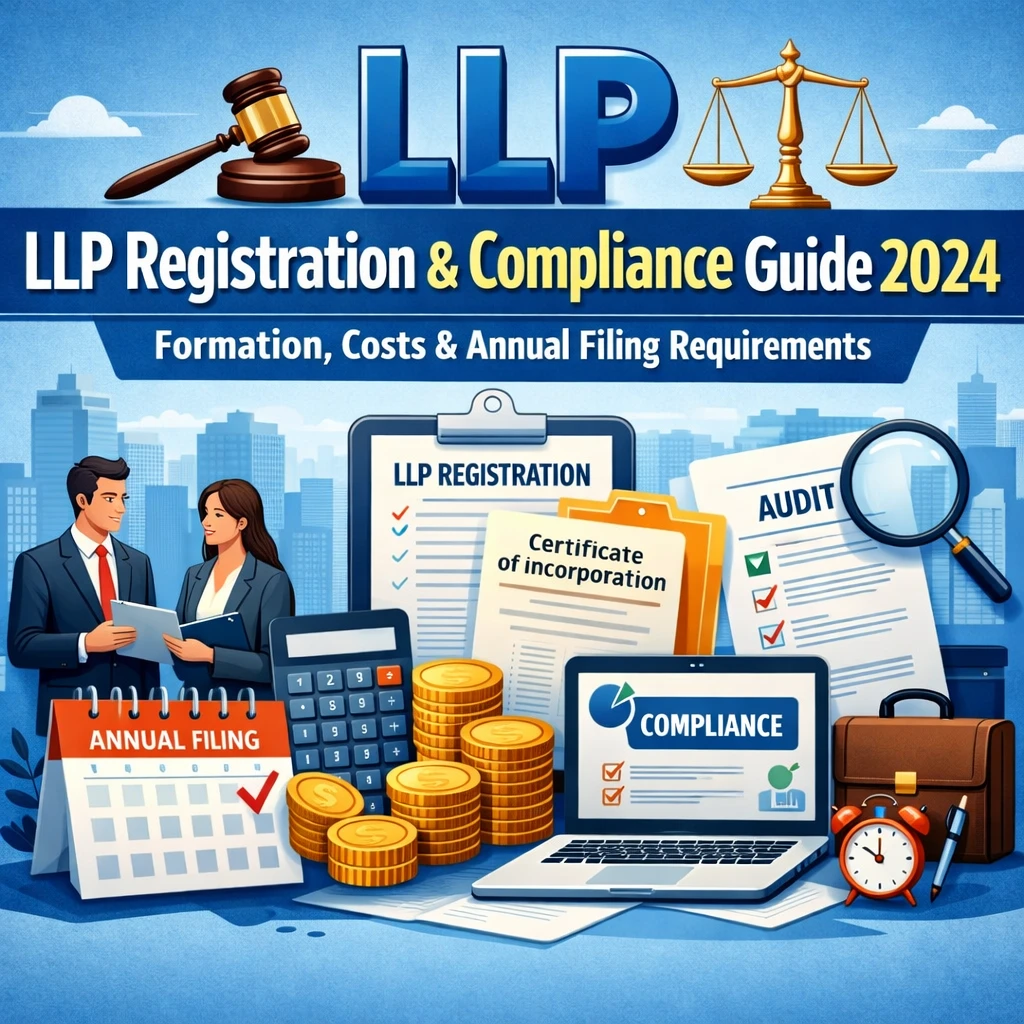
LLP Registration & Compliance Guide 2024
Master the complete process of Limited Liability Partnership registration, compliance framework, and statutory obligations in India
Introduction to LLP Registration in India
A Limited Liability Partnership (LLP) is a modern business structure that combines the flexibility of a partnership with the liability protection of a company. Under the Limited Liability Partnership Act, 2008, an LLP is a separate legal entity that provides limited liability to its partners while maintaining operational flexibility. This comprehensive guide covers everything you need to know about LLP registration, compliance requirements, and annual filing obligations for 2024.
The LLP structure has gained significant popularity among professionals, startups, and small-to-medium enterprises due to its tax efficiency, ease of management, and liability protection. Understanding the registration process and compliance framework is essential for entrepreneurs planning to establish an LLP in India.
LLPs offer limited liability protection to partners, meaning personal assets are protected from business liabilities. Partners are only liable up to their capital contribution.
What is an LLP and Why Choose This Structure?
An LLP is a business structure that combines the characteristics of both partnerships and companies. It is governed by the Limited Liability Partnership Act, 2008, and is registered with the Ministry of Corporate Affairs (MCA) through the Registrar of Companies (ROC).
- Separate Legal Entity: An LLP has its own legal identity separate from its partners, allowing it to own property, enter contracts, and sue or be sued in its own name.
- Limited Liability: Partners are not personally liable for the debts and obligations of the LLP beyond their capital contribution.
- Flexibility: LLPs offer operational flexibility similar to partnerships with minimal compliance requirements compared to companies.
- Tax Efficiency: LLPs are taxed as partnerships, allowing for pass-through taxation where profits are taxed at the partner level.
- Easy Management: LLPs do not require a Board of Directors or complex governance structures.
Step-by-Step LLP Registration Process
The LLP registration process in India involves several steps that must be completed in sequence. Here is a detailed breakdown of the registration procedure:
Step 1: Obtain Digital Signature Certificate (DSC)
Before initiating LLP registration, at least two partners must obtain a Digital Signature Certificate (DSC) from a licensed certifying authority. The DSC is required for digital filing of documents with the ROC. Partners can obtain DSC from authorized providers like NCODE, eMudhra, or DigiSign.
Step 2: Obtain Director Identification Number (DIN)
While DIN is not mandatory for LLP partners, it is recommended for identification purposes. Partners can apply for DIN through the MCA portal if they wish to have a unique identification number.
Step 3: Name Approval
Submit an application for LLP name approval through the MCA portal (SPICe+ form). The name must comply with naming conventions and should not be identical to or closely resemble existing entities. The approval typically takes 1-3 days.
Naming Guidelines: The LLP name must end with "LLP" or "Limited Liability Partnership". It should not contain words like "Bank", "Insurance", or other regulated industry terms without proper authorization.
Step 4: Prepare and File Registration Documents
After name approval, prepare the following documents and file them with the ROC:
- Form 1: Application for registration of LLP
- Form 2: LLP Agreement
- Form 3: Statement of partners and designated partners
- Proof of registered office address
- Identity and address proof of partners
- Consent of partners
Step 5: Receive Certificate of Registration
Once all documents are verified and approved by the ROC, the Certificate of Registration is issued. This certificate confirms the legal existence of the LLP and is typically issued within 7-10 working days of filing.
Ensure all documents are accurately filled and digitally signed. Any discrepancies or missing information can delay the registration process significantly.
LLP Registration Costs and Fees 2024
Understanding the cost structure for LLP registration is crucial for budgeting purposes. Here is a detailed breakdown of all costs involved:
| Cost Component | Amount (INR) | Remarks |
|---|---|---|
| Digital Signature Certificate (DSC) | 500-1,500 | Per certificate, valid for 2 years |
| LLP Registration Filing Fee | 4,500-5,500 | Based on number of partners |
| Name Approval | Free | No fee charged by ROC |
| Professional/CA Fees | 5,000-15,000 | Optional, for professional assistance |
| Address Verification | 1,000-2,000 | If required by ROC |
| Total Estimated Cost | 11,000-24,000 | Approximate range |
The actual cost may vary depending on the number of partners, location of the registered office, and whether professional assistance is sought. It is advisable to obtain quotes from multiple service providers before proceeding.
Annual Compliance Requirements for LLPs
Once an LLP is registered, it must comply with various statutory requirements on an annual basis. These compliance obligations are essential to maintain the legal status and good standing of the LLP.
Annual Return Filing
Every LLP must file an Annual Return (Form 11) with the ROC within 60 days of the end of the financial year. The Annual Return contains information about partners, designated partners, changes in the LLP agreement, and other relevant details. Non-filing of Annual Return can attract penalties up to INR 10,000.
Audit and Financial Statements
LLPs with a turnover exceeding INR 40 lakhs in any financial year must get their accounts audited by a qualified auditor. The audited financial statements must be filed along with the Annual Return. Even if audit is not mandatory, it is recommended for credibility and transparency.
Income Tax Compliance
LLPs must file income tax returns with the Income Tax Department. The LLP itself does not pay income tax; instead, the profits are distributed to partners who pay tax individually. However, the LLP must file Form ITR-5 or ITR-6 depending on its status.
GST Compliance
If the LLP's turnover exceeds the GST registration threshold (INR 40 lakhs for most states), it must register for GST. Regular GST returns (GSTR-1, GSTR-3B) must be filed on a monthly or quarterly basis depending on the turnover.
Registered Office Maintenance
The LLP must maintain a registered office at the address provided during registration. The office must be accessible during business hours and should have the LLP name displayed. Any change in the registered office must be notified to the ROC within 30 days.
Partner Changes and Modifications
Any changes in partners, designated partners, or the LLP agreement must be filed with the ROC within 30 days. This includes addition or removal of partners, changes in capital contribution, or modifications to the partnership agreement.
LLPs have minimal compliance burden compared to private companies. There is no requirement for Board meetings, minutes, or complex governance structures, making it ideal for small professional firms.
ROC Filing Requirements and Deadlines
The Registrar of Companies (ROC) oversees all LLP registrations and filings. Understanding the key filing requirements and deadlines is essential for compliance:
| Filing Requirement | Deadline | Penalty for Late Filing |
|---|---|---|
| Annual Return (Form 11) | 60 days after FY end | INR 100-500 per day |
| Change of Partners (Form 4) | 30 days from change | INR 100-500 per day |
| Change of Registered Office (Form 5) | 30 days from change | INR 100-500 per day |
| Modification of Agreement (Form 6) | 30 days from modification | INR 100-500 per day |
| Designated Partner Change (Form 3) | 30 days from change | INR 100-500 per day |
Late filing of Annual Return beyond 90 days can result in the LLP being struck off from the ROC register. Once struck off, the LLP loses its legal status and must be restored through a separate application.
LLP Agreement: Key Provisions and Requirements
The LLP Agreement is a crucial document that governs the relationship between partners and the functioning of the LLP. It must be filed with the ROC during registration and any modifications must be notified within 30 days.
Key provisions that should be included in the LLP Agreement:
- Capital Contribution: The amount of capital contributed by each partner and the terms of contribution.
- Profit Sharing: The ratio in which profits and losses are shared among partners.
- Rights and Duties: The rights and responsibilities of each partner in the management of the LLP.
- Designated Partners: The designation and responsibilities of designated partners who represent the LLP.
- Admission and Retirement: The process for admission of new partners and retirement of existing partners.
- Dispute Resolution: The mechanism for resolving disputes between partners.
- Dissolution: The terms and conditions for dissolution of the LLP.
Tax Implications and Benefits of LLP Structure
The LLP structure offers several tax advantages compared to other business structures:
Pass-Through Taxation
LLPs are taxed as partnerships, meaning the LLP itself does not pay income tax. Instead, the profits are allocated to partners who pay tax at their individual rates. This avoids the double taxation that occurs in companies.
Deduction of Expenses
All legitimate business expenses can be deducted from the LLP's income, including rent, salaries, professional fees, and depreciation. This reduces the taxable income and the overall tax liability.
Loss Carry Forward
If the LLP incurs a loss in any financial year, it can be carried forward and set off against profits in subsequent years, subject to certain conditions.
Professional Tax Exemptions
Some states offer professional tax exemptions for LLPs engaged in professional services such as consulting, legal services, and accounting. This can result in significant tax savings.
Common Mistakes to Avoid During LLP Registration
Many entrepreneurs make preventable mistakes during LLP registration that can delay the process or lead to compliance issues. Here are the most common mistakes to avoid:
- Incomplete Documentation: Submitting incomplete or incorrect documents can lead to rejection and delays. Ensure all required documents are prepared accurately.
- Unclear LLP Agreement: A poorly drafted LLP agreement can lead to disputes among partners. Ensure the agreement clearly defines all terms and conditions.
- Inadequate Registered Office: The registered office must be a physical location with proper facilities. Virtual offices or residential addresses may not be accepted.
- Ignoring Compliance Deadlines: Missing filing deadlines can result in penalties and potential strike-off of the LLP.
- Lack of Proper Record Keeping: Maintaining proper records of all transactions, agreements, and partner communications is essential for compliance and dispute resolution.
- Not Updating Partner Information: Failing to notify the ROC of changes in partners or designated partners can lead to legal complications.
Frequently Asked Questions (FAQs)
Q1: What is the minimum number of partners required to form an LLP?
A: An LLP must have a minimum of 2 partners. There is no maximum limit on the number of partners. At least one partner must be an Indian resident.
Q2: Can a company be a partner in an LLP?
A: Yes, a company can be a partner in an LLP. However, the company must designate an individual to act as its representative in the LLP.
Q3: How long does LLP registration take?
A: The entire LLP registration process typically takes 7-15 working days from the date of filing, assuming all documents are in order and no additional information is required by the ROC.
Q4: What is the difference between a designated partner and a regular partner?
A: A designated partner is responsible for ensuring compliance with statutory requirements and filing documents with the ROC. A regular partner does not have these specific responsibilities. An LLP must have at least one designated partner.
Q5: Can an LLP be converted into a company?
A: Yes, an LLP can be converted into a company through a formal process involving approval from partners and filing of necessary documents with the ROC. However, this is a complex process and should be done under professional guidance.
Q6: What happens if the Annual Return is not filed within the deadline?
A: Non-filing of Annual Return attracts penalties of INR 100-500 per day. If the Annual Return is not filed within 90 days of the deadline, the LLP may be struck off from the ROC register, losing its legal status.
Q7: Is audit mandatory for all LLPs?
A: Audit is mandatory for LLPs with a turnover exceeding INR 40 lakhs in any financial year. For smaller LLPs, audit is optional but recommended for credibility and transparency.
Practical Example: LLP Registration Scenario
Let us consider a practical example to understand the LLP registration process better:
Scenario: Raj and Priya, both chartered accountants, want to start a consulting firm. They decide to register their business as an LLP.
Process:
- Both Raj and Priya obtain Digital Signature Certificates from an authorized provider (Cost: INR 1,000 each).
- They apply for LLP name approval for "Raj Priya Consulting LLP" through the MCA portal. The name is approved within 2 days.
- They prepare the LLP Agreement defining profit sharing (60% Raj, 40% Priya), capital contribution (INR 5 lakhs each), and roles.
- They file the registration documents (Forms 1, 2, and 3) along with proof of registered office address and identity documents.
- The ROC verifies the documents and issues the Certificate of Registration within 8 days.
- Total cost: DSC (INR 2,000) + Registration fee (INR 5,000) + Professional fees (INR 8,000) = INR 15,000.
Once registered, Raj Priya Consulting LLP must comply with annual filing requirements, including Annual Return filing, income tax compliance, and GST compliance if applicable.
Conclusion
LLP registration in India is a straightforward process that offers significant advantages for professionals and small business owners. The combination of limited liability protection, tax efficiency, and operational flexibility makes LLP an attractive business structure. However, understanding the registration process, compliance requirements, and annual filing obligations is essential for successful operation.
By following the step-by-step process outlined in this guide and maintaining proper compliance, entrepreneurs can establish a strong legal foundation for their business. It is advisable to seek professional guidance from chartered accountants or legal experts to ensure smooth registration and ongoing compliance with all statutory requirements.
The LLP structure continues to gain popularity in India due to its flexibility and tax benefits. Whether you are a professional looking to start a consulting firm or entrepreneurs planning to establish a business, LLP registration offers a viable and efficient business structure that balances liability protection with operational ease.
© 2026 Tax Esquire | Expert CA Services in Greater Noida, Uttar Pradesh
8810380146 | info.taxesquire@gmail.com | taxesquire.in
This document is for informational purposes only. For personalised tax advice, consult our chartered accountants.