How to File RBI FLA Return 2026: Complete Guide for FY 2025-26 (Due Date Extended to 31 July 2026)
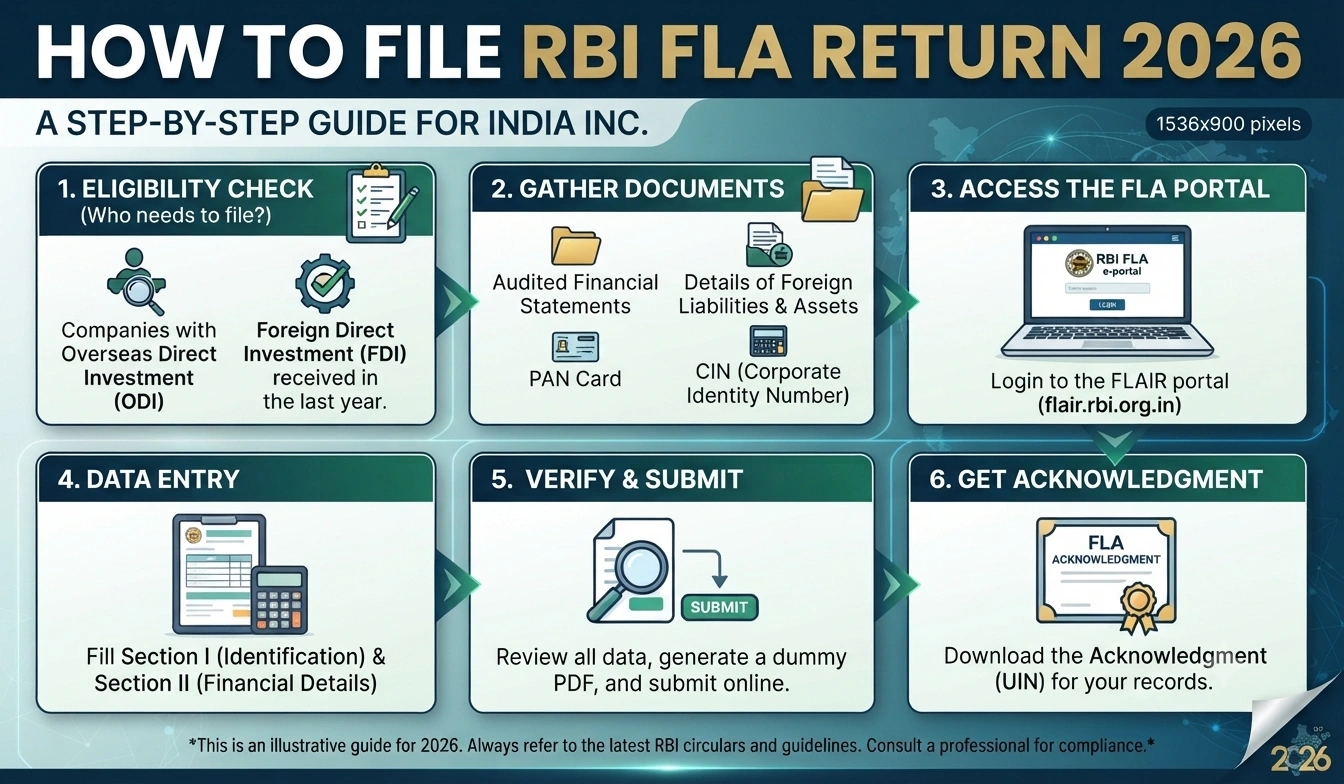
How to File RBI FLA Return 2026
Master the RBI FLA filing process step-by-step with our expert CA-backed guide
What Is the RBI FLA Return and Why Does It Matter?
The RBI FLA Return stands for Foreign Liabilities and Assets Return. And here's the thing—if your business has any dealings with foreign currency, foreign banks, or international transactions, the RBI wants to know about it. This return is how you report those details to India's central bank.
So what does this mean for you? Put simply, the RBI uses this data to track India's foreign exchange position and understand how money moves in and out of the country. It's not optional for those who fall under the reporting category. The RBI takes this seriously, and so should you.
The FLA Return isn't like your regular income tax return. It's a separate filing that covers your foreign assets and liabilities during the financial year 2025-26. Banks, NBFCs, and certain other entities need to file this return.
Filing your FLA Return on time keeps your business compliant with RBI regulations and avoids penalties that can hurt your bottom line.
Who Needs to File the RBI FLA Return?
Not every business needs to file an FLA Return. The RBI has specific criteria, and knowing whether you fall under it is your first step. Let me break this down for you.
- Scheduled commercial banks operating in India
- Non-banking financial companies (NBFCs) with foreign assets or liabilities
- Foreign banks with branches in India
- Authorized dealers in foreign exchange
- Any other entity specifically notified by the RBI
- Companies with significant foreign currency exposure
Basically, if your organization holds foreign assets, owes money to foreign entities, or deals in foreign exchange regularly, you're likely on the hook for filing. The best move? Check your RBI circular for the financial year 2025-26 to confirm your status.
Not filing when you're required to file can result in penalties and regulatory action from the RBI. Don't assume you're exempt—verify your obligation first.
Important: The Extended Due Date for FY 2025-26
Here's the good news. The RBI has extended the due date for filing the FLA Return for FY 2025-26 to 31 July 2026. This gives you breathing room compared to previous years.
But here's what I want you to understand—an extended deadline doesn't mean you should wait until the last week. That's when things go wrong. Filing early gives you time to correct errors and deal with any issues the RBI might flag. Plus, you won't be stressed about missing the deadline.
| Financial Year | Original Due Date | Extended Due Date |
|---|---|---|
| FY 2025-26 | 31 May 2026 | 31 July 2026 |
The extension gives you an extra two months. That's valuable time to gather your paperwork, reconcile your records, and file without rushing.
Documents and Information You'll Need
Before you sit down to file, get your ducks in a row. Here's what you need to gather.
- Bank statements showing all foreign currency accounts
- Details of foreign liabilities (loans, borrowings from abroad)
- Details of foreign assets (investments, deposits held overseas)
- Authorized dealer registration certificate (if applicable)
- Board resolutions approving the filing
- Internal audit reports or compliance certificates
And that's really it—but each of these needs to be accurate and up to date. Any mismatch between your records and what you file can trigger queries from the RBI.
Step-by-Step Guide to Filing RBI FLA Return Online
Step 1: Access the RBI's Online Portal
The RBI has a dedicated online portal for FLA Return filing. Go to the RBI's official website and look for the "Foreign Liabilities and Assets Return" section. You'll find the portal link there. Don't go to random websites—always use the official RBI domain.
You'll need to log in using your authorized credentials. If you're filing on behalf of a bank or NBFC, make sure you have the right user ID and password. Your compliance or treasury team probably handles this.
Step 2: Register Your Entity (If First Time Filing)
If this is your first time filing the FLA Return, you'll need to register your entity on the portal. This is a one-time process. Provide your organization's registration number, name, and contact details. The RBI will verify this information.
The registration usually takes a few days. So if you're filing for the first time, start early. You can't file until your entity is registered and approved.
Step 3: Download and Review the FLA Return Form
Once you're logged in, you'll see the FLA Return form for FY 2025-26. Download it and review the structure carefully. The form has multiple schedules covering different categories of foreign assets and liabilities.
What I mean is, don't just jump into filling it out. Spend time understanding what each schedule is asking for. This prevents mistakes that could delay your filing.
Step 4: Gather and Organize Your Data
Now comes the detailed work. Pull together all your foreign currency transaction records, bank statements, and outstanding liabilities. Organize them by category—assets and liabilities separately.
Create a spreadsheet if you haven't already. List every foreign asset and liability with dates, amounts, and counterparty details. This makes filling the form much easier and reduces errors.
Step 5: Fill in the Return Form Accurately
Start filling the form section by section. Enter your organization's details first. Then move to the schedules covering foreign assets and liabilities. Be precise with currency conversions—use the RBI's official exchange rates for the relevant dates.
Double-check every figure before moving to the next field. The RBI's system will flag obvious errors, but some mistakes slip through. Your due diligence matters here.
Step 6: Review and Validate
Before submitting, the portal will run validation checks. These checks make sure your data is complete and internally consistent. If there are errors, the system will tell you where they are. Fix them and validate again.
Don't ignore validation errors. They're there for a reason. Address each one before moving forward.
Step 7: Get Internal Approvals
Most organizations require board-level approval before filing regulatory returns. Get your internal sign-offs in place. Your board or audit committee should review and approve the FLA Return before submission.
Keep documentation of these approvals. The RBI might ask to see them during compliance checks.
Step 8: Submit the Return
Once everything is ready, submit the return through the portal. You'll get a confirmation message with a unique submission reference number. Save this number—you'll need it for follow-ups and queries.
The RBI will send you an acknowledgment via email. If you don't get it within 24 hours, contact the RBI's helpdesk to confirm receipt.
Step 9: Keep Records and Track Your Filing
After submission, keep a copy of your filed return and all supporting documents for at least seven years. The RBI might ask for clarifications or conduct audits. Having everything organized saves you time and stress.
Also, check your email regularly for any communications from the RBI regarding your filing. Respond to queries promptly.
Common Mistakes to Avoid
After years of seeing FLA Returns filed, I've noticed patterns in what goes wrong. Here's what to watch out for.
- Using incorrect exchange rates—always check the RBI's official rates
- Misclassifying assets or liabilities into wrong schedules
- Omitting small foreign transactions thinking they don't matter
- Filing without proper internal approvals
- Submitting incomplete information and hoping the RBI won't notice
The biggest mistake? Filing in a hurry. Take your time. Get it right the first time.
What Happens After You File?
Filing isn't the end of the story. The RBI will review your return. Most of the time, if everything's in order, you won't hear back. But sometimes, the RBI raises queries.
These queries usually come via email or through the portal. They ask for clarification or additional details. You'll have a specific timeline to respond—usually 15 to 30 days. Don't ignore these queries. Respond promptly and thoroughly.
The RBI might also conduct periodic audits of FLA Returns. If your organization is selected, cooperate fully. Provide all documents requested and explain your positions clearly.
Proactive compliance with FLA Return requirements strengthens your relationship with the RBI and reduces the risk of regulatory action.
Penalties for Non-Compliance
The RBI doesn't take non-compliance lightly. If you don't file the FLA Return by 31 July 2026, you're looking at penalties. The exact amount depends on the RBI's regulations, but they can be substantial.
Beyond financial penalties, non-compliance can affect your organization's reputation with the RBI. This matters if you need approvals for future foreign exchange transactions or regulatory matters.
So here's my advice—mark 31 July 2026 on your calendar right now. Set reminders two weeks before. Don't let this slip.
Late filing or non-filing of the FLA Return can result in penalties ranging from Rs. 5,000 to Rs. 50,000 or more, depending on the severity and RBI's discretion.
FAQ: Your Questions Answered
Q1: What's the difference between the FLA Return and the ITR?
The ITR (Income Tax Return) is filed with the Income Tax Department and covers your taxable income. The FLA Return is filed with the RBI and covers your foreign assets and liabilities. They're separate filings for different regulators. You might need to file both if your organization meets the criteria for each.
Q2: Can I file the FLA Return after 31 July 2026?
Technically, you can file late, but you'll face penalties. The 31 July 2026 deadline is firm. If you miss it, file as soon as possible and be prepared to explain the delay to the RBI.
Q3: Who should sign off on the FLA Return before filing?
Your board of directors or audit committee should review and approve the return. The compliance officer or CFO typically oversees the filing. Get proper internal authorization in place before submitting to the RBI.
Q4: What exchange rate should I use for foreign currency conversions?
Use the RBI's official exchange rate for the relevant date. The RBI publishes daily rates on its website. For period-end reporting, use the rate on the last day of the financial year (31 March 2026). Don't make up rates—use official sources.
Q5: What if I discover an error after filing?
Contact the RBI immediately and explain the error. You might be allowed to file an amended return. Don't try to hide errors—transparency is always the better approach. The RBI appreciates honesty and is more lenient with self-reported corrections.
Q6: Do I need a CA to file the FLA Return?
While you don't legally need a CA to file, it's smart to involve one. A qualified CA understands the nuances of FLA Return filing and can help you avoid costly mistakes. They also handle RBI queries and amendments if needed.
Key Takeaways for FY 2025-26
- The FLA Return due date for FY 2025-26 is extended to 31 July 2026
- Check if your organization is required to file based on RBI criteria
- Gather all foreign asset and liability documentation well in advance
- Use the RBI's official online portal for filing
- Get internal board approvals before submitting
- Use correct exchange rates and accurate data
- Respond promptly to any RBI queries after filing
- Keep all supporting documents for at least seven years
Final Thoughts
Filing the RBI FLA Return for FY 2025-26 doesn't have to be complicated. The extended deadline to 31 July 2026 gives you breathing room. Use that time wisely. Start early, organize your data, and file with confidence.
The thing is, compliance isn't just about avoiding penalties. It's about building trust with regulators and protecting your organization's reputation. When you file accurate, timely returns, the RBI knows you're serious about following the rules.
If you're unsure about any part of the process, don't hesitate to reach out to your compliance team or a qualified CA. It's better to ask questions now than to deal with RBI queries later.
And remember—31 July 2026 is your deadline. Mark it. Plan for it. Hit it.
" } ```
© 2026 Tax Esquire | Expert CA Services in Greater Noida, Uttar Pradesh
8810380146 | info.taxesquire@gmail.com | taxesquire.in
This document is for informational purposes only. For personalised tax advice, consult our chartered accountants.