Income Tax Deductions for Self-Employed Professionals in India 2026-2027
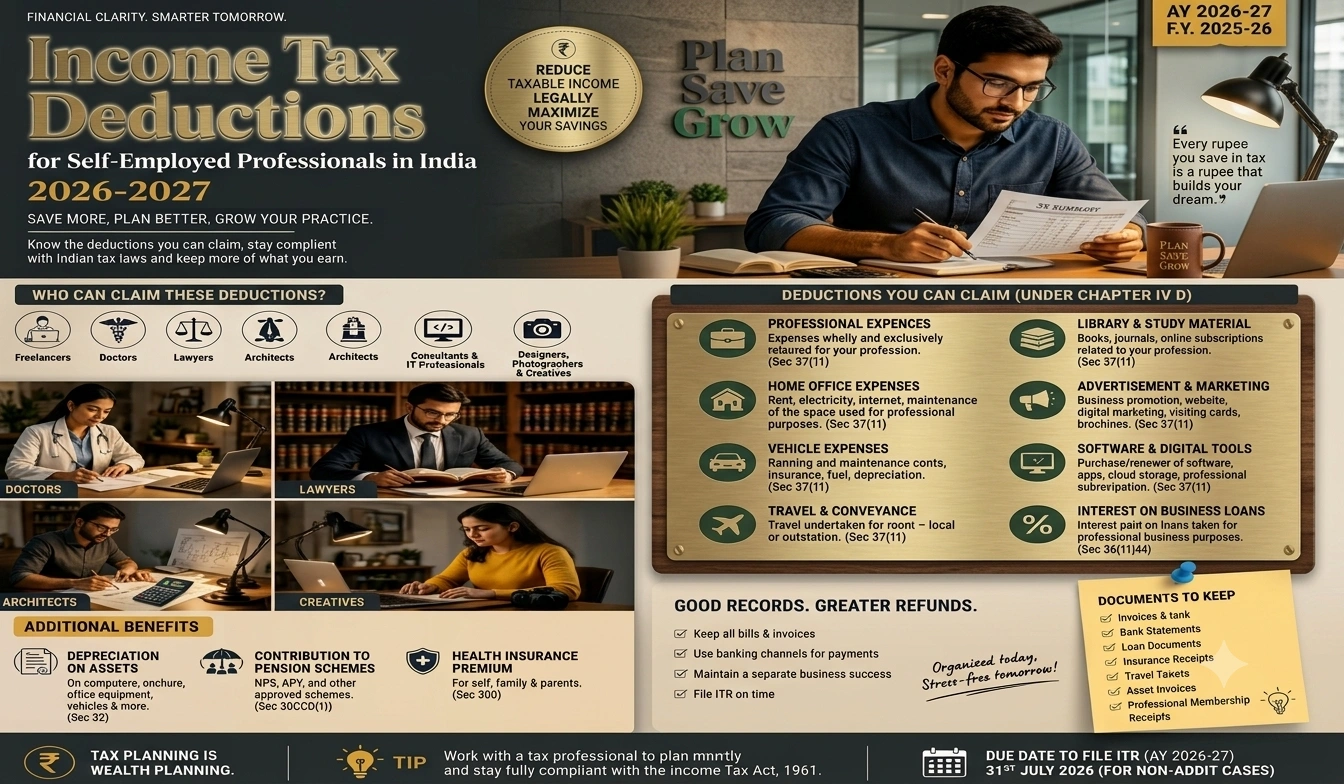
Income Tax Deductions for Self-Employed Professionals in India 2026-2027
Everything you need to know about claiming legitimate tax deductions and saving money on your income tax
Why Self-Employed Professionals Lose Money on Taxes
Look, I've seen this happen hundreds of times. A freelancer, consultant, or independent professional earns a decent income, pays their taxes, and then finds out months later they could've saved ₹50,000 or more. The reason? They didn't know which expenses they could claim.
The Indian tax system allows self-employed people to reduce their taxable income by claiming legitimate business expenses. But here's the thing: most people don't claim everything they're allowed to. They think certain expenses aren't deductible, or they're scared of getting audited, or they simply don't know the rules.
And that's really it. You end up paying more tax than you need to. So what does this mean for you? It means leaving money on the table.
Claiming all eligible deductions can reduce your taxable income by 20-40%, potentially saving you ₹30,000 to ₹1,00,000+ annually depending on your income level.
What Counts as a Deductible Business Expense?
Before we go through specific deductions, you need to understand the basic rule. Under Section 37 of the Income Tax Act, you can deduct any expense that's incurred wholly and exclusively for earning your income. Put simply, the expense must be necessary for your business and directly connected to generating revenue.
But here's where people get confused. Not every expense you incur for work is deductible. Personal expenses aren't allowed. Expenses that are capital in nature (like buying office furniture) have different rules. And some things are specifically not allowed by the tax department.
The key is that you need proper documentation. Without bills, invoices, and records, you can't prove the expense to the tax department. And honestly, that's where most people fail.
Home Office Expenses: The Biggest Opportunity
If you work from home, you're sitting on a goldmine of deductions. Many self-employed professionals don't claim anything, thinking it's too complicated or risky. But the rules are actually pretty clear.
You can deduct a portion of your house rent, electricity bills, internet charges, and maintenance costs. The percentage depends on how much of your home is used for business. If you have a dedicated room for your office and nothing else, you can claim the full cost of that room. If you use part of your living room for work, you claim a proportionate amount.
Let me give you an example. Suppose your house rent is ₹30,000 per month and your office takes up 25% of your home. You can deduct ₹7,500 monthly, or ₹90,000 annually. That's a real saving.
- House rent (proportionate share)
- Electricity and water bills
- Internet charges
- Phone bills (business portion)
- Maintenance and repair costs
- Property tax (if you own the property)
Don't claim 100% of your home expenses unless your entire house is your office. The tax department will reject unreasonable claims. Be honest about the percentage you actually use for work.
Professional and Business Expenses You Can Claim
Beyond home office costs, there are many other expenses you can deduct. And basically, if you're not claiming these, you're missing out.
| Expense Category | Examples | Deductible? |
|---|---|---|
| Office supplies | Stationery, printer ink, paper | Yes |
| Software and tools | Adobe, Microsoft, project management apps | Yes |
| Professional fees | CA fees, lawyer fees, consultant fees | Yes |
| Travel for work | Flight, train, taxi, hotel for client meetings | Yes |
| Client entertainment | Business lunch, dinner, event tickets | Partial |
| Equipment | Laptop, camera, microphone (under ₹1 lakh) | Yes |
| Insurance | Professional liability, health insurance | Yes |
| Bank charges | Account maintenance, transaction fees | Yes |
So what's the difference between partial and full deductions? Client entertainment is limited to 50% of the actual expense under Section 37(2A). You can't claim the full amount.
Depreciation and Capital Assets
Now, if you buy something expensive for your business—like a computer for ₹1,50,000 or office furniture for ₹2 lakhs—you can't deduct the entire amount in one year. That's a capital expense, and it gets treated differently.
Instead, you claim depreciation over several years. The government allows you to deduct a percentage of the asset's cost each year. For computers and IT equipment, it's 40% per year. For furniture and fittings, it's 10% per year. For buildings, it's 5% per year.
But here's something important: if the asset costs less than ₹5,000, you can deduct it fully in the year you buy it. So small purchases don't need depreciation calculations.
- Computers and IT equipment: 40% depreciation per year
- Office furniture: 10% depreciation per year
- Vehicles: 15% depreciation per year
- Building: 5% depreciation per year
- Items under ₹5,000: 100% deduction in purchase year
Expenses You Can't Claim (Even If You Think You Can)
And this is where people get into trouble. They claim expenses that aren't allowed, the tax department notices, and suddenly they're facing penalties and interest. So let me be clear about what you absolutely can't deduct.
- Personal expenses like groceries, clothing, or personal care items
- Loan repayment (only interest is deductible, not principal)
- Income tax paid by you
- Fines and penalties imposed by government
- Expenses already claimed by your employer
- Gifts and donations (except specific allowed charities)
The tax department has become strict about personal expenses claimed as business expenses. If you claim your gym membership as a health expense for work efficiency, or your vacation as a research trip, you're playing with fire. Keep claims honest and defensible.
Documentation: Your Best Defense
Here's the hard truth: if you can't prove it, you can't claim it. The tax department won't take your word for anything. They want paperwork.
For every deduction you claim, you need to keep invoices, bills, receipts, or bank statements. Digital copies are fine. Email confirmations are fine. But you need something that shows the date, amount, and nature of the expense.
What I mean is, if you spend ₹500 on office supplies, get a receipt. If you pay ₹10,000 for software, keep the invoice. If you travel for work, save your flight booking confirmation and hotel receipt. When you file your return, you don't attach all these documents, but you keep them. If the tax department asks, you produce them.
- Keep all invoices and bills for at least 6 years
- Maintain a separate business bank account (helps prove business expenses)
- Use accounting software or maintain a simple spreadsheet of expenses
- Take photos of receipts if original copies fade
- For travel, keep boarding passes, hotel receipts, and meeting notes
Sections 80C, 80D, and Other Deductions Beyond Business Expenses
Beyond business expenses, there are other deductions available to self-employed people. These are separate from your business income calculation and can give you additional tax savings.
Section 80C allows you to deduct investments like life insurance premiums, provident fund contributions, and fixed deposits. The limit is ₹1.5 lakhs per year. Section 80D covers health insurance premiums for you, your spouse, and dependents—up to ₹25,000 for those under 60 years old.
But honestly, the most important thing is to understand that business expense deductions and these section deductions are different. You claim business expenses when calculating your profit. You claim section deductions after calculating your profit. They both reduce your taxable income, but in different ways.
| Section | What You Can Claim | Limit |
|---|---|---|
| 80C | Life insurance, EPF, PPF, FD, tuition fees | ₹1,50,000 |
| 80D | Health insurance premiums | ₹25,000 (under 60) |
| 80E | Education loan interest | No limit |
| 80G | Charitable donations | 50% or 100% depending on charity |
Combining business expense deductions with section deductions can reduce your taxable income by 40-50%, creating substantial tax savings for self-employed professionals earning ₹10 lakhs or more annually.
Practical Example: How a Freelancer Saves ₹75,000 in Taxes
Let me show you how this actually works with real numbers. Suppose you're a freelance consultant earning ₹30 lakhs in FY 2026-2027.
Your business expenses include: home office (₹1.2 lakhs), software subscriptions (₹1 lakh), professional fees (₹50,000), travel (₹80,000), and office supplies (₹30,000). Total: ₹3.6 lakhs.
Your profit is ₹30 lakhs minus ₹3.6 lakhs = ₹26.4 lakhs.
Now you claim section deductions: ₹1.5 lakhs under 80C (insurance and PPF) and ₹25,000 under 80D (health insurance). That's ₹1.75 lakhs.
Your taxable income becomes ₹26.4 lakhs minus ₹1.75 lakhs = ₹24.65 lakhs.
The tax on ₹24.65 lakhs is roughly ₹4.5 lakhs. But if you hadn't claimed any deductions, the tax on ₹30 lakhs would be around ₹5.25 lakhs. You just saved ₹75,000. That's real money.
Common Mistakes Self-Employed People Make
And honestly, I see these mistakes repeatedly, and they cost people thousands of rupees.
- Not keeping separate business and personal bank accounts, making it hard to prove business expenses
- Claiming round numbers instead of actual amounts (the tax department gets suspicious)
- Claiming personal expenses mixed with business expenses
- Not claiming home office expenses because they think it's complicated
- Forgetting to claim professional development costs like courses and certifications
- Not maintaining proper bills for expenses, then trying to claim them without proof
Compliance Insights for 2026-2027
For the financial year 2026-2027, there are a few things to keep in mind. The tax department is increasingly using data analytics to identify suspicious claims. If your deductions are way out of line with your income or industry norms, you might get flagged for an audit.
Also, the government has been pushing for digital payments and documentation. Cash expenses are harder to justify now. If you spend cash on something, try to get a receipt and ideally make payment through your business account.
And if your turnover exceeds ₹1 crore, you need to maintain books of accounts and get them audited. Even if you're below that threshold, maintaining proper records is essential.
Frequently Asked Questions
Q1: Can I claim my entire home rent as a business expense?
No. You can only claim the proportion of rent that corresponds to the area used for business. If your entire home is your office, then yes, you can claim all of it. But if you have a bedroom, kitchen, and living room, and only one room is your office, you claim roughly 25% of the rent. The tax department will question claims that seem unreasonable.
Q2: What happens if I can't find a receipt for an expense I want to claim?
Without a receipt, you can't claim it. The tax department won't accept your word. If the amount is small and you have bank statements showing the transaction, you might get away with it, but it's risky. For future expenses, always get a receipt. For old expenses without receipts, it's better to not claim them than to get caught making false claims.
Q3: Can I claim my phone bill as a business expense if I use my phone for both personal and work?
Yes, but you can only claim the business portion. If you spend 70% of your phone time on work and 30% on personal use, you claim 70% of the bill. You don't need to calculate this exactly—just be reasonable. But don't claim 100% of a personal phone bill as a business expense. That's asking for trouble.
Q4: Are meal expenses during business travel deductible?
Yes, meal expenses during business travel are deductible. But there's a limit. You can claim reasonable meal costs while traveling for work, but you can't claim luxury dining or excessive amounts. Keep receipts and make sure the meal is genuinely connected to your business travel.
Q5: Can I claim losses from one year against income from another year?
Yes. If you make a loss in one year, you can carry it forward for up to 8 years and set it off against profits in future years. This is really helpful if you're starting a new business or have a lean year. Keep the loss computation certificate from your CA, and you can use it when you're profitable again.
Final Thoughts: Don't Leave Money on the Table
So here's the bottom line. Self-employed professionals have legitimate ways to reduce their tax burden. The government allows you to deduct genuine business expenses. That's not tax evasion—that's smart tax planning.
But it only works if you claim what you're entitled to and you do it properly. Keep good records. Get receipts. Be honest about your expenses. Don't try to claim personal things as business expenses. And if you're unsure, talk to a CA.
The difference between someone who saves ₹75,000 in taxes and someone who pays the full amount often comes down to whether they claimed their deductions. Don't be the person who leaves money on the table.
" } ```
© 2026 Tax Esquire | Expert CA Services in Greater Noida, Uttar Pradesh
8810380146 | info.taxesquire@gmail.com | taxesquire.in
This document is for informational purposes only. For personalised tax advice, consult our chartered accountants.