UAE Corporate Tax and VAT Difference: Complete Compliance Guide for 2027
UAE Corporate Tax and VAT Difference
Everything you need to know about corporate tax and VAT in the UAE for 2027
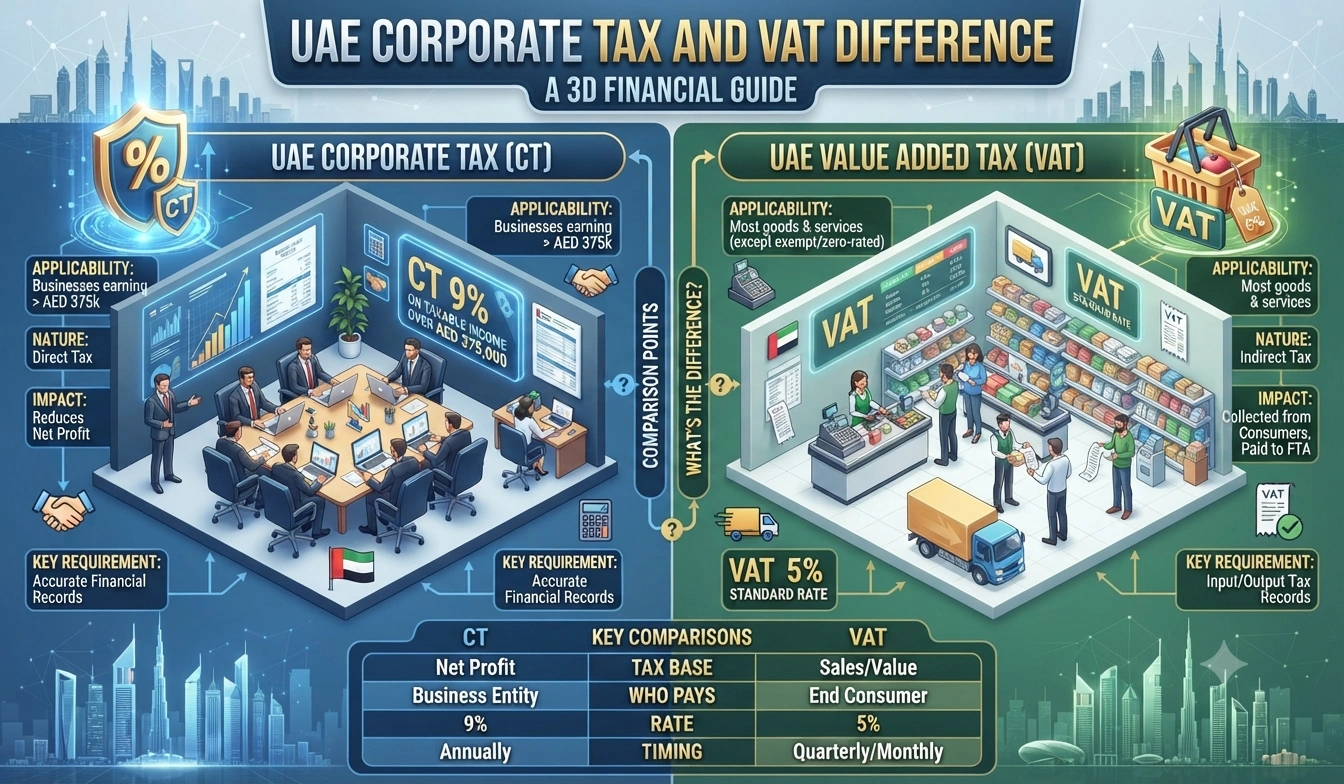
What's the Real Difference Between Corporate Tax and VAT?
Look, I'll be straight with you—most business owners mix these two up. But they're completely different animals. Corporate tax is what you pay on your company's profit. VAT is what you collect and pay on goods and services. So what does this mean for you? Let me break it down.
Corporate income tax in the UAE applies to the net profit your business makes after expenses. It's a tax on earnings. VAT, on the other hand, is a consumption tax. You're basically collecting it from customers and then passing it to the government. The mechanics are totally different, and that's really important to understand.
Here's what I see happen all the time: business owners think they're the same thing. They're not. One affects your bottom line. The other affects your cash flow. And if you get this wrong, you'll face penalties.
UAE Corporate Income Tax: The Basics
The UAE introduced corporate income tax on June 1, 2023. But here's the thing—there's a threshold. If your annual income is below 375,000 AED, you don't pay corporate tax at all. That's a big deal for startups and small businesses. But once you cross that line, the standard rate is 15% on taxable profit.
And that's really it for the headline rate. But what matters more is what counts as taxable profit. You get to deduct business expenses, depreciation, and losses from previous years. The government isn't trying to tax your gross revenue—they want tax on what you actually make after costs.
Honestly, the 375,000 AED threshold is the most important number for small business owners in 2027. If you're below it, you're essentially exempt. You still need to file, but you don't owe tax. That changes everything about how you structure your business.
The 375,000 AED exemption threshold means many UAE businesses pay zero corporate income tax. This is one of the most attractive tax policies in the Middle East region.
Understanding VAT in the UAE
VAT is different. The standard rate is 5% on most goods and services. But—and this is crucial—not everything is taxed. Some items are exempt, and some are zero-rated. The difference matters a lot for cash flow.
Zero-rated items include exports, international transport, and financial services. Exempt items include healthcare, education, and residential rent. Here's the key difference: with zero-rated items, you charge 0% VAT but you can still claim back the VAT you paid on inputs. With exempt items, you can't claim back input VAT. So what does this mean? Put simply, zero-rated is better for your cash flow than exempt.
You need to register for VAT if your annual turnover is above 375,000 AED. Below that, registration is voluntary. But here's what I tell clients: even if you're below the threshold, voluntary registration can help if you're buying a lot of goods or services because you can claim back VAT paid.
| Item Type | VAT Rate | Input VAT Claim |
|---|---|---|
| Standard goods and services | 5% | Yes |
| Zero-rated exports | 0% | Yes |
| Exempt items (healthcare, education) | 0% | No |
Key Differences: Corporate Tax vs VAT
Let me lay out the main differences so there's no confusion going into 2027.
- What gets taxed: Corporate tax hits your profit. VAT hits your sales and expenses.
- Who pays: You pay corporate tax directly. Your customers pay VAT to you, and you pass it to the government.
- Thresholds: Both have 375,000 AED thresholds, but they work differently.
- Filing frequency: Corporate tax is annual. VAT is quarterly or monthly depending on your turnover.
- Deductions: Corporate tax lets you deduct all business expenses. VAT has input tax recovery rules.
- Penalties: Missing either deadline costs you. Late corporate tax filing can mean fines. Late VAT filing can mean loss of input credits.
Don't assume the 375,000 AED threshold works the same for both taxes. The registration rules differ. You could be exempt from corporate tax but still need to register for VAT if your supplies exceed the threshold.
Corporate Tax Filing Requirements for 2027
Here's what you need to do. Even if you're below the 375,000 AED threshold and don't owe tax, you still need to file a corporate tax return. That's compulsory. The deadline is typically within six months of your financial year-end, but check with your emirate because some have different rules.
You'll need proper accounting records. I mean real records—not just bank statements. You need invoices, receipts, expense documentation, and a profit and loss statement. The Federal Tax Authority wants to see that you've calculated your taxable income correctly.
And here's something people miss: you need to report all income sources. If you have income from outside the UAE, that's taxable too. Foreign income, rental income, investment returns—it all counts. So what happens if you don't report it? The penalties are steep. We're talking fines up to 100,000 AED or more.
- File your return within six months of year-end
- Keep all supporting paperwork for at least five years
- Report all income, including foreign sources
- Claim only legitimate business expenses
- Use proper accounting software or hire a professional
VAT Filing Requirements and Compliance
VAT filing is more frequent. If your annual turnover is above 10 million AED, you file monthly. Between 375,000 and 10 million AED, you file quarterly. Below 375,000 AED, you don't have to register unless you choose to.
Each return shows what you collected from customers and what you paid on your purchases. The difference is what you owe to the government. But here's the thing—if you paid more VAT than you collected, you get a refund. That's called a negative return, and it happens often in export businesses.
You must keep invoices for everything. Every single sale and every purchase needs documentation. If you can't prove it, you can't claim it. The FTA audits VAT returns regularly, and they're tough. Missing invoices or false claims will result in penalties and interest charges.
If you're an exporter, VAT is actually good for you. You charge 0% VAT to customers but claim back all input VAT. This improves cash flow significantly.
Practical Examples: How They Work Together
Let me give you a real example. Say you run a trading company in Dubai with annual revenue of 2 million AED. Your profit after all expenses is 500,000 AED.
For corporate tax: You owe 15% on 500,000 AED = 75,000 AED. That's your tax bill. But if you had profit of only 300,000 AED, you'd owe 45,000 AED.
For VAT: You collected 100,000 AED VAT from customers (5% on 2 million AED). You paid 40,000 AED VAT on your purchases. You owe 60,000 AED VAT to the government. This is separate from corporate tax.
So your total tax bill is 75,000 AED (corporate) plus 60,000 AED (VAT) = 135,000 AED. These don't overlap. They're both due, and they're both real costs.
Now let's say you're an exporter instead. Same 2 million AED revenue, but it's all exports. You charge 0% VAT. You paid 40,000 AED VAT on inputs. You get a 40,000 AED refund. So your VAT position is actually positive. You still owe 75,000 AED corporate tax, but VAT helps your cash flow.
Common Mistakes Business Owners Make
I've seen these mistakes cost companies real money. Let me flag them for you.
- Mixing personal and business expenses: If you claim personal spending as business expenses, the FTA will disallow it. Keep them separate.
- Not keeping invoices: You can't claim VAT without proper invoices. Period. No invoice, no claim.
- Filing late: Missing deadlines triggers automatic penalties. There's no grace period.
- Underreporting income: The FTA cross-checks bank deposits and supplier records. They'll catch it.
- Wrong VAT treatment: Claiming input VAT on exempt supplies is a common error that gets audited.
- Not updating registration: If your business structure changes, tell the FTA immediately.
The FTA has been aggressive about audits in 2026 and 2027. If you're not confident about your tax position, get a professional review now. Penalties for errors discovered in audits are much higher than penalties for voluntary disclosure.
Exemptions and Special Cases
Not all businesses are treated the same. Some sectors get special treatment.
Healthcare providers don't charge VAT on medical services. Schools and universities don't charge VAT on education. But they still need to register and file returns—they just show zero VAT collected. Residential rent is also exempt from VAT, which is huge in the UAE property market.
Financial services are zero-rated, not exempt. That's better because banks and insurance companies can claim back input VAT. Insurance companies especially benefit because they handle massive amounts of input VAT.
For corporate tax, certain free zones have special rules. If you're in a free zone, you might be exempt from corporate tax entirely, even above the 375,000 AED threshold. But check with your free zone authority because rules vary by zone.
How to Stay Compliant in 2027
Honestly, compliance isn't hard if you're organized. Here's what you need to do.
First, get proper accounting software. Use something like Odoo, Xero, or QuickBooks that integrates with the FTA. These systems track income and expenses automatically and make filing much easier.
Second, keep all paperwork. Every invoice, every receipt, every bank statement. Store them digitally and physically. The FTA can ask for documents up to five years old.
Third, understand your threshold status. Are you above or below 375,000 AED? That changes everything. If you're close to the threshold, don't try to stay below it artificially—it's not worth the risk.
Fourth, file on time. Set calendar reminders. Mark your deadlines. Late filing costs you penalties and credibility with the authorities.
And honestly, if you're not confident, hire a tax professional. The cost of professional help is far less than the cost of getting it wrong.
Hiring a professional CA for tax planning can save you more in tax optimization than it costs in fees. A good tax advisor finds deductions and structures you'd miss on your own.
Penalties and Enforcement
The FTA doesn't mess around. Late filing penalties start at 500 AED and go up to 100,000 AED depending on how late you are and how serious the violation is. Late payment penalties add interest at 1% per month on the unpaid tax.
False returns—meaning you knowingly filed wrong information—can result in criminal charges. That's not just a fine. That's potential jail time and business closure. So don't take risks.
If you discover an error after filing, you can file an amended return. The FTA is usually okay with this if it's voluntary. But if they find it in an audit, the penalties are much worse. So if you made a mistake, fix it yourself before they find it.
Frequently Asked Questions
Q: Do I need to register for both corporate tax and VAT?
A: Not necessarily. If you're below 375,000 AED annual income, you don't register for either. But above that, you need to register for both. They're separate registrations with different deadlines.
Q: Can I claim VAT on personal car expenses?
A: No. VAT on personal vehicles isn't claimable. But if you buy a vehicle specifically for business use—like a delivery van—you can claim the VAT. The key is proving it's a business asset.
Q: What if I have a loss in my first year?
A: You still file a corporate tax return showing zero tax owed. You can carry forward the loss to offset future years' profits. This is really important—don't skip filing just because you made a loss.
Q: How often do I get audited?
A: The FTA audits randomly and also based on risk assessment. If you're filing correctly and on time, the chance of an audit is lower. But if you're late or have inconsistencies, you'll get audited. It's getting more common in 2026 and 2027.
Q: What's the difference between VAT refund and VAT credit?
A: A VAT credit means you can use the amount against future VAT payments. A VAT refund means the government sends you money. Export businesses usually get refunds. Most other businesses get credits that offset future liabilities.
Final Thoughts for 2027
Here's the bottom line: corporate tax and VAT are two completely different taxes that both affect your business. Understanding the difference isn't optional—it's essential. You need to know your thresholds, your filing deadlines, and your obligations for each.
The good news is that the UAE's tax system is actually quite business-friendly compared to most countries. The 375,000 AED threshold means many small businesses pay no corporate tax at all. The 5% VAT rate is reasonable. And the rules are clear if you take time to understand them.
But don't take shortcuts. File on time. Keep your records. Report all income. Claim only legitimate expenses. And if you're not sure about something, ask a professional. The cost of getting it right is always less than the cost of getting it wrong.
The FTA is more active than ever in 2027. They're using technology to cross-check information. They're auditing more aggressively. So make compliance your priority from day one. Your business will thank you.
" } ```
© 2026 Tax Esquire | Expert CA Services in Greater Noida, Uttar Pradesh
8810380146 | info.taxesquire@gmail.com | taxesquire.in
This document is for informational purposes only. For personalised tax advice, consult our chartered accountants.