Gold & Silver Rates and Tax Implications on Sale (2026)
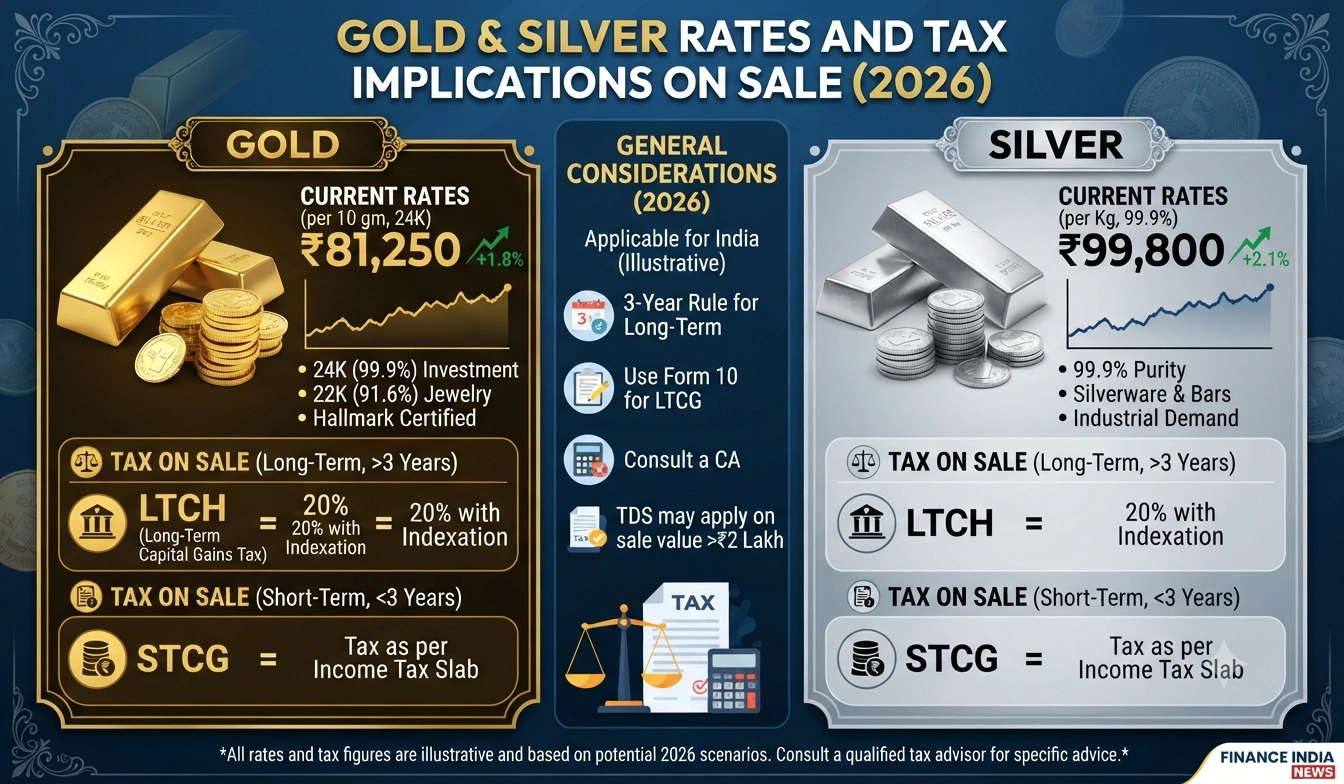
Gold & Silver Rates and Tax Implications on Sale (2026)
Your complete tax planning guide for precious metals transactions
Why Gold and Silver Tax Planning Matters Right Now
Gold and silver aren't just investments—they're tax events waiting to happen. When you sell precious metals in 2026, you're triggering capital gains tax that many people don't expect. The difference between planning ahead and scrambling later? Thousands of rupees.
And here's what most investors miss: the tax treatment depends on how long you've held the metal, whether it's physical or digital, and what form it takes. A gold coin gets taxed differently than a gold bar. A silver ring gets taxed differently than silver bullion. It's not simple, but it's manageable if you know the rules.
So what does this mean for you? If you're planning to sell any precious metals in 2026, you need to understand the tax implications before you hit sell. That's what this guide covers.
Current Gold and Silver Rates in 2026
Gold and silver rates move daily based on global market conditions, currency fluctuations, and demand. In 2026, these metals continue to be popular investment vehicles in India, driven by cultural preferences and economic uncertainty.
The key thing to understand is that for tax purposes, what matters isn't the current rate—it's the rate on the day you sell. The Income Tax Department recognizes the sale price as your selling value, not some average rate.
| Metal Type | Typical Form | Tax Classification |
|---|---|---|
| Gold | Bars, coins, jewelry | Capital asset |
| Silver | Bars, coins, bullion | Capital asset |
| Gold ETFs | Digital holdings | Listed security |
| Sovereign Gold Bond | Government bonds | Capital asset |
Rates in 2026 continue to reflect global gold prices (around ₹6,500-7,500 per gram) and silver prices (around ₹70-90 per gram), though these fluctuate daily. The exact rate you get depends on your buyer—jewelers, banks, and online dealers all offer slightly different prices.
Tracking daily rates helps you time your sale for maximum profit. Use official sources like IBJA (Indian Bullion Jewellers Association) rates or your bank's daily quotes for accuracy.
Capital Gains Tax on Gold and Silver Sales
When you sell gold or silver, the profit you make is treated as capital gains. This is where most investors get confused. The tax depends on two things: how long you held it and what type of metal it is.
Long-Term Capital Gains on Gold and Silver
If you hold gold or silver for more than 36 months (3 years), it becomes a long-term capital asset. Here's where it gets interesting: gold and silver get special treatment under the Income Tax Act.
But here's the catch that catches everyone: gold and silver don't get the standard long-term capital gains rate. Instead, they're taxed at 20% with indexation benefit. What does that mean? You get to adjust your purchase price for inflation before calculating the gain. So if you bought gold in 2020 for ₹5,00,000 and sold it in 2026 for ₹8,00,000, you don't pay tax on the full ₹3,00,000 gain—you reduce your cost using the inflation index.
| Holding Period | Tax Rate | Indexation Benefit |
|---|---|---|
| Less than 36 months | Slab rate (upto 30%) | No |
| More than 36 months | 20% flat | Yes |
Let me give you a real example. Say you bought 10 grams of gold in January 2020 for ₹4,00,000 (at ₹40,000 per gram). You sell it in June 2026 for ₹7,50,000 (at ₹75,000 per gram). Your raw profit is ₹3,50,000. But with indexation, your cost gets adjusted. The inflation index from 2020 to 2026 is roughly 1.35. So your indexed cost becomes ₹4,00,000 × 1.35 = ₹5,40,000. Your taxable gain is now ₹7,50,000 - ₹5,40,000 = ₹2,10,000. At 20%, you pay ₹42,000 in tax. Without indexation, you'd pay ₹70,000 (20% of ₹3,50,000). That's a difference of ₹28,000—and that's real money.
Short-Term Capital Gains on Gold and Silver
If you sell gold or silver within 36 months of buying it, it's short-term capital gains. And here's the tough part: you pay tax at your regular income tax slab rate—which could be 5%, 20%, or 30%, depending on your income.
So if you're in the 30% tax bracket and you sell gold after 2 years, you pay 30% tax on your entire gain. No indexation benefit. No reduction. Just straight 30%.
The message here is simple: if you're buying gold or silver as an investment, try to hold it for at least 3 years. The tax difference is huge.
Selling gold or silver within 3 years can cost you significantly more in taxes. If you're in a high tax bracket, short-term gains could eat 25-30% of your profit. Plan your sale timing carefully.
GST on Gold and Silver Transactions in 2026
Here's where it gets confusing for most people: GST and capital gains tax are different things, and both apply to precious metals in different situations.
When you buy gold or silver from a jeweler or dealer in 2026, you pay 5% GST. When you sell it, GST applies again on the sale value at 5%. So you're paying GST on both ends of the transaction.
But—and this is important—if you're buying or selling from a jeweler who's registered under GST, they handle the GST. If you're selling to a private buyer (not a registered dealer), GST might not apply depending on the transaction structure. This is where things get murky.
- Buying from registered jeweler: 5% GST added to price
- Selling to registered jeweler: 5% GST applies on sale value
- Selling to private buyer: GST may not apply (but document the transaction)
- Gold ETF transactions: No GST (treated as securities)
- Sovereign Gold Bonds: No GST on sale
- Jewelry with making charges: GST applies to making charges separately
The key thing is this: GST and capital gains tax are separate. You might pay 5% GST on a sale and also owe 20% capital gains tax. They stack on top of each other.
Practical Tax Planning Strategies for 2026
Now that you know the rules, let's talk strategy. How do you actually minimize your tax burden when selling gold or silver?
Strategy 1: Use the 3-Year Rule
The simplest strategy is to hold gold for more than 3 years. The tax difference between short-term and long-term is massive. If you can wait, wait. Your future self will thank you.
If you're buying gold now in 2026 planning to sell in 2027, you're not hitting the 3-year mark. But if you're buying now planning to sell in 2029 or later, you're in the long-term zone. That's when indexation kicks in and your real tax burden drops significantly.
Strategy 2: Spread Sales Across Financial Years
If you're selling a large amount of gold, consider spreading the sales across two financial years (2026-27 and 2027-28). This keeps your taxable income lower in each year and might push you into a lower tax bracket.
Example: If you sell ₹10 lakhs worth of gold in one year and you're already earning ₹8 lakhs, your total income jumps to ₹18 lakhs. But if you sell ₹5 lakhs in 2026-27 and ₹5 lakhs in 2027-28, you might stay in a lower bracket both years. The total tax could be lower even without changing the tax rate.
Strategy 3: Use Gold ETFs for Lower Tax Complexity
Gold ETFs (Exchange Traded Funds) are treated as listed securities, not physical gold. This means they get the standard long-term capital gains treatment: 20% tax after one year, with indexation. No GST complications. No purity verification issues. No storage problems.
If you're buying gold for investment in 2026, consider whether a gold ETF makes more sense than physical gold. Less hassle, cleaner tax treatment, easier to track for your records.
Strategy 4: Keep Detailed Purchase Records
This isn't sexy, but it's critical. To claim indexation benefit, you need to prove your cost of acquisition. That means you need the original bill, receipt, or documentation from when you bought the gold.
If you bought gold years ago and don't have the original bill, you can use the fair market value on the date you acquired it (if you can prove the date). But that's harder. Better to keep records from day one.
Proper documentation of your gold purchase price is the easiest way to reduce your tax liability legally. It costs nothing and saves thousands when you sell.
Strategy 5: Understand Loss Adjustment
If you sell gold at a loss (you bought it for ₹5,00,000 and sold it for ₹4,50,000), you can use that loss to offset other capital gains. This is called capital loss adjustment.
So if you made a ₹1,00,000 gain on selling silver and a ₹50,000 loss on selling gold, you only pay tax on the net gain of ₹50,000. You can carry forward unused losses for up to 8 years.
The key here is: don't ignore losses. Document them properly. They have real value.
Compliance Requirements for Selling Gold and Silver in 2026
Beyond taxes, there are compliance rules you need to follow when selling precious metals. The government wants to track large transactions to prevent money laundering.
Cash Transaction Limits
If you sell gold or silver for cash, there are limits. For transactions above ₹10 lakhs, the buyer (usually a jeweler or dealer) needs to report the transaction and follow Know Your Customer (KYC) rules. For amounts above ₹20 lakhs, they need to file a report with the Financial Intelligence Unit.
This doesn't mean you can't sell gold for that amount—you can. But it needs to be documented properly. The dealer will ask for your PAN, address proof, and other details. Don't try to avoid this by splitting the transaction into smaller amounts. That's called structuring, and it's illegal.
Reporting in Income Tax Returns
If you sell gold or silver, you need to report the transaction in your income tax return. You report the capital gain (or loss) in Schedule 2 of your ITR form.
Don't skip this. The Income Tax Department has access to dealer reports and bank records. If you sell gold through a registered dealer, they report it. If you sell through a bank, they report it. Hiding it isn't an option.
- Report capital gain in Schedule 2 of ITR form
- Attach proof of purchase (bills, receipts)
- Keep bank statements showing the sale proceeds
- If you claimed indexation benefit, calculate and show it clearly
- File your return before the due date (usually July 31st)
Purity and Hallmarking
When you sell physical gold or silver, the buyer will check purity. For gold, common purities are 22K, 18K, and 24K. For silver, it's usually 92.5% (Sterling silver) or 99.9% pure.
Hallmarked gold (with the BIS mark) gets better prices because it's certified. If your gold isn't hallmarked, the buyer might apply a discount. This affects your selling price and therefore your capital gain calculation.
So when you buy gold for investment, consider getting it hallmarked. It costs a bit more upfront but pays off when you sell.
Gold and Silver Sales Through Banks
Many banks offer gold buying and selling services. If you sell through a bank, the transaction is fully documented and reported. This is actually cleaner from a tax perspective because there's no ambiguity about the transaction amount or date.
Banks also offer sovereign gold bonds, which are government-issued and have their own tax treatment. If you're holding a sovereign gold bond and sell it, the capital gain is taxed the same way as physical gold—20% with indexation for long-term holdings.
Special Cases: Inherited Gold and Gifted Gold
If you inherited gold from a parent or relative, the cost of acquisition is the fair market value on the date of death, not what they originally paid. If you received gold as a gift, your cost is the fair market value on the date you received it (with some exceptions for gifts from relatives).
This matters because it affects your capital gain calculation. If your mother bought gold for ₹2,00,000 in 2010 and you inherited it in 2020 when it was worth ₹5,00,000, your cost of acquisition is ₹5,00,000. If you sell it in 2026 for ₹7,50,000, your gain is only ₹2,50,000, not ₹5,50,000.
Don't assume inherited gold has the same cost as the original purchase. The cost resets to fair market value on the date of inheritance. This is a common mistake that leads to overpaying taxes.
Frequently Asked Questions About Gold and Silver Tax
Q1: Do I need to pay tax if I sell gold jewelry?
Yes. If you sell gold jewelry at a profit, it's capital gains tax. If you sell it at the price you paid (no profit), there's no tax. But if you bought it for ₹50,000 and sold it for ₹60,000, you owe tax on the ₹10,000 gain. Jewelry is treated the same as gold bars or coins—it's all capital assets.
Q2: What if I sell gold without a bill or receipt?
You can still claim the fair market value on the date you acquired it as your cost. You'll need to provide evidence of the date (like old bank statements, family records, or anything that shows when you got it). The Income Tax Department accepts reasonable evidence. But honestly, it's much easier if you have the original bill.
Q3: Is there tax on selling gold if I'm below the income tax filing threshold?
This depends on your total income. If your total income (salary + capital gains + other income) is below the filing threshold for your age, you might not need to file a return. But if capital gains alone push you above the threshold, you need to file. And honestly, it's better to file anyway. There's no downside.
Q4: Can I use my spouse's income to reduce my tax on gold sales?
No. Capital gains are taxed in the hands of the person who sells the asset. If you sell gold, you pay tax on the gain. If your spouse sells gold, they pay tax on their gain. You can't combine incomes. But here's what you can do: if both of you own gold, you can plan who sells when to optimize the household tax. If your spouse is in a lower tax bracket, they could sell first.
Q5: What's the difference between capital gains tax and GST on gold?
GST is a transaction tax (5%) that applies when you buy or sell from a registered dealer. Capital gains tax is an income tax on your profit. Both apply. If you buy gold for ₹1,00,000 and pay 5% GST, you spend ₹1,05,000. If you sell it for ₹1,20,000 and pay 5% GST, you get ₹1,14,000. Your capital gain is ₹1,14,000 - ₹1,05,000 = ₹9,000. You pay capital gains tax on ₹9,000, not on the GST amounts.
Common Mistakes to Avoid When Selling Gold in 2026
Let me be direct: most people make at least one of these mistakes when selling gold. Knowing about them now saves you money later.
- Not tracking the holding period correctly and paying short-term tax when you should get long-term
- Forgetting to claim indexation benefit on long-term gains
- Selling gold in cash and not reporting it in the income tax return
- Splitting large sales into small amounts to avoid dealer reporting (this is illegal)
- Not keeping original purchase bills and then struggling to prove cost
- Selling through unregistered dealers and getting stuck with no documentation
- Assuming jewelry has no tax because it's personal use (it does if you sell it)
Action Plan: What to Do Before You Sell Gold or Silver in 2026
Here's your step-by-step checklist before you sell any precious metals:
- Calculate your holding period from purchase date to planned sale date
- Gather all purchase documentation (bills, receipts, certificates)
- Get your gold valued by at least 2-3 dealers to know the market price
- If holding period is close to 3 years, consider waiting to get long-term treatment
- Calculate your estimated capital gain and tax liability
- Check if you need to spread the sale across multiple years
- Decide whether to sell to a bank, jeweler, or dealer (banks are cleanest for documentation)
- Plan to report the transaction in your next income tax return
Conclusion: Planning Beats Panic
Gold and silver are great investments, but they come with tax responsibilities. The good news? These taxes are predictable and manageable if you plan ahead.
The 3-year holding period is your best friend. Long-term capital gains at 20% with indexation are far better than short-term gains at your slab rate. Keep your purchase documents. Track your holding periods. Report your sales in your income tax return. That's really it.
If you're selling a large amount of gold in 2026, spend 30 minutes with a CA to plan it out. The tax savings will be worth it many times over.
" } ```
© 2026 Tax Esquire | Expert CA Services in Greater Noida, Uttar Pradesh
8810380146 | info.taxesquire@gmail.com | taxesquire.in
This document is for informational purposes only. For personalised tax advice, consult our chartered accountants.