GST on E-Commerce: Complete Compliance Guide for Online Sellers in 2027

GST on E-Commerce
Everything you need to know about GST registration, filing, and compliance for your online business
Why GST Compliance Matters for E-Commerce Sellers
Look, if you're selling anything online—whether it's products, digital services, or subscriptions—GST applies to you. And that's not just a suggestion. It's the law. Running an e-commerce business without proper GST compliance isn't just risky; it can cost you big time in penalties, blocked accounts, and legal trouble.
The thing is, most online sellers don't realize when they cross the GST registration threshold. You might think you're too small to worry about it. But here's the reality: the GST authorities are watching. They track your sales across all platforms—Amazon, Flipkart, Shopify, your own website—and they'll catch you if you're not registered when you should be.
So what does this mean for you? It means getting your GST house in order right now, before it becomes a problem. In 2027, the rules are tighter than ever, and compliance is non-negotiable.
Proper GST compliance builds trust with customers, keeps your business legally protected, and helps you avoid sudden account suspensions or penalties that could shut you down.
Understanding GST Registration Thresholds for Online Sellers
Let's start with the basics. You need to register for GST if your turnover crosses certain limits. But here's where e-commerce gets tricky: the thresholds are different for different types of sellers.
For regular suppliers selling physical goods, the threshold is Rs. 40 lakhs for most states and Rs. 20 lakhs for certain northeastern states and hilly regions. But if you're selling services or operating from multiple states, the rules change. And if you're selling through e-commerce platforms like Amazon or Flipkart, the platform itself might be considered your agent, which affects how your turnover is counted.
Basically, what I mean is this: you can't just add up your sales and compare it to the threshold. You need to understand how GST counts your turnover.
| Type of Seller | Threshold Limit (2027) | Key Point |
|---|---|---|
| Goods Supplier (Regular States) | Rs. 40 Lakhs | Cumulative annual turnover |
| Goods Supplier (NE/Hilly) | Rs. 20 Lakhs | Lower threshold in these regions |
| Service Provider | Rs. 20 Lakhs | Applies to all service sellers |
| E-Commerce Operator (Agent) | Rs. 40 Lakhs | Platform handles remittance |
Now here's something many sellers miss: voluntary registration. You don't have to wait until you hit the threshold. You can register voluntarily even if you're below the limit. Why would you do this? Because it lets you claim input tax credits on your purchases. If you're buying inventory and paying GST on it, you want to recover that tax.
Don't ignore the threshold. The GST department cross-checks sales data from e-commerce platforms and payment gateways. If you're registered late, you'll face penalties, interest on unpaid tax, and potential legal action. The authorities aren't lenient about this.
The GST Registration Process for E-Commerce Businesses
Getting registered for GST is straightforward if you know what you're doing. But most online sellers get stuck because they're not sure what paperwork they need or which form to fill.
The registration happens online through the GST portal. You'll need to fill Form GST REG-01. Here's what you'll need to have ready:
- PAN card (yours or your business's)
- Bank account details (with cancelled cheque)
- Address proof for your business location
- Identity proof
- Email ID and mobile number
- If you have employees: Form 16A or salary certificates
And that's really it. Once you submit, the GST officer might ask for clarifications or additional documents. But typically, you get your GST number within 3-7 working days if everything's in order.
Here's a practical example: Let's say you're Priya, selling handmade jewelry on Amazon. Your sales hit Rs. 42 lakhs in a financial year. You need to register immediately. You gather your PAN, open a dedicated business bank account, take proof of your home address, and file Form GST REG-01 online. Within a week, you get your GSTIN. Now you can start issuing proper invoices and filing returns.
But here's where many sellers slip up: they register late. They hit 45 lakhs in sales before they realize they should've registered at 40 lakhs. Now they owe GST on the entire 45 lakhs, plus interest at 18% per annum, plus penalties. That's a big hit to your profits.
GST Compliance Requirements for Online Sellers
Once you're registered, compliance becomes your daily responsibility. And I'm not just talking about filing returns. There's much more to it.
First, invoicing. Every sale needs a proper GST invoice. This isn't optional. Your invoice must show the GSTIN, HSN code, tax rate, and tax amount. If you're using e-commerce platforms, the platform might issue the invoice on your behalf, but you're still responsible for accuracy. If it's wrong, it's your liability.
Second, record-keeping. You need to maintain records of all purchases and sales. This includes invoices, payment receipts, delivery notes, and returns. Keep these for at least 5 years. The GST department can ask for any of this during an audit.
Third, GST returns. This is where most sellers struggle. You need to file different returns depending on your business type:
- GSTR-1: Monthly outward supplies (what you sold)
- GSTR-2A: Monthly inward supplies (what you bought) — auto-populated
- GSTR-3B: Monthly reconciliation and tax payment
- GSTR-9: Annual return
- GSTR-9C: Annual audit report (if applicable)
The deadlines are tight. GSTR-1 is due by the 11th of the next month. GSTR-3B is due by the 20th. If you miss these, you face late fees and interest. So what does this mean for you? It means setting up a system now to track your sales and purchases daily.
When you file returns on time and maintain clean records, you create a paper trail that protects you during audits. It also makes it easy to claim input tax credits and reduce your actual GST liability.
Input Tax Credit: How to Save Money on GST
This is the part that actually saves you money. Input Tax Credit (ITC) means you can deduct the GST you paid on purchases from the GST you need to pay on sales.
Let me show you how this works with an example. Say you buy inventory worth Rs. 1 lakh at 18% GST. You pay Rs. 18,000 in GST. Then you sell that inventory for Rs. 1.5 lakhs at 18% GST. You collect Rs. 27,000 in GST from your customer. But you don't pay Rs. 27,000 to the government. You pay Rs. 27,000 minus Rs. 18,000 = Rs. 9,000. That's the power of ITC.
But here's the catch: you can only claim ITC if your supplier is registered and has issued a proper GST invoice. If you buy from an unregistered seller, there's no ITC. So always ask for GST invoices from your suppliers.
Also, not all expenses qualify for ITC. Personal expenses, entertainment, and certain items like personal vehicles don't qualify. So be careful what you claim.
In 2027, the rules around ITC have become stricter. The GST department is actively auditing ITC claims. If you claim ITC on something that doesn't qualify, you'll face penalties and interest. So keep proper documentation for every ITC claim you make.
Special GST Rules for E-Commerce Platforms
If you're selling through Amazon, Flipkart, Meesho, or any other platform, there are special GST rules you need to know.
First, the platform is considered your agent. This means the platform collects GST on your behalf and remits it to the government. You don't directly pay GST to the government; the platform does. But you're still responsible for providing accurate information to the platform.
Second, the platform reports your sales to the GST department. They file GSTR-8 returns showing all sales made through their platform. This means the government knows exactly how much you're selling. You can't hide anything. So don't even try.
Third, you still need to file your own returns. Even though the platform collects GST, you file GSTR-1 and GSTR-3B showing your sales. Your return should match the data the platform reports. If there's a mismatch, the GST department will ask you to explain.
Here's a practical scenario: You sell Rs. 50 lakhs of products through Amazon in a year. Amazon collects GST at 18% (Rs. 9 lakhs) and remits it to the government. You file your GSTR-1 showing Rs. 50 lakhs in sales. The government cross-checks this with Amazon's GSTR-8. If your numbers match, no problem. If they don't, you're in trouble.
The GST authorities have data analytics tools that flag mismatches between your returns and platform data. They're getting smarter at catching discrepancies. In 2027, don't assume you can file something different from what the platform reports. You'll get caught.
GST on Different Types of E-Commerce Sales
Not all e-commerce sales are taxed the same way. The GST rate depends on what you're selling.
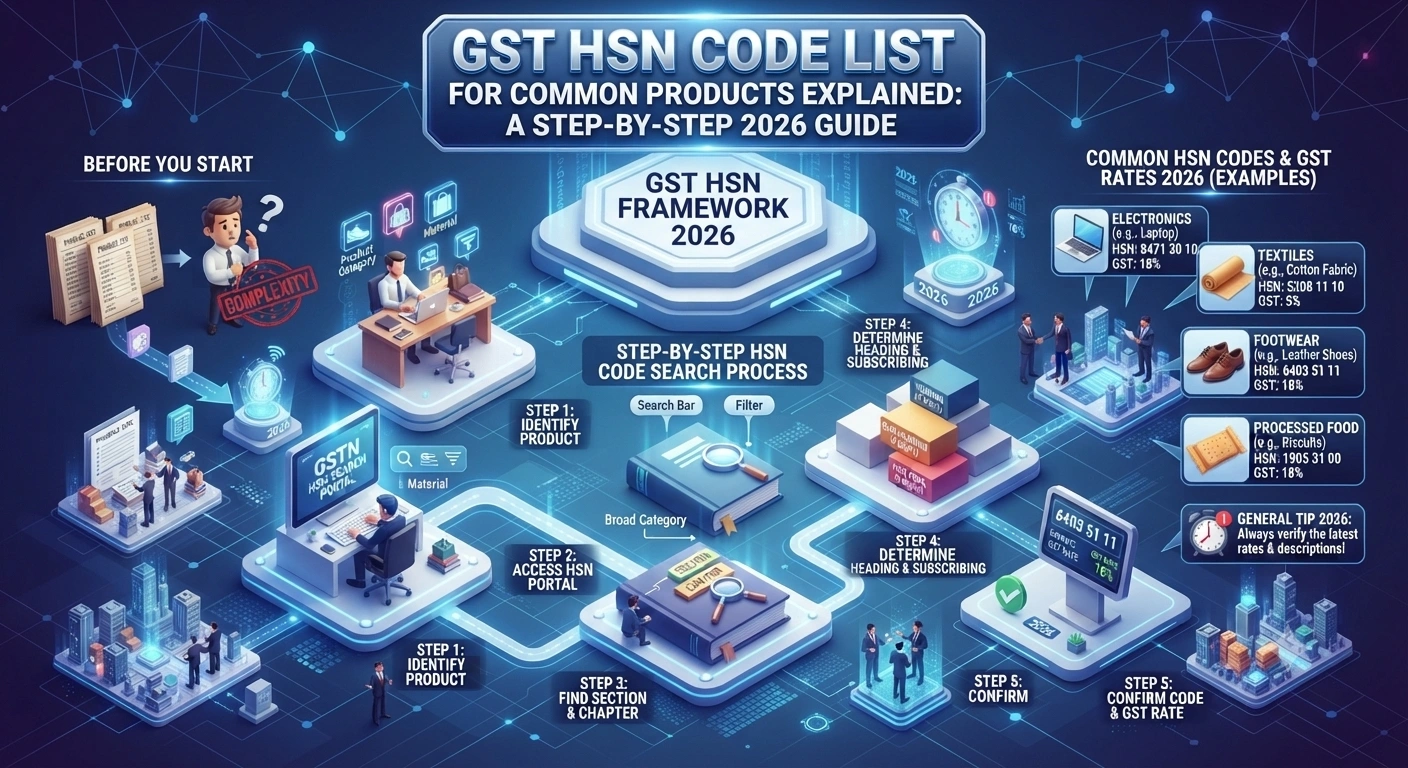
Physical goods have different rates. Books, newspapers, and milk are 0% (no GST). Most food items are 5%. Clothing and footwear are 5%. Electronics and gadgets are typically 18%. Luxury items like watches and bags can be 28%. So the first step is figuring out the right HSN code and tax rate for your product.
Services have their own rates. Consulting services are 18%. Transportation is 5%. Digital services (like software, apps, online courses) are 18%. If you're selling digital products, you need to understand the place of supply rules, which determine which state's GST applies.
And then there's the HSN code. This is a 6-digit code that identifies your product. Getting this wrong can cause problems. The GST department uses HSN codes to track what you're selling. If your HSN code doesn't match your product, your return might be rejected.
| Product Category | GST Rate | Example |
|---|---|---|
| Essential Food Items | 0% or 5% | Rice, pulses, vegetables |
| Apparel & Footwear | 5% | Clothes, shoes |
| Electronics | 12% or 18% | Phones, laptops |
| Luxury Goods | 28% | Watches, jewelry |
| Services | 5% or 18% | Consulting, design |
Common GST Compliance Mistakes E-Commerce Sellers Make
After working with hundreds of online sellers, I've seen the same mistakes over and over. Let me share what to avoid.
Mistake #1: Late registration. Sellers cross the threshold but don't register immediately. They think they'll do it next month. But the GST department doesn't care about your timeline. You owe tax from the day you crossed the threshold. Register the moment you realize you need to.
Mistake #2: Wrong invoicing. They issue invoices without GSTIN, without proper HSN codes, or with incorrect tax amounts. Every invoice is a legal document. Getting it wrong invites scrutiny from the GST department.
Mistake #3: Not reconciling returns. They file GSTR-1 without checking if it matches the platform data. Then when the GST department notices a mismatch, they panic. Spend 30 minutes monthly reconciling your data.
Mistake #4: Claiming ITC on personal expenses. They claim input tax on items that don't qualify. Then during an audit, the GST officer disallows the claim and adds penalties. Be strict about what you claim.
Mistake #5: Missing deadlines. They file returns late and pay penalties. In 2027, the GST system is automated. Late filing automatically triggers penalties. There's no grace period. Mark your calendar and file on time.
Mistake #6: Poor record-keeping. They don't maintain invoices, receipts, or delivery notes. Then when audited, they can't prove their claims. Keep everything organized and backed up digitally.
GST Penalties and How to Avoid Them
Let's talk about what happens when you mess up. The GST penalty structure is designed to hurt, and it does.
If you don't register when you should, the penalty is 10% of the tax due or Rs. 10,000, whichever is higher. So if you owe Rs. 2 lakhs in tax, you pay Rs. 20,000 in penalty. That's on top of the tax itself.
If you file returns late, you pay interest at 18% per annum on the unpaid tax, plus a late fee of Rs. 100 per day (capped at Rs. 5,000). So if you're late by 30 days and owe Rs. 50,000 in tax, you pay Rs. 50,000 plus interest plus Rs. 3,000 in late fees. That's over Rs. 56,000 for being 30 days late.
If you issue wrong invoices or claim false ITC, the penalty can be up to 10% of the tax or Rs. 10,000. And if it's considered fraud, you could face prosecution and jail time. I'm not exaggerating. The GST authorities don't play around with fraud.
Here's how to avoid all this: Register on time. File returns on deadline. Issue correct invoices. Claim only legitimate ITC. Keep records. It's that simple. And if you're unsure about something, ask your CA or a GST consultant. A 30-minute consultation costs far less than a penalty.
When you maintain compliance proactively, you avoid penalties, interest, and legal complications. You also build a clean compliance record that makes future dealings with the GST department smooth and hassle-free.
GST Audit: What E-Commerce Sellers Need to Know
The GST department conducts audits. It's a fact you need to accept. But here's what you should know: not every seller gets audited, but e-commerce sellers are more likely to be selected because the government has easy access to your sales data.
An audit typically happens if your turnover is above Rs. 1 crore or if the GST department spots anomalies in your returns. They might notice that your ITC claims are unusually high, or your tax rate doesn't match your product category, or your sales pattern is suspicious.
When they audit, they ask for invoices, purchase receipts, delivery notes, bank statements, and payment gateway records. They want to verify that your sales are real, your ITC claims are legitimate, and your tax calculations are correct. So what does this mean for you? It means keeping all your records organized and accessible.
The audit process typically takes 2-3 months. If they find discrepancies, they issue a show-cause notice asking you to explain. You have 15 days to respond. If you can't explain, they assess the additional tax, plus interest, plus penalties.
Here's my advice: maintain records so clean that an audit doesn't scare you. If an auditor asks for your Q3 2027 invoices, you should be able to pull them up in 10 minutes. That confidence goes a long way.
GST Technology and Tools for E-Commerce Sellers
In 2027, you don't have to manually file GST returns or calculate taxes. There are tools that do this for you.
First, there's the official GST portal. It's free and lets you file all returns, check your compliance status, and download certificates. If you're just starting, this is your baseline tool.
But if you're serious about compliance, use accounting software like Tally, Zoho Books, or Busy. These integrate with your e-commerce platform, automatically pull your sales data, and generate GST returns. They also maintain your records and flag compliance deadlines. The investment (typically Rs. 500-2000 per month) pays for itself by saving you time and mistakes.
Some e-commerce platforms like Shopify have built-in GST compliance features. They calculate taxes automatically, generate compliant invoices, and help you track your turnover. If you're using these platforms, use these features.
And finally, consider hiring a GST consultant or CA. For e-commerce sellers with turnover above Rs. 50 lakhs, this is almost essential. They stay updated on rule changes, handle audits, and optimize your tax position. It's not an expense; it's an investment in peace of mind.
Frequently Asked Questions
Q1: I'm selling on multiple platforms (Amazon, Flipkart, and my own website). How do I count my turnover for GST registration?
A: You add up sales from all sources. The GST law doesn't care where you sell. If your combined turnover across all platforms is Rs. 42 lakhs, you need to register. The GST department has visibility into all your sales through platform data, so they'll catch you if you try to hide anything.
Q2: What happens if I sell products with different GST rates?
A: You invoice each product at its applicable rate. If you sell a 5% GST item and an 18% GST item in the same order, your invoice shows both rates separately with their respective taxes. Your GST return then shows sales split by tax rate. The GST portal has fields for this, so it's straightforward if you use accounting software.
Q3: Can I claim GST on my personal expenses like my home office rent?
A: No. You can only claim ITC on business expenses. If you work from home but your home is primarily residential, you can't claim GST on rent. However, if you have a dedicated office space that's separate, you might be able to claim a portion. The key is documentation. Keep records showing what portion of your home is used exclusively for business.
Q4: I missed filing my GSTR-3B by 5 days. What penalty will I face?
A: You'll face a late fee of Rs. 100 per day (capped at Rs. 5,000 per return), plus 18% interest per annum on the unpaid tax. So 5 days late means Rs. 500 in late fee plus interest. File immediately to minimize the damage. Going forward, set calendar reminders for the 20th of every month.
Q5: Do I need to register for GST if I'm selling digital products or services?
A: Yes. Digital products and services are taxable under GST. The threshold for service providers is Rs. 20 lakhs, lower than goods suppliers. If you're selling online courses, software, design services, or any digital product, and your turnover exceeds Rs. 20 lakhs, you must register.
Q6: What's the difference between GSTR-1 and GSTR-3B?
A: GSTR-1 is your sales return. You report all your outward supplies (what you sold) here. GSTR-3B is your reconciliation and payment return. You report your total tax liability here, account for ITC you're claiming, and calculate the net GST you owe. You file GSTR-1 by the 11th of the next month and GSTR-3B by the 20th. Both are compulsory.
Practical Compliance Checklist for E-Commerce Sellers
Here's a checklist you can use right now to assess your GST compliance:
- Have I calculated my annual turnover across all sales channels?
- Do I need to register based on my turnover?
- If yes, have I registered? If no, when do I plan to register?
- Do I have a system to track daily sales and purchases?
- Am I issuing GST-compliant invoices with GSTIN, HSN codes, and correct tax rates?
- Do I have a calendar reminder for GSTR-1 (11th of next month) and GSTR-3B (20th of next month)?
- Am I maintaining records of all invoices, receipts, and delivery notes?
- Have I identified which expenses qualify for ITC and which don't?
- Do I reconcile my returns with platform data before filing?
- Have I set aside funds for GST liability each month?
If you can check all these boxes, you're in good shape. If not, start working on them now.
Wrapping Up: Your GST Compliance Action Plan
GST compliance for e-commerce sellers isn't complicated, but it does need attention. The good news is that most of it is straightforward if you understand the basics and stay organized.
Here's what you should do right now: First, calculate your turnover. If you're below the threshold, you still might want to register voluntarily to claim ITC. Second, set up a system to track your sales and purchases daily. Third, register for GST if you haven't already. Fourth, start issuing compliant invoices. Fifth, mark your calendar for return filing deadlines and set reminders. Sixth, maintain clean records.
And honestly? If your business is growing, hire a CA or GST consultant. The cost is minimal compared to the protection you get. They'll help you optimize your tax position, stay compliant, and handle audits if they happen.
In 2027, GST compliance is non-negotiable. The government has the data, the tools, and the willingness to enforce. But if you stay ahead of it, you'll sleep better at night knowing your business is on solid legal ground.
© 2026 Tax Esquire | Expert CA Services in Greater Noida, Uttar Pradesh
8810380146 | info.taxesquire@gmail.com | taxesquire.in
This document is for informational purposes only. For personalised tax advice, consult our chartered accountants.