Best Tax-Saving Investment Options for Salaried Employees 2026-27
Best Tax-Saving Investment Options for Salaried Employees 2026-27
Smart investment strategies to reduce your tax burden and build wealth simultaneously
Why Tax-Saving Investments Matter Right Now
Look, if you're a salaried employee in 2026-27, you're likely paying more tax than you need to. Most people don't realize they're leaving money on the table simply because they don't know about the right investment options. The government gives you legitimate ways to reduce your taxable income, and honestly, not using them is like leaving your own money with the tax department.
The thing is, tax-saving doesn't mean being clever or finding loopholes. It means making smart investments that benefit you AND help you pay less tax. Win-win, right? In 2026-27, the rules haven't changed much, but the investment landscape has evolved. You need to know what works best for your situation.
So what does this mean for you? It means you can potentially save anywhere from ₹50,000 to ₹3,00,000 per year depending on your income and investment strategy. That's real money that stays in your pocket instead of going to the government.
Section 80C: Your Primary Tax-Saving Tool
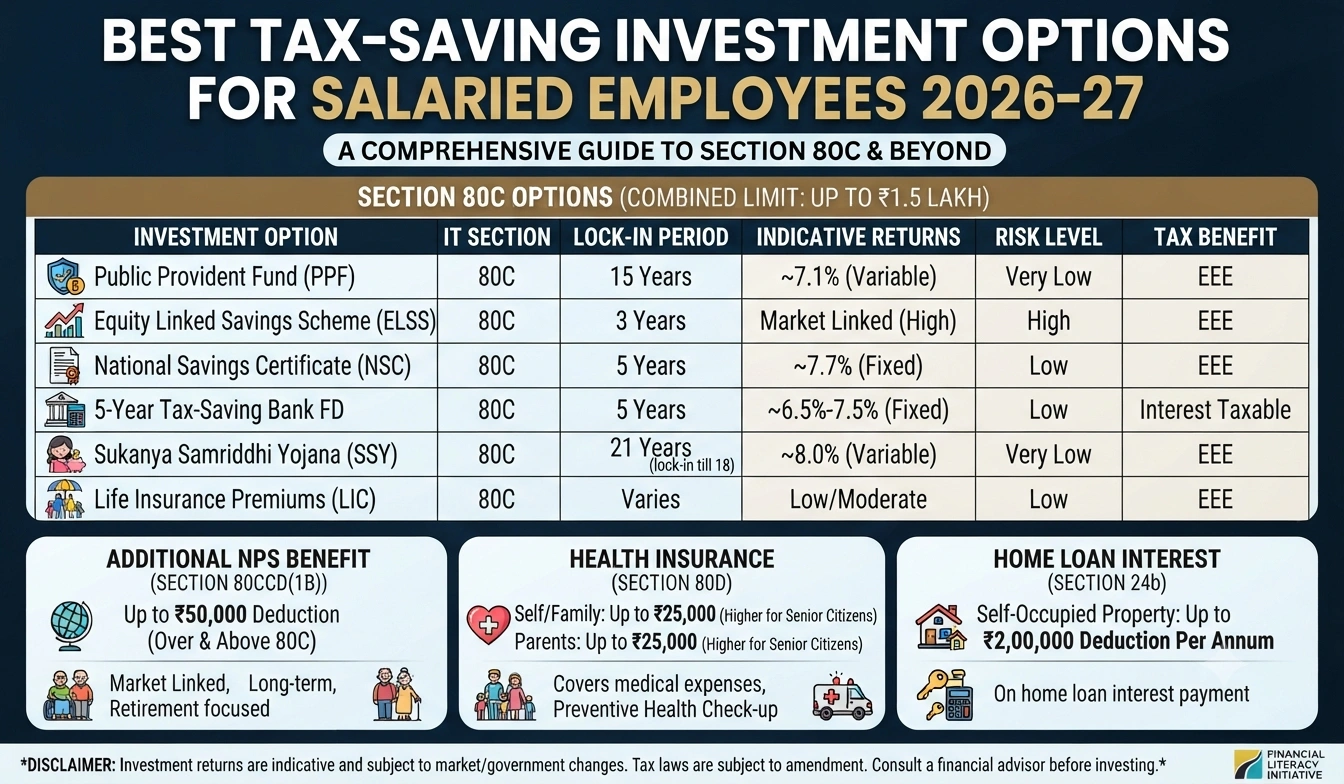
Section 80C is the bread and butter of tax saving for salaried employees. Under this section, you can claim deductions up to ₹1,50,000 per financial year. But here's the catch—you need to invest in the right instruments.
And that's really it. You pick eligible investments, invest your money, and reduce your taxable income. Simple as that. But choosing the wrong investment is where most people go wrong.
Life Insurance Premiums
Life insurance premiums paid under Section 80C are one of the safest options. You get tax deduction plus life coverage. It's like getting two benefits from one rupee. In 2026-27, if you pay ₹50,000 annually as insurance premium, you can deduct the full amount from your income.
But don't just buy any insurance. Make sure it's a genuine life insurance policy, not just a savings plan dressed up as insurance. The policy should have a real death benefit component.
Life insurance gives you dual advantage: tax deduction under 80C plus financial protection for your family. You're essentially getting tax-free returns on your life coverage.
Public Provident Fund (PPF)
PPF is the safest investment option available. You get a guaranteed return, complete tax exemption on maturity, and a 15-year lock-in period. In 2026-27, you can invest up to ₹1,50,000 annually and claim full deduction under Section 80C.
The interest rate is set quarterly based on government securities yield. Currently, it's around 7-8% per annum. Your money grows completely tax-free. No tax on interest, no tax on maturity. That's rare in India.
What I mean is, if you invest ₹1,50,000 in PPF for 15 years at 7.5% interest, you'll get approximately ₹4,00,000 at maturity. And you won't pay a single rupee in tax on that growth. Compare that to any fixed deposit where you pay tax on interest every year.
| Investment Amount | Tax Deduction | Approx. Maturity (15 years at 7.5%) |
|---|---|---|
| ₹1,00,000 | ₹1,00,000 | ₹2,66,000 |
| ₹1,50,000 | ₹1,50,000 | ₹4,00,000 |
Equity-Linked Savings Scheme (ELSS)
ELSS mutual funds offer tax deduction under Section 80C with a 3-year lock-in period. Unlike PPF's 15-year lock-in, ELSS is much shorter. You invest in equity markets, so returns are higher but also more volatile.
In 2026-27, if you invest ₹50,000 in ELSS, you get full deduction. The best part? After 3 years, you're completely free to withdraw or continue investing. And if you hold for more than a year, you pay no tax on capital gains.
Honestly, ELSS is perfect for young employees who can handle market volatility. If you're 30 years old and invest ₹50,000 annually in ELSS for 20 years, assuming 12% average returns, you could have about ₹30,00,000. That's wealth creation plus tax saving combined.
ELSS is equity-based. Markets can go down. If you can't handle seeing your investment value drop by 20-30% temporarily, ELSS isn't for you. Choose PPF or fixed deposits instead.
National Savings Certificate (NSC)
NSC is a government savings scheme with a 5-year maturity period. You get guaranteed returns, and the interest compounds annually. In 2026-27, the interest rate is around 6.8% per annum.
You can invest up to ₹1,50,000 annually and claim full deduction under Section 80C. The interest earned is taxable, but you can claim it under Section 80C in the year of maturity.
- Minimum investment: ₹1,000
- Maximum investment: No limit
- Maturity period: 5 years
- Interest rate: Fixed for the entire period
- Tax deduction: Full amount under 80C
- Liquidity: Can withdraw after 1 year with penalty
Section 80D: Health Insurance Deductions
Beyond Section 80C, Section 80D lets you claim deductions for health insurance premiums. This is separate from your ₹1,50,000 limit under 80C. So you get additional tax saving.
In 2026-27, you can claim up to ₹25,000 for your own health insurance and your spouse's. For parents, you can claim up to ₹25,000 (₹50,000 if both are senior citizens above 60 years).
So what does this mean for you? If you pay ₹15,000 for your health insurance and ₹20,000 for your parents' health insurance, you can claim ₹35,000 deduction under 80D. That's on top of your 80C deductions.
And here's the thing—health insurance is mandatory anyway. You're not spending extra money; you're just getting tax benefit on something you already need to buy.
| Category | Deduction Limit 2026-27 |
|---|---|
| Self and spouse | ₹25,000 |
| Parents (below 60 years) | ₹25,000 |
| Parents (60 years and above) | ₹50,000 |
Section 80E: Education Loan Interest
If you've taken an education loan, you can claim deduction on the interest paid under Section 80E. There's no upper limit. You can claim the entire interest amount.
But here's what matters: this applies to loans taken for higher education. Not just any education. It should be for yourself, your spouse, or your children. And the loan should be from a bank or financial institution.
The deduction is available for 8 years or until the loan is fully repaid, whichever is earlier. So if you took a ₹10 lakh education loan at 8% interest, you'd pay about ₹80,000 interest in the first year. You can claim the entire ₹80,000 as deduction.
Section 80CCD: National Pension Scheme (NPS)
NPS is a retirement savings scheme with tax benefits. You can claim deductions under Section 80C for up to ₹1,50,000 invested in NPS. But there's more—under Section 80CCD(1B), you can claim additional deduction of ₹50,000 for NPS contributions.
So basically, you can invest ₹2,00,000 in NPS and claim full deduction. That's ₹1,50,000 under 80C and ₹50,000 under 80CCD(1B). The money grows tax-free until retirement.
The thing is, NPS is perfect for long-term wealth creation. You can choose between equity and debt funds based on your risk appetite. When you retire, 60% of the corpus is tax-free, and 40% is taxable as income.
NPS gives you the highest deduction limit (₹2,00,000 combined) plus tax-free growth. If you're young, investing in NPS can create a corpus of ₹50,00,000 or more by retirement.
Other Tax-Saving Options
Senior Citizens Savings Scheme (SCSS)
If you're 60 years or older, SCSS offers excellent returns with tax deduction. You can invest up to ₹30 lakh in SCSS and claim deduction under Section 80C. The interest rate is around 8.2% per annum in 2026-27.
The maturity period is 5 years with an option to extend for 3 more years. Interest is paid quarterly. And here's the benefit—no tax on the interest if your income is below the taxable limit.
Home Loan Principal Repayment (Section 80C)
Principal repayment on your home loan qualifies for deduction under Section 80C. If you're paying ₹50,000 annually as principal, you get ₹50,000 deduction. Plus, you can claim interest deduction under Section 24(b) separately.
So on a home loan, you get double tax benefit. This makes home loans one of the best tax-saving tools for salaried employees.
Sukanya Samriddhi Account (SSA)
If you have a daughter, SSA is brilliant. You can open an account for your daughter and invest up to ₹1,50,000 annually. Full deduction under Section 80C. The interest rate is around 8% per annum in 2026-27.
The account matures when your daughter turns 21. All interest is completely tax-free. It's designed specifically to build a corpus for your daughter's education or marriage.
Practical Tax-Saving Strategy for 2026-27
Let me give you a real example. Say you're a 35-year-old salaried employee with a salary of ₹10 lakh per year and no dependents.
- Invest ₹50,000 in PPF (guaranteed safety, tax-free growth)
- Invest ₹50,000 in ELSS (equity exposure, 3-year lock-in)
- Pay ₹30,000 as life insurance premium (protection + tax benefit)
- Invest ₹20,000 in NPS (additional ₹50,000 under 80CCD(1B))
- Pay ₹15,000 for health insurance (Section 80D deduction)
- Total deductions: ₹2,15,000
Your taxable income reduces from ₹10 lakh to ₹7,85,000. In the 30% tax bracket, you save ₹64,500 in taxes. That's real money saved.
Don't invest just for tax saving. Invest in instruments you actually understand and can hold for the required period. Investing ₹1,50,000 in ELSS and then panicking when markets drop 20% defeats the purpose.
Compliance Tips for 2026-27
When you claim deductions, you need to maintain proper paperwork. The income tax department can ask for proof anytime during the financial year or even after filing your return.
- Keep all investment certificates, receipts, and confirmations
- Maintain bank statements showing payments
- Get acknowledgment from your insurance company
- Keep PPF passbook updated with all transactions
- Save mutual fund statements and transaction confirmations
- Document home loan agreements and payment proofs
And here's something important—don't claim deductions you haven't actually invested. If you claim ₹1,50,000 under 80C but only invested ₹1,00,000, that's fraud. The tax department will catch it, and you'll face penalties plus interest.
Common Mistakes to Avoid
Most salaried employees make the same mistakes repeatedly. Put simply, here are the main ones:
1. Investing at the last moment: Many people wait until March and then rush to invest. This leads to poor investment decisions. Plan your investments from April itself.
2. Confusing Section 80C and 80CCD: These are different. 80C has a ₹1,50,000 limit. 80CCD(1B) adds another ₹50,000 specifically for NPS. Don't overlap them.
3. Investing in unsuitable products: Just because something gives tax deduction doesn't mean it's right for you. If you can't handle market volatility, don't invest in ELSS.
4. Ignoring health insurance: Many young employees skip health insurance thinking they're healthy. But medical emergencies don't care about age. Get health insurance for the tax benefit and protection both.
5. Not maintaining records: Without proper documentation, you can't prove your investments to the tax department. Keep everything organized.
Frequently Asked Questions
Q1: Can I invest more than ₹1,50,000 under Section 80C?
No, the maximum deduction under Section 80C in 2026-27 is ₹1,50,000. If you invest more, the excess won't get deduction. But you can use Section 80CCD(1B) for additional ₹50,000 in NPS.
Q2: Is PPF better than ELSS?
Not necessarily. PPF is safer with guaranteed returns. ELSS has higher growth potential but with market risk. Choose based on your risk appetite and time horizon. If you're young and can handle volatility, ELSS is better. If you want guaranteed returns, PPF is the choice.
Q3: Can I claim tax deduction for health insurance premium paid for my parents?
Yes, you can claim deduction under Section 80D for health insurance premium paid for your parents. The limit is ₹25,000 if they're below 60 years and ₹50,000 if they're 60 years or above. This is separate from your own health insurance deduction.
Q4: When should I start investing for tax saving?
Start as early as possible. The earlier you start, the more time your money has to grow. If you're 25 years old and invest ₹1,50,000 annually for 35 years, you'll have a corpus of ₹1 crore or more depending on returns. Don't wait until December to invest.
Q5: Can I claim deduction for home loan interest under Section 80C?
No, home loan interest is claimed under Section 24(b), not 80C. But the principal repayment is claimed under 80C. So on a home loan, you get two separate deductions—principal under 80C and interest under 24(b).
Key Takeaways for Tax-Saving in 2026-27
Honestly, tax saving is straightforward if you know what to do. The government gives you legitimate tools. Using them isn't being clever; it's being smart. Here's what you need to remember:
- Section 80C gives you ₹1,50,000 deduction. Use it wisely based on your needs.
- PPF is the safest option with guaranteed tax-free returns.
- ELSS is perfect if you can handle market volatility and want higher growth.
- Health insurance under 80D is mandatory and gives additional deduction.
- NPS offers the highest deduction limit (₹2,00,000) for retirement planning.
- Don't invest just for tax saving. Invest in instruments you understand and can hold.
- Maintain proper documentation. Without it, you can't claim deductions.
- Plan your investments from April, not March. Rushed decisions lead to mistakes.
" } ```
© 2026 Tax Esquire | Expert CA Services in Greater Noida, Uttar Pradesh
8810380146 | info.taxesquire@gmail.com | taxesquire.in
This document is for informational purposes only. For personalised tax advice, consult our chartered accountants.