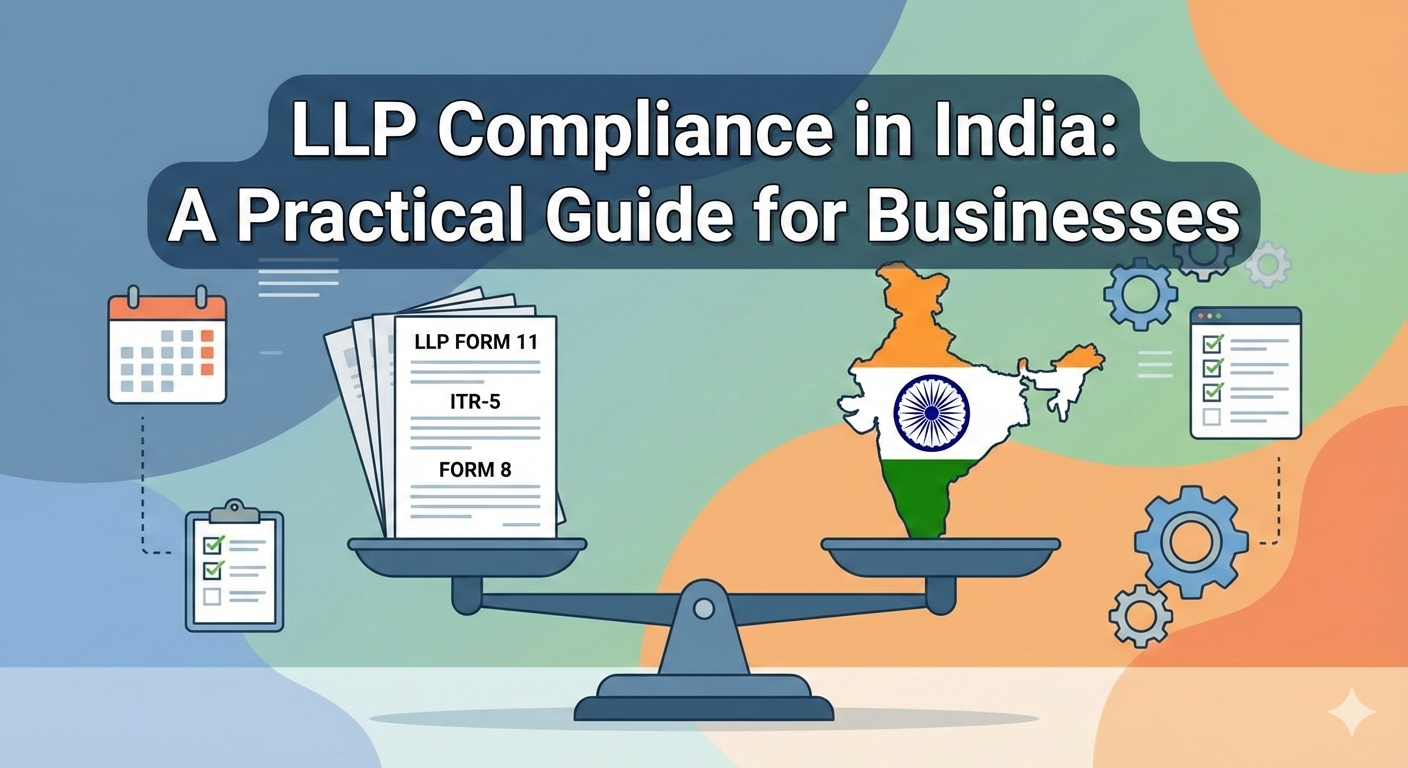
LLP Compliance in India: A Complete Guide for Businesses
For Indian small enterprises and entrepreneurs, the LLP model has become standard. It has become the preferred form for contemporary service providers and expanding businesses since it combines the advantages of a partnership with the security of a corporation. ". The Limited Liability Partnership structure gives founders both the security of restricted liability and the flexibility of a partnership. "Founders frequently speed through the Limited Liability Partnership creation process only to be caught off guard by the ensuing red tape. It's a typical rookie error. Although the Ministry has made it simple to get started, going radio silence on your filings has made it even simpler to accrue fines. To keep your legal shield intact, you have to be proactive.
'Good enough' compliance is nonexistent in the Indian Limited Liability Partnership industry; you're either on top of it or in trouble." The LLP framework requires a particular type of discipline, even though it is praised for having less red tape. There is a trade-off. In addition to securing its "Active" status, a corporation can protect itself against accumulating penalties that can silently drain a startup by closely adhering to both the Limited Liability Partnership Act and Indian tax rules. Consistent compliance ultimately serves as a trust-building exercise for future stakeholders rather than a legal burden.
Understanding the Importance of Limited Liability Partnership (LLP) Compliance
In reality, compliance is a reliable method; it is not a burdensome one. It is your best defence against a legal nightmare, even if it may seem like a pointless administrative burden. Here's the thing: investors do their research. Compliance isn't. Consider your Ministry of Corporate Affairs past as a background check for your business. You've essentially reached a brick wall with the financial penalties and incomplete job. Investors will walk away from that administrative mess because they perceive it as an indication of careless leadership. Even if you have the greatest technology in India, your presentation will be over before you've finished your slides if your compliance is a complete mess. Your growth measurements become irrelevant at that moment. There are more benefits to updating your data on a regular basis than avoiding penalties.-To those who are most important to your development, it yells openness and dependability. You run the risk of complete operational collapse if you disregard the paperwork. You're looking at more than simply delayed results; you're looking at partners being kicked out and the government effectively ruining your business. When it comes to defunct businesses, the MCA has no tolerance. You are suffocating your business if you are at the top of the deadlines. You are killing your business if you don't perform such things on time or on the right day.
Post-Incorporation Compliance Requirements
The first step in rising is incorporation. Form 3 comes next. You have precisely thirty days to register that LLP Agreement; else, you would be subject to the Registrar's regulations rather than your own. This is more than just documentation; it is the only thing that formally safeguards your partner obligations and profit-sharing arrangements. Ignoring this filing is a rookie error that exposes your internal setup to the small print of the Act. Additionally, the LLP needs to obtain a duty deduction and collection account number (TAN) and an infinite account number (visage). These are necessary for banking operations and duty compliance.
Getting a bank account in the Limited Liability Partnership name is the first step. It's the only way to maintain financial transparency and satisfy the tax collector. Step two: pay attention to your numbers. You must register for GST and begin filing the appropriate paperwork if your revenue exceeds the GST threshold. Once you reach that certain threshold, GST requires a change in your business practices.
Registrar of Companies Compliance on an Annual Basis
Regardless of whether it has done business during the fiscal year, every limited liability partnership (LLP) in India must submit two essential forms to the Ministry of Corporate Affairs.
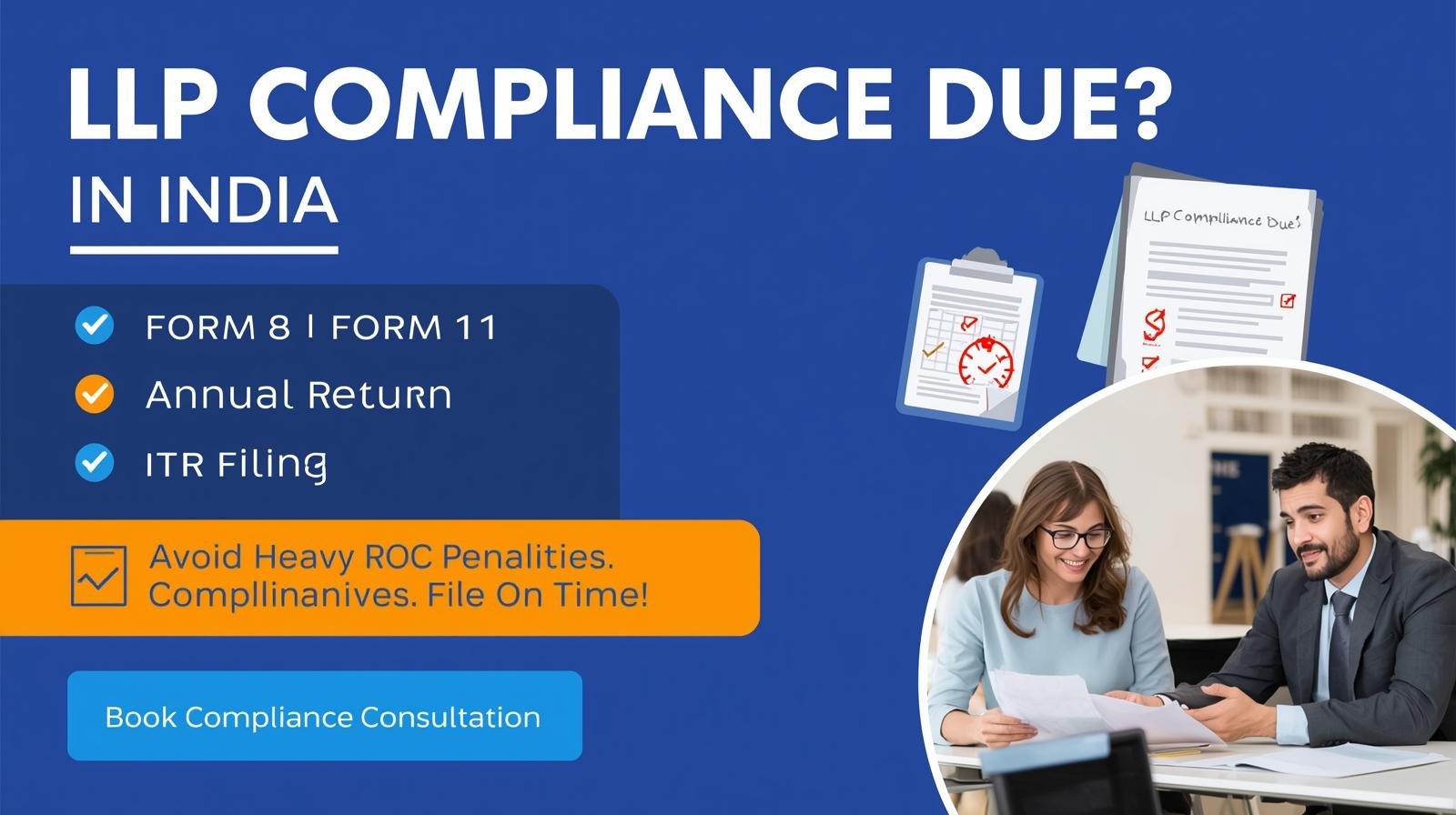
Form 11: Annual Report
The management structure and partner data of the Limited Liability Partnership are fully summarised in Form 11, the annual return. It must be submitted no later than sixty days after the fiscal year ends, usually by May 30 of each year. This form contains information about the overall number of partners, the total amount of allowance received, and any significant management changes or replacement’s that occurred during the year.No sales? No income? It make no difference. Form Eleven is still required to be submitted. You cannot simply skip the MCA because you and your business had a bad year. That form must be entered if the thing appears to be alive on paper. For a period.
Statement of Accounts and Solvency Form 8 must be completed
By October 30th, usually 30 days after the fiscal year closes, Form 8 must be completed. A statement of profitability and the LLP's financial records are included in this form.
Because there is a penalty of ₹100 per day, with no maximum limit, for not filing these documents on time, it is imperative that you do so. Ignoring compliance could cause financial tasks to increase quickly.
Compliance with Income Tax for LLPs
LLPs must break income duty laws, and Ministry of Corporate Affairs forms must be incomplete. LLPs are considered separate legal entities for tax purposes and must file an income tax return.
The income duty return must be submitted by July 31 of the assessment period, albeit, if the LLP's development falls below the inspection level. However, September 30 is the deadline, providing all goes as planned.
Conditions of a Tax Audit
If an LLP development surpasses ₹40 lakh or its capital gift exceeds ₹25 lakh, it must undergo a duty inspection. If an LLP's duty is over the designated level, they must also misbehave with regard to advance duty payment’s in addition to income duty. According to the Income Tax Act, delays in duty payment may result in interest and penalties.
Preservation of the books of accounts
Every LLP must have accurate books of accounts that accurately depict its financial situation. Information on income, charges, means, arrears, and capital benefactions should all be included in these document’s. The books must be kept up to date at the designated office and preserved for the allotted time.
The responsibilities of the designated partner
At least two designated mates are required for an LLP, and at least one of them needs to reside in India. Ensuring that the LLP conforms with all legal and nonsupervisory requirement’s is the responsibility of designated mates.
Each designated partner with a Director Identification Number is required to fulfil KYC requirements on a regular basis. The noise may be deactivated if KYC is not completed, which would impact the LLP's form capabilities.
Event-Based Obligations
LLPs are required to submit periodic paperwork as well as to disclose specific changes as they occur. These consist of
• A mate's admission or abdication
• The office address that is listed has changed.
• Modification to the LLP Contract
• A shift in capital contributions
• The LLP name has changed.
Within the allotted period, each of these occurrences must be reported to the Registrar using the appropriate forms. Detentions may result in fines and legal issues.
Repercussions for Non-Compliance
Serious counteraccusations may result from failure to comply with LLP regulations. Piecemeal from daily late freight’s, patient neglect can result in designated mates being executed. In severe circumstances, the LLP may be dissolved by the Registrar starting strike-off procedures.
The LLP's capacity to obtain loans, draw in investors, or participate in government tenders may also be impacted by noncompliance. A poor compliance record raises questions about governance standards and fiscal restraint.
Conclusion
In India, LLP compliance is a continuous duty that necessitates focus, self-control, and prompt legal action. The LLP structure has statutory scores that cannot be disregarded, even if it provides minimal liability benefits and practical inflexibility. In addition to avoiding fines, companies that put compliance first gain credibility, financial transparency, and long-term stability.
An LLP can run smoothly and focus on expansion without facing legal obstacles if it keeps accurate record’s, files periodic returns on schedule, complete’s duty scores, and covers nonsupervisory updates. Proactively managing compliance turns it from a nonsupervisory burden into a basis for long-term success.
© 2026 Tax Esquire | Expert CA Services in Greater Noida, Uttar Pradesh
8810380146 | info.taxesquire@gmail.com | taxesquire.in
This document is for informational purposes only. For personalised tax advice, consult our chartered accountants.