Auditing Requirements of Private Limited Company in India
Introduction
Audit compliance is one of the most critical legal obligations for companies registered in India. Under the Companies Act, 2013, every private limited company is required to maintain proper books of accounts and get them audited annually by a qualified Chartered Accountant.
Unlike sole proprietorship’s or partnership’s, where audit’s applicability depends on turnover, companies are mandatorily subject to statutory audit regardless of size’s, revenue’s, or operational activity. Even dormant companies must comply.
Why Audit Compliance Matters:
● Ensures true and fair view of financial statement’s
● Protect’s stakeholder interests (investors, banks, government)
● Detect’s fraud, mismanagement, and financial irregularities
● Strengthens corporate governance and transparency
In today’s regulatory environment, audit is not just compliance it is a business credibility tool.
What is a Company Audit?
A company audit is an independent and systematic examination of financial’s statement’s, accounting record’s, and internal control’s of a business.
It is conducted by an independent CA who expresses an opinion on whether the financial statements present a true and fair view of the company’s financial position.
Key Components of an Audit:
● Verification of book’s of account’s
● Examination of supporting document’s
● Evaluation of internal controls
● Compliance check with applicable laws
Types of Audit Opinions:
● Unqualified Opinion → Clean report (no issues)
● Qualified Opinion → Minor issues found
● Adverse Opinion → Financials are misleading
● Disclaimer → Auditor unable to form opinion
Types of Audits Applicable to Private Limited Companies
Private limited companies in India may be subject to multiple audits depending on their size, turnover, and nature of operations.
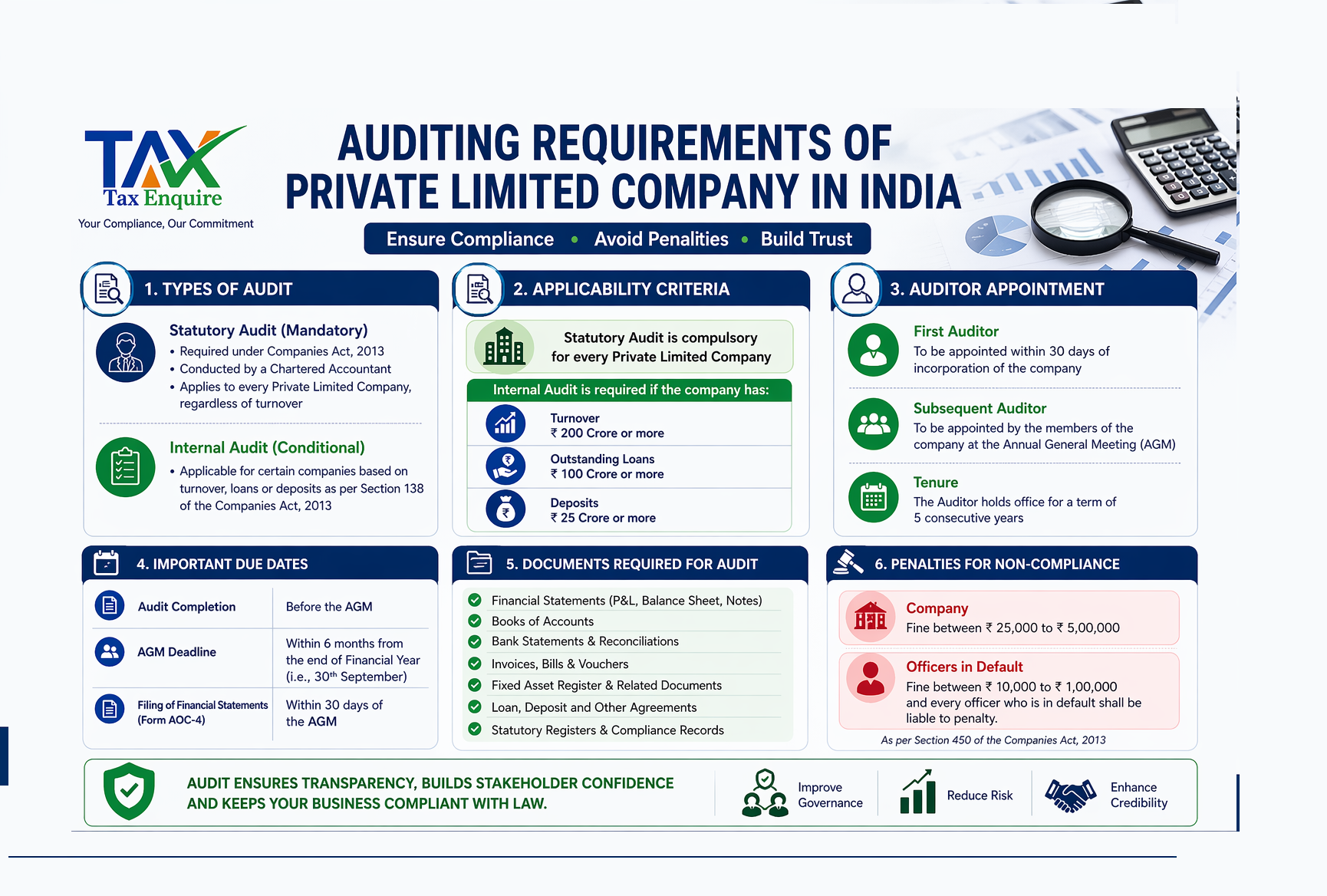
1. Statutory Audit (Mandatory for All Companies)
● Conducted under the Companies Act
● Applies to every private limited company
● Auditor examines financial statements and issues a report
2. Tax Audit
Conducted under the Income Tax Act, 1961.
Applicability (FY 2025-26):
● Business turnover exceeding prescribed limits
● Professionals exceeding specified receipts
Ensures proper reporting of income and compliance with tax provisions.
3. Internal Audit
Applicable to certain classes of companies based on:
● Turnover
● Paid-up share capital
● Outstanding loans
Purpose:
● Improve internal control systems
● Identify operational inefficiencies
● Reduce financial risks
4. Cost Audit
Applicable to companies engaged in specified industries like:
● Manufacturing
● Telecom
● Energy
Focuses on cost records and cost efficiency.
5. GST Audit (Practical Perspective)
While GST audit provisions have evolved, businesses may still undergo:
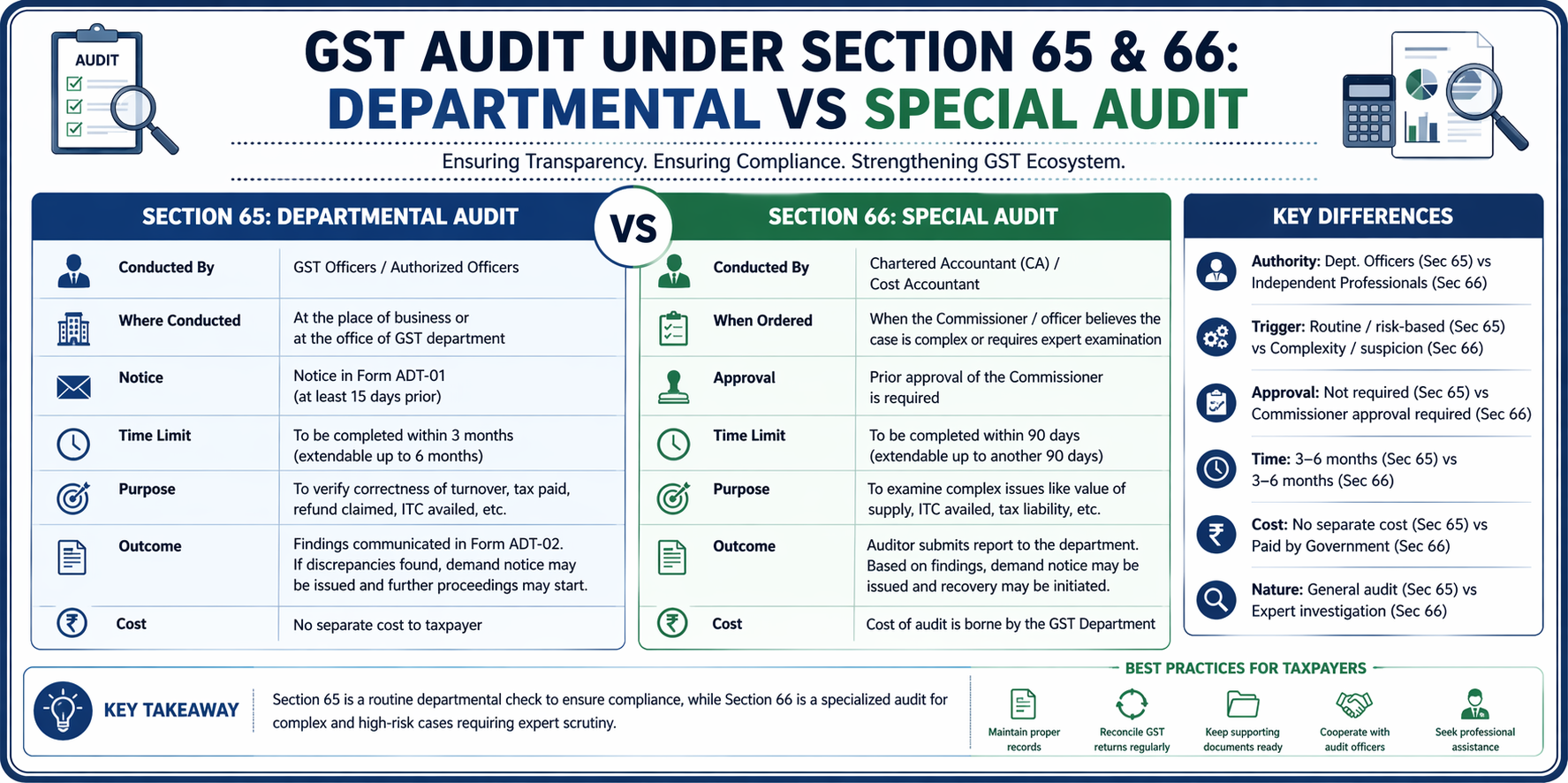
● Departmental audits
● Special audits
Applicability of Audit for Private Limited Companies
Core Rule:
Every private limited company must undergo statutory audit compulsorily, even if:
● There is no turnover
● The company is inactive or dormant
Additional Threshold-Based Audits:
|
Audit Type |
Applicability |
|
Statutory Audit |
Mandatory for all companies |
|
Tax Audit |
Based on turnover limits |
|
Internal Audit |
Based on size thresholds |
|
Cost Audit |
Industry-specific |
Important Insight:
Many businesses assume that “no business = no
audit.”
This is incorrect under company law.
Appointment of Auditor
The appointment of an auditor is governed by strict provisions:
First Auditor:
● Appointed by the Board of Directors within 30 days of incorporation
● If not appointed, shareholders must appoint within 90 days
Subsequent Auditor:
● Appointed at the Annual General Meeting (AGM)
● Holds office for up to 5 years
ROC Compliance:
● Filing of ADT-1 for auditor appointment
Rotation of Auditor:
Applicable to certain companies to ensure independence.
Consequences of Non-Appointment:
● Penalties on company and officers
● Government may appoint auditor
Audit Process & Timeline
Understanding the audit process helps businesses stay prepared.
Step-by-Step Audit Process:
- Appointment of auditor
- Preparation of financial statements
- Submission of books and records
- Audit planning and risk assessment
- Verification and testing
- Draft audit findings
- Final audit report issuance
Timeline:
● Financial Year: 1 April – 31 March
● Audit Completion: Before AGM
● AGM Deadline: Usually 30 September
ROC Compliance & Filing Requirements
After audit completion, companies must file documents with ROC.
Key Forms:
● AOC-4 → Financial statements
● MGT-7 / MGT-7A → Annual return
Due Dates:
● AOC-4: Within 30 days of AGM
● MGT-7: Within 60 days of AGM
Additional Fees:
Late filing results in heavy per-day penalties, which can accumulate significantly.
Documents Required for Company Audit
Proper documentation is the backbone of a successful audit.
Financial Statements:
● Balance Sheet
● Profit & Loss Account
● Cash Flow Statement
Supporting Documents:
● Bank statements
● Purchase & sales invoices
● Expense bills and vouchers
● GST returns (GSTR-1, GSTR-3B)
● Income tax returns
Statutory Records:
● Register of members
● Board meeting minutes
● Shareholding records
Benefits of Conducting Audit
Audit offers both legal and strategic benefits:
Key Benefits:
● Ensure’s compliance with law’s
● Build’s investor confidence
● Helps in securing loans and funding
● Detect’s fraud and errors early
● Improves internal financial discipline
Penalties for Non-Compliance
Failure to comply with audit requirements can lead to severe consequences:
Penalties Include:
● Fines on company and directors
● Additional ROC fees
● Disqualification of directors
● Legal proceedings
● Example:
Delay in ROC filing can lead to ₹100 per day penalty, with no maximum cap in certain cases.
Common Mistakes to Avoid
Major Errors:
● Not appointing auditor on time
● Missing ROC filing deadlines
● Poor bookkeeping practices
● Ignoring compliance updates
● Lack of audit planning
Conclusion
Audit compliance is not just a statutory requirement it is a foundation of financial integrity and business success. Every private limited company must treat audits as a strategic function, not just a yearly obligation.
By maintaining proper records, appointing auditors on time, and ensuring timely filing’s, businesses can avoid penalties and build a strong, credible financial reputation.