Higher Rates of TDS & TCS for Non-Filers – Why Timely ITR Filing Is Now Compulsory
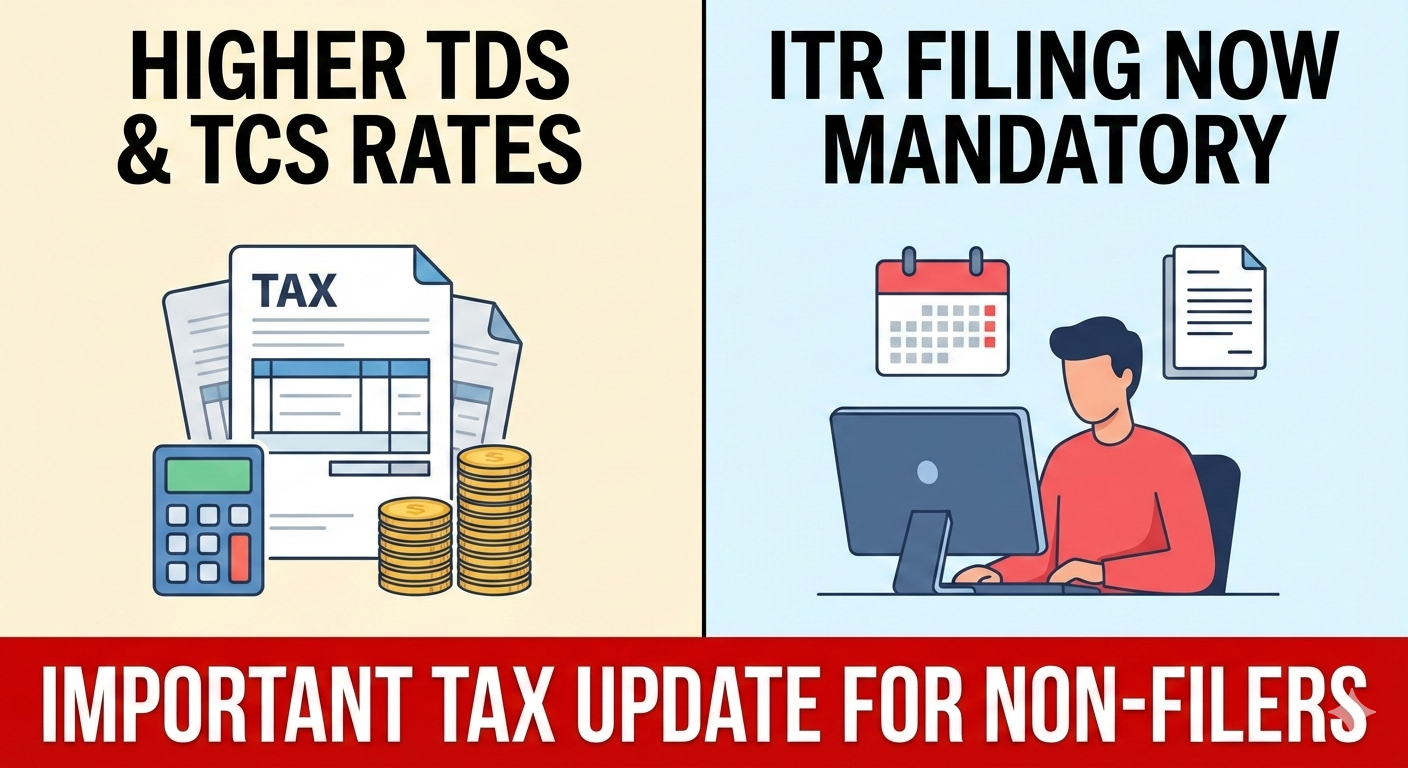
The Income Tax Department is becoming strict with those who do not file their Income Tax Returns (ITR) on time. One of the biggest changes is higher rates of TDS (Tax Deducted at Source) and TCS (Tax Collected at Source) for “specified persons” who are non-filers of ITR. These provisions mainly operate through Section 206AB (for TDS) and Section 206CCA (for TCS) of the Income Tax Act.
For individuals and businesses, this means that if you don’t file your ITR regularly, more tax will be deducted/collected upfront, which directly affects your cash flow. As a professional tax & business advisory firm, Tax Esquire Corporate Advisors helps you stay compliant and avoid these higher rates legally and smartly.
Who Is Treated as a “Non-Filer” or Specified Person?
The concept of higher TDS/TCS does not apply to every person who misses just one return. The law defines “specified person” broadly as:
-
A person who has not filed ITR for the relevant previous year(s) as prescribed, and
-
Has aggregate TDS + TCS of ₹50,000 or more in that year.
However:
-
Non-residents without a permanent establishment in India are generally excluded.
-
These provisions are mainly targeted at people/entities who have substantial transactions, but still do not file returns.
In practice, when a payer (deductor/collector) is making a payment subject to TDS/TCS, they must check on the income tax portal (compliance utility / PAN status) whether the PAN belongs to a specified person or not. If yes, higher TDS/TCS rates apply automatically.
Section 206AB – Higher TDS Rate for Non-Filers
Section 206AB mandates deduction of TDS at a higher rate where the payee is a specified person. The applicable TDS rate will be the highest of the following:
-
Twice the rate specified in the relevant TDS provision, or
-
Twice the rate or rates in force, or
-
5% (minimum floor in many cases).
Example (illustrative):
-
Normal TDS rate on professional fees (Section 194J) = 10%
-
If the payee is a non-filer (specified person under Section 206AB), then:
-
Twice of 10% = 20%
-
Twice the rate in force – usually same
-
5% (comparatively lower)
-
So, TDS @ 20% may be required instead of 10%.
This substantially reduces net payment received by the payee and blocks working capital. Though the payee may claim refund later while filing delayed ITR, the financial impact and cash blockage for several months can be huge.
Also note: Section 206AB does not apply in some specific TDS sections like salary (Section 192), lottery winnings, horse race income, cash withdrawals under 194N (where separate higher rate rule exists), etc. But for many common sections like 194C (contract), 194J
(professional fees), 194H (commission), 194A (interest) etc., it can apply.
Section 206CCA – Higher TCS Rate for Non-Filers
Similarly, Section 206CCA imposes higher TCS where the buyer/collectee is a specified person. Here also, the TCS rate will be the highest of:
-
Twice the rate specified under the relevant TCS provision, or
-
5%.
Illustration:
-
TCS on sale of goods under Section 206C(1H) normally = 0.1% (above threshold).
-
If the buyer is a non-filer specified person:
-
Twice of 0.1% = 0.2%
-
Minimum 5% is much higher, so 5% applies in many cases.
-
So instead of nominal TCS @ 0.1%, the seller may have to collect TCS @ 5%, drastically increasing the upfront tax cost for the buyer.
This makes purchases expensive for non-filers and encourages them to regularise their tax filing status.
Impact on Businesses, Professionals and High-Value Individuals
-
Higher upfront tax outflow
-
-
If you are a non-filer and your clients or payers detect you as a specified person, they are legally bound to deduct/collect higher TDS/TCS.
-
This immediately reduces your take-home amount from every invoice or transaction.
-
-
Cash flow and working capital pressure
-
-
Even though extra TDS/TCS is adjustable at the time of filing ITR, the refund process takes time.
-
For businesses with tight margins, this can cause working capital stress and make vendor payments, EMIs, salaries, etc., more difficult.
-
-
Compliance burden on deductors/collectors
-
-
Companies, firms and even individuals responsible for deducting TDS or collecting TCS must check PAN status and ITR filing status.
-
If they don’t deduct at higher rates when required, the Income Tax Department can treat them as assessee-in-default, along with interest and penalty exposure.
-
-
Reputational and relationship issues
-
-
When clients or customers realise you are marked as non-filer, it can affect your credibility.
-
Many large corporates prefer dealing only with fully compliant vendors.
-
Why the Government Introduced Higher TDS & TCS for Non-Filers
The main intention behind these sections is to widen the tax base and improve voluntary compliance. Key motives:
-
To identify persons with high financial transactions but no tax returns.
-
To ensure such persons either file timely ITR or face higher tax cost on every transaction.
-
To create a data trail so that non-compliant entities can no longer remain invisible to the system.
Instead of conducting raids on everyone, the government now uses data analytics, AIS/TIS, TDS & TCS information to monitor financial behaviour. Higher rates act as a built-in enforcement tool.
How Tax Esquire Helps You Avoid Higher TDS & TCS
At Tax Esquire Corporate Advisors, we focus on preventive tax planning and full compliance, so that you never fall into the “specified person / non-filer” category. We assist you in:
-
Timely ITR filing for Individuals, Firms, LLPs, Companies, and Trusts.
-
Monitoring your TDS/TCS credits and AIS/TIS reports to ensure consistency with your books.
-
Advising on correct PAN linking and status so that deductors don’t wrongly apply higher rates.
Year-round compliance support for GST, TDS returns, advance tax, and other statutory filings.
If you are already facing higher TDS or TCS deductions, we help you:
-
File pending ITRs and regularise your status.
-
Claim refunds or set-off of excess TDS return filing in a structured way. Represent your case in notices, mismatches, or departmental queries related to these sections.
Simple Tips to Stay Safe from Higher Rates
-
Always file your ITR on time, even if your income is below taxable limit but your TDS/TCS is substantial.
-
Reconcile Form 26AS, AIS & TIS with your ledger and bank statements regularly.
-
Ensure your PAN is active, linked with Aadhaar and correctly updated with banks, clients, and vendors.
-
Keep a professional CA firm like Tax Esquire to manage your year-round compliance instead of rushing at the last moment.
Conclusion
Higher TDS and TCS rates for non-filers are not just legal provisions – they are a strong warning from the tax system: if you are doing business or high-value transactions in India, regular tax filing is non-negotiable.
© 2026 Tax Esquire | Expert CA Services in Greater Noida, Uttar Pradesh
8810380146 | info.taxesquire@gmail.com | taxesquire.in
This document is for informational purposes only. For personalised tax advice, consult our chartered accountants.