IGST on Imports & Customs Assessment: No Parallel GST Proceedings – AP High Court 2026
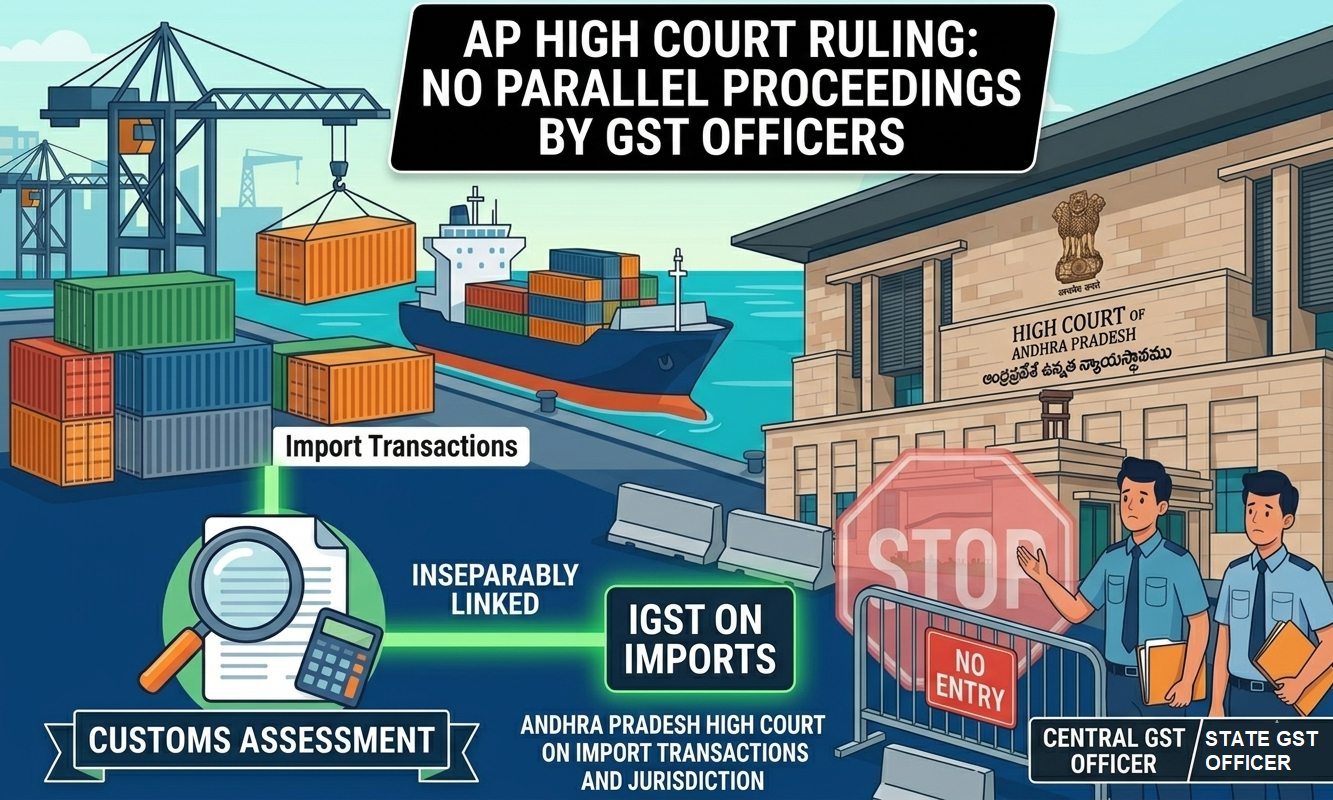
07.04.2026: IGST on imports is inseparably Liked with Customs Assessment, GST Officers whether Central or State cannot Initiate Parallel Proceedings in Respect of Import Transactions: Andhra Pradesh High Court
In this instance, the petitioner claimed exemption from IGST on a variety of inputs that were imported during the assessment years of 2017–18 and 2022–2023. The Central GST jurisdiction was administratively allocated to the petitioner. Nevertheless, the State Tax authorities disputed exemption claims and the classification of imported goods after conducting an examination and issuing an intimation under Section 73(5) of the CGST Act. A second notification, akin to a show-cause notice, was then sent out, bringing up other points not addressed in the first notification.
Feeling wronged, the petitioner filed a writ suit contesting:
● The authority of State GST authorities to start IGST-related import procedures
● The legality of Circular No. 80/54/2018-GST, which purportedly limited exemption advantages. Additionally, the petitioner cited the fact that Customs officials had already started legal action and issued an order acknowledging the validity of some imported items for exemption.
Issue:
Is it within the authority of state GST authorities to determine and collect IGST on imported goods? If the taxpayer is assigned to Central jurisdiction, can cross-empowerment under GST legislation allow State officers to start proceedings under the IGST Act?
Held that:
First, the Court noted that IGST on imported products is paid and collected in line with Section 3 of the Customs Tariff Act at the point of import, citing the provision to Section 5(1) of the IGST Act. This makes it abundantly evident that the Customs Act and Customs Tariff Act regulate the entire process of assessment, classification, valuation, and exemption pertaining to imported products, including IGST. The Customs Act's Section 2(2) definition of assessment further emphasises that customs authorities have the authority to decide any tax (including IGST) that must be paid on imported goods in addition to customs duty.
The Court further ruled that Section 28 of the Customs Act offers a comprehensive code for recovering unpaid or underpaid duties and taxes, including import-related IGST. Therefore, GST officials cannot usurp the authority of Customs authorities to assess and reclaim IGST on imports.
Regarding cross-empowerment, the Court also made it clear that certain clauses, such Section 6 of the CGST/APGST Acts and Section 4 of the IGST Act, only allow it under specific conditions and subject to taxpayer administrative allocation. The State GST officer was unable to take over jurisdiction since the petitioner was given Central jurisdiction. As a result, the department's request for cross-empowerment was denied.
According to established principles, the court decided that a writ petition is admissible even at the notice stage when a show cause notice is issued without jurisdiction. The Court further stated that the authorities could not rely on the contested circular because it had already been overturned by another High Court.