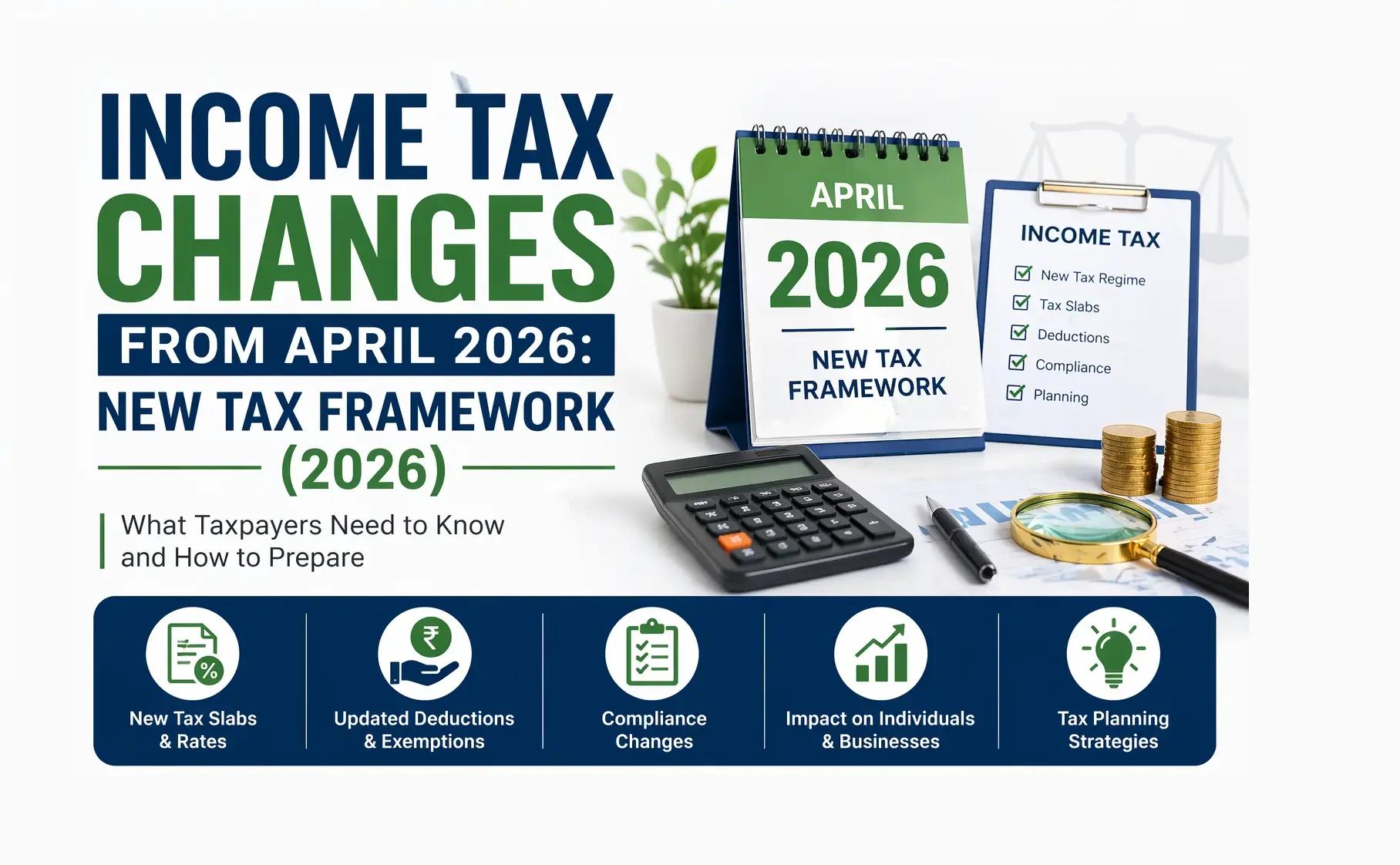
Income Tax Changes from April 2026 New Tax Framework
Introduction
India is set to witness one of the most significant overhauls in its taxation system with the implementation of new income tax provisions effective April 1, 2026. These changes are aligned with the proposed Income Tax Act, 2025, which aims to modernize and simplify the current tax structure.
For decades, taxpayers have navigated a system filled with multiple deductions, exemptions, and complex compliance requirements. The upcoming reforms seek to eliminate these complications and introduce a simpler, more transparent, and technology-driven framework.
This guide provides a comprehensive understanding of the key changes, their implications, and how taxpayers can prepare effectively.
Background: Income Tax Act, 2025
The Income Tax Act, 1961 has been the backbone of India’s tax system for over six decades. However, with evolving economic conditions, digital transformation, and increasing taxpayer base, the need for a modernized legal framework became essential.
The proposed Income Tax Act, 2025 is designed to:
● Replace outdated provisions with simplified language
● Reduce interpretational disputes and litigation
● Align taxation with global best practices
● Integrate technology into compliance and monitoring
A key philosophy behind this reform is to shift from a complex, exemption-driven system to a streamlined, rate-based structure that is easier to understand and implement.
Major Highlights of Income Tax Changes (2026)
The 2026 tax reforms introduce several structural and functional changes:
● Single “Tax Year” Concept replacing FY & AY
● Increased reliance on the new tax regime
● Rationalization of tax slabs for better equity
● Gradual removal or limitation of deductions
● Stronger use of data analytics and AI in tax administration
● Faster processing of returns and refunds
These reforms are aimed at creating a taxpayer-friendly ecosystem that encourages voluntary compliance.
New Tax Regime vs Old Tax Regime
The coexistence of two tax regimes has been a key feature in recent years. However, the 2026 framework strongly favors the new regime.
Key Differences:
|
Aspect |
Old Tax Regime |
New Tax Regime (2026) |
|
Tax Rates |
Higher |
Lower |
|
Deductions |
Extensive |
Minimal |
|
Compliance |
Complex |
Simplified |
|
Suitability |
High investors |
General taxpayers |
Which One Should You Choose?
● If you rely heavily on deductions (like investments, insurance, loans), the old regime may still be beneficial.
● If you prefer simplicity and lower tax rates, the new regime is more suitable.
The government’s long-term goal is to make the new regime the default system.
Revised Income Tax Slabs for FY 2026-27
The revised tax slabs are expected to provide balanced relief across income groups, especially for middle-income taxpayers.
Expected Features:
● Higher basic exemption threshold
● Smoother progression of tax rates
● Reduced marginal tax burden
This restructuring ensures that taxpayers pay fair taxes without excessive complexity, encouraging more individuals to enter the tax system.
Changes in Deductions and Exemptions
One of the most transformative aspects of the reform is the reduction in deductions and exemptions.
Key Developments:
● Many traditional deductions may be removed or limited
● Tax-saving instruments will lose prominence
● Standard deduction may continue in a simplified form
Impact:
● Tax planning strategies will shift significantly
● Focus will move from saving tax to managing income efficiently
This marks a fundamental change in how taxpayers approach financial planning.
New Income Tax Rules 2026: Key Updates and Changes
The New Income Tax Rules 2026 are set to take effect from 1 April 2026, marking a major update to the existing tax framework that has been in place for many years. These revised rules have been issued by the Central Board of Direct Taxes (CBDT) to align with the proposed Income Tax Act and to modernize various provisions.
The updated rules introduce higher exemption limits, revised valuation norms for perquisites, and improved reporting requirements. Overall, the objective is to bring the tax system in line with current economic realities and reduce outdated thresholds that no longer reflect actual costs.
Key Highlights of the New Rules
● Significant increase in allowance limits for employees
● Updated valuation of perquisites such as car benefits
● Higher tax-free thresholds for certain benefits
● Relaxation in conditions for medical treatment abroad
● Improved clarity in reporting and compliance
These revisions aim to make taxation more practical and aligned with present-day expenses.
Major Changes in Allowances and Perquisites (2026 vs Old Rules)
|
Particulars |
Earlier Limit |
Revised Limit (2026) |
|
Children Education Allowance |
₹100 per month per child |
₹3,000 per month per child |
|
Hostel Allowance |
₹300 per month per child |
₹9,000 per month per child |
|
Free Meals |
₹50 per meal |
₹200 per meal |
|
Non-Cash Gifts |
₹5,000 per year |
₹15,000 per year |
These changes reflect a substantial increase, bringing relief to salaried individuals by aligning exemptions with current cost levels.
Changes in Car Perquisite Valuation
For Cars with Engine Capacity Below 1.6 Litres
● Earlier: ₹1,800 (perquisite) + ₹900 (driver)
● Now: ₹5,000 (perquisite) + ₹3,000 (driver)
For Cars with Engine Capacity Above 1.6 Litres
● Earlier: ₹2,400 (perquisite) + ₹900 (driver)
● Now: ₹7,000 (perquisite) + ₹3,000 (driver)
Introduction of the ‘Tax Year’ Concept
The new system introduces a “Tax Year”, replacing the traditional Financial Year (FY) and Assessment Year (AY).
Why This Matters:
● Eliminates confusion between earning year and assessment year
● Simplifies return filing for individuals and businesses
● Aligns India’s system with international standards
This
change alone significantly improves clarity and ease of compliance.
Changes in TDS and TCS Provisions
Tax Deducted at Source (TDS) and Tax Collected at Source (TCS) mechanisms are being refined to improve efficiency.
Key Updates:
● Rationalized rates to reduce inconsistencies
● Revised thresholds for applicability
● Enhanced reporting for better tracking
Impact:
● Improved tax collection at the source
● Reduced chances of tax evasion
● Greater accountability in financial transactions
Capital Gains Tax Changes
The taxation of capital gains is expected to become more uniform and predictable.
Major Reforms:
● Simplified classification of capital assets
● Standardized holding periods
● Rationalized tax rates across asset classes
Impact on Investors:
● Easier understanding of tax implications
● Reduced ambiguity in calculations
● Improved investment decision-making
Impact on Different Taxpayers
1. Salaried Individuals
Salaried taxpayers will benefit from:
● Lower tax rates under the new regime
● Simplified salary structures
● Reduced paperwork
However, the removal of deductions may increase taxable income for some individuals.
2. Business Owners & Professionals
Businesses and professionals will experience:
● Streamlined compliance requirements
● Improved clarity in tax provisions
● Integration with digital systems
They will need to adapt to new reporting formats and compliance standards.
3. Investors
Investors will benefit from:
● Simplified capital gains taxation
● Transparent rules
● Reduced compliance burden
This
promotes a more stable and predictable investment environment.
Compliance & Filing Changes
The new framework emphasizes automation and digital compliance.
Key Features:
● Pre-filled income tax returns
● Faster refund processing
● Real-time data verification
● AI-driven scrutiny
These
changes aim to reduce manual errors and make compliance faster and more
accurate.
Benefits of the New Tax Framework
● Simplified tax structure
● Reduced litigation and disputes
● Increased transparency
● Faster processing timelines
● Better user experience
Overall, the system becomes more efficient and
taxpayer-friendly.
Challenges & Concerns
Despite the benefits, certain challenges remain
:
● Reduced flexibility due to fewer deductions
● Adjustment period for taxpayers
● Need to re-evaluate financial strategies
Taxpayers must proactively adapt to avoid potential disadvantages.
Practical Examples & Tax Comparison
Scenario Comparison:
Old Regime:
● Income: ₹12,00,000
● Deductions: ₹2,50,000
● Taxable Income: ₹9,50,000
New Regime:
● Income: ₹12,00,000
● Minimal deductions
● Lower tax rates apply
What Taxpayers Should Do Now
Action Plan:
● Evaluate both tax regimes carefully
● Reassess tax-saving investments
● Maintain proper financial records
● Use tax calculators and professional advice
● Stay updated with official notifications
Early planning ensures maximum tax efficiency and compliance.
Conclusion
The income tax reforms effective from April 2026 represent a paradigm shift in India’s taxation approach. By focusing on simplification, transparency, and efficiency, the government aims to create a system that is easier to understand and comply with. While the reduction in deductions may initially seem restrictive, the overall framework offers long-term benefits through lower tax rates and simplified processes.Taxpayers who proactively adapt to these changes will be better positioned to optimize their tax liability and ensure smooth compliance.
© 2026 Tax Esquire | Expert CA Services in Greater Noida, Uttar Pradesh
8810380146 | info.taxesquire@gmail.com | taxesquire.in
This document is for informational purposes only. For personalised tax advice, consult our chartered accountants.