Long-Term Capital Gains (LTCG)
Introduced
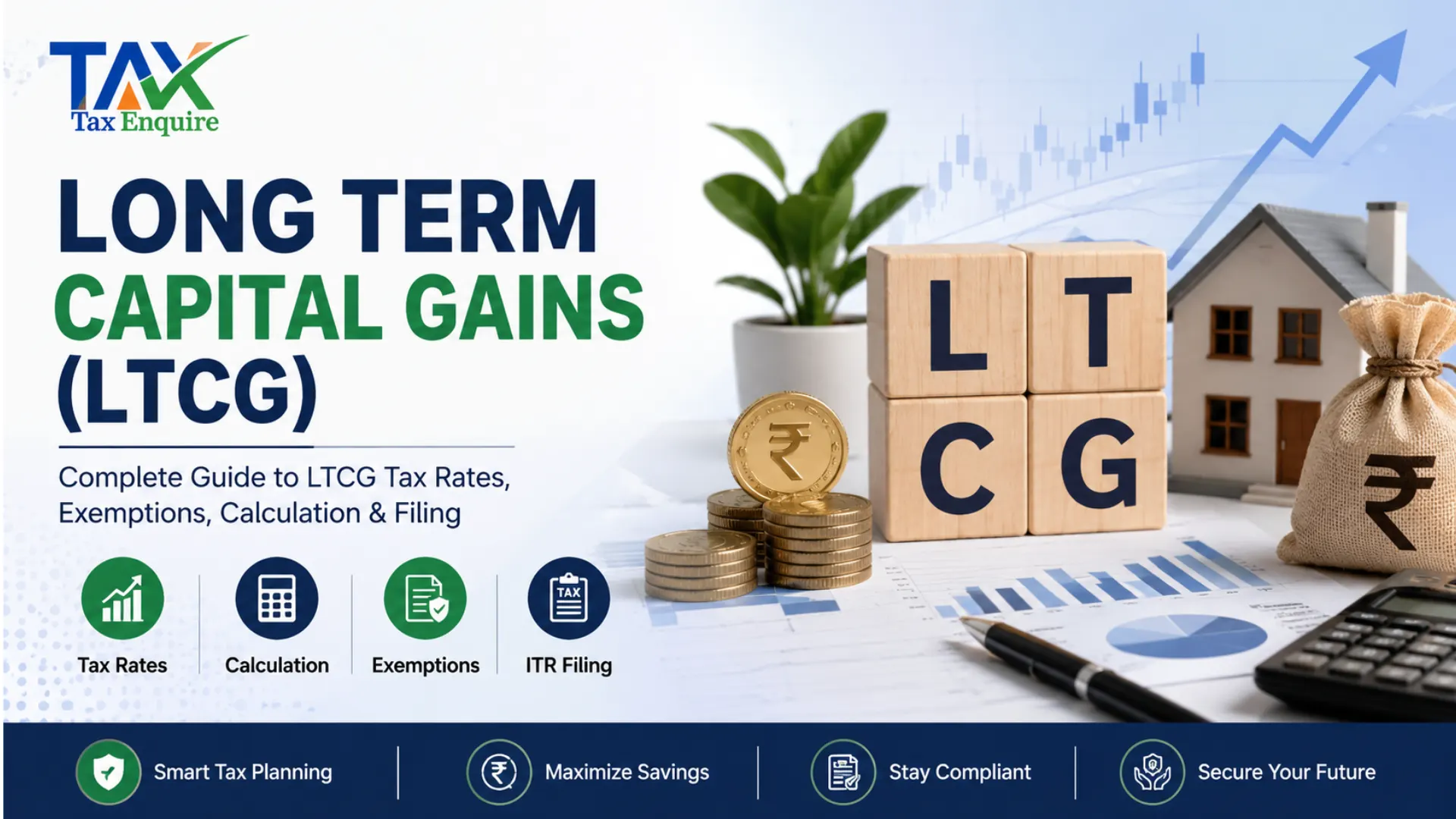
Long Term Capital Gains (LTCG) arise when a taxpayer earns profit from the sale of a capital asset held for a specified period. Capital assets may include shares, mutual funds, property, gold, bonds, and other investments. The Income Tax Act taxes such gains at special rates depending on the nature of the asset. Understanding LTCG tax is important for proper tax planning, claiming exemptions, and filing income tax returns correctly.
What is Specified LTCG holding period and rates?
Long Term Capital Gain refers to the profit earned from selling a capital asset after holding it for more than the prescribed holding period. The holding period differs based on the type of asset.
Common Holding Periods for LTCG
If the asset is sold before the specified period, the gain is treated as Short Term Capital Gain (STCG). Long Term Capital Gain (LTCG) Tax Rate The tax rate on LTCG depends upon the nature of the asset sold. NOTE: If you bought the property before July 23, 2024, you’ve got a choice: you can go with the new 12.5% rate without indexation or stick to the older 20% rate with indexation. Exemptions on Long-Term Capital Gain Tax The Income Tax Act provides various exemptions to help taxpayers reduce or completely save Long-Term Capital Gains (LTCG) tax. These exemptions are available when the taxpayer reinvests the capital gains or sale proceeds in specified assets such as residential property or government-approved bonds. Taxpayers can claim these exemptions by satisfying the prescribed conditions under different sections of the Income Tax Act. Major LTCG Exemptions Available 1. Section 54 Section 54 exemption is available when an individual or HUF sells a residential property and reinvests the capital gains in another residential house property. Conditions for Claiming Section 54 The asset sold must be a long-term residential property The new house must be purchased within 1 year before or 2 years after sale Construction of new house must be completed within 3 years Exemption is limited to the amount invested 2. Section 54EC Section 54EC provides exemption when LTCG from land or building is invested in specified government bonds. Eligible Bonds under Section 54EC National Highways Authority of India (NHAI) Bonds Rural Electrification Corporation (REC) Bonds Important Conditions Investment must be made within 6 months from transfer date Maximum investment allowed is ₹50 lakh Bonds carry a lock-in period 3. Section 54F Section 54F applies when LTCG arises from the sale of assets other than residential property and the sale proceeds are invested in a residential house. Conditions for Section 54F Taxpayer should not own more than the prescribed number of residential properties Entire net consideration should be invested for full exemption Partial investment results in proportionate exemption 4. Section 112A Section 112A provides relief for LTCG arising from listed equity shares and equity-oriented mutual funds. Key Highlights Applicable on listed equity shares and equity mutual funds Tax applies only when LTCG exceeds the prescribed exemption limit Securities Transaction Tax (STT) conditions must be fulfilled Indexation Benefits Indexation adjusts the purchase price of an asset based on inflation using the Cost Inflation Index (CII). It helps reduce taxable capital gains. Benefits of Indexation Reduces tax liability Adjusts inflation impact Useful for property, gold, and debt assets Increases acquisition cost for tax purposes Long Term Capital Gain Tax Exemptions Indexation helps taxpayers adjust the purchase cost of an asset based on inflation. This reduces the taxable Long-Term Capital Gain (LTCG) and lowers the overall tax liability. Example of LTCG Calculation with Indexation Mr. Sharma purchased a residential property in FY 2012-13 for ₹20 lakh and sold it in FY 2025-26 for ₹70 lakh. Property Details Example LTCG with Indexation MR.X bought a house in 2005 for Rs. 20 lakhs. He sold it in August 2025 for Rs. 65 lakhs. Now he has an option of choosing the tax rate of 12.5% without indexation or 20% with indexation. The Cost Inflation Index (CII) for 2005-06 is 117 and for 2025-26 is 376. The Long-Term Capital Gains will be calculated as follows: As indexation benefit has been considered in the above example, the tax on said transfer will be applicable at the rate of 20%. Example LTCG Without Indexation Mr.X bought a house in 2005 for Rs. 20 lakhs. He sold it in August 2025 for Rs. 65 lakhs. The Long-Term Capital Gains without indexation will be calculated as follows: Since the indexation benefit has not been availed, the capital gain of Rs. 45,00,000 will be taxed at 12.5%. Capital Gains Accounts Scheme The Capital Gains Accounts Scheme (CGAS) allows taxpayers to temporarily deposit capital gains before utilizing them for eligible investments or property purchase. Features of CGAS Helps claim exemption under Sections 54, 54B, 54D, 54F, etc. Deposit must be made before ITR filing due date Available through authorized banks LTCG Tax on Specific Assets 1. LTCG Tax on Shares LTCG on listed equity shares and equity-oriented mutual funds is taxable under Section 112A. Key Points Applicable after 12 months holding period Gains above prescribed exemption limit are taxable Tax rate is 12.5% 2. LTCG Tax on Property Sale of immovable property after 24 months results in LTCG. Key Points Taxed at 20% with indexation Exemptions available under Sections 54 and 54EC Stamp duty valuation may apply in some cases How to fill Long Term Capital Gain in ITR-2? Taxpayers must report LTCG details in Schedule CG of ITR-2. Steps to Report LTCG Select Schedule Capital Gains Enter asset sale details Mention purchase and sale value Claim exemption details if applicable Verify tax computation Proper disclosure helps avoid notices and penalties. Section 112A- LTCG Tax on Equity Section 112A governs taxation of LTCG arising from equity shares and equity-oriented mutual funds. Applicability of Section 112A Listed equity shares Equity mutual funds Units of business trusts Tax Rate Under Section 112A LTCG exceeding exemption limit is taxable at 12.5% STT payment condition must be satisfied LTCG Exemptions under Section 54 Section 54 exemption is available when LTCG from residential property is invested in another residential house property. Conditions Applicable to individuals and HUFs New property must be purchased or constructed within prescribed time Exemption amount depends on reinvestment value Exemption under Section 54EC Section 54EC allows exemption when LTCG is invested in specified bonds. Eligible Bonds REC Bonds NHAI Bonds Important Conditions Investment within 6 months Maximum investment limit applies Lock-in period applicable Exemption under Section 54F Section 54F applies when LTCG from assets other than residential property is invested in a residential house. Conditions for Section 54F Entire sale consideration should be invested Taxpayer should satisfy ownership conditions Exemption may be proportionately reduced Capital Gains Account Scheme (CGAS) CGAS helps taxpayers park unutilized capital gains until they are used for eligible reinvestments. Types of Accounts Type A – Savings Deposit Type B – Term Deposit Failure to utilize the deposited amount within prescribed time may make it taxable. Set-Off and Carry Forward of Capital Losses Capital losses can be adjusted against eligible capital gains. Set-Off Rules Long-term capital loss can only be adjusted against LTCG Short-term capital loss can be adjusted against both STCG and LTCG Carry Forward Rules Losses can be carried forward for 8 assessment years Return must be filed within due date Budget 2024 Changes in LTCG Tax Budget 2024 introduced important amendments in LTCG taxation. Key Changes Revised tax rates for certain capital assets Changes in indexation benefits for selected transactions Updates in taxation of listed and unlisted assets Rationalization of capital gains provisions Taxpayers should carefully evaluate the new rules before planning investments and asset sales. Conclusion Understanding Long-Term Capital Gains (LTCG) tax is essential for effective tax planning and better investment management. From knowing the applicable tax rates and calculation methods to utilizing indexation benefits and claiming exemptions under Sections 54, 54EC, 54F, and 112A, every aspect plays an important role in reducing tax liability legally. Taxpayers should also be aware of reporting LTCG correctly in ITR-2, using the Capital Gains Account Scheme (CGAS) when required, and understanding the rules for set-off and carry forward of capital losses. Proper planning can help maximize tax savings while ensuring compliance with the Income Tax Act. Author: CA POONAM GUPTA & ADV LOKESH GUPTA
© 2026 Tax Esquire | Expert CA Services in Greater Noida, Uttar Pradesh
8810380146 | info.taxesquire@gmail.com | taxesquire.in
This document is for informational purposes only. For personalised tax advice, consult our chartered accountants.