
New TDS And TCS Changes Applicable from FY 2026-27
Introduction
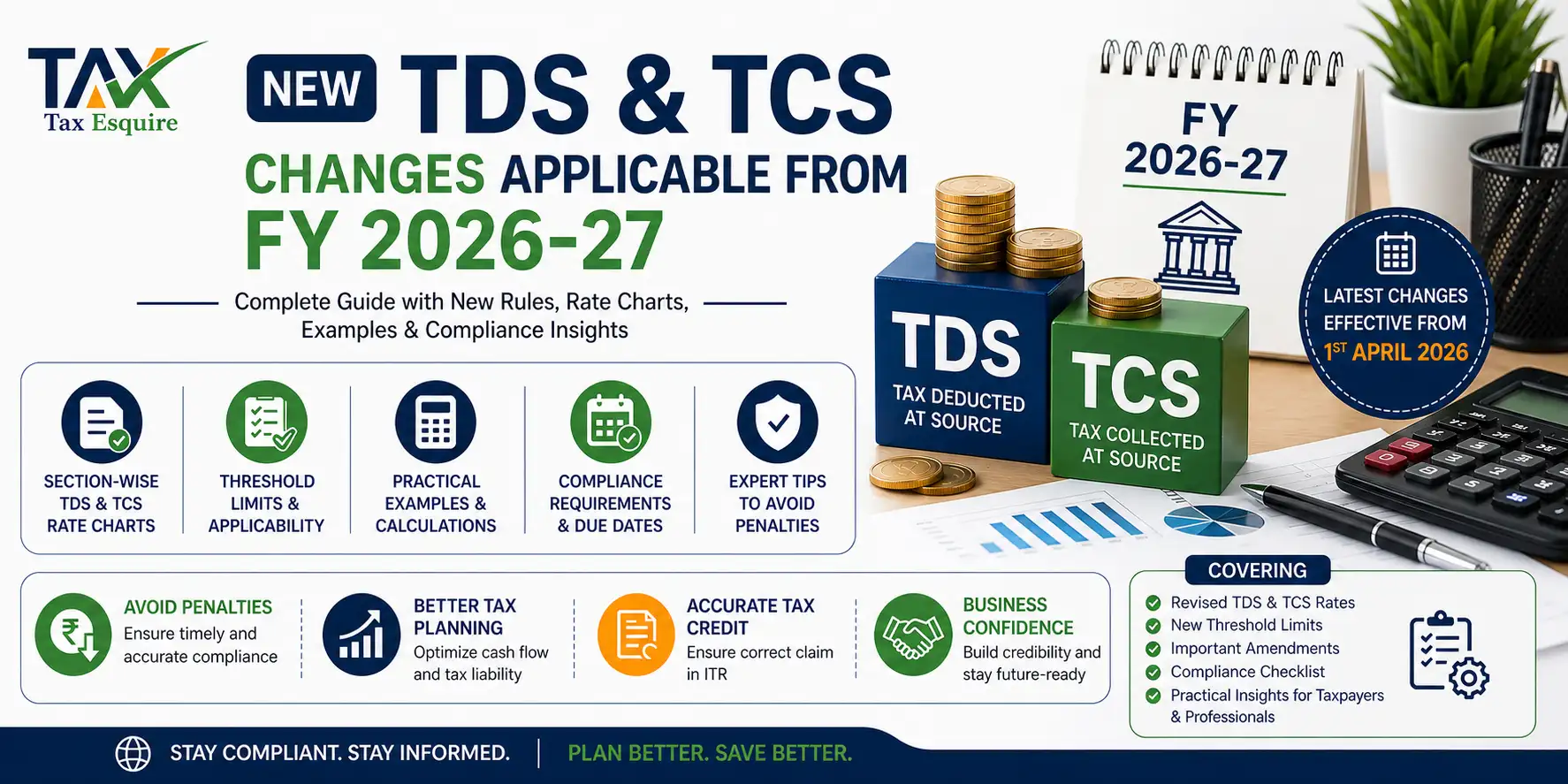
Tax Deducted at Source (TDS) and Tax Collected at Source (TCS) are foundational pillars of India’s direct tax system. These mechanisms ensure real-time tax collection, reduce tax evasion, and improve financial transparency across the economy.
With the introduction of revised provisions aligned with the Income Tax Act, 2025, effective from April 1, 2026, there are important updates in rates, thresholds, compliance procedures, and reporting standards.
This comprehensive guide is designed for businesses, professionals, accountants, and taxpayers, offering a complete understanding of TDS & TCS rates for FY 2026–27, along with practical insights and expert guidance.
What is TDS (Tax Deducted at Source)?
TDS is a mechanism where tax is deducted at the time of making specified payments such as salary, interest, rent, commission, or professional fees. The deducted tax is then deposited with the government.
Key Characteristics:
Deducted before payment is made
Applicable on income generation stage
Responsibility lies with the payer (deductor)
Credit is reflected in the recipient’s Form 26AS
Purpose of TDS:
Ensures steady revenue flow for the government
Minimizes tax evasion
Distributes tax burden throughout the year
What is TCS (Tax Collected at Source)?
TCS is the tax collected by the seller from the buyer at the time of sale of specified goods or transactions.
Key Characteristics:
Collected at the time of sale
Applicable on specified goods/services
Responsibility lies with the seller (collector)
Common Transactions Covered:
Sale of scrap, minerals
Sale of goods exceeding threshold
Foreign remittances (LRS)
Overseas tour packages
Purpose of TCS:
Tracks high-value transactions
Expands tax base
Improves transaction transparency
Key Changes in TDS & TCS from April 2026
The financial year 2026–27 introduces structural refinements aimed at simplification and digitization:
Major Updates:
Rationalization of threshold limits
Simplification of rate structures
Integration with AI-based compliance systems
Enhanced reporting & reconciliation requirements
Stricter penalties for defaults and delays
Impact:
Increased compliance for businesses
Improved transparency in transactions
Reduced ambiguity in tax deduction rules
TDS Rate Chart for FY 2026–27 (Section-wise)
Below is a simplified yet comprehensive overview:
Important Notes:
Higher rate applies if PAN is not available (Section 206AA)
Special rates apply for non-residents
Surcharge and cess may apply where relevant
TCS Rate Chart for FY 2026–27
Key Highlights:
Higher rates may apply in non-filing cases (Section 206CCA)
TCS credit can be claimed by the buyer during ITR filing
TDS Threshold Limits for FY 2026–27
Threshold limits determine when TDS becomes applicable.
Key Insights:
No TDS if payment is below prescribed limit
Limits apply per transaction or annually, depending on section
Aggregation rules may apply
Example:
If contractor payment is:
₹25,000 → No TDS
₹35,000 → TDS applicable
TCS Threshold Limits & Applicability
Applicability Rules:
Triggered when sales exceed specified threshold
Seller must collect tax at time of receipt
Example:
If total sales exceed ₹50 lakh:
TCS @0.1% applies on amount exceeding ₹50 lakh
Major Sections Covered (Important Provisions Explained)
Understanding the key sections under TDS and TCS is crucial because each section applies to a specific type of transaction, and incorrect classification can lead to penalties or disallowances.
Section 192 – TDS on Salary
This section governs TDS on salary payments made by an employer to an employee.
Key Features:
TDS is calculated based on applicable income tax slab rates
Employer must consider:
Employee’s total income
Deductions (80C, 80D, HRA, etc.)
Chosen tax regime (old vs new)
Important Points:
No fixed TDS rate — depends on income level
Adjustments allowed during the year
Employer is responsible for accurate computation
Practical Insight: Incorrect estimation may result in short deduction, leading to interest liability
Section 194C – TDS on Contractor Payments
Applies to payments made to contractors or subcontractors for carrying out any work.
Applicable Work Includes:
Construction
Manufacturing (with material supplied by client)
Transport services
Labour contracts
Rates:
1% → Individual/HUF contractor
2% → Others
Threshold:
₹30,000 per transaction OR
₹1,00,000 annually
Practical Insight: Even a small recurring payment can trigger TDS once the annual limit is crossed.
Section 194J – TDS on Professional Fees
This section applies to payments made for professional or technical services.
Covered Professionals:
Chartered Accountants
Doctors
Lawyers
Architects
Consultants
Rate: Generally 10%
Threshold: ₹30,000 per year
Practical Insight: Misclassification between 194C and 194J is one of the most common errors in practice.
Section 194H – Commission or Brokerage
Applicable to commission payments (excluding insurance commission).
Examples:
Sales commission
Brokerage fees
Referral incentives
Rate: 5%
Practical Insight: Businesses often forget to deduct TDS on indirect commissions, leading to compliance issues.
Section 194I – TDS on Rent
Applies to rent payments for land, building, machinery, or equipment.
Rate:
10% for land/building
2% for plant & machinery
Threshold:
₹2,40,000 annually
Practical Insight: Even office rent or warehouse rent falls under this section.
Section 194Q – TDS on Purchase of Goods
Introduced to track high-value business transactions.
Applicability:
Buyer turnover > ₹10 crore
Purchase value > ₹50 lakh
Rate:
0.1%
Practical Insight: Overlaps with TCS (Section 206C(1H)), but TDS takes precedence.
Section 206C – TCS Provisions
Covers tax collection on sale of specified goods and transactions.
Includes:
Scrap, minerals
Sale of goods
Foreign remittances
Overseas tour packages
Rates:
0.1% to 20% depending on transaction
Practical Insight: TCS ensures tracking of high-value and international transactions.
Practical Examples of TDS & TCS Calculation
Example 1: Contractor Payment
Invoice: ₹1,00,000
TDS @1% = ₹1,000
Net Payment = ₹99,000
Example 2: Professional Fees
Invoice: ₹50,000
TDS @10% = ₹5,000
Net Payment = ₹45,000
Example 3: TCS on Sale of Goods
Total Sales: ₹70 lakh
Threshold: ₹50 lakh
Taxable Amount = ₹20 lakh
TCS @0.1% = ₹2,000
Compliance Requirements & Due Dates
TDS Compliance:
Deposit: 7th of next month
Returns: Quarterly (Form 24Q, 26Q)
TCS Compliance:
Monthly deposit
Quarterly returns
Penalties:
Interest under Section 201
Late fee under Section 234E
Disallowance under Section 40(a)(ia)
Common Mistakes to Avoid
Incorrect section selection
Applying wrong rates
Ignoring threshold limits
Delay in deposit or return filing
PAN mismatch errors
Even small errors can lead to notices and penalties.
Impact on Businesses & Professionals
Businesses:
Increased compliance burden
Need for automation tools
Professionals:
Greater advisory role
Increased demand for tax expertise
Startups & SMEs:
Cash flow impact due to deductions
Need for accurate tracking systems
Benefits of Understanding TDS/TCS Properly
A strong understanding of TDS and TCS is not just about compliance—it directly impacts financial efficiency, risk management, and business credibility.
1. Avoidance of Interest, Penalties & Legal Notices
Non-compliance can result in:
Interest under Section 201
Late fees under Section 234E
Penalties and prosecution in extreme cases
Proper understanding ensures zero-default compliance.
2. Accurate Claim of Tax Credit
TDS/TCS is reflected in Form 26AS and AIS.
Benefit:
Prevents mismatch in tax credit
Avoids refund delays
Incorrect reporting can block your legitimate tax refunds.
3. Improved Cash Flow Management
TDS/TCS directly impacts liquidity.
Example:
Higher deduction → Lower immediate cash inflow
Benefit: Helps businesses plan working capital efficiently
4. Better Financial Planning & Forecasting
When you understand deductions:
You can estimate net income accurately
Plan investments and expenses accordingly
Essential for budgeting and long-term planning.
5. Reduced Risk During Tax Scrutiny & Audits
Proper compliance ensures:
Clean financial records
Smooth audits
Lower chances of scrutiny notices
This builds credibility with tax authorities.
6. Seamless Vendor & Client Relationships
Incorrect TDS/TCS handling can cause:
Disputes with vendors
Payment mismatches
Benefit:
Smooth reconciliation
Strong professional relationships
7. Strategic Tax Optimization Opportunities
Understanding provisions allows:
Correct structuring of transactions
Avoidance of unnecessary tax deductions
Helps in legally optimizing tax liability.
Expert Tips for FY 2026–27
Reconcile books with Form 26AS regularly
Use automated accounting software
Track threshold limits carefully
Maintain proper documentation
Stay updated with amendments
Why Professional Assistance is Recommended
Handling TDS/TCS can be complex due to multiple sections, rates, and compliance rules.
Benefits of Expert Support:
Accurate classification of transactions
Timely compliance and filing
Reduced risk of penalties
Strategic tax planning
End-to-end support
Especially important for businesses with high transaction volumes.
Conclusion
TDS and TCS are critical tools for ensuring transparency and efficiency in the taxation system. With the changes introduced from April 2026, understanding the latest rates, thresholds, and compliance requirements is essential for every taxpayer and business.
A proactive approach, supported by proper knowledge and expert guidance, can help ensure smooth compliance, avoid penalties, and optimize financial management.
© 2026 Tax Esquire | Expert CA Services in Greater Noida, Uttar Pradesh
8810380146 | info.taxesquire@gmail.com | taxesquire.in
This document is for informational purposes only. For personalised tax advice, consult our chartered accountants.