
What is Concept of Tax Year in the New Income Tax Act, 2025
Introduction
India’s taxation framework is set for a major transformation with the proposed Income Tax Act, 2025. One of the most significant reforms is the introduction of the Tax Year, replacing the long-standing and often confusing concepts of Financial Year (FY) and Assessment Year (AY).
For decades, taxpayers in India have followed a dual-year system where income is earned in one year and taxed in another. While administratively functional, this structure has frequently led to confusion, especially among individuals, small businesses, and new taxpayers.
The new system aims to simplify this approach by introducing a single, unified timeline making tax compliance more intuitive, transparent, and aligned with global practices.
What is a Tax Year?
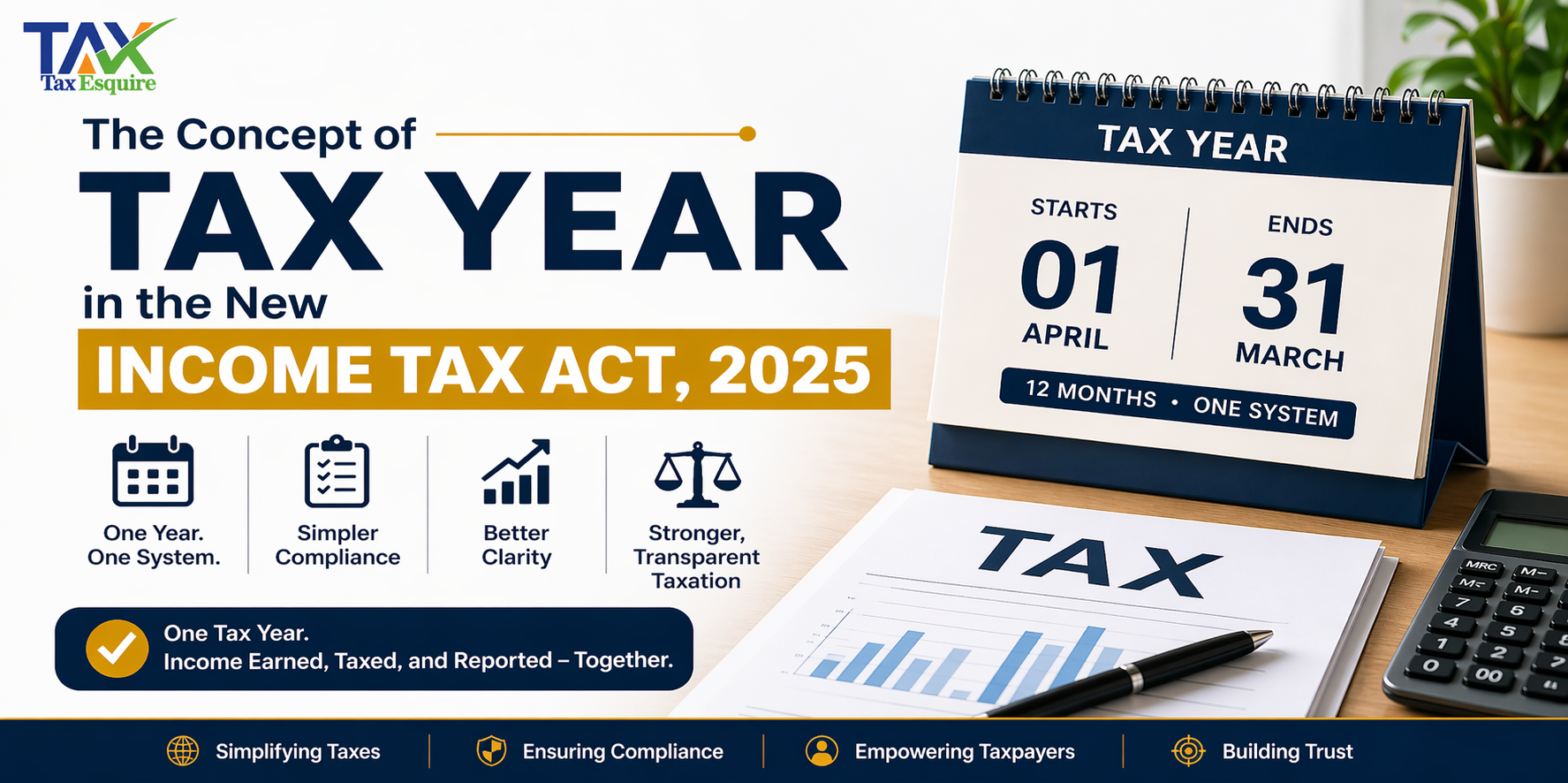
Under the proposed law, a Tax Year refers to a 12-month period during which income is earned and taxed within the same timeframe.
Key Features of Tax Year:
Begins on 1st April
Ends on 31st March
Covers income earning, reporting, and taxation together
In simple terms: Income earned during a year is taxed for that same year—no separate assessment period.
This eliminates the need to differentiate between when income is earned and when it is assessed, making the system far easier to understand and follow.
Financial Year vs Assessment Year vs Tax Year
To fully appreciate this reform, it is important to understand how the earlier system worked and how the new model improves it.
Old System: Financial Year (FY) & Assessment Year (AY)
Financial Year (FY) – Income Period
The Financial Year is the period in which income is earned.
Example: Income earned from 1 April 2024 to 31 March 2025 falls under FY 2024–25.
Assessment Year (AY) – Taxation Period
The Assessment Year is the following year in which:
Income is reported
Taxes are calculated
Returns are filed
Example: Income of FY 2024–25 is assessed in AY 2025–26.
Problem with the Old System
Two different terms for one income cycle
Frequent confusion while filing returns
Difficulty in understanding timelines
New System: Tax Year
The new law replaces this dual structure with a single concept — the Tax Year.
No separate Assessment Year
Income and taxation belong to the same period
Simplified compliance and reporting
Key Differences at a Glance
This shift removes the one-year gap and simplifies the entire taxation process.
Why Was the Tax Year Introduced?
The introduction of the Tax Year is not just a cosmetic change—it is a structural reform aimed at improving the tax ecosystem.
Key Reasons:
Simplification: Eliminates confusion between FY and AY
Ease of Compliance: Makes return filing more straightforward
Global Alignment: Matches international tax systems
Administrative Efficiency: Reduces duplication in records and communication
Overall, the goal is to make taxation more user-friendly and transparent.
Applicability of Tax Year (Who Will It Affect?)
The Tax Year framework applies broadly across all categories of taxpayers:
Individuals: Salaried employees and freelancers will find tax filing easier due to simplified timelines.
Businesses & Corporates: Companies will need to align accounting systems and compliance processes with the new structure.
Professionals & Startups: Consultants and startups benefit from reduced ambiguity and better clarity in reporting.
Non-Residents: Non-resident taxpayers will also follow the Tax Year, subject to specific provisions.
How the Tax Year Works in Practice
The functioning of the Tax Year is straightforward:
Income is earned between April 1 and March 31
Tax liability is calculated for the same period
Returns are filed for that same Tax Year
No need to track a separate “assessment year,” reducing errors and confusion.
Transition from Old System to New Tax Year
Moving from the FY–AY model to the Tax Year system requires a structured transition.
Key Transition Points:
Existing assessments under the old system will continue until completion
New filings will adopt the Tax Year concept
Transitional provisions may be introduced to avoid overlap
Taxpayers and professionals must stay updated with official notifications during this phase.
Impact on Taxpayers
Positive Impact
Clear and simple tax timelines
Reduced filing errors
Better understanding of tax obligations
Adjustment Areas
Learning new terminology
Updating financial habits and documentation
Overall, the reform is particularly beneficial for small and mid-level taxpayers.
Impact on Businesses & Professionals
Operational Impact
Updates in accounting and ERP systems
Changes in compliance documentation
Strategic Impact
Revised tax planning strategies
Alignment of audit and reporting cycles
Professional advisors will play a critical role in ensuring smooth adaptation.
Key Benefits of the Tax Year System
The Tax Year system offers several long-term advantages:
Clarity: Single timeline replaces dual concepts
Consistency: Uniform understanding across taxpayers
Efficiency: Streamlined compliance process
Global Compatibility: Aligns with international standards
This reform enhances the overall taxpayer experience.
Challenges & Criticism of the New System
Despite its advantages, certain challenges may arise:
Initial confusion during implementation
Need for software and system upgrade’s
Training requirements for professionals
Short-term compliance disruptions
The effectiveness of this reform will depend largely on smooth execution and awareness.
Expert Insights & Recommendations
Tax professionals suggest the following:
Stay updated with government notifications
Upgrade accounting and compliance systems
Educate teams and clients about the new concept
Plan taxes proactively under the new framework
Early preparation will ensure a smooth transition.
Conclusion
The introduction of the Tax Year under the Income Tax Act, 2025 marks a significant evolution in India’s tax system. By eliminating the long-standing distinction between Financial Year and Assessment Year, the government aims to simplify compliance and improve clarity for taxpayers.
While the transition phase may require some adjustment, the long-term benefits such as improved transparency, reduced complexity, and enhanced efficiency make this reform a forward-looking step in India’s tax landscape.
Author: CA POONAM GUPTA & ADV LOKESH GUPTA
© 2026 Tax Esquire | Expert CA Services in Greater Noida, Uttar Pradesh
8810380146 | info.taxesquire@gmail.com | taxesquire.in
This document is for informational purposes only. For personalised tax advice, consult our chartered accountants.