Salary Structuring to Save Maximum Tax
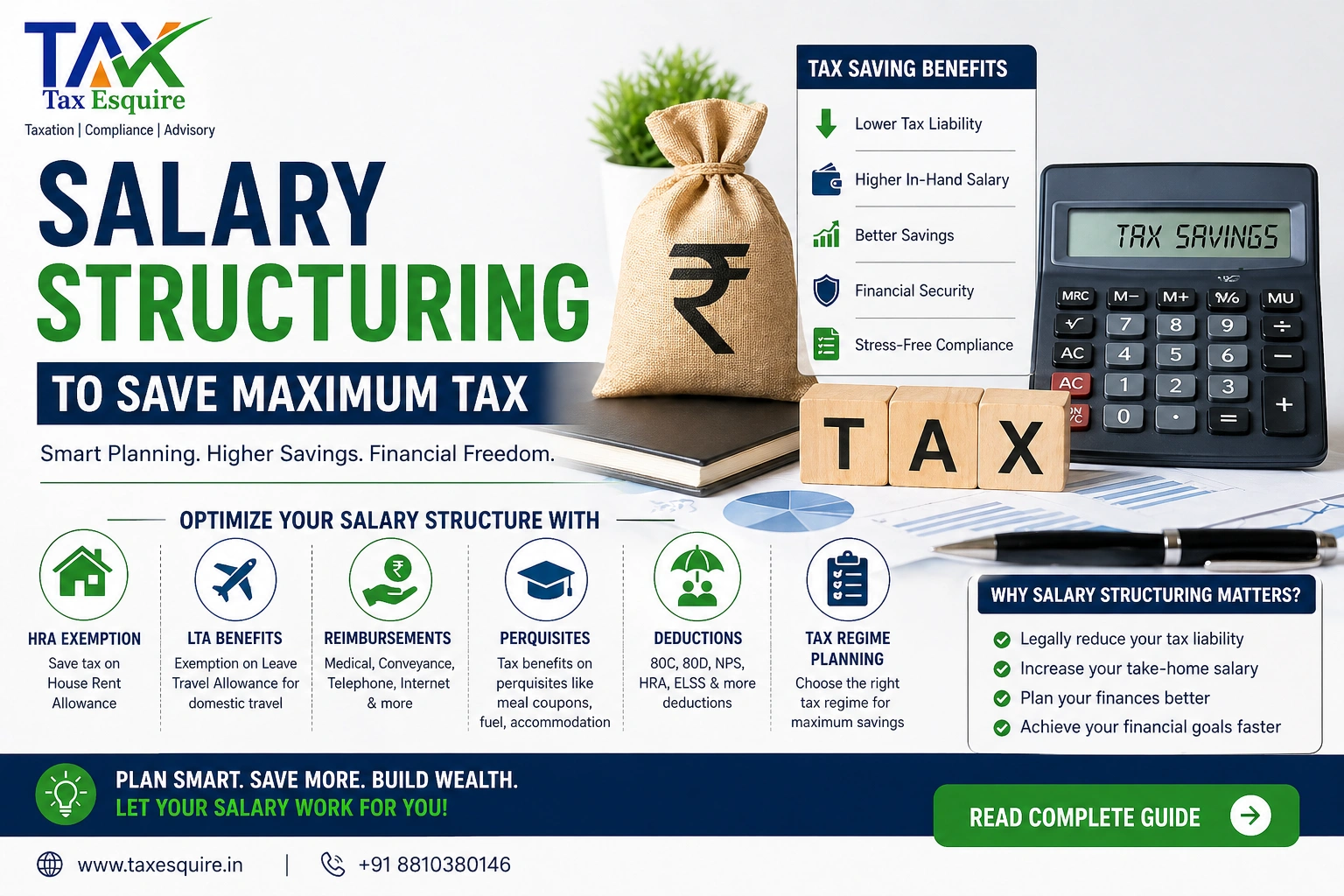
Salary structuring is a strategic way of designing your salary components to legally reduce tax liability while maximizing take-home income. Many salaried individuals focus only on deductions like Section 80C, but the real opportunity lies in how salary is broken into components such as allowances, reimbursements, and perquisites.
A well-structured salary ensures:
Lower taxable income
Efficient use of exemptions
Improved financial planning
Compliance with tax laws
In today’s evolving tax system, especially with the choice between old and new tax regimes, salary structuring has become more important than ever.
What is Salary Structure?
Salary structure is the detailed composition of your Cost to Company (CTC). It defines how your salary is divided into different heads, each having different tax implications.
Key Components:
Basic Salary – Core component, fully taxable
Allowances – HRA, LTA, special allowance, etc.
Perquisites – Non-cash benefits like car, accommodation
Reimbursements – Expenses reimbursed by employer
Retiral Benefits – PF, gratuity
Salary structure directly impacts:
Tax liability
Net take-home salary
Investment and savings potential
Why Salary Structuring is Important for Tax Saving
Without proper structuring, a large portion of your salary becomes taxable unnecessarily.
Importance:
Tax Optimization – Use exemptions effectively
Higher Take-Home Pay – Reduce unnecessary tax outflow
Better Financial Planning – Align salary with investments
Flexibility – Customize salary as per personal needs
Example: Two employees earning ₹20 lakh can pay different taxes depending on salary structure.
Taxability of Salary Components (Detailed Breakdown)
Understanding taxability helps identify which components to increase or reduce.
Fully Taxable Components:
Basic Salary
Dearness Allowance
Bonus & Incentives
Special Allowance
Partially Taxable Components:
HRA (based on exemption rules)
LTA (only for travel expenses)
Tax-Free / Conditional:
Reimbursements (if supported by bills)
Certain allowances within limits
The goal is to shift salary from fully taxable to partially/conditionally exempt components.
Key Salary Components to Optimize Tax
1. Basic Salary
Basic salary is the foundation of your pay and affects multiple calculations like PF, gratuity, and HRA.
Ideally kept between 40%–50% of CTC
Higher basic = higher tax liability
Lower basic = better flexibility but must comply with labor norms
2. House Rent Allowance (HRA)
HRA is one of the most effective tax-saving components.
Exemption is calculated as least of:
Actual HRA received
50% of salary (metro) / 40% (non-metro)
Rent paid – 10% of salary
Proper planning (rent agreement + receipts) can significantly reduce taxes.
3. Leave Travel Allowance (LTA)
Covers domestic travel expenses
Available for 2 journeys in a block of 4 years
Only travel cost (not hotel/food) is exempt
Requires actual travel proof and bills
4. Standard Deduction
Flat deduction of ₹50,000 (old regime)
Automatically reduces taxable salary
No documentation required
Simplifies tax calculation
5. Bonus & Incentives
Fully taxable
Paid as performance-linked income
Strategy: Keep the bonuses balanced or convert part into tax-efficient benefits
Tax-Saving Allowances You Should Include
Allowances can significantly reduce tax if structured properly.
Common Tax-Efficient Allowances:
Meal Coupons – Tax-free within limits
Telephone/Internet – Reimbursed against bills
Conveyance/Fuel – For official use
Uniform Allowance
Children Education Allowance
These reduce taxable income when supported by documentation
Perquisites & Reimbursements
Perquisites are benefits provided in addition to salary.
Examples:
Company car
Rent-free accommodation
Employer-paid insurance
Laptop/mobile
Reimbursements:
Medical bill’s
Travel expenses
Office-related costs
These are tax-efficient alternatives to direct salary
Deductions You Can Maximize Along with Salary Structuring
Even with structured salary, deductions play a major role.
Key Sections:
80C – Investments up to ₹1.5 lakh
80D – Health insurance premium
Section 24 – Home loan interest
80CCD(1B) – NPS additional ₹50,000
Combining deductions + structuring gives maximum tax benefit
Old vs New Tax Regime: Which is Better for Structured Salary?
Old Tax Regime:
Allows deductions and exemptions
Ideal for structured salary
New Tax Regime:
Lower tax rates
Minimal deductions allowed
If you actively use HRA, LTA, and deductions → Old regime is better
If you prefer simplicity → New regime
Ideal Tax-Efficient Salary Structure (Example)
Example: ₹20 Lakh CTC
Proper allocation reduces taxable income significantly
Common Mistakes in Salary Structuring
Ignoring tax-saving allowances
Keeping excessive basic salary
Not submitting proofs
Choosing wrong tax regime
Lack of planning at job offer stage
These mistakes can increase tax burden drastically
Tips to Negotiate Better Salary Structure with Employer
Negotiate during offer stage
Request flexible benefit plan (FBP)
Replace taxable salary with reimbursements
Ask HR for tax-efficient breakup
Employers are often open to restructuring if asked correctly
Benefits of Proper Salary Structuring
Salary structuring is not just a technical HR exercise, it is a powerful financial strategy that directly impacts your tax outflow, savings, and overall financial stability. When designed correctly, it helps salaried individuals optimize income without increasing salary.
Let’s understand each benefit in detail
1. Reduced Tax Liability
The biggest advantage of proper salary structuring is significant reduction in tax burden.
How it works:
Instead of receiving the entire salary as fully taxable income (like basic salary or special allowance), a portion is shifted to:
Exempt allowances (HRA, LTA)
Reimbursements (fuel, phone, internet)
Tax-efficient perquisites
Example: If ₹2,00,000 of your salary is structured as reimbursements and allowances instead of taxable income, your taxable income reduces by the same amount.
Result: Lower taxable income and Lower income tax payable. This is legal tax optimization, not tax evasion.
2. Increased Take-Home Salary
A well-structured salary directly improves your net in-hand income, even if your CTC remains the same.
Why this happens:
Lower tax deduction (TDS)
More income classified as non-taxable or partially taxable
Example: Two employees earning ₹15 lakh CTC:
Poor structure → Higher tax → Lower take-home
Smart structure → Lower tax → Higher take-home
Result: More money in your bank account every month, and Better lifestyle and spending flexibility
3. Better Investment Capacity
When your tax outflow is reduced and take-home increases, you automatically have more funds available for investment.
Impact on financial planning:
Ability to invest in ELSS, mutual funds, NPS
Higher contributions to retirement planning
Better wealth creation over time
Long-term effect: Even saving ₹10,000 extra per month can create lakhs of wealth over time due to compounding.
Result: Stronger financial future, and Faster achievement of goals (home, retirement, etc.)
4. Improved Cash Flow
Cash flow refers to how smoothly money move’s in and out of your finances. Proper salary structuring improves this significantly.
How it helps:
Reduces monthly TDS deductions
Provides reimbursements for regular expenses
Ensures consistent liquidity
Example: If your internet, fuel, or meal expenses are reimbursed, your personal spending burden reduces, improving monthly cash flow.
Result: Better monthly budgeting, less financial stress, and more liquidity for emergencies
5. Legal Compliance
Proper salary structuring ensures that all tax-saving benefits are claimed within the framework of income tax laws.
Why this is important:
Avoids penalties and tax notices
Ensures correct filing of Income Tax Return (ITR)
Maintains transparency with employer and tax authorities
Key compliance aspects:
Proper documentation (rent receipts, bills, proofs)
Correct declaration of exemptions
Alignment with tax regime rules
Result: Peace of mind, no legal complications, and smooth tax assessments.
It’s a long-term wealth-building strategy
Compliance & Documentation Requirements
To claim exemptions, proper documentation is mandatory:
Rent receipts for HRA
Travel tickets for LTA
Bills for reimbursements
Investment proofs
Form 16 verification
Non-compliance can lead to tax notices or disallowed claim’s
Conclusion
Salary structuring is one of the smartest ways to legally minimize taxes without increasing income. By balancing taxable and tax-efficient component’s, choosing the right tax regime, and maintaining proper documentation, salaried individuals can significantly improve their financial position.
The key is early planning, smart structuring, and disciplined compliance
Lower taxable income
Efficient use of exemptions
Improved financial planning
Compliance with tax laws
Basic Salary – Core component, fully taxable
Allowances – HRA, LTA, special allowance, etc.
Perquisites – Non-cash benefits like car, accommodation
Reimbursements – Expenses reimbursed by employer
Retiral Benefits – PF, gratuity
Tax liability
Net take-home salary
Investment and savings potential
Tax Optimization – Use exemptions effectively
Higher Take-Home Pay – Reduce unnecessary tax outflow
Better Financial Planning – Align salary with investments
Flexibility – Customize salary as per personal needs
Basic Salary
Dearness Allowance
Bonus & Incentives
Special Allowance
HRA (based on exemption rules)
LTA (only for travel expenses)
Reimbursements (if supported by bills)
Certain allowances within limits
Ideally kept between 40%–50% of CTC
Higher basic = higher tax liability
Lower basic = better flexibility but must comply with labor norms
Actual HRA received
50% of salary (metro) / 40% (non-metro)
Rent paid – 10% of salary
Covers domestic travel expenses
Available for 2 journeys in a block of 4 years
Only travel cost (not hotel/food) is exempt
Flat deduction of ₹50,000 (old regime)
Automatically reduces taxable salary
No documentation required
Fully taxable
Paid as performance-linked income
Meal Coupons – Tax-free within limits
Telephone/Internet – Reimbursed against bills
Conveyance/Fuel – For official use
Uniform Allowance
Children Education Allowance
Company car
Rent-free accommodation
Employer-paid insurance
Laptop/mobile
Medical bill’s
Travel expenses
Office-related costs
80C – Investments up to ₹1.5 lakh
80D – Health insurance premium
Section 24 – Home loan interest
80CCD(1B) – NPS additional ₹50,000
Allows deductions and exemptions
Ideal for structured salary
Lower tax rates
Minimal deductions allowed
If you prefer simplicity → New regime
Ignoring tax-saving allowances
Keeping excessive basic salary
Not submitting proofs
Choosing wrong tax regime
Lack of planning at job offer stage
Negotiate during offer stage
Request flexible benefit plan (FBP)
Replace taxable salary with reimbursements
Ask HR for tax-efficient breakup
Exempt allowances (HRA, LTA)
Reimbursements (fuel, phone, internet)
Tax-efficient perquisites
Lower tax deduction (TDS)
More income classified as non-taxable or partially taxable
Poor structure → Higher tax → Lower take-home
Smart structure → Lower tax → Higher take-home
Ability to invest in ELSS, mutual funds, NPS
Higher contributions to retirement planning
Better wealth creation over time
Reduces monthly TDS deductions
Provides reimbursements for regular expenses
Ensures consistent liquidity
Avoids penalties and tax notices
Ensures correct filing of Income Tax Return (ITR)
Maintains transparency with employer and tax authorities
Proper documentation (rent receipts, bills, proofs)
Correct declaration of exemptions
Alignment with tax regime rules
Rent receipts for HRA
Travel tickets for LTA
Bills for reimbursements
Investment proofs
Form 16 verification
© 2026 Tax Esquire | Expert CA Services in Greater Noida, Uttar Pradesh
8810380146 | info.taxesquire@gmail.com | taxesquire.in
This document is for informational purposes only. For personalised tax advice, consult our chartered accountants.