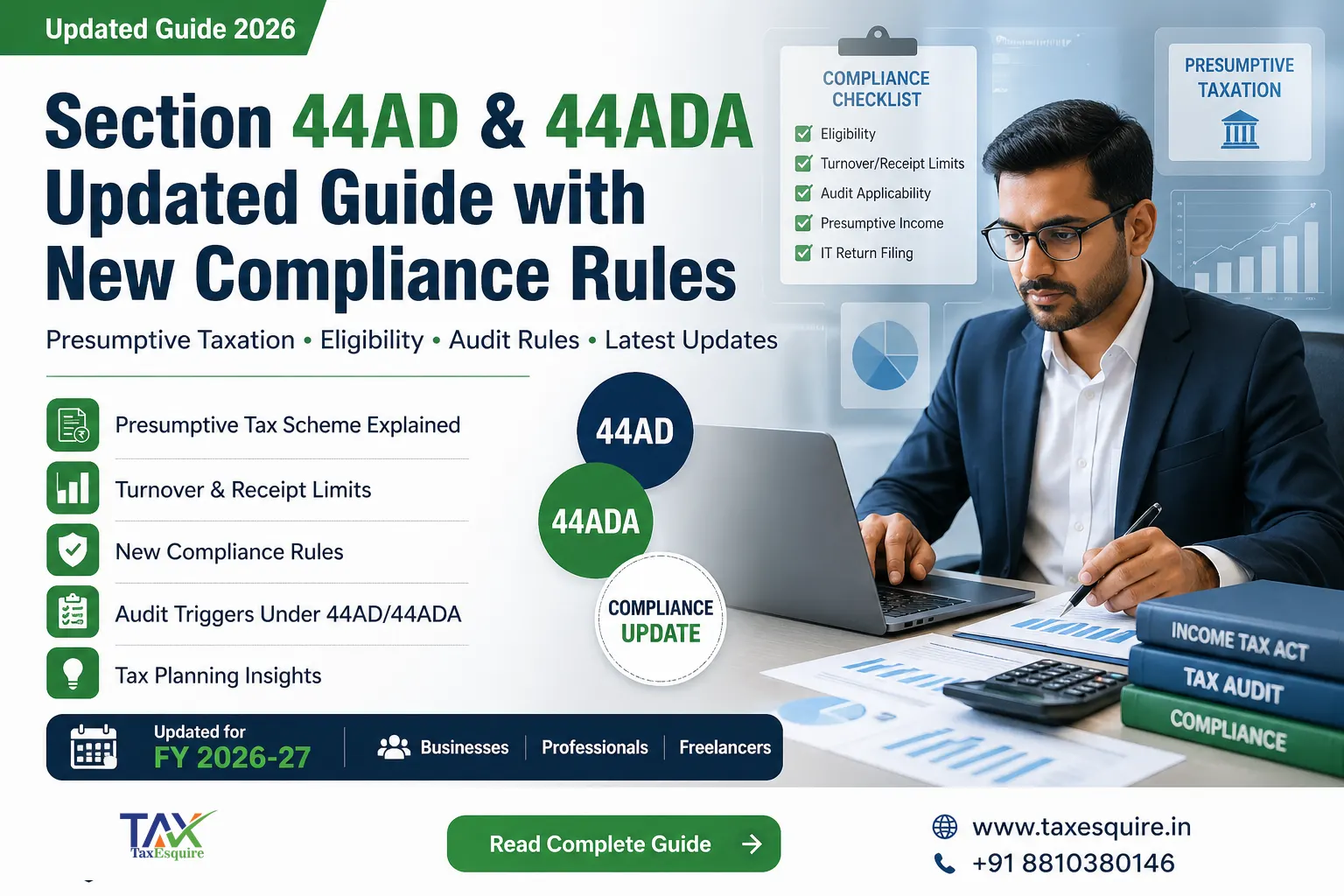
Section 44AD & 44ADA Updated Guide with New Compliance Rules
For small business owners and professionals in India, tax compliance can often feel complicated and time-consuming. Maintaining detailed books of accounts, tracking every expense, and dealing with audits can become a burden especially when resources are limited.
To address this challenge, the Income Tax Act introduced presumptive taxation schemes under Section 44AD and Section 44ADA. These provisions allow eligible taxpayers to declare income at a fixed percentage, reducing the need for detailed accounting.
However, with recent development’s such as higher turnover limits, increased digital monitoring, AIS reporting, and stricter compliance checks, these sections are no longer as simple as they once seemed.
What is Presumptive Taxation?
Presumptive taxation is a method where the government assume’s your profit based on your total turnover or receipt’s.
Instead of calculating:
Actual income
Actual expenses
Net profit
You simply declare income at a fixed rate prescribed by law.
Why was this introduced?
The idea behind presumptive taxation is simple:
Small taxpayers often struggle with complex compliance
Many do not maintain proper records
Litigation increases when income is disputed
So, the government offers a “shortcut method”:
Declare income at a fixed percentage → Pay tax → Stay compliant
How it helps in practice
No need to maintain detailed books
No need to justify every expense
Faster return filing
Reduced chances of scrutiny (if done correctly)
But remember: simplicity comes with conditions and ignoring them can lead to penalties.
Section 44AD – For Small Businesses
Section 44AD is specifically designed for small businesses engaged in trading, manufacturing, or other business activities.
Who can use it?
Resident Individual
Hindu Undivided Family (HUF)
Partnership Firm (excluding LLP)
Turnover Limit
Up to ₹2 crore (standard limit)
Up to ₹3 crore if cash transactions are within 5%
This increased limit encourages businesses to adopt digital transactions.
How income is calculated
8% of turnover (cash transactions)
6% of turnover (digital transactions)
This means even if your actual profit is lower, you must declare at least this percentage to stay within the scheme.
Important conditions
You cannot claim individual expenses like rent, salary, etc.
Books of accounts are not mandatory
Once you opt out after choosing it, a 5-year restriction applies
Who should be careful?: Businesses with low profit margins may end up paying higher tax under this scheme.
Section 44ADA – For Professionals
Section 44ADA is meant for professionals and freelancers who earn income through skill or expertise.
Who is covered?
Traditionally:
Doctors
Lawyers
Chartered Accountants
Architects
Engineers
In practice today, it also includes many freelancers and consultants, especially in digital fields.
Income limit
₹50 lakh (basic limit)
₹75 lakh (if cash receipts ≤ 5%)
Income calculation : Fixed at 50% of total receipts
This means:
Half of your income is assumed as profit
The remaining 50% is treated as expenses (without proof)
Key advantage
Professionals often have higher margins, so this method:
Simplifies taxation
Removes the need for expense tracking
Key concern: If your actual profit is less than 50%, this scheme may not be beneficial.
Section 44AD vs 44ADA – Detailed Comparison
Although both are presumptive schemes, they serve completely different categories.
Section 44AD applies to businesses
Section 44ADA applies to professionals
The biggest difference lies in profit percentage:
Businesses: 6%–8%
Professionals: 50%
This reflects the government’s assumption that professionals generally earn higher margins.
Practical takeaway: A freelancer incorrectly choosing 44AD instead of 44ADA (or vice versa) can:
Trigger scrutiny
Lead to incorrect tax calculation
So classification of income is extremely important.
Latest Updates & New Compliance Rules (FY 2026–27)
Over the past few years, compliance has become more data-driven and automated.
1. Higher Turnover Limits: To promote digital economy:
₹3 crore (44AD)
₹75 lakh (44ADA)
Applicable only if cash transactions are minimal.
2. Digital Tracking (AIS & TIS): The Income Tax Department now tracks:
Bank transactions
GST data
TDS entries
If your declared income does not match these records, you may receive a notice.
3. ITR-4 Enhancements: Return forms now require:
More accurate disclosures
Better reporting of income sources
4. Advance Tax Rule: Instead of quarterly payments:
You must pay 100% advance tax by 15th March
Missing this can result in interest liability.
Compliance Requirements Under Both Sections
Even though these schemes are simplified, compliance is not optional.
You must:
File your income tax return on time
Report correct turnover/receipts
Pay advance tax
Ensure consistency with GST (if applicable)
Books of Accounts: Not required under presumptive scheme but:
You should still maintain basic records
This helps in case of future verification
When Tax Audit Becomes Mandatory
Many taxpayers assume audit is never required under presumptive taxation which is not true.
Audit is required when:
You declare income below prescribed rate
Your total income exceeds exemption limit
You violate the 5-year rule (44AD)
Example: If a business declares profit lower than 6%:
Audit becomes mandatory
Books must be maintained
This is one of the most misunderstood areas and often leads to penalties.
Benefits of Section 44AD & 44ADA
Presumptive taxation under Sections 44AD and 44ADA is designed to make tax compliance simple, predictable, and cost-effective for small businesses and professionals. Below is a deeper look at how these benefits work in real life:
1. No Complex Accounting
Under normal taxation, taxpayers are required to maintain detailed books of accounts, cash book, ledger, expense records, invoices, and supporting documents. This can be time-consuming and often requires accounting expertise.
With presumptive taxation:
You are not required to maintain detailed books
There is no need to track every expense or justify deductions
Record-keeping becomes minimal and manageable
This is especially helpful for small traders and freelancers who do not have dedicated accounting teams.
2. Reduced Compliance Burden
Tax laws in India involve multiple layers of compliance books of accounts, audit requirements, detailed income calculations, and reconciliations.
Sections 44AD and 44ADA simplify this by:
Eliminating the need for detailed profit calculations
Reducing documentation requirements
Removing the need for audit (in most cases)
As a result, taxpayers can focus more on running their business or profession rather than dealing with complex tax procedures.
3. Lower Professional Costs
Under the normal taxation system, many taxpayers rely on Chartered Accountants for:
Maintaining books
Preparing financial statements
Conducting tax audits
Filing detailed returns
These services can be costly.
With presumptive taxation:
The need for professional assistance is significantly reduced
Compliance becomes simpler, lowering dependency on experts
This leads to direct savings in accounting and audit fees, which is a major advantage for small taxpayers.
4. Quick and Easy Return Filing
Filing income tax returns under normal provisions can be complicated due to:
Detailed income computation
Expense categorization
Balance sheet and profit & loss statements
Under Sections 44AD and 44ADA:
Income is declared at a fixed percentage
Filing is done using ITR-4 (Sugam), which is much simpler
The overall process is faster and less stressful
Even first-time taxpayers can handle filing more confidently with basic guidance.
5. Lower Chances of Scrutiny
When income is calculated based on actual profits, discrepancies or aggressive deductions can trigger scrutiny by the Income Tax Department.
Presumptive taxation reduces this risk because:
Income is declared at standardized rates
There is less scope for manipulation of expenses
Compliance appears more consistent and straightforward
While scrutiny is never completely eliminated, the chances are comparatively lower when rules are properly followed and income matches reported data (like AIS and GST).
Limitations & Risks
Despite the simplicity, there are important drawbacks:
You cannot claim actual expenses
You may pay higher tax than actual profit
Switching rules are restrictive
Mismatch with AIS/GST can trigger notices
Reality check: Presumptive taxation is not always the cheapest option—it is the simplest option.
Practical Examples & Case Studies
Case 1: Small Trader
Turnover: ₹60 lakh
Income declared @6% = ₹3.6 lakh
Even if actual profit is ₹2 lakh, tax will be calculated on ₹3.6 lakh.
Case 2: Freelancer
Receipts: ₹30 lakh
Income declared @50% = ₹15 lakh
If actual expenses are high, this may increase tax liability.
Key Insight
Always compare:
Presumptive income vs Actual income
before making a decision.
Common Mistakes to Avoid
Selecting wrong section
Ignoring the 5-year rule
Declaring unrealistically low turnover
Not checking AIS data
Missing advance tax deadline
These mistakes often lead to notices and penalties.
Who Should Opt for 44AD or 44ADA?
Best suited for:
Small traders with stable margins
Freelancers with predictable income
Those who want simple compliance
Not suitable for:
Low-margin businesses
High-expense professionals
Rapidly growing startups
Choosing wisely can make a huge difference in tax liability.
Step-by-Step Guide to Filing ITR-4 (Sugam)
Filing under presumptive scheme is relatively simple:
Login to Income Tax Portal
Select ITR-4 (Sugam)
Enter turnover or receipts
Declare presumptive income
Add tax details and verify
Submit and e-verify
Expert Tips for Tax Saving & Compliance
Use digital transactions to reduce tax rate
Compare schemes before opting
Pay advance tax on time
Keep basic records even if not required
Seek professional advice for fluctuating income
Smart planning ensures:
Lower tax
Better compliance
Peace of mind
Conclusion
Section 44AD and 44ADA are powerful tool’s for simplifying taxation, but they must be used carefully and strategically.
With increased digital monitoring and stricter compliance rules, taxpayers must:
Stay accurate
Stay consistent
Stay informed
The right approach is not just about saving tax but about avoiding future problem’s while staying compliant.
Actual income
Actual expenses
Net profit
Small taxpayers often struggle with complex compliance
Many do not maintain proper records
Litigation increases when income is disputed
No need to maintain detailed books
No need to justify every expense
Faster return filing
Reduced chances of scrutiny (if done correctly)
Resident Individual
Hindu Undivided Family (HUF)
Partnership Firm (excluding LLP)
Up to ₹2 crore (standard limit)
Up to ₹3 crore if cash transactions are within 5%
8% of turnover (cash transactions)
6% of turnover (digital transactions)
You cannot claim individual expenses like rent, salary, etc.
Books of accounts are not mandatory
Once you opt out after choosing it, a 5-year restriction applies
Doctors
Lawyers
Chartered Accountants
Architects
Engineers
₹50 lakh (basic limit)
₹75 lakh (if cash receipts ≤ 5%)
Half of your income is assumed as profit
The remaining 50% is treated as expenses (without proof)
Simplifies taxation
Removes the need for expense tracking
Section 44AD applies to businesses
Section 44ADA applies to professionals
Businesses: 6%–8%
Professionals: 50%
Trigger scrutiny
Lead to incorrect tax calculation
₹3 crore (44AD)
₹75 lakh (44ADA)
Applicable only if cash transactions are minimal.
Bank transactions
GST data
TDS entries
More accurate disclosures
Better reporting of income sources
You must pay 100% advance tax by 15th March
File your income tax return on time
Report correct turnover/receipts
Pay advance tax
Ensure consistency with GST (if applicable)
You should still maintain basic records
This helps in case of future verification
You declare income below prescribed rate
Your total income exceeds exemption limit
You violate the 5-year rule (44AD)
Audit becomes mandatory
Books must be maintained
You are not required to maintain detailed books
There is no need to track every expense or justify deductions
Record-keeping becomes minimal and manageable
Eliminating the need for detailed profit calculations
Reducing documentation requirements
Removing the need for audit (in most cases)
Maintaining books
Preparing financial statements
Conducting tax audits
Filing detailed returns
The need for professional assistance is significantly reduced
Compliance becomes simpler, lowering dependency on experts
Detailed income computation
Expense categorization
Balance sheet and profit & loss statements
Income is declared at a fixed percentage
Filing is done using ITR-4 (Sugam), which is much simpler
The overall process is faster and less stressful
Income is declared at standardized rates
There is less scope for manipulation of expenses
Compliance appears more consistent and straightforward
You cannot claim actual expenses
You may pay higher tax than actual profit
Switching rules are restrictive
Mismatch with AIS/GST can trigger notices
Income declared @6% = ₹3.6 lakh
Income declared @50% = ₹15 lakh
before making a decision.
Selecting wrong section
Ignoring the 5-year rule
Declaring unrealistically low turnover
Not checking AIS data
Missing advance tax deadline
Small traders with stable margins
Freelancers with predictable income
Those who want simple compliance
Low-margin businesses
High-expense professionals
Rapidly growing startups
Login to Income Tax Portal
Select ITR-4 (Sugam)
Enter turnover or receipts
Declare presumptive income
Add tax details and verify
Submit and e-verify
Use digital transactions to reduce tax rate
Compare schemes before opting
Pay advance tax on time
Keep basic records even if not required
Seek professional advice for fluctuating income
Lower tax
Better compliance
Peace of mind
Stay accurate
Stay consistent
Stay informed
© 2026 Tax Esquire | Expert CA Services in Greater Noida, Uttar Pradesh
8810380146 | info.taxesquire@gmail.com | taxesquire.in
This document is for informational purposes only. For personalised tax advice, consult our chartered accountants.