
Important Dates And Calendar For All Taxes
Introduction
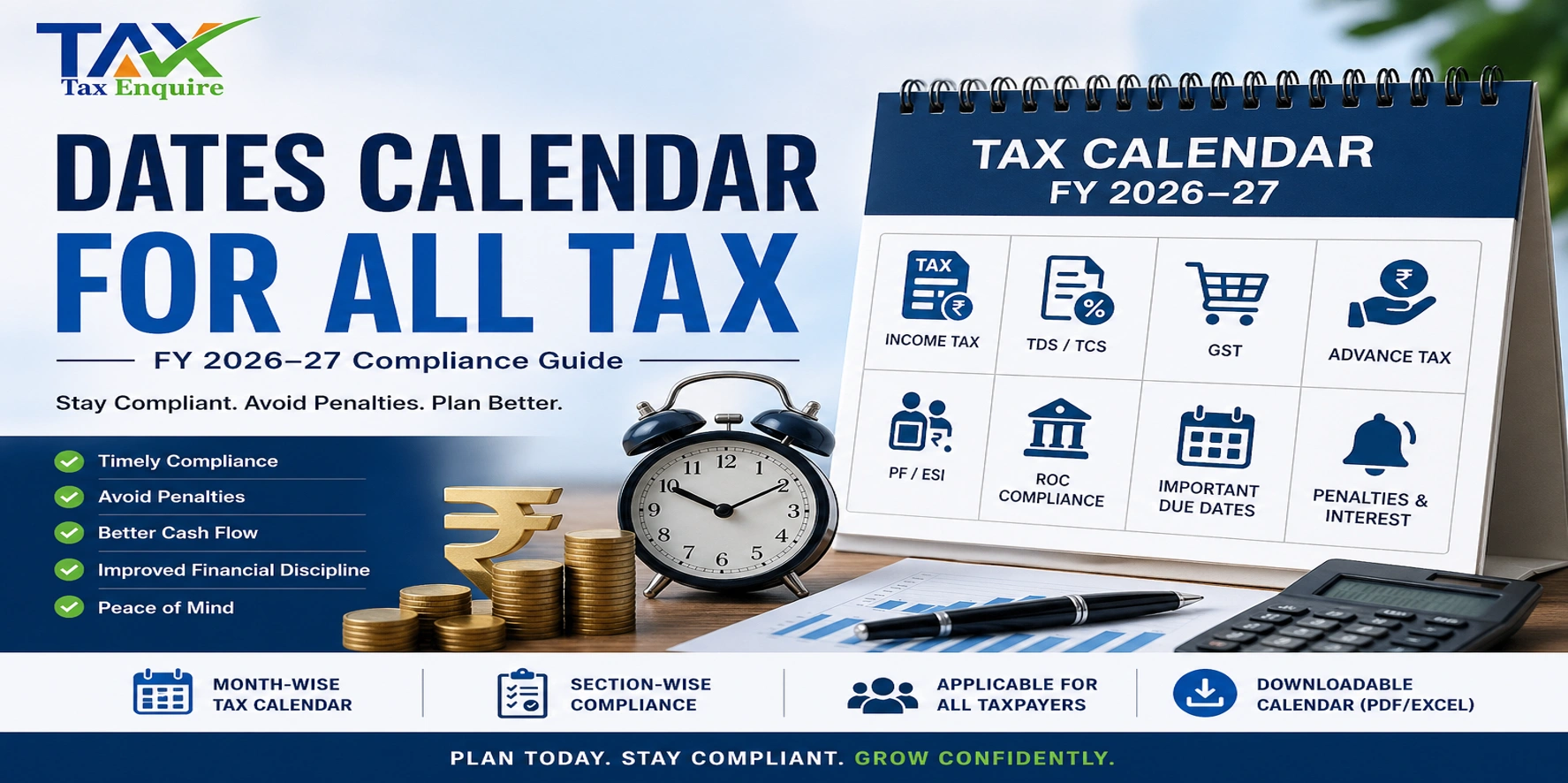
In India, tax compliance is not just about paying taxes—it’s about meeting deadlines accurately and consistently. Missing a due date can lead to penalties, interest, and even legal notices. A Dates Calendar for All Tax helps taxpayers stay organized by providing a structured timeline of all important compliance dates across Income Tax, GST, TDS, and other statutory requirements. Whether you are a salaried employee, freelancer, or business owner, maintaining a tax calendar ensures peace of mind and financial discipline.
What is a Tax Compliance Calendar?
A Tax Compliance Calendar is a systematic schedule that lists all important tax-related due dates for a financial year.
Purpose:
Track filing and payment deadlines
Avoid penalties and late fees
Ensure smooth financial planning
Who Should Use It?
Individuals & salaried employees
Freelancers & consultants
Businesses & companies
Chartered Accountants & tax professionals
Types of Taxes Covered
A comprehensive tax calendar includes:
Income Tax
ITR filing
Advance tax payments
Tax audit compliance
TDS (Tax Deducted at Source)
Monthly deposit
Quarterly returns
Certificate issuance
TCS (Tax Collected at Source): Collection & return filing
GST (Goods and Services Tax)
GSTR-1, GSTR-3B
Annual returns
Advance Tax : Quarterly installments
Other Compliances
PF & ESI
ROC filings
Professional Tax
Key Highlights of FY 2026–27
Increased focus on digital compliance & automation
Stricter tracking of TDS/TCS reporting
Greater integration between GST & Income Tax systems
Emphasis on timely filing to avoid system-generated notices
Tax authorities are now using AI-based tracking, making compliance more critical than ever.
Complete Month-wise Tax Calendar (April 2026 – March 2027)
April: TDS payment (March) and GST returns (March)
May: TDS return (Q4) and GSTR-1 & GSTR-3B
June: Advance Tax (1st installment – 15 June)
July: ITR filing (non-audit cases) and TDS returns
August: Regular GST & TDS compliance
September: Advance Tax (2nd installment – 15 Sept)
October: Tax audit due date
November: ITR for audit cases
December: Advance Tax (3rd installment – 15 Dec)
January: Routine filings
February: Pre year-end planning
March: Advance Tax (final installment – 15 March) and Year-end compliance
Section-wise Compliance Calendar
Income Tax Sections:
Section 139(1) → ITR filing
Section 44AB → Tax audit
Section 234F → Late filing fee
GST Sections:
GST return filing provisions
Input Tax Credit rules
This helps professionals link due dates with legal provisions.
Quarterly Compliance Overview
TDS/TCS Returns:
Q1 → July
Q2 → October
Q3 → January
Q4 → May
Advance Tax:
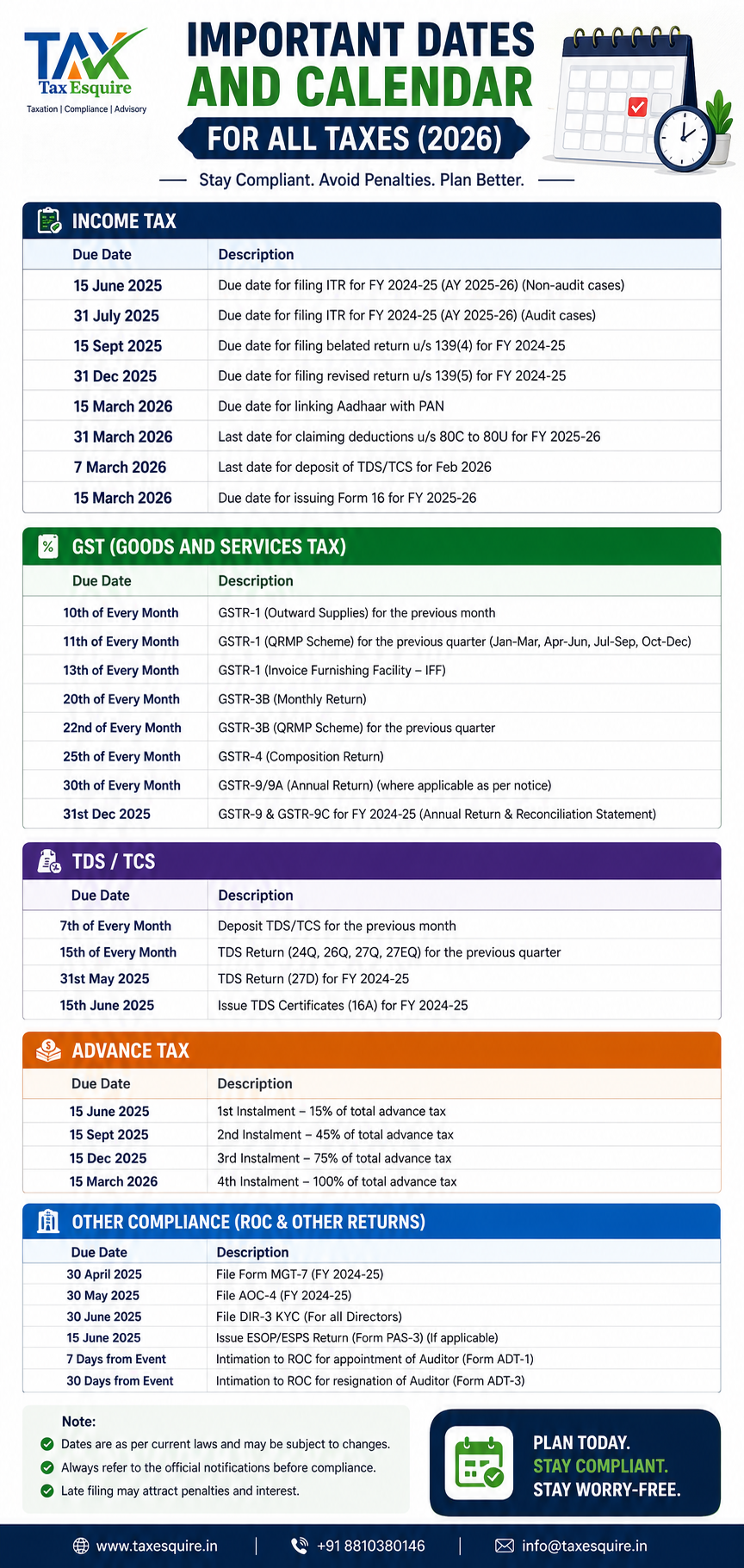
15 June – 15%
15 Sept – 45%
15 Dec – 75%
15 March – 100%
GST (QRMP Scheme):
Quarterly return filing
Due Dates Based on Taxpayer Type
Salaried Individuals
ITR filing
Tax saving investments
Freelancers & Professionals
Advance tax
GST (if applicable)
Businesses & Companies
GST returns
TDS compliance
Audit & ROC filings
Important Income Tax Deadlines
ITR (Non-audit) → 31 July
ITR (Audit cases) → 31 October
Belated return → 31 December
Revised return → 31 December
GST Compliance Calendar
GSTR-1 → Monthly/Quarterly
GSTR-3B → Monthly
GSTR-9/9C → Annual return
Timely GST filing ensures smooth Input Tax Credit (ITC) flow.
TDS & TCS Compliance Dates
Monthly: Deposit by 7th of next month
Quarterly: Return filing
Certificates: Form 16 / 16A issuance
Advance Tax Schedule
Advance tax is payable in installments:
15 June → 15%
15 September → 45%
15 December → 75%
15 March → 100%
Due Date Extension & Relief Provisions
Sometimes, authorities extend deadlines due to:
Technical issues
Natural disasters
Policy changes
Notifications are issued by CBDT & GST Council
Checklist Before Each Due Date (NEW – PRACTICAL)
Verify financial records
Reconcile GST & books
Check TDS deductions
Ensure sufficient funds
Avoid last-minute filing
Downloadable Tax Calendar
Providing a downloadable calendar helps:
Easy tracking
Better planning
Offline access
You can offer: PDF version and Excel compliance tracker
Penalties & Interest for Non-Compliance
Late filing fee (Section 234F)
Interest on delayed payment
GST late fees
Notices & legal action
Common Mistakes in Tax Compliance (NEW)
Missing due dates
Incorrect data filing
Ignoring notices
Wrong tax calculation
Not reconciling records
Benefits of Using a Tax Calendar
A well-structured Tax Calendar is more than just a list of due dates—it is a powerful financial planning tool that helps individuals and businesses stay compliant, organized, and stress-free. Below are the key benefits explained in detail:
1. Timely Compliance
One of the biggest advantages of using a tax calendar is ensuring on-time compliance with all tax obligations.
It provides a clear schedule of due dates for Income Tax, GST, TDS, and other statutory filings.
Helps avoid last-minute rush and errors in filing returns.
Ensures all required documents are prepared in advance.
Timely compliance builds a strong financial reputation and avoids unnecessary complications with tax authorities.
2. Avoid Penalties & Interest
Missing tax deadlines can result in heavy penalties, late fees, and interest charges under various provisions of tax laws.
Late filing of Income Tax Returns can attract penalties under Section 234F.
Delayed GST filings lead to late fees and interest liability.
TDS non-compliance can result in disallowance of expenses and penalties.
A tax calendar acts as a preventive tool, ensuring you never miss important deadlines and avoid financial losses.
3. Better Cash Flow Management
Tax payments such as advance tax, GST liability, and TDS deposits require proper financial planning.
A tax calendar helps you anticipate upcoming payments in advance.
Allows businesses to allocate funds efficiently without disrupting operations.
Prevents sudden cash shortages due to unexpected tax liabilities.
This leads to smooth financial operations and better liquidity management.
4. Improved Financial Discipline
Using a tax calendar promotes systematic and organized financial behavior.
Encourages regular bookkeeping and record maintenance.
Helps track income, expenses, and tax liabilities consistently.
Reduces dependency on last-minute adjustments and corrections.
Over time, this builds strong financial discipline, which is essential for long-term success.
5. Peace of Mind
Perhaps the most underrated benefit is the mental relief and confidence it provides.
Eliminates stress related to missing deadlines or facing notices.
Ensures all compliances are under control and well-managed.
Allows you to focus on your core work or business activities.
When your tax obligations are planned and tracked, you enjoy complete peace of mind without compliance worries.
Role of CA / Tax Consultant (NEW)
A Chartered Accountant helps in:
Accurate tax planning
Timely compliance
Handling notices
Optimizing tax liability
Professional guidance reduces risk and improves efficiency.
Conclusion
A Dates Calendar for All Tax is an essential tool for managing your financial responsibilities efficiently. With increasing compliance requirements and digital monitoring, staying updated with due dates is no longer optional—it is a necessity.By following a structured calendar, maintaining records, and seeking professional help when needed, taxpayers can ensure smooth, stress-free, and penalty-free compliance.
© 2026 Tax Esquire | Expert CA Services in Greater Noida, Uttar Pradesh
8810380146 | info.taxesquire@gmail.com | taxesquire.in
This document is for informational purposes only. For personalised tax advice, consult our chartered accountants.