Tax Year Concept Under Income Tax Act, 2025
Introduction
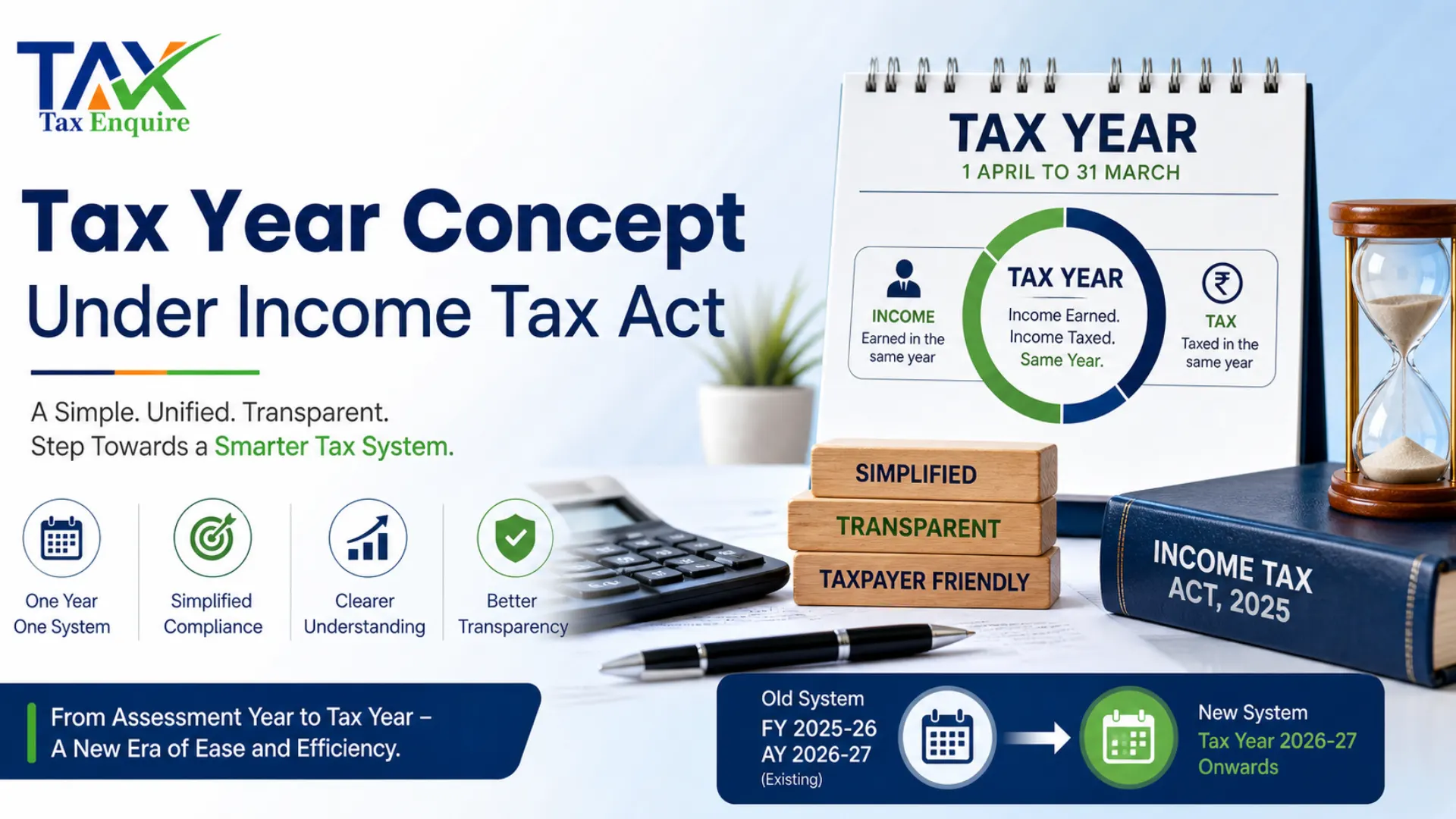
The Indian taxation system is undergoing a significant transformation with the introduction of the Tax Year under the Income Tax Act, 2025. Traditionally, taxpayers dealt with two different terms Financial Year (FY) and Assessment Year (AY) which often created confusion, especially for individuals and small businesses.
To simplify this structure, the government has introduced a single unified concept called the “Tax Year”, which represents the period in which income is earned and taxed. This change aims to make tax compliance more intuitive, transparent, and aligned with global practices.
Why Tax Year Was Introduced
The shift to the Tax Year system is primarily driven by the need to simplify tax laws and improve ease of compliance. Under the earlier framework:
Income was earned in one year (Financial Year)
Tax was calculated and filed in another year (Assessment Year)
This dual system often led to:
Misinterpretation of timelines
Filing errors
Confusion among taxpayers
The Tax Year eliminates this complexity by merging both concepts into a single timeline, ensuring that taxpayers can easily relate income with its taxation period.
Comparison: Tax Year vs Financial Year vs Assessment Year
Applicability & Transition Provisions
The Tax Year concept is not immediately applicable to all filings and follows a clear transition timeline:
FY 2025–26 / AY 2026–27 → Governed by the existing Income-tax Act, 1961
From 1 April 2026 onwards → Tax Year concept becomes applicable
Transition Impact:
Returns filed in 2026 for FY 2025–26 will still follow the old system (AY concept)
Income earned from 1 April 2026 will fall under the Tax Year system
This phased approach ensures a smooth transition without disrupting ongoing compliance.
Key Features of Tax Year System The Tax Year framework introduces several important features: Single Time Frame: Eliminates confusion between FY and AY Same Year Taxation: Income and taxation relate to the same period Simplified Compliance: Easier filing and understanding for taxpayers Better Clarity: Reduces chances of errors and misreporting Global Alignment: Aligns India with international tax practices Overall, it is designed to create a more taxpayer-friendly system. Due Dates under Tax Year System While the terminology changes, the compliance structure largely remains consistent. Current (AY 2026–27 – Old System) Non-audit cases: 31 July 2026 Audit cases: 31 October 2026 Transfer pricing cases: 30 November 2026 Under Tax Year (From 2026–27 onwards) Return filing will continue in the subsequent year Advance tax payments will follow the existing schedule: September December March June Advantages of Tax Year Concept The introduction of the Tax Year offers several benefits: Reduced Confusion: No need to differentiate between FY and AY Simplified Filing: Easier for individuals and small taxpayers Improved Accuracy: Lower chances of filing mistakes Better Compliance: Clear timelines encourage timely filings Reduced Litigation: Fewer disputes due to clarity in interpretation This reform is a step toward a simpler and more transparent tax system. Step-by-Step Compliance Guide For AY 2026–27 (Old System) Calculate income for FY 2025–26 Select the correct ITR form Compute tax liability File return using AY 2026–27 Verify the return For Tax Year 2026–27 Onwards Track income within the Tax Year (1 April – 31 March) Pay advance tax as applicable Maintain proper documentation File return using the same Tax Year reference Complete verification and compliance Conclusion The introduction of the Tax Year under the Income Tax Act, 2025 marks a major reform in India’s taxation framework. By replacing the dual concepts of Financial Year and Assessment Year, the new system brings clarity, simplicity, and efficiency to tax compliance. Although the transition phase (FY 2025–26 / AY 2026–27) still follows the old structure, taxpayers must prepare for the upcoming shift. In the long run, the Tax Year concept is expected to enhance ease of doing business, reduce errors, and modernize India’s tax system.
Author: CA POONAM GUPTA & ADV LOKESH GUPTA
© 2026 Tax Esquire | Expert CA Services in Greater Noida, Uttar Pradesh
8810380146 | info.taxesquire@gmail.com | taxesquire.in
This document is for informational purposes only. For personalised tax advice, consult our chartered accountants.