Internal Audit & External Audit in Thailand: Complete Guide for Businesses (2026)
Introduction to Audit System in Thailand
Thailand’s corporate environment is governed by a structured legal and financial reporting framework designed to ensure transparency, accountability, and investor confidence. Auditing is a critical part of this system, helping businesse’s maintain accurate financial’s record’s and comply with statutory requirement’s.
In Thailand, audits are broadly classified into two categories:
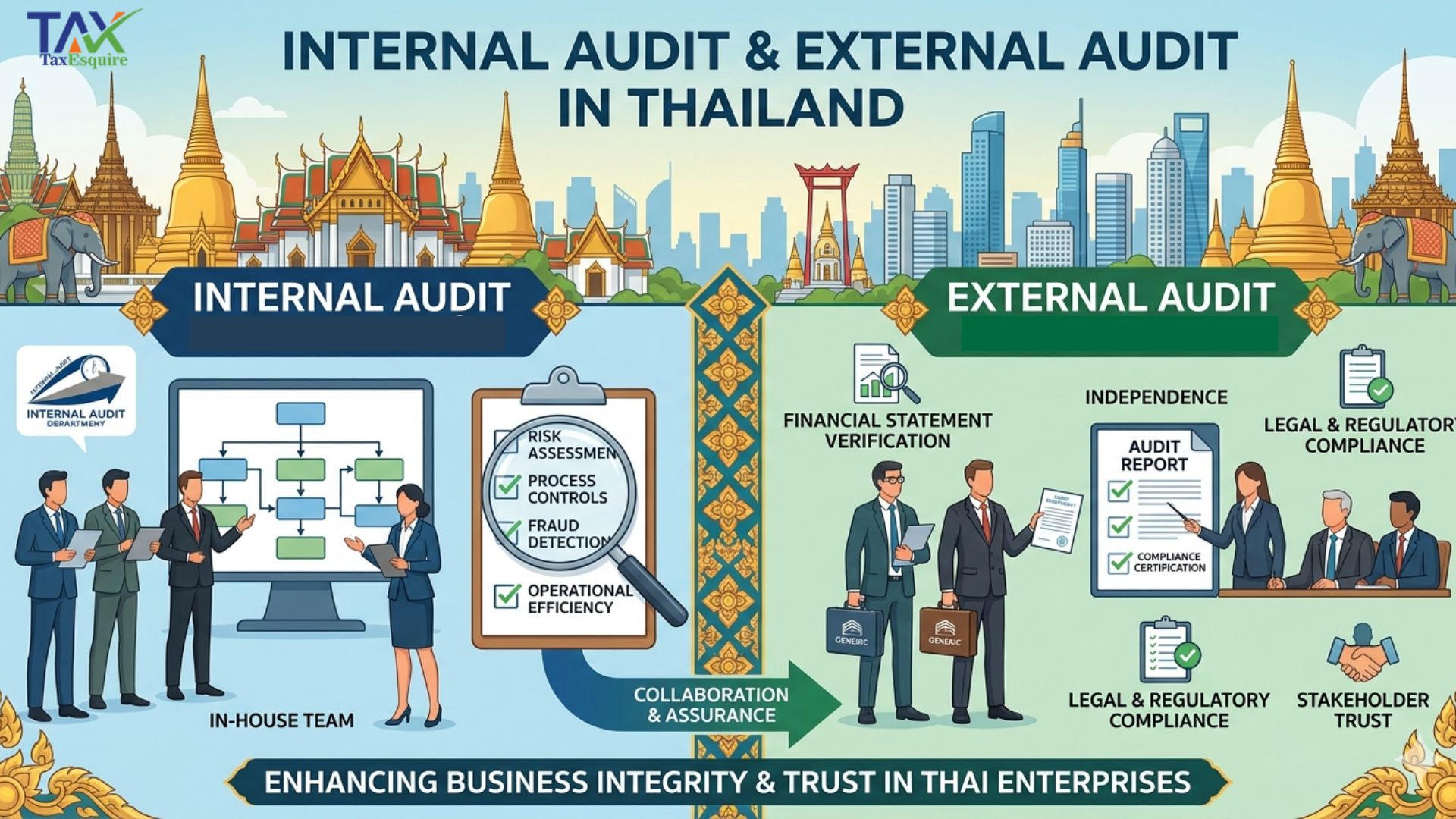
● Internal Audit – focuse’s on improving internal processe’s, risk management’s, and governance’s.
● External Audit – focuse’s on statutory compliance’s and verification of financial statement’s.
While external audit’s are legally mandatory for most companie’s, internal audit’s are increasingly adopted as a strategic tool to strengthen internal control’s and business efficiency. Together, these audit’s create a strong foundation for sustainable business operation’s.
What is an Internal Audit?
An internal audit is an independent and objective evaluation conducted within an organization to assess and improve the effectiveness of risk management’s, internal control’s, and governance processe’s.
Key Objectives
● Evaluate internal control system’s
● Identify operational inefficiencie’s
● Detect and prevent fraud
● Ensure compliance with internal policies and procedure’s
Nature of Internal Audit
Internal audit is proactive and advisory in nature. It not only identifie’s issue’s but also provide’s recommendation’s to improve business performance.
Who Conducts Internal Audit?
● In-house internal audit team
● Outsourced professional firm’s
Scope
● Financial processe’s
● Operational efficiency
● Compliance and risk management
● IT systems and control’s
Although not mandatory for all companie’s in Thailand, internal audit is highly recommended for businesse’s with complex operation’s, large transaction volume’s, or higher compliance risk’s.
What is an External Audit?
An external audit is an independent examination of a company’s financial statement’s conducted by a licensed auditor’s to ensure their accuracy and compliance with applicable laws and accounting standard’s.
Purpose
● Verify the correctness of financial statement’s
● Ensure compliance with Thai Financial Reporting Standard’s (TFRS)
● Provide assurance to shareholder’s and regulator’s
Legal Requirement in Thailand
External audits are mandatory for most registered companie’s, including:
● Private limited companies
● Public limited companies
● Foreign owned entities
Who Conducts External Audit?
● Independent Certified Public Accountants (CPAs) licensed in Thailand
Audit Report
The outcome of an external audit is an audit report, which may be:
● Unqualified (clean opinion)
● Qualified
● Adverse
● Disclaimer
This report is submitted along with financial statements to regulatory authorities.
Key Differences Between Internal Audit and External Audit
|
Basis |
Internal Audit |
External Audit |
|
Objective |
Improve internal processes and controls |
Verify financial statements |
|
Nature |
Advisory |
Independent and statutory |
|
Conducted By |
Internal team or consultants |
Independent CPA |
|
Mandatory |
Not mandatory |
Legally required |
|
Reporting To |
Management |
Shareholders and regulators |
|
Frequency |
Continuous or periodic |
Annual |
|
Focus |
Risk management and efficiency |
Financial accuracy and compliance |
Summary: Internal audit helps improve the business, while external audit ensures legal compliance and credibility.
Legal & Regulatory Framework in Thailand
Audit compliance in Thailand is governed by several regulatory bodies and laws:
Key Authorities
● Department of Business Development (DBD)
● Revenue Department
● Securities and Exchange Commission (SEC) (for listed companies)
Regulatory Requirements
● Companies must prepare annual financial statements
● Financial statements must comply with Thai Financial Reporting Standards (TFRS)
● External audit is mandatory before submission
Auditor Requirements
● Must be a licensed CPA in Thailand
● Must maintain independence from the company
Non-compliance can result in penalties, fines, or legal action.
Applicability: Who Needs Internal and External Audit?
External Audit (Mandatory)
● All registered companies in Thailand
● Private Limited Companies
● Public Limited Companies
● Foreign owned businesses
● BOI promoted companies
Internal Audit (Recommended)
● Large corporations
● Multinational companies
● Businesses with complex operations
● Companies in regulated industries
Many organizations implement both audits to ensure strong governance and compliance.
Internal Audit Process in Thailand
The internal audit process typically follows a structured approach:
1. Planning
● Define audit scope and objectives
● Understand business operations
2. Risk Assessment
● Identify key risk areas
● Prioritize audit focus
3. Fieldwork
● Review documents and processes
● Test internal controls
4. Reporting
● Document findings
● Provide recommendations
5. Follow-Up
● Monitor implementation of corrective actions
This continuous process helps organizations improve efficiency and reduce risks.
External Audit Process & Timeline
Audit Process
- Appointment of auditor
- Audit planning and risk assessment
- Examination of financial records
- Verification of compliance with standards
- Issuance of audit report
Timeline
● Conducted annually
● Financial statements must be audited before submission to authorities
Timely preparation is crucial to avoid delays and penalties.
Benefits of Internal Audit for Thai Businesses
● Strengthens internal controls
● Improves operational efficiency
● Enhances risk management
● Prevents fraud and errors
● Supports better decision-making
Internal audit acts as a preventive and improvement tool for businesses.
Benefits of External Audit
● Ensure’s compliance with legal requirement’s
● Build’s trust with investors and stakeholder’s
● Enhances financial transparency
● Improves credibility of financial statements
● Facilitates access to funding and investment
External audit’s ac’ts as a verification and trust building mechanism.
Challenges in Audit Compliance in Thailand
Businesses may face several challenges, including:
● Complex regulatory requirement’s
● Language barrier’s for foreign companie’s
● Maintaining accurate and complete record’s
● Coordination with auditor’s
● Time constraints during audit season
Proper planning and professional guidance can help overcome these challenges.
Common Mistakes Businesses Should Avoid
● Ignoring the importance of internal audit
● Poor documentation and record-keeping
● Delayed audit preparation
● compliance with accounting standard’s
● Lack of communication with auditor’s
Avoiding these mistake’s ensure’s smoother audit’s and compliance.
Internal vs External Audit: Which One Does Your Business Need?
Internal Audit is Suitable When:
● You want to improve internal processes
● You need strong risk management
● You aim to prevent fraud and inefficiencies
External Audit is Required When:
● You must comply with Thai laws
● You need certified financial statements
● You want to build credibility with stakeholders
Best Practice
Most successful businesses adopt both audits:
● Internal audit for continuous improvement
● External audit for statutory compliance
Conclusion
Internal and external audit’s play complementary role’s in Thailand’s business environment. While external audit’s ensure compliance with legal and financial reporting standard’s, internal audit’s help organization’s strengthen internal system’s, manage risk’s, and improve efficiency. In today’s competitive and regulated environment, businesses should not treat audit’s as mere formalitie’s. Instead, they should leverage both internal and external audit’s as strategic tool’s to enhance transparency, build trust, and achieve long term growth.
Author: CA POONAM GUPTA & ADV LOKESH GUPTA
© 2026 Tax Esquire | Expert CA Services in Greater Noida, Uttar Pradesh
8810380146 | info.taxesquire@gmail.com | taxesquire.in
This document is for informational purposes only. For personalised tax advice, consult our chartered accountants.