What is an External Audit in India : Full Explanation, Process & Importance
Introduction
In today’s business environment, transparency and trust are essential for long term success. Companie’s are not only expected to maintain accurate financial record’s but also to demonstrate credibility to stakeholder’s such as investor’s, regulator’s, and lender’s.. One of the most effective ways to ensure this is through an external audit.
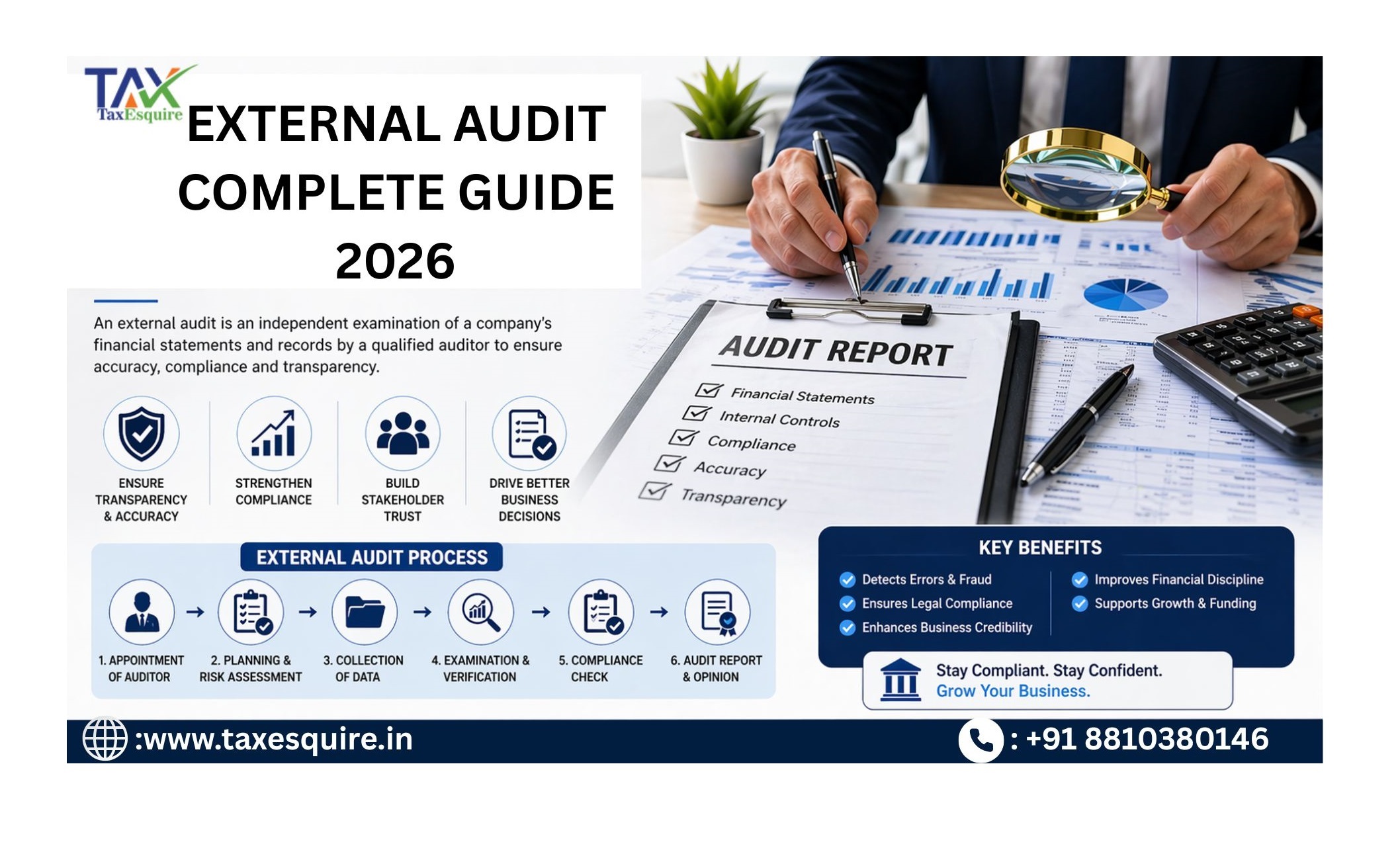
An external audit is an independent examination of a company’s financial statement’s conducted by a qualified third party auditor. Unlike internal audit’s, which are performed by in house team’s, external audit’s provide an unbiased and objective opinion on the company’s financial health.
In India, external audits are often aligned with statutory audit requirements under the Companies Act, 2013, making them a critical part of corporate compliance.
What is an External Audit?
An external audit is a formal and independent verification of a company’s financial statements and accounting records by an external auditor, usually a Chartered Accountant (CA) or a CA firm.
Key Objective:
To determine whether the company’s financial statements:
● Are free from material misstatements
● Comply with applicable accounting standards
● Present a true and fair view of the financial position
Audit Output:
The result of an external audit is an audit report, which includes:
● Auditor’s opinion
● Observations and findings
● Any qualifications or disclaimers
Legal Framework in India
In India, external audits are governed primarily by:
● Companies Act, 2013
● Standards on Auditing (SA) issued by the Institute of Chartered Accountants of India (ICAI)
● Accounting Standards / Ind AS
Key Sections:
● Section 139 – Appointment of Auditor
● Section 143 – Powers and Duties of Auditor
● Section 147 – Penalties
Applicability of External Audit
For Companies:
External audit is mandatory for all companies, including:
● Private Limited Companies
● Public Limited Companies
● One Person Companies (OPC)
● Section-8 Companies
,
Even with no revenue, no transactions, and a dormant company, an audit is still required.
Objectives of External Audit
The external audit serves multiple important purposes:
1. Ensure Accuracy: Verify correctness of financial record’s.
2. Detect Fraud & Errors: Identify irregularities, fraud, or misstatement’s.
3. Ensure Compliance: Confirm adherence to laws and accounting standard’s.
4. Build Stakeholder Trust: Increase confidence among investor’s, bank’s, and regulator’s.
5. Provide Independent Opinion: Offer an unbiased assessment of financial health.
External Audit Process (Step-by-Step)
The audit process is systematic and detailed:
1. Appointment of Auditor: Auditor is appointed by shareholders or board.
2. Planning & Risk Assessment: Auditor understands business operations and identifies risk areas.
3. Collection of Data: Gather financial records, statements, and documents.
4. Audit Testing
● Sample checking of transactions
● Verification of invoices, entries, and balances
5. Internal Control Evaluation: Assess strength of internal system’s and control’s.
6. Compliance Check: Ensure compliance with laws and accounting standard’s.
7. Audit Report Preparation: Final opinion is drafted based on finding’s.
Types of External Audit Opinions
After completing the audit, the auditor issues one of the following opinions:
1. Unqualified Opinion (Clean Report)
● Financial statements are accurate
● No major issues
2. Qualified Opinion
● Minor issues exist but overall statements are reliable
3. Adverse Opinion
● Financial statements are misleading
4. Disclaimer of Opinion
● Auditor unable to form an opinion
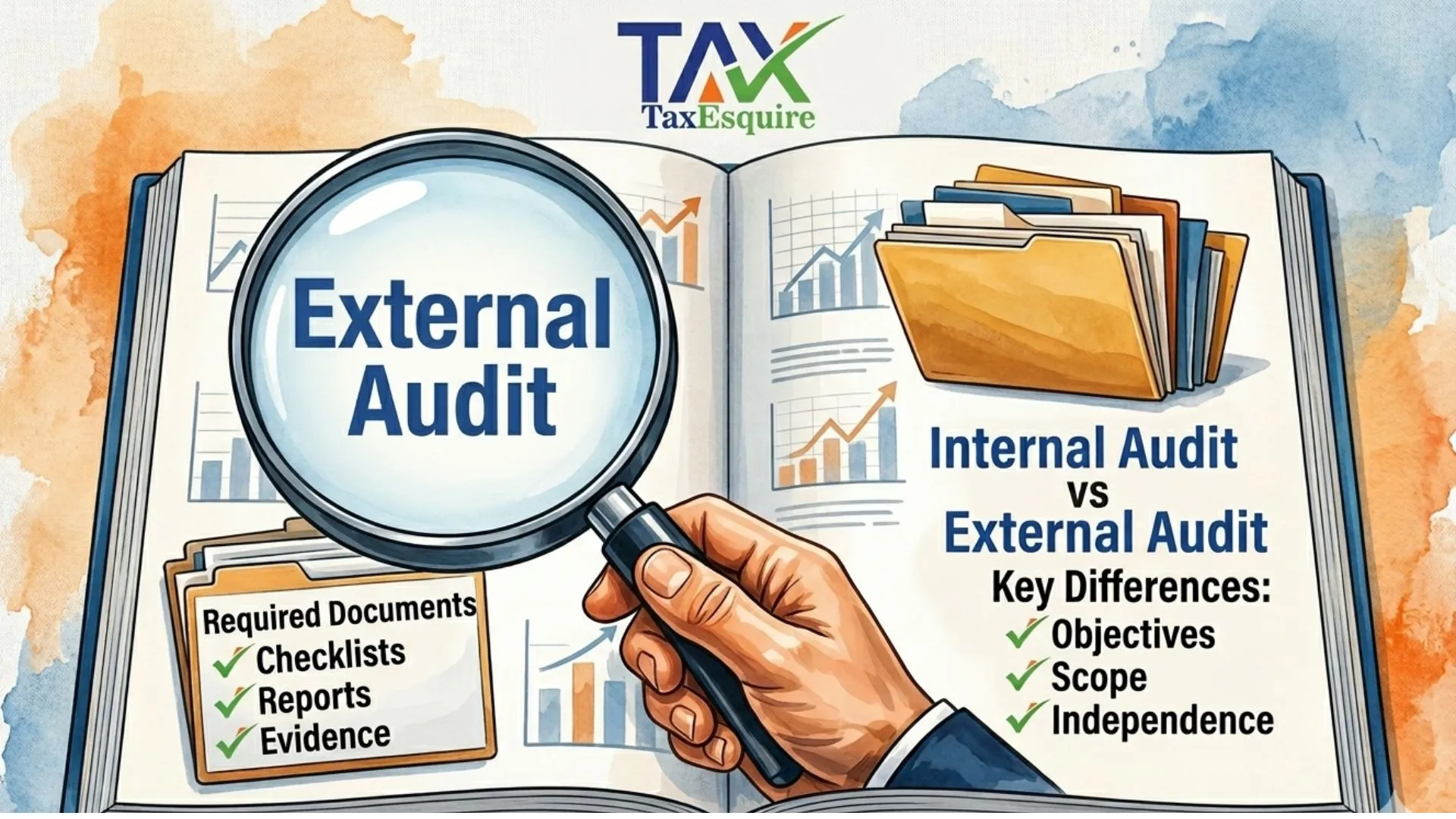
Documents Required for External Audit
To conduct an audit efficiently, companies must provide:
● Financial statements
● Books of accounts
● Bank statements
● Invoices and vouchers
● GST returns
● TDS records
● Fixed asset register
● Payroll records
● Statutory registers
● Previous audit reports
Proper documentation ensures a smooth and faster audit process.
Benefits of External Audit
External audits provide several advantages beyond compliance:
1. Enhances Credibility: Improves trust among investor’s and stakeholder’s.
2. Detects Fraud Early: Identifies financial irregularities.
3. Improves Financial Discipline: Encourages accurate bookkeeping.
4. Facilitates Funding: Helps in obtaining loan’s and investment’s.
5. Ensures Compliance: Reduce’s risk of penaltie’s and legal issue’s.
6. Better Decision-Making: Provide’s reliable financial insight’s.
Challenges in External Audit
Companies often face:
● Poor documentation
● Delayed submissions
● Weak internal controls
● Lack of professional guidance
Common Mistakes to Avoid
● Delaying auditor appointment
● Ignoring compliance deadlines
● Maintaining incomplete records
● Not reconciling accounts
● Overlooking legal requirements
Avoiding these mistakes ensures a hassle-free audit experience.
External Audit vs Statutory Audit
Many people confuse these terms.In India:
● External Audit = Statutory Audit Both refer to:
● Independent audit
● Conducted by CA
● Required under Companies Act
Why External Audit is Important
External audit play’s a vital role in:
● Strengthening corporate governance
● Preventing financial fraud
● Ensuring transparency
● Supporting business growth
● Enhancing credibility in the market
It acts as a foundation for trust and accountability in business operation’s.
Why Choose TaxEsquire?
At TaxEsquire, we provide expert external audit services tailored to your business needs:
Experienced Chartered Accountant’s
Complete statutory compliance support
Timely audit and reporting
Accurate financial analysis
Affordable’s and transparent’s pricing
We ensure your audit process is smooth, compliant, and stress-free.
Conclusion
External audit is not just a compliance requirement, it’s a powerful tool for financial transparency, risk management’s, and business credibility. Whether you are a startup, SME, or large company, conducting a proper external audit helps:
● Build trust
● Ensure compliance
● Strengthen financial systems
Partnering with professionals like TaxEsquire ensure’s that your audit is handled efficiently while you focu’s on growing your business.
Author: CA POONAM GUPTA & ADV LOKESH GUPTA
© 2026 Tax Esquire | Expert CA Services in Greater Noida, Uttar Pradesh
8810380146 | info.taxesquire@gmail.com | taxesquire.in
This document is for informational purposes only. For personalised tax advice, consult our chartered accountants.