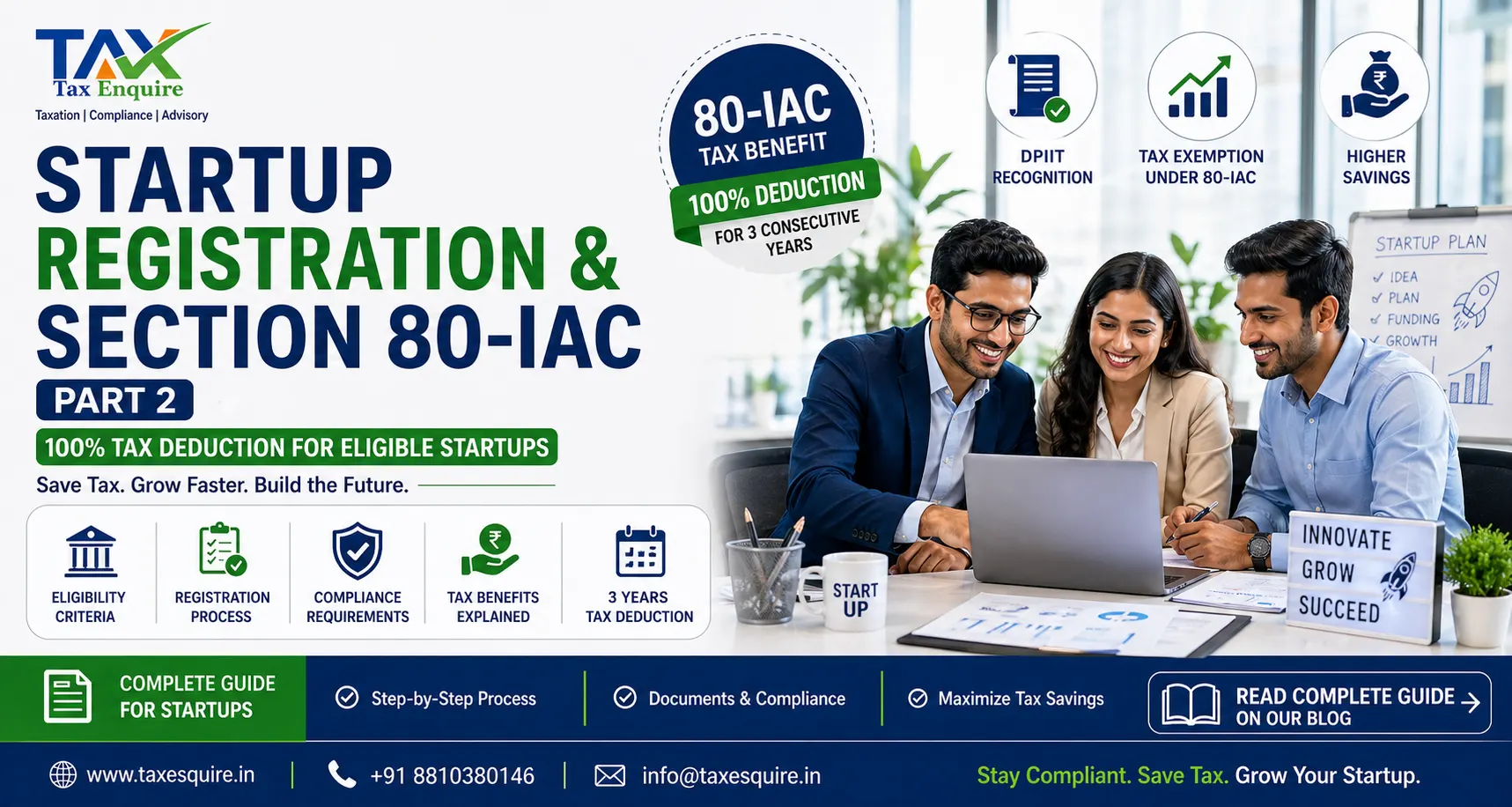
Startup Registration & Section 80-IAC Part - 2
What is Section 80-IAC?
Section 80-IAC of Income Tax Act provides tax exemption to eligible startups.
Objective:
To reduce tax burden during the initial years when startups need maximum capital for growth.
Tax Benefits Under Section 80-IAC
Key Benefit: 100% deduction on profits
Duration: Available for 3 consecutive years out of 10 years
Impact:
No income tax liability
Higher retained earnings
Increased reinvestment capacity
This is one of the biggest tax advantages available to startups.
Eligibility Criteria for 80-IAC
Must be DPIIT recognized
Must be a Pvt Ltd Company or LLP
Must be engaged in innovation
Turnover must be ≤ ₹100 crore
Must obtain approval from Inter-Ministerial Board (IMB)
IMB approval is the most critical step.
Conditions to Claim 80-IAC Deduction
Compliance Requirements:
Maintain proper books of accounts
Conduct audit (if required)
File Income Tax Returns on time
Use new assets (no old machinery transfer)
Not formed by splitting existing business
Even after approval, compliance is essential to continue benefits.
Step-by-Step Process to Apply for 80-IAC
Step 1: DPIIT Recognition
Step 2: Apply for IMB Approval
Step 3: Submit:
Financial details
Business model
Innovation proof
Step 4: Claim Deduction
Claim while filing Income Tax Return.
Professional assistance is recommended for approval.
Startup Registration vs 80-IAC (Key Differences)
Both are interconnected but serve different purposes.
Common Reasons for Rejection
Key Reasons:
Weak innovation explanation
Incomplete or incorrect documentation
Business not scalable
Traditional business model
Non-compliance
A strong application is crucial for approval.
Compliance Requirements After Approval
File Income Tax Returns annually
Maintain books of accounts
Conduct audits
Ensure eligibility conditions remain valid
Non-compliance can lead to cancellation of benefits.
Latest Updates (2026)
Extended eligibility timeline’s
Simplified registration process
Increased scrutiny on innovation
Government focus on tech startups
Always verify the latest notifications before applying.
Common Mistakes to Avoid
Delaying registration
Choosing wrong structure
Ignoring compliance
Poor documentation
Not planning tax strategy
Avoiding these mistakes ensures smooth approval.
Expert Tips to Maximize Benefits
Apply early for DPIIT recognition
Keep detailed documentation
Highlight innovation clearly
Maintain financial discipline
Take professional guidance
Strategic planning can significantly reduce taxes.
Conclusion
Startup Registration and Section 80-IAC together provide a strong foundation for business growth in India. While the benefits are substantial, they require proper execution and compliance.
Final Takeaways:
Register early
Maintain proper documentation
Plan tax benefits in advance
Stay compliant
A well-planned startup can save significant taxes and scale faster.
For prior information, please read ' Startup Registration & Section 80-IAC. - Click Here